Showing posts with label health. Show all posts

Saturday, July 31, 2010

As water worries mount, researcher says Marcellus Shale poses risk to air


Protecting watersheds in the Marcellus Shale region and forcing driller disclosure of fracking chemicals are the foremost demands of those concerned about potential environmental harm from natural gas activity.

The focused attention leaves out potentially greater threats, said Conrad "Dan" Volz, Ph.D., director and principal investigator of University of Pittsburgh's Center for Healthy Environments and Communities. The region's air could face a so far undetected threat, he said.

While a spill at a natural gas drilling site that contaminates water is catastrophic, air pollution can be a more insidious problem - one he said he feels is being overlooked.

While environmental groups and citizens scour lists of chemicals added to hydraulic fracturing fluid used to break up the shale formation, the greater threat may come from toxins that come to the surface as flowback, said Mr. Volz. He said state air-monitoring stations tend to be located in urban areas, away from rural areas where much of the drilling would be taking place.

He said the flowback is a slurry that can contain naturally-occurring benzene, strontium and arsenic. The flowback is often stored in uncovered fracking ponds where volatile organic compounds evaporate into the air. Condenser stations, wells and pipelines also discharge VOCs.

VOCs, both manmade and naturally occurring, are emitted into the air by certain liquids and solids. Some can adversely affect health in cases of chronic exposure, according to the Environmental Protection Agency.

VOCs emitted by a single well pad may not be that significant, and Dr. Volz said there's debate over the risk to air quality and health. But as drilling intensifies, however, air quality will become an issue, he said.

Dr. Volz delivered his comments at a rollout of his group's Marcellus Shale website, www.fractracker.org, to a group of stakeholders that included economic development officials, environmental groups and academics in Danville on Thursday.

He hopes Fractracker.org will help inform policymakers on issues such as where to place permanent air-monitoring stations.

Compounding air quality unknowns is the lack of state Department of Environmental Protection air-monitoring stations in many parts of the Marcellus Shale region. The stations tend to be in urban areas with historically high industrial activity. Stations are in Swiftwater, Peckville, Scranton, Wilkes-Barre and Nanticoke. None are in Wayne, Wyoming, Susquehanna or Bradford counties, where drilling activity is more common.

The DEP has a mobile air-quality lab collecting data around natural gas activity. The data has not been released, said DEP spokesman Mark Carmon. But Mr Carmon said it can provide a snapshot of the impact of natural gas activity on air quality.

Chris Tucker, spokesman for Energy In Depth, an oil and gas producers' association, said open fracking pits are increasingly being replaced by closed loop systems such as one being used by Anadarko Petroleum Corp., reducing the release of VOCs.

He also said that unlike natural gas in Southwestern Pennsylvania, natural gas coming from the Northeast is so- called "dry gas," nearly pure methane, with fewer condensates and VOCs.

University of Scranton chemistry professor Michael C. Cann said thousands of different chemicals come out of the earth in fracking fluid, but without research or testing, it's hard to assess the impact of the process.

"Certainly there are dangerous, naturally-occurring volatile organic compounds, but without research and testing, there's no way to know the risk," Dr. Cann said.
LINK

DEMAND ACCOUNTABILITY!

Fracking With Food: How the Natural Gas Industry Poisons Cows and Crops

AlterNet
by Byard Duncan
July 30, 2010

Scientists, too, are grappling for information. Though there exists an increasingly comprehensive catalog of knowledge about water problems related to fracking, little work has been done to determine how the practice affects animals and crops.

“I see very little research being done on cows,” said Theo Colborn, founder of the non-profit Endocrine Disruption Exchange. Because animal testing with many chemicals known to be involved in fracking has historically failed to deal with instances of a) limited exposure and b) prolonged exposure, no one really knows what the potential health effects are – for cows or humans.

“It’s very difficult to deal with this problem,” Colborn said. “Who has the money? Who can perform the tests?”

Certainly not the federal EPA. Earlier this year, it announced plans to launch a two-year study of hydraulic fracturing’s effects on water. According to an EPA spokesperson, no part of that study will deal with plants or animals.

And yet, there is significant anecdotal evidence that suggests fracking can seriously compromise food. In April 2009, 19 head of cattle dropped dead after ingesting an unknown substance near a gas drilling rig in northern Louisiana. Seven months before that, a tomato farmer in Avella, Penn. reported a series of problems with the water and soil on his property after drilling started: he found arsenic levels 2,600 times what is recommended, as well as dangerously high levels of benzene and naphthalene – all known fracking components. And in May 2009, one farmer in Clearview, Penn. told Reuters he thought that gas drilling operations had killed four of his cows.

Occurrences like these aren’t just limited to the eastern U.S. In Colorado, a veterinarian named Elizabeth Chandler has documented numerous fertility problems in livestock near active drill sites, including false pregnancy, smaller litters and stillbirths in goats; reduced birth rates in hogs; and delayed heat cycles in dogs.

In another case, Rick Roles, a resident of Rifle, Colorado, reported that his horses became sterile after three disposal pits were installed near his home. Like those in Chandler’s study, Roles’ goats began yielding fewer offspring and producing more stillbirths. Roles himself suffered from swelling of the hands, numbness and body pain – symptoms, he said, that subsided when he stopped eating vegetables from his garden and drinking his goats’ milk.

Actual scientific studies are few and far between, but what’s out there paints a pretty damning picture. One, titled “Livestock Poisoning from Oil Field Drilling Fluids, Muds and Additives,” appeared in the journal Veterinary & Human Toxicology in 1991. It examined seven instances where oil and gas wells had poisoned and/or killed livestock. In one such case, green liquid was found leaking from a tank near a gas well site. The study’s authors found 13 dead cows, whose “postmortem blood was chocolate-brown in color.” Poisoning cases involving carbon disulfide, turpentine, toluene, xylene, ethylene, and complex solvent mixtures “are frequently encountered,” the study concluded.

Another study, this one conducted in Alberta, Canada in 2001, investigated the effects of gas flaring on the reproductive systems of cattle near active gas and oil fields. Its conclusions: “One of the most consistent associations in the analysis was between exposure to sour gas flaring facilities [as opposed to “sweet” ones, which contain more aromatic hydrocarbons, aliphatic hydrocarbons and carbon particles] and an increased risk of stillbirth. In 3 of the 4 years studied, cumulative exposure to sour flares was associated with an increased risk of stillbirth.”

'Rare Cases'

When questioned about fracking and food, America’s Natural Gas Alliance, an organization composed of the nation’s leading gas production and exploration companies, neglected to get into any specifics. Instead, it offered this response:

“In rare cases where incidents have occurred, companies have worked with the appropriate regulatory authority to identify, contain and correct the issue, and to implement measures to ensure they don’t recur. ANGA member companies understand and respect people’s concerns about the safety of their water and air, and we are committed to engaging in dialogue with community members, policymakers and stakeholders to talk about the safety of natural gas production and the opportunities natural gas offers communities across our country.”

Environmental groups have a markedly different perspective on the issue. “There’s a lot of violations that happen out there that are never documented,” said Wes Gillingham, program director of Catskill Mountainkeeper.

When we talked, Gillingham took out an enormous aerial photo of a drill rig. One disposal pit was surrounded by gray blotches of moisture: leaked fracking fluid. “The stuff that’s coming up – this stuff is getting into the environment,” he said, pointing at the blotches. “You’ve got heavy metals and normally occurring radioactive materials, all of which bioaccumulate in a grazer. That stuff is coming up in the grass where the grass is growing.”

So what sorts of concerns should people have about eating animals that have themselves ingested xylene, benzene, heavy metals, radioactive material? Gillingham, like so many farmers, federal officials and industry reps, can’t say for sure.

“It’s a serious issue in terms of potential contamination getting to market and nobody knowing about it,” he said. “It’s an important piece of research that needs to be done.”

DEMAND ACCOUNTABILITY!

Sunday, July 18, 2010

Sunday Matinee: BENZENE TOXICITY


Thank you Elizabeth Burns, ThePolylineLawsuit.com

DEMAND ACCOUNTABILITY!

Friday, June 25, 2010

Methane concerns felt in Terry Twp.

Wednesday, May 26, 2010

Beyond Burlington

In Bradford County, more and more residents appear to be dealing with "water mysteries".

On May 5th Splashdown! reported properties in the Plank Road vicinity of Towanda, PA. with new above ground water tanks sitting in their yards... replacing what must be wells whose water has become contaminated. Reports of this situation did not appear in local papers.

Here now are additional recently installed replacement water tanks, and evidence of a newly drilled well... this time in the area around Spring Lake, where drilling is also going on, with roads torn up and closed.

LOCATION OF J.T. PLACE RESIDENCE, SITE OF CONTAMINATED WELL ON SPRING LAKE ROAD

J.T. PLACE RESIDENCE, WITH 2 NEW "WATER BUFFALOS"

NEW ELECTRIC SERVICE FOR WATER BUFFALOS
(Note on post reads: To Chesapeake, Do not take
any water from the well. J.T. Place)

The people of Bradford County NEED to know when and where wells and aquifers are being contaminated. If the water at this residence, across from Spring Lake is contaminated, what about Spring Lake??? This is a matter of public health and safety. And yet... the facts are not being reported to the public.

EVIDENT NEW WELL AT THIS SPRING LAKE AREA RESIDENCE...

WHY are we not reading about these important newsworthy items in our local paper? And why, when asked, are residents unwilling to talk about the situation?

Finally... why is the Bradford County Council on the Arts (BCRAC) unwilling to show the award-winning documentary "GASLAND" to the people of Bradford County? Invited repeatedly, the film was termed "unbalanced" and filled with "scare tactics" by Brooks Eldredge-Martin, the art council's executive director, who ruled the film therefore unsuitable, depriving the people of Bradford County of the ability to make up their own minds about the film!
Aside from the fact that this raises a lot of issues, fortunately "GASLAND" will be shown in Montrose, Elmira and Ithaca (see the Announcements sidebar) and has recently been screened in Williamsport, where approximately 1000 people turned out to see it. In each case, filmmaker, Josh Fox is there to answer questions from the audience...

DEMAND ACCOUNTABILITY!

Friday, May 21, 2010

"The Big Deception"... Calvin Tillman Addresses Paid Liars

When I first decided that we needed to have some biological testing accomplished here in DISH, TX, I was cautioned against getting our state health department involved. Most figured that they would run up here and began covering the back side of the oil and gas industry like they have done so many times before. However, I also have some very smart and nationally recognized people who help me in these decisions and we decided that if they would take our input on the testing, we might be OK. So we asked the Texas Department of State Health Services (DSHS) to test the air and a tentatively identified compound test in conjunction with the tests they were running. But they ignored the request from a nationally recognized scientist, who has more scientific recognition in her little toe, than anyone who works for the DSHS will ever have. Therefore, their report subsequently has turned out more political than scientific.

As one well known citizen who lives in the barnett shale has stated, "everything you hear from the natural gas industry in either a lie, or half truth". Here in DISH, we are used to the paid liars from this industry coming in and feeding us the normal lines like what good neighbors they want to be. However, when you get this from your state agencies that are sworn to protect you, it does not set as well. Many people believe everything these people say, and they are never held accountable when they are wrong...or deceitful. The DSHS showed up just like many of the other paid liars, thinking that they would blow smoke up the rear ends of a bunch of country bumpkins that didn't know any better, and just like the other paid liars, they left with their tails between their legs. Country bumpkins typically recognize the smell of BS pretty quickly.

After thinking about this, and doing some research into the matter, it was clear that no matter what was detected, the DSHS would have found a way to say there is nothing wrong. They have a history of doing just that, please see the following link, where they failed to protect the public interest in Texas once again.

http://www.dshs.state.tx.us/epitox/consults/delroc_hc.pdf

In this "investigation" the community was worried about water run-off from a former refinery (hmm same industry), and subsequent surface water contamination. However, the same characters who came to DISH, decided the surface water didn't need testing. The soil and sediment were tested and both exceeded the Health Based Assessment Comparison for aluminum, arsenic, BaP TEQ (benzene derivative), and vandium. Conclusion - "no apparent public health hazard". In my line of business we call people like this "hacks".

In our case, they were looking hard for criticisms from us before the meeting, so that they could prepare to answer them. I made some comment to the media about the number of folks who had toluene and xylene in their systems, and oddly enough they came up with statistics that show we are actually lower than the rest of the United States, this was not in the report, just the presentation. At this point I started getting that familiar smell that we have grown accustomed to here in DISH... and not the natural gas smell. I then asked for the source of the statistics they used to determine this and they sent me to NHANES, said "just google it". Maybe that was their joke, because me and others searched for hours with no success finding this data. I did find a statement that said VOCs are present in most everyone at some level, but it would not be in detectable levels in everyone, so that may have been one of those "half truths".

During my several hours of research, I did find that the 95th percentile used in the DISH study appears to be a hand picked by the "hacks", and likely hand picked for a purpose. Apparently, you do not need a percentile reference number, but when one is used the 90th percentile seems to be the number used by real scientists. If 50% of the households in DISH were above the 95th percentile for chemical exposure, I wonder how many are over the 90th percentile. However, if they would have figured that, it is likely that they would have that trend they were looking for, and we damn sure wouldn't want that, now would we? I think similar lying with statistics was accomplished in Flower Mound as well. If they start finding problems, the boys and girls in Austin would not get those critical campaign contributions they have grown accustom to. In my business we look for trends, and I am starting to see a trend with these "hacks".

If the above blatant failures were not enough to show what a joke this was, you must hear the rest of the story. Dr. Bradford admitted when questioned that the study was not a scientific study. However, they came to a very solid conclusion, with this non-scientific study. The conclusion goes something like...we see exposure but have no idea where the exposure is coming from, but it damn sure aint coming from that compressor station that we smelled those horrible odors from.

They then admitted that they did not know how close any of the citizens lived to the compressor sites, nor did they know the number of males vs females that were tested, and did not even know the age range of those who were tested. You would think they would have known the answers to the easy stuff if they wanted to appear believable. The data that they used for comparison in DISH was seven years old. Outdated data is something they also used in Flower Mound to help them reach their objective. I guess they figured they had this one in the bag like all the others before, too bad the country bumpkin's weren't buying.

Children were not tested as part of this "investigation". There apparently was no data to compare the results; however, in my wild goose chase that Dr. Bradford sent me on, I found several studies that referenced children. The one mentioned above showed how these chemicals affect children differently than adults...and yea it is much worse. She avoided the question during the meeting when asked about how children are affected differently than adults. Frankly, I believe that they were sent here to not find anything and they would likely find exposure in our children. If they find toluene and xylene in kids they would not be able to blame it on smoking. Even us country bumpkins don't let our five year olds smoke. They would not have been able to give us the "half truths" that they did, and people don't play when it come to their kids. If us nice country folk knew our kids have BTEX chemical exposure, we may not be so nice any more. I am hopeful that the light will shine on some of the roaches who are responsible for these illusions, and I think there is another facility I would rather see them at, and it is located in Huntsville, Texas.

The house of cards they built came down very quickly. I am extremely disappointed that these folks did not take their oaths seriously, and are allowing the public to continue being put at risk. I had originally felt sorry for those who were likely on the puppets for the higher ups, but it is all too apparent that this is not there first deception, so they should have moved on to something else if they weren't committed to covering things like this up. They have actually offered to come back for another round of testing. I think I would rather see if the Chesapeake or Devon environmental department is available, they are much better liars.

In closing I would like to say that this "investigation" brings more questions than answers, and it is time for us to demand a stop to the social injustices that these state agencies are allowed to impose. Many people have no other options than to take their word for it, and no recourse when they are wrong. We apparently have not only been sacrificed for the good of the shale by these companies, but also the State of Texas. It is time for us to hold these paid liars accountable for their actions. Please let me know if you have any skills to help me investigate similar injustices.

Fortunately, the last state agency that left the DISH town hall with their tails between their legs was shamed into installing a permanent air monitor. Frankly, I am delightfully surprised by the improvements in our air quality over the last month. I am certainly not calling all clear, but it may be that we don't even need more testing, but I know that another community will face the same situation if there is not something done. If this industry would just do it right, we would not have many of these problems. The Gulf would not be becoming the dead sea and our children would not be exposed to cancer causing toxins. Please post on your blogs and websites.

See report here:
http://www.dshs.state.tx.us/epitox/consults/dish_ei_2010.pdf

Calvin Tillman
Mayor, DISH, TX
(940) 453-3640


DEMAND ACCOUNTABILITY!

Friday, May 7, 2010

Pennsylvania’s Natural Gas Regulators Starting to Smell the Coffee?

“Quite frankly, the citizens of this state are being played for chumps."
Kate Sinding

Senior Attorney, New York City
Switchboard.NRDC.org
May 4, 2010

So said John Quigley, Secretary of Conservation and Natural Resources for Pennsylvania at a Marcellus Shale Policy Conference sponsored over the past two days by Duquesne University and the Pennsylvania Environmental Council.

Said John Hanger, Commissioner of the Department of Environmental Protection: “Let me be clear: Self regulation doesn't work. That's not contestable. We've made mistakes before. We have to get this right or the costs will overwhelm the benefits.”

The Philadelphia Inquirer described the officials’ comments as “part of a coordinated effort by Gov. Rendell's administration to build public support for the legislature to impose greater oversight on the [gas] industry.”

Sounds like the “what didn’t go wrong?” experience in Dimock and other horror stories from Pennsylvania – where drilling in the Marcellus Shale has been proceeding apace – are starting to sink in with the state’s regulators.

Regulators in other gas drilling states should sit up sharply and take notice – particularly in New York, where there is still an opportunity to figure out whether it is possible, and if so how, to rigorously regulate gas production to properly protect human health and the environment.

As the horrifying experience in the Gulf of Mexico demonstrates, we cannot be too careful when it comes to domestic fossil fuel development. The costs when things go awry can be both devastating and lasting.

DEMAND ACCOUNTABILITY!

Wednesday, May 5, 2010

Water woes aired in Burlington: a Daily Review Report...

BY ERIC HRIN (STAFF WRITER)
thedailyreview.com
May 5, 2010

BURLINGTON - Some residents in Burlington Borough are dealing with a water mystery.

The matter came to the surface at the borough council meeting Tuesday.

According to council member Jerri Renzo, at least five residents on the Berwick Turnpike have been dealing with the problem for a year.

"We're finding like a grit in the bottom of our tub, which we never had before," she said. "We've always had iron, but we learned to live with that. But we've had problems with our water softener, so we had someone come and check it, and they said it was the water ... it wasn't that we needed a new one or anything like that."

She said her water was tested, and it showed high levels of magnesium and strontium. Now, she said they're buying bottled water to drink, noting it's an inconvenience and can be costly.

She said they just don't know what's causing it. "We don't know," she said. "We want to find out."

According to Renzo, the state Department of Environmental Protection (DEP) advised the residents not to drink it or brush their teeth or cook with it, so they're not ingesting it.

"We've never had good water in this town, no one has, but over the past year, it's gotten worse," she said.

Judy Parmenter said a test showed high levels of manganese, iron, sodium, and chloride in her water.

During the meeting, she showed a cup with a dark-colored residue in it from her water.

She thought about 10 people were affected in the borough.

But the residents may have an answer soon.

According to Parmenter, someone from state Sen. Gene Yaw's office informed her that John Hanger, DEP secretary, is reviewing the situation and maybe already delegating it to the proper people.

"We should be hearing from them in a week, we hope," she said.

"It's gets to be very smelly," she said of the water. "The smell is terrible, it goes through the whole house. It sometimes makes you nauseated. When you take a shower, sometimes it burns, sometimes it itches."

Hmmm... sounds familiar!

"Some people got a rash, not all of us."

Parmenter said the whole experience has been inconvenient with having to get bottled water to use.

"I'm hoping they're (DEP) going to tell me that they're going to send in officials to help us find the cause, to help us find a way to clear it up and stop it from going to other residents."

LINK

and now... some things the Daily Review hasn't been reporting!

According to a report dated April 30, 2010, titled New York State Senator Antoine Thompson Makes a Second Fact Finding Trip to Towanda and Dimock, PA, on Thursday, April 29 Senator Thompson, Chair of the NY Senate Environmental Conservation Committee, went on a second fact finding trip to gas drilling sites in northern PA, heading a group of state senators, NYC DEP officials and an assembly person.

"As on the first trip, the morning was devoted to a Chesapeake-guided tour of one of their model well sites near Towanda PA. Mayor Calvin Tillman of DISH, Texas had been invited to join the group. At the 11th hour, the Senator's office received a call from Chesapeake, reportedly at the behest of influential NY O&G lawyer Tom West http://www.westfirmlaw.com/ that Mayor Tillman would not be welcome.

Michael Lebron, a principal of New Yorkers for Sustainable Energy Solutions State Wide (NYSESS) and a board member of Damascus Citizens for Sustainability (DCS), stepped in and took Mayor Tillman on a different tour: to locations where water well contamination has occurred in association with gas drilling activity by Chesapeake in Bradford County. In each instance, a pattern of contamination was described as follows: tap water would first turn black, then it would acquire a foul odor, and then methane levels increased to the point where the water could be lit. In one instance, the contamination occurred after a gas well was drilled one mile away. In another, it was reported that a one acre pond turned black, then became bubbly, and that electrical had to be cut off from a woodworking shop and a utility transformer moved across the street because methane levels risked an explosion."

CONTAMINATION: PLANK ROAD and VICINITY, TOWANDA, BRADFORD CO. PA

REPLACEMENT WATER TANK, LUCE PROPERTY, MAHONEY RD., TOWANDA

PLANK ROAD HOME WITH 2 "WATER BUFFALOS" AND 10' WELL VENT PIPE

The people of Towanda, and other communities in Bradford County NEED to know when and where wells and aquifers are being contaminated. This is a matter of public health and safety. And yet... the facts are not being reported to the public.
These are not the only instances of contamination in Bradford County. Why aren't they being reported?
Subsurface contamination can and does migrate. It can and has affected water wells at unpredictable distances from the gas drilling site. People, domestic animals and wildlife have become sickened or died of contamination resulting from gas drilling. This is a serious matter. It is hard to conceive that the daily newspaper is not striving to be vigilant and intent on keeping the people in the communities it serves informed and aware of potential dangers...

DEMAND ACCOUNTABILITY!

Wednesday, March 17, 2010

Gas pipelines, compressors concern some landowners

Environmental, economic issues cited
By David Falchek (Staff Writer)
ithacajournal.com
Published: March 17, 2010


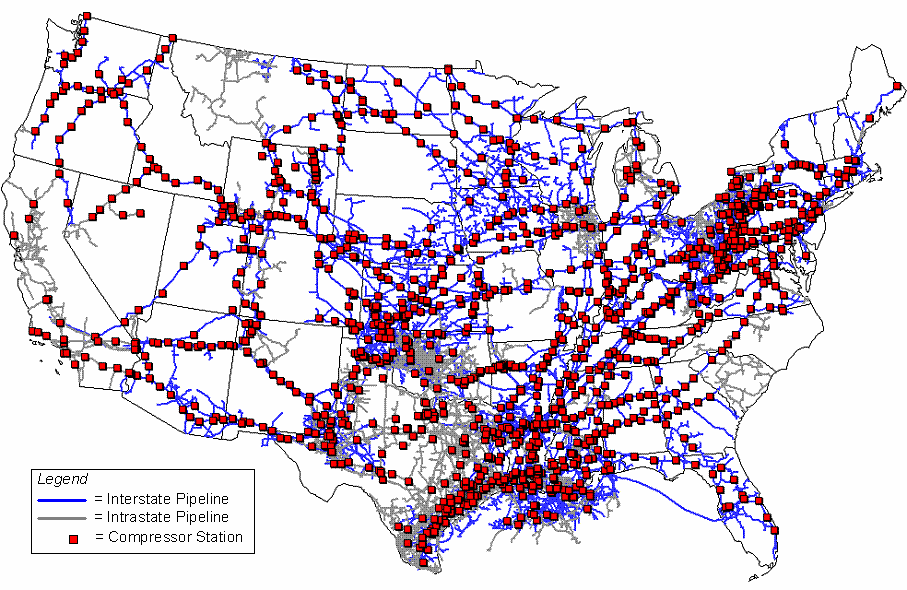
Yeah, you've heard that before, but this time it's about pipelines. Without a sprawling circulatory system to draw gas from thousands of wells and channel it to paying customers, the multibillion-dollar industry sprouting over the Marcellus Shale would not be worth a penny.
While the infrastructure may look beautiful to the burgeoning gas industry, advocates and some landowners find the vision blossoming in Broome County less than attractive. A point of dissatisfaction, so far, involves a proposal by Laser Midstream, of Houston, for a 30-mile pipeline connecting well fields in Susquehanna County, Pa., to the Millennium Pipeline - a main artery running through Broome County that serves major markets in the Northeast.

The project would include a compressor station on 20 acres of unspecified Windsor property near the Millennium junction, with three 1,380-horsepower compressors, equipment to purify gas and tanks to collect waste.

Landowner coalitions that favor natural gas development have opposed the Laser Midstream proposal because it brings Pennsylvania gas into their territory. That, they say, could reduce capacity to move gas they hope to someday be flowing from under their land.

Others oppose the project on environmental grounds. Compressor stations, they say, will produce emissions and noise that will mar the landscape and possibly create health risks.

“Every operation to get this clean gas they brag about is dirty,” said Victoria Switzer, an environmentalist and resident of Dimock, Pa., where Marcellus-related drilling is intensifying. Stationary equipment concentrated on parcels to drill, frack and pump gas produces round-the-clock exhaust that fouls the air, she said.

For the complete report, CLICK HERE.

DEMAND ACCOUNTABILITY!

Tuesday, February 23, 2010

Friday, February 19, 2010

CBF and TU Call For Ban On Marcellus Gas Wells In Floodplains After Incidents In Susquehanna & Lycoming Counties

PA Environment Digest Daily Blog
February 18, 2010


In the rush to develop the Marcellus shale formation in Pennsylvania, natural gas wells are being permitted and drilled in floodplains. Two such wells, one operated by Stone Energy along Wyalusing Creek in Rush Township, Susquehanna County, and one operated by XTO along Muncy Creek in Shrewsbury Township, Lycoming County already experienced flooding events.
The Chesapeake Bay Foundation (CBF) and Trout Unlimited (TU) call upon the Pennsylvania Department of Environmental Protection (DEP) to remedy this clear environmental and public health hazard.
“The handling of fracking chemicals and highly contaminated drilling wastewater in floodplains is an environmental disaster waiting to happen. It has to stop,” said Matt Ehrhart, executive director of CBF’s Pennsylvania Office. “Permitting well pads in floodplains causes a very serious threat of pollution. We call upon DEP to use its authority under the Clean Streams Law to order the companies operating these wells to permanently cap and abandon them, and then reclaim the sites to their natural condition.”
While current regulations do not allow well pads to be located within 100 feet of streams or within the floodway without an encroachment permit, neither the Pennsylvania Oil and Gas Act nor its regulations prohibit siting wells in floodplains. Because horizontal drilling technology is used to drill into Marcellus shale, the gas underneath streams and floodplains can easily be accessed from a pad location in an upland area, avoiding risk of flooding and catastrophic pollution to Pennsylvania’s rivers and streams. There is no reason to site wells in floodplains.
“This loophole must be closed immediately,” said Dave Rothrock, president of the Pennsylvania Council of Trout Unlimited.
In late January, heavy rains hit northern Pennsylvania and several streams and rivers experienced flooding events, including Wyalusing and Muncy Creeks. Both the Stone Energy and the XTO sites were flooded as a result of these events.
“The risk of pollution to our streams will increase exponentially in a matter of weeks,” said Rothrock. “As we head into the season of snowmelt and spring rains, there should be absolutely no more well drilling activity in floodplains anywhere in Pennsylvania.”
The Stone Energy site was permitted along Wyalusing Creek by DEP without the necessary encroachment permits. While DEP issued a notice of violation to the company the week before the flood, the agency should have never issued the well drilling permit in the first place. CBF has previously highlighted serious flaws in the fast track permitting process implemented by DEP since April 2009, where permit applications do not receive careful environmental review but are instead pushed quickly out the door.
...
“The Stone Energy site is yet another example of permits being issued without the necessary review,” said Ehrhart. “DEP should not have issued a drilling permit that close to the creek, plain and simple. If the agency was spending any time looking at the proposed location, it would have known that.”
...
Complete article: LINK

DEMAND ACCOUNTABILITY!

Mayor Tillman Talks about the Effects of Drilling in DISH, TX

Sarah Blazonis
Fox 40 WICZ TV
Friday, February 19, 2010


Mayor Calvin Tillman says town officials in DISH, TX, had big ideas about what natural gas wells like these could bring to the area.

"Jobs, prosperity -- most of the things the folks in the Marcellus Shale are probably thinking about right now," said Tillman.

Tillman says drilling into the Bartlett Shale has cost the town as much as it's gained.

DISH's web site provides information about about its noise problem and air quality study -- which found several toxins related to gas production.

Sixty percent of residents who filled out a health questionnaire reported symptoms known to be related to those toxins.

"Watery eyes, sore throat, severe headaches, nausea, neurological problems," Tillman said.

Tillman was invited to the area by the Binghamton Regional Sustainability Coalition. He plans to talk to residents about urging state lawmakers to pass regulations to protect the environment if drilling is approved in New York.

A local environmental defense lawyer says getting these regulations passed depends on team work from both sides of the issue.

"The economy vs. the environment, landowners vs. everyone else -- these are false dichotomies, and there's one water table that everyone's drinking from," said Helen Slottje, a managing attorney with the Community Environmental Defense Council, Inc.

Above all, DISH's mayor says the Southern Tier shouldn't rush into drilling.

"Slow down," said Tillman. "Slow down and think about it. Think it through, make sure that you put every precaution in place you can before you start."

It's a lesson Tillman says his town learned the hard way.
Residents voted just this week for a 90-day moratorium on new drilling permits.
LINK

DEMAND ACCOUNTABILITY!

Thursday, January 21, 2010

MARCELLUS SHALE: Submit your concerns to DEP

Erika Staaf
Clean Water Advocate
PennEnvironment

More and more, Pennsylvanians are becoming aware of the many environmental threats posed by drilling for natural gas in the Marcellus Shale -- an underground gas formation covering huge swaths of the state.

In recent months, gas drilling in Pennsylvania has led to toxic pollution in nearby streams and rivers, and local communities' drinking water supplies being contaminated.

We need to make sure that if gas drilling is taking place in Pennsylvania, it's done in ways that protect public health and our environment.

Luckily, the public has an opportunity to have its voice heard on this important issue. Over the next month, the Department of Environmental Protection is asking for comments to see how gas drilling should be addressed in Pennsylvania.

We need DEP to implement strong health-based standards for chemicals associated with drilling activities in Pennsylvania and the wastewater being produced. We also need these standards implemented as quickly as possible.

Concerned citizens can submit comments to RegComments@state.pa.us and can get more information at www.PennEnvironment.org.

WRITE TODAY! A healthy Pennsylvania depends on each of us!

DEMAND ACCOUNTABILITY!
Sunday, November 15, 2009

TEDX: The Endocrine Disruptor Exchange

Chemicals in Natural Gas Operations

Introduction


As natural gas production rapidly increases across the U.S., its associated pollution has reached the stage where it is contaminating essential life support systems - water, air, and soil - and causing harm to the health of humans, wildlife, domestic animals, and vegetation. This project was designed to explore the health effects of products and chemicals used in drilling, fracturing (frac’ing, or stimulation), recovery and delivery of natural gas. It provides a glimpse at the pattern(s) of possible health hazards posed by the chemicals being used. There are hundreds of products in current use, the components of which are, in many cases, unavailable for public scrutiny and for which we have information only on a small percentage. We therefore make no claim that our list is complete.

Toxic chemicals are used at every stage of development to reach and release the gas. ...............

In addition to the land and water contamination issues, at each stage of production and delivery, tons of toxic volatile compounds, including benzene, toluene, ethylbenzene, xylene, etc., and fugitive natural gas (methane), escape and mix with nitrogen oxides from the exhaust of diesel-driven, mobile and stationary equipment to produce ground-level ozone. Ozone combined with particulate matter less than 2.5 microns produces smog (haze). Gas field produced ozone has created a serious air pollution problem similar to that found in large urban areas, and can spread up to 200 miles beyond the immediate region where gas is being produced. Ozone not only causes irreversible damage to the lungs, it is equally damaging to conifers, aspen, forage, alfalfa, and other crops commonly grown in the West. Adding to this is the dust created by fleets of diesel-driven water trucks working around the clock hauling the constantly accumulating condensate water from well pads to central evaporation pits.

All meaningful environmental oversight and regulation of the natural gas production was removed by the executive branch and Congress in the 2005 Federal Energy Appropriations Bill. Without restraints from the Clean Water Act, Safe Drinking Water Act, Clean Air Act, and CERCLA, the gas industry is steamrolling over vast land segments in the West. Exploitation is so rapid that in less than 6 months in one county, 10 new well pads were built on the banks of the Colorado River, the source of agricultural and drinking water for 25 million people downstream. Spacing has dropped from one well pad per 240 acres to one per 10 acres. From the air it appears as a spreading, cancer-like network of dirt roads over vast acreage, contributing to desertification.

For the complete intro, CLICK HERE.

What you need to know about natural gas production

TEDX has produced a video of Dr. Theo Colborn's 47 minute lecture, complete with photos and data slides to illustrate the fact that natural gas is not the 'clean energy' that industry is touting it to be.
CLICK HERE to view.
CLICK HERE to order a DVD.

DEMAND ACCOUNTABILITY!

Saturday, November 7, 2009

Remember the story about the Colorado nurse who came in contact with fracking fluid?

...the issues are still unresolved. The potential for this kind of disaster persists. The perils spread to more and more places across America, while the industry continues to deny responsibility and elude regulation...
Reread and reflect on the insanity of this story:

By Joe Hanel
Durango Herald - Denver Bureau
July 17, 2008

Nurse sick after aiding gas worker

Driller refuses to disclose chemicals that would have helped treatment

DENVER - A nurse at Mercy Regional Medical Center fell gravely ill from chemical exposure after treating a sick gas-field worker in April [2008].

[Three months later] Cathy Behr is back at work and recovering after she fell ill from helping a man who showed up at the hospital soaked in unknown chemicals. The worker's company wouldn't share information about the chemicals that could have helped Behr's doctor diagnose and treat her injury, she said.

At the time, she was suffering from liver, heart and lung failure in Mercy's intensive care unit.

Chemical exposure leads to liver, heart, lung failure

On a busy Thursday morning in April [08], a gas-field worker walked into Mercy Regional Medical Center’s emergency room, complaining of feeling sick and lightheaded.

From 20 feet away, the nurse on duty, Cathy Behr, could smell "a sweet kind of alcohol-hydrocarbon" odor. It would be the last thing she smelled for three weeks.

Behr put on rubber gloves and a thick paper mask, and went to the worker. She realizes now she should have told him to wait in the parking lot while she put on more protective gear.

"I took him straight to the shower. Mistake. This is the embarrassing part of the story," Behr said Wednesday in an interview with The Durango Herald .

Another nurse took the Materials Safety Data Sheets from the man’s supervisor and looked up the chemicals in a computer database.

Meanwhile, Behr noticed the patient’s boots were damp. She removed his clothing and boots and double-bagged them in plastic sacks. The other nurse almost vomited while taking the bags outside.

But Behr didn’t notice. She had already lost her sense of smell and wouldn’t get it back for three weeks.

At the time, though, she felt fine - just a little headache, which she put down to not eating lunch.

The nurses called a Code Orange, which locks down the emergency room and brings in the fire department’s hazardous-materials crew. Behr estimates she inhaled chemicals for five to 10 minutes.

Behr went home that night feeling fine. But two days later, she became sick with what she thought was the flu. Her husband took her to the hospital Monday after she didn’t recover.

"Delayed symptoms are common with this particular chemical," Behr said.

The doctors sent her home with antibiotics and oxygen. But two days later, she was back in the hospital. She only connected her illness to the gas-field worker a week after she was exposed.

Friday, she got dramatically worse. Her vision was blurred.

"I went into liver failure, heart failure and respiratory failure," she said.

The intensive care doctor decided to treat her for chemical exposure, but when he called the energy company to find out how to diagnose and treat her, he couldn’t get what he needed.

"He was denied this information because it was a proprietary chemical," Behr said.

So he guessed how to treat it.

"It was the right guess, because slowly I started getting better," she said.

She returned to working her 12-hour shifts at Mercy last week, although she still has trouble when hiking at high altitude.

"I feel extremely fortunate to work at a hospital that has extremely excellent intensive-care facilities for such a little town," Behr said. "I’ve known that as a nurse for a long time."

[Behr] wanted to share her experience ... at a hearing of the Colorado Oil and Gas Conservation Commission, but commissioners decided not to allow her testimony.

Gas-industry critics have long complained about the composition of frac fluids.

But representatives of Halliburton and other companies said current federal laws are good enough.
...
Much is still unknown about the Mercy incident, including the identity and fate of the gas company worker. Mercy employees, including Behr, said they can't talk about him or reveal where he worked because of privacy laws.
...

The site of the original chemical accident isn't known. The COGCC's Neslin said he doesn't think it happened in Colorado, and the COGCC is not investigating. Los Pinos Fire Protection District spokesman Tom Aurnhammer said he couldn't recall responding to a gas-field spill in April.

Jane Tabor, a spokeswoman for New Mexico's Energy, Minerals and Natural Resources Department, said New Mexico oil regulators don't know of such an incident. And the Bureau of Land Management's Farmington office has not heard of any spills.

Behr still doesn't know long-term health effects of her exposure.

CLICK HERE for complete details.

Editorializing in red by Splashdown.

DEMAND ACCOUNTABILITY!

Wednesday, October 21, 2009

Delaware River Impacts From Natural Gas Drilling

Delaware River Basin Commission "Doesn’t Ask" what will happen to hundreds of millions of gallons of toxic wastewater when deciding on million gallon a day water withdrawal permit
By Iris Marie Bloom
Community Contributor
(Phila.) Weekly Press
21 Oct. 09

Upstate, some folks have started putting spikes in the roads to block trucks related to the natural gas industry. Downstate, meetings have stayed polite but tense, so far.

In New York, the Executive Committee of the Sierra Club decided on October 17, looking at the damage across the river in Pennsylvania so far, to ask New York State to ban hydraulic extraction, the water-intensive new natural gas technology, outright. But in Pennsylvania last week, the state legislature decimated its own environmental regulatory agency, the Department of Environmental Protection, with 27% cuts, while protecting the natural gas industry from a severance tax that would have given state coffers 90 million dollars this year, according to its sponsor. As soon as that was accomplished, Rendell’s point man on the issue went to work for the industry.

Nationally, clean water advocates are working to pass the FRAC Act, a bill to restore the Clean Drinking Water Act. The FRAC Act would close a loophole exempting hydraulic extraction – which has contaminated drinking water with toxic substances in at least three states so far, including Pennsylvania – from federal regulation.

What’s that all got to do with Philadelphia? Here, it’s all about drinking water.

The Delaware River Basin Commission (DRBC) indicated at a meeting sponsored by the American Water Resources Association in Center City on October 15th that it will likely approve a massive withdrawal request for a million gallons of water per day from the Upper Delaware River. Off the record, some officials indicated that public outcry and "TV cameras" might make a difference. All of the water will be mixed with toxic chemicals at a ratio of about 7,500 chemicals per million and a half gallons of water, according to the natural gas industry. Both the industry and the DRBC concur that no plan currently exists to treat the resulting heavily polluted wastewater. Hundreds of millions of gallons of wastewater will be brought back to the surface from natural gas drilling operations and stored in pits (some open, some closed), with a certain amount of inevitable spills, until industry officials and regulators figure out what to do with it.

That could take years. There are currently no treatment plants in Pennsylvania capable of adequately treating the heavily polluted wastewater. Building new plants capable of doing so is extremely expensive, and officials estimate it would take about 50 such plants to handle the anticipated discharge. There is no information available about what might happen to the 40% to 70% of the contaminated water left behind, deep in the ground.

Meanwhile, Carol Collier, Executive Director of the DRBC, commented on October 15 that perhaps the wastewater would be "trucked downstream to where TDS (total dissolved solids, the most measurable and obvious component of frac wastewater) is not such an issue." Translated into simple language, that apparently means discharging the water in the Delaware River far south of where it is being trucked (200 trucks a day, leaving every 7 to 8 minutes) to natural gas pads in northern Pennsylvania. South of Trenton, the Delaware River has a greater volume of water to dilute the pollution. North of Trenton, the Delaware is better protected from severe pollution under the environmental designation, "Special Protection Waters."

Fifty percent of Philadelphia’s drinking water comes from the Delaware River; fifty percent comes from the Schuylkill River, which may also be impacted.

What’s in those chemicals? The exact formulas are not disclosed, at least as long as the process remains exempt from the Safe Drinking Water Act. But EPA officials and other scientists have identified 54 to 300 components of "frac fluid" and wastewater resulting from hydraulic fracturing for natural gas in deep shale layers, such as the Marcellus Shale in Pennsylvania.

The components include known carcinogens and powerful fish pesticides, and the wastewater includes radioactive material from underground as well as heavy metals and extreme amounts of salt from ancient oceans.

The DRBC is still accepting public comment about the proposal from Chesapeake Appalachia, LLC to withdraw a million gallons a day in Wayne, PA, and may make their decision about the proposal and other proposals pending in November. The agency is under tremendous pressure to approve the proposal. Appalachia has taken out ads in northern Pennsylvania blaming the DRBC for keeping landowners from getting the royalties they expect after leasing their lands to gas companies. Hostility towards the DRBC from landowners is mounting accordingly.

In related recent news, one to three spills of frac fluid, from 5,000 to 8,000 gallons, occurred last week in Dimock, PA. Last month, 161 species completely died off in Dunkard Creek in Southwestern PA, creating a mystery that investigators have still not solved. Last week the DEP issued drinking water notices again for the Monongahela River due to unacceptable levels of total dissolved solids (TDS), a result of hydraulic fracturing wastewater being discharged into the river. The Monongahela River provides drinking water to 350,000 people in Pennsylvania.

In August, the EPA confirmed the presence of 2-BE (butoxyethanol), which is associated with kidney damage, harm to the adrenal gland, and reproductive problems, in drinking water both in Colorado and in Pavillion, Wyoming, in association with hydraulic extraction for natural gas there. Butoxyethanol is a known constituent of fracing fluid.

Citizens in both states complaining of adrenal cancer, seizures, birth defects and miscarriages have called for a halt to hydraulic fracturing in their regions after 2-BE contamination in their drinking water was confirmed by the EPA.

At the October 15 public meeting, DRBC director Collier was asked whether existing treatment plants in Pennsylvania have the capacity to treat chemicals such as 2-BE. She answered, "I don’t know."

Collier was also asked for clarification: "Are you saying that you plan to approve the withdrawal of a million gallons a day from the Delaware River without any plan to treat the resulting wastewater?"

The answer was yes: "We don’t ask that question [what will happen to the wastewater] when we are approving water withdrawal proposals."

To continue reading this article, CLICK HERE.

DEMAND ACCOUNTABILITY!

Tuesday, October 13, 2009

DISH IS DESPERATE! MAYOR TILLMAN PLEADS FOR HELP

I just received this email from the mayor of DISH, TX:
(for background, see today's earlier posts: DEAD TREES... and INDEPENDENT STUDY...)

The news that I continually get makes this nightmare worse and worse. I have yet another twenty something young lady who has undiagnosed neurological problems that started when she moved here. She has been shipped out of state for testing on a number of occasions, and they have been unable to diagnose the problems she is having. I am having a difficult time in know what the next move should be. I wonder if there is a medical doctor out there who may come to help us here? Maybe there would be someone who could perform toxicology tests on the citizens. Please give me any input you may have, and if you know of anyone who may be willing to help, please let us know. Maybe you could post something on your websites or blogs soliciting help. Together I know you reach thousands of people. Thanks.

Calvin Tillman
Mayor, DISH, TX
(940) 453-3640

Monday, September 28, 2009

Natural Gas Drilling Threatens Communities in Northeastern United States

by Nastassja Noell | 09.28.2009
originally published at:
http://www.phillyimc.org/en/natural-gas-drilling-threatens-communities-northeastern-united-states


Natural Gas Drilling is forcing residents in West Virginia to put spikes in the roads to stop drilling trucks from destroying their land, water, and air. In Pennsylvania rural folks are trespassing in order to document toxic natural gas production waste spills. New York City, Washington DC, Philadelphia's drinking water are at risk of contamination.

This week while protesters at the G-20 are getting beaten by police and soaking their bandannas in vinegar to protect their lungs from tear gas,
some folks in neighboring counties and states are putting spikes in roads to stop the drilling trucks, and taking down street signs so that truck drivers can't find their way to drilling sites. Others are documenting ecological devastation, and raising their voices in unison against the officials who purport to protect them.

In Pennsylvania, Ohio, West Virginia, and New York folks struggle with local officials and corporate media, bringing national attention to the victims of peak-energy's destructive frenzy. Numerous incidents involving road accidents, water contamination, and unresponsive government officials have pushed Pittsburgh's neighbors in Wetzel County, West Virginia to place spike strips along RT 89, a road heavily trafficked by Chesapeake Energy's trucks traveling to drilling sites. (1)

"They ruined my life and they've created a new world for you to deal with" said Ron Gulla, a rural resident who lives about 30 miles from Pittsburgh. Mr. Gulla has been speaking at meetings throughout the region, helping landowners make informed decisions before leasing their land to natural gas companies. "This is the defense of your life and property, we're fighting for our f#cking lives!"

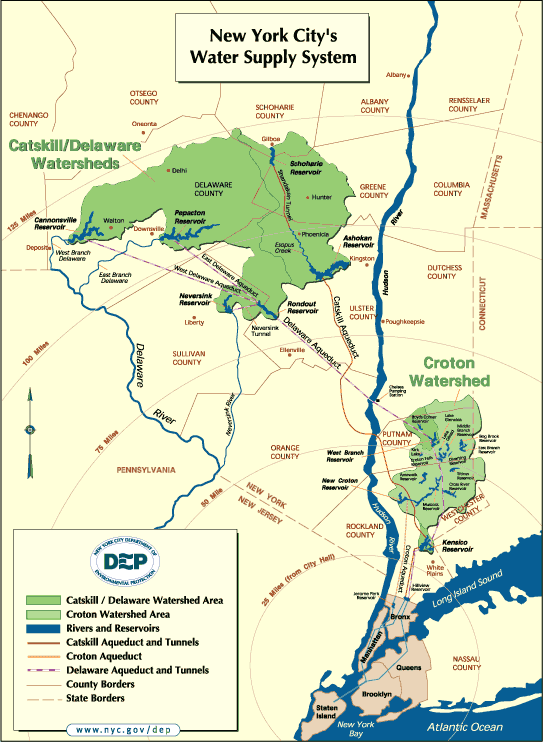
The Marcellus Shale is a fossil fuel rich rock bed that ranges from the middle of Ohio east to the Catskill Mountains, from upstate New York down south through Kentucky. Drilling waste water may contaminate the drinking water of New York City, Washington D.C., and Philadelphia. Officials in New York City have been pushing legislation to ban natural gas drilling in the Catskill Mountains, which feed the city's drinking water reservoirs. Washington DC gets its drinking water from the Potomac River, whose tributaries are threatened by the toxic liquid wastes produced during natural gas drilling.

The oil and gas industry calls the Marcellus Shale an "unconventional natural gas source"; mining this area was uneconomical until this decade, where the price of oil has been skyrocketing. The Marcellus Shale is the 3rd largest natural gas field in the world, expected to generate enough natural gas for 2 to 10 years of US consumption. The process is being advertised as a local clean energy source, bringing in jobs and economic growth. The mining of the Marcellus Shale is projected to continue to pollute the soil, streams and aquifers in the Northeastern United States for 5 to 30 years. After the Marcellus is depleted, oil companies will work on the Utica Shale, which rests thousands of feet beneath the Marcellus.

Natural gas drilling waste water -- which includes radium, uranium, mercury, and lead -- is suspected to be responsible for the deaths of the 161 species of life which were found killed along 38 miles of Dunkard Creek in Pennsylvania.(2) The Natural Resource Defense Council has reported that livestock have been dying after drinking drilling waste water.(3) The Oil and Natural Gas Industries are officially exempt from the Safe Drinking Water Act, the Clean Air Act, the Clean Water Act, the Emergency Planning and Community Right to Know Act, the Natural Resource Recovery Act and other federal regulations.(4) These exemptions have made the federal government complicit in Coloradan Laura Amos's adrenal cancer(5), and Pennsylvanian Pat Farnelli and her children's violent stomach pains and diarrhea.(6)(7) Benzene and radioactive waste from a WWII military dumping site are suspected of having caused a childhood cancer cluster in Clyde, Ohio, torturing 20 children(8); these toxic contaminants are also produced as wastes during natural gas production(9) and stored in open pits on drilling sites.(10)

At the center of the struggle is the new process of natural gas drilling called horizontal hydrofracking, also known as "fracking."

Natural gas production in the Marcellus Shale involve two stages which each introduce toxic contaminants into our environment. Producers must first drill the well and then they "frack" the well. The first process, drilling, dredges uranium, radium, mercury, and lead laden shale rocks to the surface (11) to make way for a pipe used in the fracking process. These toxic shale materials are stored in open pits on the site for long periods of time, and the liquid wastes are eventually brought to municipal water treatment plants for filtration. Municipal water treatment plants are already so overburdened and unable to filter out toxins from our drinking water that on September 12, the New York Times reported "the nation’s water does not meet public health goals, and enforcement of water pollution laws is unacceptably low."(12)

The second stage of natural gas production, the "fracking" process, is very expensive: each fracking job requires 2-9 million of gallons of water to be extracted from local water sources and creates 1-4 million gallons of toxic liquid waste, which must be brought to a hazardous waste dump or extensively filtered before entering the public watersheds.(13) This amount of waste is generated numerous times per well, as each well can be fracked up to 10 times. The Pennsylvania Department of Environmental Protection allows 800,000 gallons to be taken from Cross Creek Lake every day; Range Resources, a Texas based oil and natural gas company, is the recipient of that permit.(14) This wednesday, Sept. 30 at 7pm, a public hearing in Williamsport , PA will be held for a waste water treatment facility requesting permission to pump 400,000 gallons of minimally treated drilling waste water *every day* into the Susquehanna River.(15)

Throughout the nation State Parks and Public Schools have leased their mineral rights to oil and gas companies in an attempt to balance budgets.(16) And this school year, kids at Elk Lake School in Dimock, PA may get to play in radioactive sludge during recess.(17)

Residents throughout the nation have complained that their wells, soils and streams have been contaminated with the heavy metals and radioactive tailings dredged up from the shale along with the gas.(18) The numerous chemicals used in the fracking process are also a concern. As the natural gas is pumped away from the site through pipelines, the hazardous fracking waste fluids are usually stored on site in open pits for long periods of time.(19) These open pits are often only 100 ft from a persons home or a creek or critical migration corridor, and are sometimes surrounded by a flimsy 3 foot high plastic fencing in a feeble attempt to protect the kids, dogs, livestock, wildlife, and downwind neighbors from the toxins.(20)

Some citizens have been concerned that workers may be poking holes into the plastic sheets that line the bottom of the liquid waste pits, allowing the liquids to drain into the soil and saving the company the expense of disposal at expensive hazardous waste facilities. A landowner told Indymedia that he has watched the levels in waste water pits steadily decrease after they were filled up. In Garfield County, Colorado, a resident videotaped bulldozers burying liquid waste pits with soil, the videotaper reported that the natural gas company Encana owns that drilling pad.(21) Hundreds of miles north of this contamination site, two of Encana's natural gas pipelines were bombed, distraught Canadian citizens are suspected to be responsible.(22)

Recently, residents in Dimock, Pennsylvania were able to voice enough concern to get the Pennsylvania Department of Environmental Protection (DEP) to temporarily stop fracking activities by Cabot, a natural gas producing company that has been spilling toxins into wetlands and a creek.(23) Cabot's fracking activities will be halted for two weeks, but the company may still drill and bore holes for pipelines through wetland areas. Cabot's drilling activities underneath wetlands has been a source of contention for citizen groups due to documented footage of bentonite spills along Cabot's Cranberry Pipeline, a pipeline which currently is being horizontally drilled underneath a wetlands area in Susquehanna County.(24)

Pennsylvania DEP's oil and gas investigation unit is understaffed, and individual citizens are having to monitor drilling activities. Craig Lobins, DEP Northwest Regional Manager for the Oil and Gas Program recently explained to citizens at a meeting in Forest City, PA how the department is unable to fully monitor all drilling sites:

"Lets be realistic about it, they drill 24-7, and I don't think anyone expects someone to stand on a rig 24 hours a day 7 days a week." Mr.Lobins explained to the crowd of over 100 concerned citizens who attended the meeting hosted by the group R.E.S.C.U.E. " And if we did expect them to stand there all day, imagine how expensive that would be."(25)

At a meeting of the Oil and Gas Advisory Technical Board on October 30 of 2008, official notes state that Mr. Lobins "expressed the need for more Oil and Gas Inspectors. He said even if there is no projected increase in permitting, DEP is still understaffed in this area."(26)

But, when Mr. Lobins was asked at the recent Forest City meeting on Sept 16, if he supported a moratorium on drilling until the DEP had enough staff and local oversight of drilling activity, he responded "No." Instead of hiring more investigators, Lobins told the citizens at the Forest City meeting that local residents should be "the eyes of the DEP". Citizens who followed Mr. Lobins suggestion were subsequently told by agents of the DEP that they can't be trespassing onto gas leased land to monitor these sites for illegal activity.

Joanne Fiorito, acting as the eyes of the DEP, recently discovered a waste spill at a drilling site just off RT 29 and upon reporting the spill was warned not to trespass. "If the DEP can't monitor these sites on their own," said Ms. Joanne Fiorito "and then the DEP tells us that we cannot trespass after we found a spill on the Grimsley well pad site that wasn't reported to the DEP by Cabot, well then, where does this leave the citizens of PA who are dependent on the DEP doing its job? It has gotten to the point where I and others will have to do it ourselves, and I personally don't care if they arrest me for civil disobedience, because this land, air and water is what keeps us all alive."

Vera Scroggins, 58, a public broadcast reporter for Binghamton's Open2Everyone TV filmed the Grimsley well pad site discovery spill as well as Cabot's Cranberry Pipeline's bentonite spills with Ms. Fiorito. Her video will be broadcast in the Binghamton, NY region on Channel 4 on September 28 and October 5, 2009. You can request a copy for your local public broadcast channel by contacting Open 2 Everyone TV Binghamton << O2ETV.info@gmail.com >>.

The following states are threatened by natural gas drilling: AL, AK, CO, FL, ID, IL, IN, KY, KS, LA, MI, MO, MT, ND, NM, NY ,OH, OK, PA, UT, TX, WV, WY, VA...

CONTACT THESE GROUPS FOR MORE INFORMATION ON HOW TO HELP:
EarthJustice
Clean Water Action
Susquehanna Citizens for Clean Water
Binghamton Regional Sustainability Coalition
Damascus Citizens for Sustainability
Chesapeake Bay Foundation
R.E.S.C.U.E.
ShaleShock and the Listening Project
Allegheny Defense Project

SOURCES:
(1) Chesapeake Energy reports that citizens in Wetzel County, West Virginia have placed spikes along RT 89 -- http://www.wcag-wv.org/S/Safety/SpikeStrip.htm

(2) Pittsburgh Post Gazette reports that 161 species found killed along 38 miles of Dunkard Creek -- "Sudden death of ecosystem ravages long creek 'Everything is being killed': 161 aquatic species have died along Dunkard Creek" by Don Hopey, Pittsburgh Post-Gazette; September 20, 2009. http://www.post-gazette.com/pg/09263/999458-113.stm

(3) NRDC states that there have reported deaths of livestock may be associated with drilling waste -- "Are Gas & Oil Operations Harming Livestock?" By the Natural Resources Defense Council, May 06, 2009. http://www.opposingviews.com/articles/opinion-are-gas-oil-operations-harming-livestock

(4) Oil and Natural Gas Industries are officially exempt from many federal regulations protecting water, air, and communities, these exemptions listed and explained -- "Free Pass for Oil and Gas: Environmental Protections Rolled Back as Western Drilling Surges: Oil and Gas Industry Exemptions" by The Environmental Working Group; March 26, 2009. http://www.ewg.org/reports/Free-Pass-for-Oil-and-Gas/Oil-and-Gas-Industry-Exemptions

(5) Laura Amos gets adrenal cancer from EnCana contaminating her drinking water with 2-BE -- "Family's water well was contaminated after hydraulic fracturing near their home" by Laura Amos; EarthWorks Action. http://www.earthworksaction.org/cvLauraAmos.cfm

(6) Pat Farnelli and her children suffer from contamination of their drinking water -- "U.S. energy future hits snag in rural Pennsylvania" by Jon Hurtle, Reuters; March 13, 2009. http://www.reuters.com/article/domesticNews/idUSTRE52C07920090313

(7) Pat Farnelli's drinking water is contaminated and there is a the drilling rig in her backyard -- "Officials in Three States Pin Water Woes on Gas Drilling" byAbrahm Lustgarten, ProPublica; April 26, 2009. http://www.propublica.org/feature/officials-in-three-states-pin-water-woes-on-gas-drilling-426

(8) 20 children in Clyde, Ohio tortured -- "Questions outweigh clues to cancer cluster in Clyde: 20 of the town's children fall ill over the last 8 years" by Tom Henry, Toledo Blade; February 1, 2009. http://toledoblade.com/apps/pbcs.dll/article?AID=/20090201/NEWS16/902010302/-1/NEWS24

(9) Toxins in natural gas production waste pits include benzene, uranium, radium, mercury, lead, toulene, and other carcinogens -- "Chemicals in Natural Gas Production: Pit Chemicals" by The Endocrine Disruption Exchange; November 15, 2007. http://www.endocrinedisruption.com/chemicals.pits.php

(10) Drilling waste fluids in open pits in Texas; http://txsharon.blogspot.com/2008/07/more-barnett-shale-sludge-pond.html

(11) Uranium, Radium, Lead and Mercury are brought to the surface during drilling of the Marcellus Shale -- "Shale Gas: Focus on the Marcellus Shale" by LisaSumi for the Oil and Gas Accountability Project/Earthworks; May 2008. http://www.earthworksaction.org/pubs/OGAPMarcellusShaleReport-6-12-08.pdf

(12) New York Times reports that the nation's drinking water does not meet public health goals -- "Clean Water Laws Are Neglected, at a Cost in Suffering" by CharlesDuhigg, New York Times; September 13, 2009. http://www.nytimes.com/2009/09/13/us/13water.html?_r=2&pagewanted=1

(13) Hydrofracking requires 2-9 million gallons of clean water and creates 1-4 million gallons of hazardous industrial waste water -- "Drilling 101" byShaleshock Citizen's Action Alliance. http://www.shaleshock.org/drilling-101/

(14) The PA DEP has permitted Range Resources to extract up to 800,000 gallons of water every day -- DEP File No. 141142-WMP7-004, WUDS Primary Facility ID # 59795. DEP Oil and Gas Program, Southwest Regional Office; July 15, 2009. document accessed from http://www.marcellus-shale.us/pdf/Water-Plan_RR-final.pdf

(15) The Department of Environmental Protection will conduct a public hearing at 7 p.m. on Wednesday, Sept. 30, to accept testimony on an industrial waste discharge permit application submitted byTerrAqua Resource Management LLC to treat and discharge 400,000 gallons per day of gas well drilling wastewater to the West Branch of the Susquehanna River in Williamsport. The hearing will be held at the DEP Northcentral Regional Office, 208 West Third St., Suite 101, Williamsport, PA -- http://www.depweb.state.pa.us/news/cwp/view.asp?a=1278&q=548355

(16) State Parks throughout the nation are leasing their mineral rights to natural gas companies to offset budget problems; Arkansas' Woolly Hollow State Park, Pennsylvania's Goddard State Park, New York's Allegany State Park, Ohio's Salt Fork State Park, New Mexico's Living Desert Zoo and Gardens State Park -- "State park drilling controversy increasing" by the AP, Observer-Reporter; August 30, 2009. http://www.observer-reporter.com/OR/Story/d0412-BC-US-StateParks-Drilli-1stLd-Writethru-08-16-1146

(17) Elk Lake School in Dimock, PA has leased land for natural gas drilling -- "Accounts opened for SCCTC expansion funds" by Michael J. Rudolf, Susquehanna County Independent;
July 29, 2009. http://www.independentweekender.com/news/1.149838

(18) "EPA says wells in Wyoming show possible pollution from frac'ing: Scientists have found methane gas, hydrocarbons, lead and copper" by John Colson, Post Independent Staff
Glenwood Springs, Colorado; August 28, 2009. http://www.postindependent.com/article/20090828/VALLEYNEWS/908279986/108...

(19) Open pits at an Encana drilling site in Garfield County, CO -- "This is EnCana's hydraulic fracturing operations on the F11E pad on April 22, 2009". http://www.youtube.com/watch?v=HRvrT5KCzPM

(20) Open waste pits present dangers to wildlife migration corridors -- "Drilling in the Rocky Mountains: How Much and at What Cost" by Pete Morton,Ph .D, Chris Weller, Janice Thomson, PhD, and Nada Culver, for The Wilderness Society; March 2009. http://www.sagebrushsea.org/pdf/TWS_Drilling_How_Much_What_Cost.pdf

(21) Bulldozers cover drilling waste pits with water and remove plastic liner -- "EnCana Buries Hydraulic Fracturing Pit Sludge in Unlined Pit" May 14, 2009. http://www.youtube.com/watch?v=-ZijSwabuc4

(22) "Second bomb blast hits Encana pipeline" by Allan Dowd, Reuters; October 16, 2008.

(23) "DEP orders driller to stop all hydraulic fracturing in Susquehanna County" The Times-Tribune; September 26, 2009.

(24) Bentonite spills in wetlands along Cabot's Cranberry Pipeline -- Susquehanna County Citizens for Clean Water video documentary by VeraScroggins, and "We are the Eyes of the DEP" video documentary by the Spore Collective.

(25) Forest City meeting was rebroadcast on WHRW Binghamton Radio 90.5, "The Point" September 22, 2009; 11:30-1pm. see the archives of whrw.org

(26) "Minutes of the Oil and Gas Technical Advisory Board Meeting" Marriott Spring Hill Suites, Washington, PA; October 30, 2008. http://www.dep.state.pa.us/dep/subject/advcoun/oil_gas/Minutes%20103008....

DEMAND ACCOUNTABILITY!

RURAL IMPACT VIDEOS, 6 parts

Natural gas development in Colorado, the impacts on communities, environment and public health. A primer for public servants and residents of counties that care for their lifestyles.

Drilling for Gas in Bradford County, PA ... Listen!

Cattle Drinking Drilling Waste!

EPA... FDA... Hello? How many different ways are we going to have to eat this? ... Thank you TXSharon for all you do! ... Stay tuned in at http://txsharon.blogspot.com

Landfarms

A film by Txsharon. Thank you Sharon for all you do. Click HERE to read the complete article on Bluedaze: Landfarms: Spreading Toxic Drilling Waste on Farmland

SkyTruth: Upper Green River Valley - A View From Above