Showing posts with label CLEAN WATER ACT. Show all posts

Monday, May 10, 2010

Hydraulic fracking spells disaster

Workers World
May 6, 2010

Despite industry claims that the rapidly expanding practice of hydraulic fracturing to extract natural gas from deep underground shale layers is “perfectly safe,” on April 15 the Pennsylvania Department of Environmental Protection fined Houston-based Cabot Oil and Gas $240,000 for causing the contamination of 14 residential water wells in Dimock Township, Pa.

The company was also ordered to plug three gas wells it was operating in the town, which sits atop the Marcellus Shale formation, and was banned from drilling in the area. One water well in Dimock exploded last year, and DEP inspectors witnessed gas bubbling up at the base of eight other wells in March. Despite the ruling, Cabot has plans to drill 100 new wells in Dimock this year.

Independent newsroom ProPublica has reported on 50 similar cases across Pennsylvania, including reports of fish kills, water and air pollution, fires, out-of-control flaring, human illnesses and animal deaths.

The concern over the safety of hydraulic fracturing has prompted calls for a moratorium on drilling in Pennsylvania. In the process, often referred to as fracking, 2 to 9 millions of gallons of water, mixed with sand and up to 250 chemicals, are pushed into underground shale layers to release natural gas.

In January the Pennsylvania state Legislature opened up 32,000 additional acres of state forest land to be leased for drilling. As a result, 692,000 acres of the 2.1 million acres of state forest land are now open for gas wells. During a recent push to expand the practice into the Delaware River basin, the Philadelphia City Council was pressured to pass a resolution on March 25 calling for an environmental impact statement before any new permits are issued.

Fracking has been in use for a number of years throughout the U.S., particularly in the Southwest. Five natural gas sites border the town of Dish, Texas, in a quarter-mile complex. In nearby Fort Worth, Texas, 1,400 wells have been drilled in urban areas, many near schools and residential centers.

Speaking at a meeting at Temple University’s Department of Civil and Environmental Engineering on April 16, Dish Mayor Calvin Tillman described how carcinogenic air pollution from natural gas drilling has damaged the quality of life in his town of 180 residents. The town sits atop the Barnett Shale, a geological formation similar to the Marcellus Shale.

Using his own money, Tillman has been traveling to Pennsylvania and New York to warn about the dangers of the gas boom. In his small town, trees are dying on a 30-acre farm that adjoins a labyrinth of small underground pipelines used to transport fuel from the fracking wells to outside markets. Horses have also fallen ill. Residents report problems with frequent nausea, severe headaches, breathing difficulties, chronic eye irritation, allergies, throat irritations and even brain disorders.

When Texas state inspectors, who are usually linked to the drilling companies, reported they could not find any problem with the wells, Dish town officials hired an environmental firm to collect one-day air samples near the compressors. Their study found high levels of 15 chemicals, including benzene, a known carcinogen. As a result the Texas Commission on Environmental Quality conducted air studies at 94 sites in the region. They found two sites with very high levels of benzene and 19 others with levels that raised concern.

In April, blood and urine testing of 28 adult Dish residents revealed that half the residents had slightly elevated levels of benzene and other contaminants. Four residents tested positive for benzene, including Tillman. Tillman noted that no testing was done on children, pregnant women or the elderly — groups likely to be most susceptible to the contaminants. Tillman’s water also tested positive for traces of styrene, ethyl benzene and xylene.

Growing concern over the danger of fracking has led to a push for legislation in Pennsylvania that would require drillers to disclose chemical ingredients in hydraulic fracturing fluids. Other proposed legislation calls for a moratorium on drilling until environmental impact studies can be performed. Both bills have yet to be passed and face mounting opposition from the natural gas industry.

Nationally, the oil and gas industry won exemption from major provisions of the Safe Drinking Water Act, the Clean Water Act and other federal environmental laws with the passage of the 2005 Energy Bill. The bill’s “Halliburton loophole” protected the company from having to reveal the composition of their fracturing fluid, despite the fact that the list of hazardous substances compiled by the Environmental Protection Agency’s Superfund — the program established to address abandoned hazardous waste sites — includes toxic profiles on benzene, styrene, toluene and other agents known to be in the mix. Efforts are also underway to challenge this legislation.

The EPA announced it will spend $4.4 million to start a study on the impact of fracturing in October, but Dr. Michel Boufadel, director of the Environmental Hydrology and Hydraulics Laboratory at Temple University College of Engineering, expressed concerns that the EPA’s study does not go far enough.

Speaking at the April 16 meeting, Boufadel noted that very few scientific studies on fracking have been conducted by researchers not connected to the drilling industry. He also pointed out that most studies assume that any leak of water contaminated by fracturing fluids would spread horizontally from a holding tank and be detected by ground level monitors.

Boufadel explained that the 250 chemicals contained in the fracturing fluid create “gooey, high density water” — a gel that suspends the sand particles needed to work into cracks in the shale layers. The result is “radioactive water six times more saline than sea water and containing known carcinogens.”

“If you don’t account for this heavy density you would expect water to move outward, but the reality is that it moves down,” Boufadel stressed. “If you only use existing traditional models of monitoring wells at ground level, you won’t detect contamination until it’s too late.”

LINK


Articles copyright 1995-2010 Workers World. Verbatim copying and distribution of this entire article is permitted in any medium without royalty provided this notice is preserved.

DEMAND ACCOUNTABILITY!

Wednesday, April 14, 2010

Fracking: As Safe as Coca-Cola!

By Kate Sheppard
Mother Jones
Tue. April 13, 2010


The natural gas industry would like us to believe that the chemicals they're injecting into the ground in order to extract gas are as harmless as Coca-Cola. Therefore, they should be shielded from the scrutiny of federal regulators. No need to investigate—just take their word for it!

In comments to the Environmental Protection Agency obtained by Mother Jones, Penneco Oil Company, an oil and natural gas business based in Pennsylvania and West Virginia, says that it will "strongly oppose" increased regulation of hydraulic fracturing, a.k.a "fracking," and questions why the EPA would even want to investigate the controversial practice of injecting water and chemicals into shale, coal beds, and other geological formations to extract natural gas.

Here's one clue: Natural gas extractors have been found to use compounds containing toxic chemicals like benzene, toluene, ethylbenzene, and xylene. A congressional investigation recently found that companies have injected hundreds of thousands of gallons of diesel-based chemicals into the ground. Yet the industry is currently exempt from Clean Water Act standards, and companies are not even required to disclose exactly what their fracking fluids contain. The industry claims such information is proprietary.

Natural gas interests are fighting hard against efforts to subject the industry to tougher scrutiny. Shortly after the EPA announced that it would take a closer look at fracking due to concerns about water contamination, the industry began demanding protection under a climate bill. Penneco goes so far as to argue that the EPA is just making things up:

We are concerned that bureaucratic machinations have caused the EPA to hypothesize a problem and that EPA is now seeking research to justify a solution to a nonexistent problem. We are adamant that this process should start from the context of reality; Hydrofracking is a modern industrial and technological success which has delivered clean reliable energy to millions of American homes, reducing our dependence on foreign sources of energy -- and that the research should work forward from that premise.

Instead, Penneco wants the EPA to take a more "positive" approach to its investigation. The company "would like to see questions for research prefaced and asked from the positive regarding hydraulic fracturing." For example, "What has been the benefit to America's streams and waterways as a result of hydraulic fracturing allowing for fewer acres of disturbance while increasing the amount of recoverable reserves?"

REALLY!

But perhaps the most comical part of the submission comes when the company claims that injecting diesel fuel and other toxic chemicals into the ground is no more dangerous than soda pop:

The formula for Coca-Cola is a closely guarded secret—though the ingredients are disclosed. In its dilute form—as a beverage—Coca-Cola is a known acid. It is entirely likely that in transport, as a concentrate, Coke may qualify as a toxic chemical. Perhaps, on game day at a stadium, where the stadium may have thousands of gallons of Coke syrup waiting to be mixed with carbonated water, the stadium may have high levels of toxic chemicals on hand. However, as we all know, there is no practical risk and the substance is relatively harmless. We believe that the same reasonable standard of common sense needs to be employed with hydraulic fracturing chemical studies.

Thus, Penneco concludes, any study from the EPA should consider the "absolute benefit that our society and the environment have reaped as a result of the introduction of hydraulic fracturing technology." Glad that's settled!

!!!

If Congress places limits on carbon dioxide, the demand for natural gas is only expected to grow—along with pressure by the industry on lawmakers to let it operate without scrutiny.

LINK TO MOTHER JONES ARTICLE

Editorial comments by Splashdown in red.

DEMAND ACCOUNTABILITY!

Wednesday, February 17, 2010

Fracking oversight OK says EPA water chief

(Drawing Distinctions)

NewsWatch:Energy
Tom Fowler
February 17, 2010

Hydraulic fracturing has been the source of much anxiety and anger as drilling in the Marcellus Shales in New York and Pennsylvania picked up in recent years. A lack of direct federal involvement in oversight of the process and incidents of residential water supplies near drill sites becoming contaminated have been the main rallying points for opponents.

But one official at the Environmental Protection Agency says he's confident state regulators are doing a good job watching over fracking and that it has not yet been linked to any water contamination, reports Dow Jones:

"I have no information that states aren't doing a good job already," Steve Heare, director of EPA's Drinking Water Protection Division said on the sidelines of a state regulators conference here [Washington]. He also said despite claims by environmental organizations, he hadn't seen any documented cases that the hydro-fracking process was contaminating water supplies.

In its 2011 budget, the EPA is seeking to spend $4 million to study the environmental impacts of the process.

Bill Kappel, a U.S. Geological Survey official, said contamination of water supplies is more likely to happen as companies process the waste water from hydrofracking. In some instances, municipal water systems that treat the water have reported higher levels of heavy metals and radioactivity.

"Treatment of the [waste] water hasn't caught up with the hydro-fracking technology," Kappel said.

But both re-injection of that waste water and water treatment at the surface is already regulated by the federal government under the Safe Drinking Water and Clean Water Acts.

It seems poor well completion work is also to blame in some of the instances where there has been contamination as well. That's a pretty important distinction to make because it narrows the possible areas where errors/accidents can occur and should focus people on what part of the process has the greater risks.
LINK
Editorial comments by Splashdown in red.

DEMAND ACCOUNTABILITY!

Friday, January 29, 2010

Don't Frack with New York! Governor Patterson Poisons the Well to Balance the Budget

Alison Rose Levy
The Huffington Post
January 28, 2010

Former New York State Governor Eliot Spitzer may have had his sexual peccadilloes but he knew how to stand up to corporate interests that threatened the public good. It was a big boost for oil companies, planning to despoil New York State, when the powerhouse Spitzer was replaced by his easily rolled-over successor.

While belt-tightening throughout the state budget, Governor Patterson added $3 million to fast track harmful gas drilling practices--a quick fix economic solution with tragic long-range health, economic, and environmental consequences.

On Monday, a statewide coalition of New York state residents, businesses, and environmental groups rallied in the state capital of Albany to ask legislators to oppose Patterson's plans to contaminate state-wide water supplies (including New York City's) by permitting a damaging form of gas drilling, known as "fracking," or hydraulic fracturing.

Thanks to lobbying by Halliburton and other energy companies, under the Bush-Cheney administration, fracking got exempted from the Clean Water Act even though it releases large quantities of undisclosed carcinogens and toxic chemicals into the earth and water supply.

According to a recent study, conducted by the Environmental Working Group (EWG), just one drilling site deploys harmful chemicals sufficient "to contaminate more than 100 billion gallons of drinking water to unsafe levels ... more than 10 times as much water as the entire state of New York uses in a single day."

The chemicals used in fracking "pose a serious threat to the nation's water supplies, but those risks have been largely ignored," says the report. "Drinking water contamination and property damage have been linked to hydraulic fracturing in four states--Colorado, Ohio, Pennsylvania and Wyoming. In one incident that polluted a Colorado creek, the drilling company is still trying to clean it up--four years later."

Nor does the drilling create local jobs or business. Instead, companies bus in workers from Texas, housing them in "man camps," sites where reportedly alcohol and drug abuse, and sexual predation abound. While no one wants a "man camp" next door, a gas well also ruins the neighborhood. If one owner sells property for drilling, all neighboring land can be conscripted for leasing, with no rights of refusal. Fracking also releases chemicals into the air; an army of trucks must carry over roads and New York State highways up to four million gallons of contaminated water (per well)-- which amps up air pollution and costly highway repairs. There is currently no way to effectively decontaminate the high quantities of waste water produced by fracking.

"We can't let the gleam of potential profits leave us with a legacy of polluted water and industrialized landscapes," said Wes Gillingham, program director of Catskill Mountainkeeper.

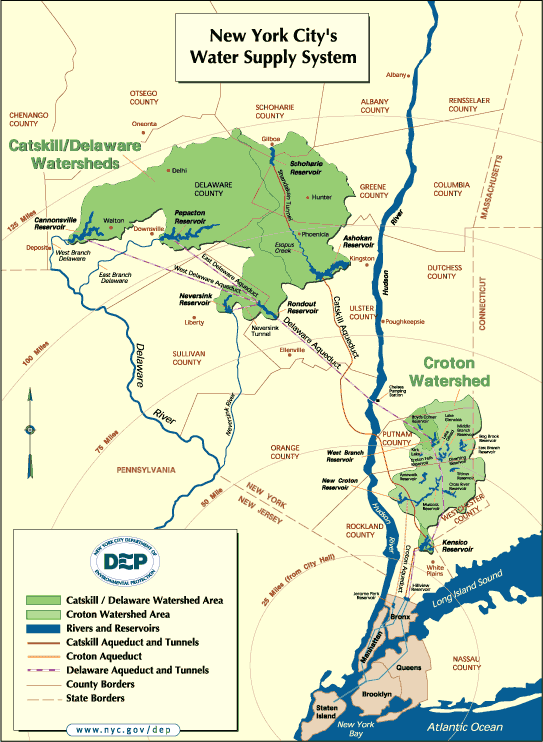
Last month, New York City's Department of Environmental Protection issued a report urging a halt to gas drilling since, "Natural gas drilling and exploration are incompatible with the operation of New York City's unfiltered water supply system and pose unacceptable risks for more than nine million New Yorkers in the City and State." They noted that drilling entails "invasive industrialization and creates a substantial risk of chemical contamination, and infrastructure damage."

This week, Mayor Bloomberg chimed in, "The consequences are so severe that it is not a risk that I think we should run. I do not think that we should allow fractured drilling anywhere near our water supply."

Although land can be fenced in, water can't be. It flows underground, it rises into clouds, it's borne by the winds, and released by the rains, far from its source.

While the Mayor nobly aims to protect the immediate area surrounding the city's upstate water reservoir, so far no studies have investigated how far water-born contaminants from throughout the state could flow downstream to impact NYC, or it's water supply. Fracking originated in arid western regions, and its proponents don't know the extent of pollution possible in a region of interconnected rivers and frequent rains like New York and New England.

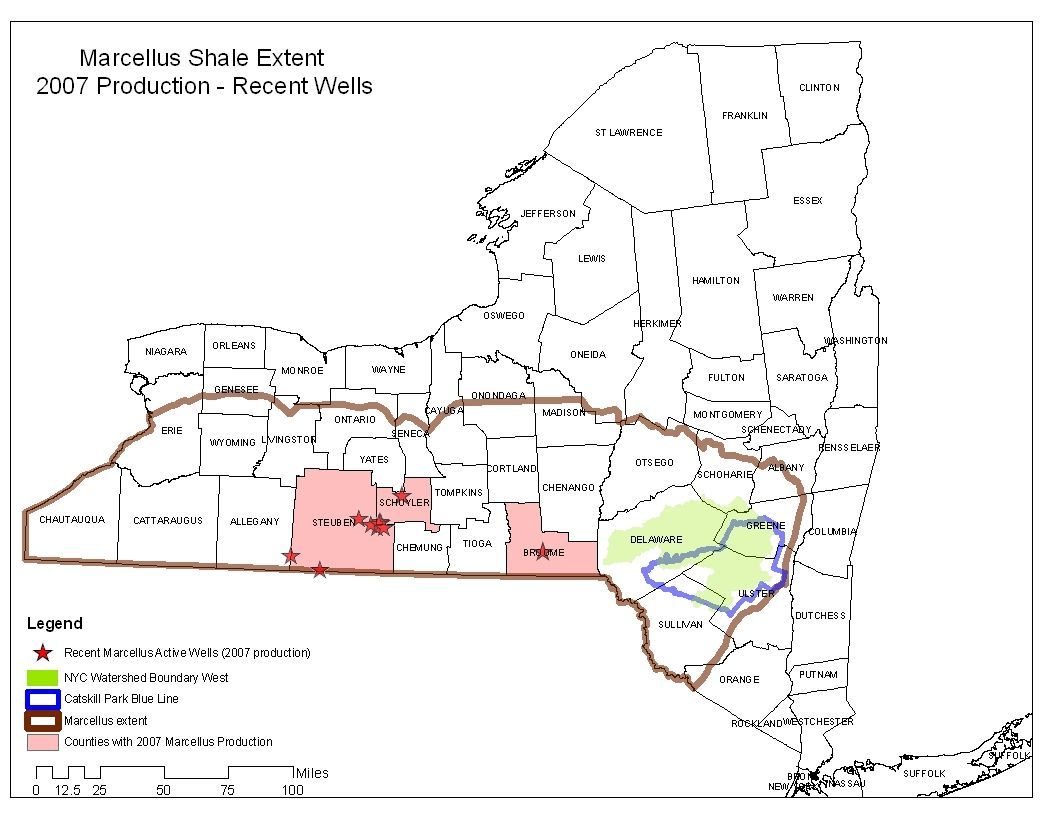
In New York State, gas drillers hope to use fracking in the regions of the New York City Watershed, the Delaware River, the Finger Lakes, and upstate watersheds, the source of waters that flow downstate to New York, Pennsylvania, New Jersey, and Delaware.

With fresh water resources becoming scarcer worldwide due to population growth and climate change, it's unconscionable for a short-term Governor to short-sell a precious resource to balance his budget. Perhaps the soon to declare gubernatorial candidate, Andrew Cuomo, will like his popular father, Governor Mario Cuomo, become a successful champion.

To take action, sign up with the Environmental Advocates NY Citizens for Safe Energy http://www.catskillcitizens.org/ The Environmental Working Group proposes a national ban or better regulation. Or join No Fracking Way on Facebook. Or cut to the chase, and ask soon to declare candidate, Andrew Cuomo to make New York State a model for future-oriented policies, rather than a disastrous object lesson in the costs of short-sighted gain.

DEMAND ACCOUNTABILITY!

Thursday, January 21, 2010

XTO-ExxonMobil Merger Talks/Commentary


Exxon Chairman and Chief Executive Rex Tillerson faced questions about the environmental impact of hydraulic fracturing at a Capitol Hill hearing on his company's planned merger with XTO. Kevin Book, energy analyst with Clearview Energy Partners, joins Clean Skies News to talk about the implications of the merger.

Source: Clean Skies News

DEMAND ACCOUNTABILITY!

Saturday, January 2, 2010

EPA questions New York state plan to drill for shale gas

Thu Dec 31, 2009

PHILADELPHIA (Reuters) - The U.S. Environmental Protection Agency has "serious reservations" about allowing shale gas drilling in New York City's watershed, warning of a threat to the drinking water for 9 million people.

An EPA report on the divisive issue is the latest potential roadblock for energy companies seeking to exploit the Marcellus Shale formation, which state officials say may contain enough natural gas to satisfy U.S. demand for more than a decade.

"We have concerns regarding potential impacts to human health and the environment that we believe warrant further scientific and regulatory analysis," wrote John Filippelli, chief of the agency's Strategic Planning and Programs Branch.

"EPA has serious reservations about whether gas drilling in the New York City watershed is consistent with the vision of high-quality unfiltered water supply," he wrote in the agency's report, dated Wednesday.

Last week, New York City asked the state to ban shale gas drilling in the city's watershed.

At issue is the controversial process of shale gas extraction known as hydraulic fracturing, or "fracking," in which a combination of chemicals, sand and water are blasted through rock to free trapped gas. Fracking is exempted from regulation under the U.S. Clean Water Act.

The natural gas industry argues that drilling poses no risk to drinking water, saying the chemicals are injected through layers of steel and concrete thousands of feet below aquifers.

But opponents argue that toxic fracking chemicals are contaminating drinking water, citing numerous reports of private wells near gas installations having water that is discolored, foul tasting, or even flammable because of methane that has escaped from drilling operations.

Theo Colborn, a researcher with the Endocrine Disruption Exchange who has drawn links between fracturing chemicals and a range of illnesses including cancer, said the EPA report indicates the agency was taking a new look at fracturing in light of growing public concern and media coverage.

"The natural gas industry can't keep saying it's clean," she said.

TO DRILL OR NOT TO DRILL

"We're pleased to see that the EPA recognizes what the state so far has not, that gas drilling is entirely inappropriate with in the drinking supply for 9 million people," said James Simpson, a staff attorney for Riverkeeper, a New York environmental group.

Eric Goldstein, a senior lawyer for the Natural Resources Defense Council, said the state's proposal "will require a dramatic rethinking and revamping if it is going to pass muster with federal guardians of water quality.

...

For complete article, CLICK HERE.

DEMAND ACCOUNTABILITY!

Wednesday, December 16, 2009

EQB Designates Seven Streams as ‘Exceptional Value,’ Increases Protection for 265 Miles of Waterways

N E W S R E L E A S E COMMONWEALTH OF PENNSYLVANIA

COMMONWEALTH OF PENNSYLVANIA

Dept. of Environmental Protection
Commonwealth News Bureau
Room 308, Main Capitol Building
Harrisburg, PA 17120

FOR IMMEDIATE RELEASE
12/15/2009

CONTACT:
Tom Rathbun
Phone: (717) 787-1323

Harrisburg – Environmental Protection Secretary John Hanger announced today that 265 miles of streams in Pennsylvania will receive increased protection after being designated as “exceptional value” waterways by the Environmental Quality Board.

“Streams that are designated as exceptional value will receive the highest level of protection against pollution from point and non-point sources that could affect the quality and aquatic health of the watershed,” Hanger said. “This demonstrates the usefulness of maintaining a statewide water quality monitoring network that can accurately report the current health of our watersheds and determine if water quality in these basins is changing for the better or worse.”

The waterways receiving the new designation include Young Womans Creek in Clinton, Lycoming and Potter counties; Muncy Creek in Sullivan County; an unnamed tributary to Tunkhannock Creek in Susquehanna County; Spruce Creek in Union County; Blue Eye Run and East Hickory Creek in Warren County; and East Branch Dyberry Creek in Wayne County.

DEP recommended the new designations based on five years of data collected through Pennsylvania’s Water Quality Network, which provides long-term, fixed-location monitoring of watersheds’ chemical and biological quality.

Data collected through monitoring gives DEP a reference point from which to observe changes in water quality and to track the health of streams to see if human activity is affecting water quality or to determine if cleanup and pollution control efforts are improving conditions. The network also gives the state data to monitor the quality of water that Pennsylvania sends to or receives from neighboring states.

Surface water quality standards are mandated by the federal Clean Water Act, which requires states to designate uses for streams such as drinking water, recreation and fishing, and to set criteria to protect streams for those uses. In addition, an anti-degradation component of the act requires that streams designated as exceptional value or high quality must be maintained at existing quality.

For more information, visit www.depweb.state.pa.us, keyword: Water Quality.

DEMAND ACCOUNTABILITY!

Sunday, November 15, 2009

TEDX: The Endocrine Disruptor Exchange

Chemicals in Natural Gas Operations

Introduction


As natural gas production rapidly increases across the U.S., its associated pollution has reached the stage where it is contaminating essential life support systems - water, air, and soil - and causing harm to the health of humans, wildlife, domestic animals, and vegetation. This project was designed to explore the health effects of products and chemicals used in drilling, fracturing (frac’ing, or stimulation), recovery and delivery of natural gas. It provides a glimpse at the pattern(s) of possible health hazards posed by the chemicals being used. There are hundreds of products in current use, the components of which are, in many cases, unavailable for public scrutiny and for which we have information only on a small percentage. We therefore make no claim that our list is complete.

Toxic chemicals are used at every stage of development to reach and release the gas. ...............

In addition to the land and water contamination issues, at each stage of production and delivery, tons of toxic volatile compounds, including benzene, toluene, ethylbenzene, xylene, etc., and fugitive natural gas (methane), escape and mix with nitrogen oxides from the exhaust of diesel-driven, mobile and stationary equipment to produce ground-level ozone. Ozone combined with particulate matter less than 2.5 microns produces smog (haze). Gas field produced ozone has created a serious air pollution problem similar to that found in large urban areas, and can spread up to 200 miles beyond the immediate region where gas is being produced. Ozone not only causes irreversible damage to the lungs, it is equally damaging to conifers, aspen, forage, alfalfa, and other crops commonly grown in the West. Adding to this is the dust created by fleets of diesel-driven water trucks working around the clock hauling the constantly accumulating condensate water from well pads to central evaporation pits.

All meaningful environmental oversight and regulation of the natural gas production was removed by the executive branch and Congress in the 2005 Federal Energy Appropriations Bill. Without restraints from the Clean Water Act, Safe Drinking Water Act, Clean Air Act, and CERCLA, the gas industry is steamrolling over vast land segments in the West. Exploitation is so rapid that in less than 6 months in one county, 10 new well pads were built on the banks of the Colorado River, the source of agricultural and drinking water for 25 million people downstream. Spacing has dropped from one well pad per 240 acres to one per 10 acres. From the air it appears as a spreading, cancer-like network of dirt roads over vast acreage, contributing to desertification.

For the complete intro, CLICK HERE.

What you need to know about natural gas production

TEDX has produced a video of Dr. Theo Colborn's 47 minute lecture, complete with photos and data slides to illustrate the fact that natural gas is not the 'clean energy' that industry is touting it to be.
CLICK HERE to view.
CLICK HERE to order a DVD.

DEMAND ACCOUNTABILITY!

Sunday, October 25, 2009

EPA Vows Better Enforcement Of Clean Water Act

Published: October 15, 2009

The Environmental Protection Agency said on Thursday that it would overhaul enforcement of the Clean Water Act, as lawmakers sharply criticized the agency’s decade-long lapses in punishing polluters.
...
E.P.A. administrator, Lisa P. Jackson, said that agency officials “are falling short of this administration’s expectations for the effectiveness of our clean water enforcement programs.”

“The time is long overdue for E.P.A. to re-examine its approach to Clean Water Act enforcement,” said Ms. Jackson, who was confirmed to her position in January. She added that the agency would set strict benchmarks for state regulators, eventually compel companies to submit electronic pollution records so violations could be detected and punished more easily, and “develop more innovative approaches to target enforcement to the most serious violations and the most significant sources.”

One approach will probably include a series of enforcement actions against companies and municipalities that have violated the Clean Water Act, according to people with knowledge of the E.P.A.’s plans who were not authorized to speak publicly.

The agency has not settled on a list of potential targets, but is likely to focus on mining companies, large livestock farms, municipal wastewater treatment plants and construction companies that operate sites where polluted stormwater has run into nearby lakes and rivers.

“Going forward, if states are falling down on the job, we’re going to reverse the permits they’ve issued, and if they’re not enforcing the law, we’ll step in and do it ourselves,” said one agency official.

For the complete article, CLICK HERE.

DEMAND ACCOUNTABILITY!

Tuesday, October 20, 2009

Radioactive Wastes from Oil and Gas Drilling

Saturday's post regarding the proposed wastewater treatment facility in Athens Twp., PA raised the issue of radioactive waste, a topic which is minimalized or not often referred to, but is, nonetheless a topic of significant concern, particularly as levels accumulate.
"The permit application states “Radium 226, Radium 228, Gross Alpha, and Gross Beta radiation” are present in the water incoming for treatment, and because of this, “SRWR is concerned that concentrations (of radioactive materials) will accumulate in the clarifier sludge, rendering the sludge a radioactive waste.
The document adds that SRWR is considering two different methods to help reduce the radioactivity of the sludge, and that “evaluation is continuing to determine the optimum location for this process and the most appropriate and safest* means for handling and disposing of the waste that would be generated.”
*Remember, "safest" doesn't mean safe. It merely means least dangerous.

Here then is the EPA publication on the subject:

Overview

The oil and gas industry provides three-fifths of the energy for the United States. When most of us drive a car, turn on a light bulb, or cook on a stove, a large portion of the energy we use comes from the fossils of plants and animals. While fossil fuels are chemical sources of energy, the processes used to extract them from the earth often generate radioactive waste.

Even though we use them on a daily basis, most people know little about the processes that take oil and gas from the ground to produce energy. These processes may leave behind waste containing concentrations of naturally-occurring radioactive material (NORM) from the surrounding soils and rocks. Once exposed or concentrated by human activity, this naturally-occurring material becomes Technologically-Enhanced NORM or TENORM. Radioactive materials are not necessarily present in the soils at every well or drilling site. However in some areas of the country, such as the upper Midwest or Gulf Coast states, the soils are more like to contain radioactive material.

Radioactive wastes from oil and gas drilling take the form of produced water, drilling mud, sludge, slimes, or evaporation ponds and pits. It can also concentrate in the mineral scales that form in pipes (pipe scale), storage tanks, or other extraction equipment. Radionuclides in these wastes are primarily radium-226, radium-228, and radon gas. The radon is released to the atmosphere, while the produced water and mud containing radium are placed in ponds or pits for evaporation, re-use, or recovery.

The people most likely to be exposed to this source of radiation are workers at the site. They may inhale radon gas which is released during drilling and produced by the decay of radium, raising their risk of lung cancer. ...

Who is protecting you

U.S. Environmental Protection Agency (EPA)

EPA is responsible for setting federal radiation standards for exposure to NORM and TENORM.

EPA develops standards for the oil and gas extraction and production industry under the Clean Air Act, Clean Water Act, Safe Drinking Water Act*, Resource Conservation and Recovery Act and the Comprehensive Environmental Response, Compensation, and Liability Act.

*Please urge Congress to vote for the FRAC Act, removing industry exemptions for hydraulic fracturing! (see sidebar at left)

The States

Each state has one or more programs that address both NORM and TENORM.
Some states have established or set limits to control to TENORM. These limits apply to the oil and gas drilling industry. Most states also control public exposure to radiation through programs implementing the federal Clean Air Act, Clean Water Act and other environmental laws authorized by the EPA.

U.S. Department of Labor (DOL), Occupational Safety and Health Administration (OSHA)

DOL’s Occupational Health and Safety Administration (OSHA) establishes health and safety regulations for the oil and gas extraction, production, and servicing industry. OSHA also issues hazardous information bulletins to inform staff and the public of significant occupational safety and health issues including radiation hazard recognition, evaluation, and control in the workplace.

U.S. Department of Energy (DOE)

DOE provides grants for research on the use and disposal of radioactive materials related to the development of energy sources.

What you can do to protect yourself

Government organizations continue to address potential threats from oil and gas drilling and production for the public health and safety but you can take actions as well for your own health and safety.

Workers in the industry have the potential for overexposure to radioactive material and must stay up-to-date on federal, state, and industry health and safety guidelines. Following these procedures will reduce total on-site exposure. Workers also need to take precautions to avoid bringing radioactive material residue on their clothes and shoes home to their families and neighborhoods.

  • Change out of potentially contaminated clothes and shoes before returning to the family car and to your home or office.
  • Do not re-use or bring home discarded equipment or material such as pipes, devices, bricks, rocks, or water.

Members of the public should contact their local state geological survey or bureau of health to determine if there is a likelihood of NORM and TENORM occurrence associated with oil and gas production in their state, or area where they live. Until then:

  • Limit exposures and disturbance of the production site and any abandoned equipment.
  • Do not handle, dispose or re-use abandoned equipment used at drilling sites.
For Resources and the complete report, CLICK HERE.

DEMAND ACCOUNTABILITY!

Monday, September 14, 2009

Saturday, September 12, 2009

TOXIC WATERS

The New York Times Reports on the Worsening Pollution of America's Waters and Regulators' Response

Following are excerpts and links from an extensive article by Charles Duhigg, part of a series, on neglected clean water laws and lax regulator response.

• Almost four decades ago, Congress passed the Clean Water Act to force polluters to disclose the toxins they dump into waterways and to give regulators the power to fine or jail offenders. States have passed pollution statutes of their own. But in recent years, violations of the Clean Water Act have risen steadily across the nation, an extensive review of water pollution records by The New York Times found.

• In the last five years alone, chemical factories, manufacturing plants and other workplaces have violated water pollution laws more than half a million times.

• However, the vast majority of those polluters have escaped punishment. State officials have repeatedly ignored obvious illegal dumping, and the Environmental Protection Agency, which can prosecute polluters when states fail to act, has often declined to intervene.

• The Times obtained hundreds of thousands of water pollution records through Freedom of Information Act requests to every state and the E.P.A., and compiled a national database of water pollution violations that is more comprehensive than those maintained by states or the E.P.A.
(For an interactive version, which can show violations in any community, visit
www.nytimes.com/toxicwaters.)
In addition, The Times interviewed more than 250 state and federal regulators, water-system managers, environmental advocates and scientists.

That research shows that an estimated one in 10 Americans have been exposed to drinking water that contains dangerous chemicals or fails to meet a federal health benchmark in other ways.

• Because most of today’s water pollution has no scent or taste, many people who consume dangerous chemicals do not realize it, even after they become sick, researchers say.

• The Times’s research also shows that last year, 40 percent of the nation’s community water systems violated the Safe Drinking Water Act at least once, according to an analysis of E.P.A. data. ... More than 23 million people received drinking water from municipal systems that violated a health-based standard.

In some cases, people got sick right away. In other situations, pollutants like chemicals, inorganic toxins and heavy metals can accumulate in the body for years or decades before they cause problems. Some of the most frequently detected contaminants have been linked to cancer, birth defects and neurological disorders.

Records analyzed by The Times indicate that the Clean Water Act has been violated more than 506,000 times since 2004, by more than 23,000 companies and other facilities, according to reports submitted by polluters themselves.

• Finally, the Times’s research shows that fewer than 3 percent of Clean Water Act violations resulted in fines or other significant punishments by state officials. And the E.P.A. has often declined to prosecute polluters or force states to strengthen their enforcement by threatening to withhold federal money or take away powers the agency has delegated to state officials.

• The E.P.A. administrator, Ms. Lisa Jackson, whose appointment was confirmed in January, said in an interview that she intended to strengthen enforcement of the Clean Water Act and pressure states to apply the law. ... "Data available to E.P.A. shows that, in many parts of the country, the level of significant noncompliance with permitting requirements is unacceptably high and the level of enforcement activity is unacceptably low.”

(To find out about every state’s enforcement record and read comments from regulators, visit www.nytimes.com/waterdata.)

[In West Virginia, where health problems seem undeniably linked to contaminated water, industy predictably states that it is not responsible for the difficult to prove source of toxins in drinking water. However, according to Ben Stout, a biology professor at Wheeling Jesuit University who tested the waters, “The chemicals coming out of people’s taps are identical to the chemicals the coal companies are pumping into the ground.”]*

The memos are marked “DO NOT DISTRIBUTE.”
They were written this year by E.P.A. staff, the culmination of a five-year investigation of states’ enforcement of federal pollution laws. And in bland, bureaucratic terms, they describe a regulatory system — at the E.P.A. and among state agencies — that in many ways simply does not work. For years, according to one memo, federal regulators knew that more than 30 states had major problems documenting which companies were violating pollution laws. Another notes that states’ “personnel lack direction, ability or training” to levy fines large enough to deter polluters.

[Not surpringly!]* Enforcement lapses were particularly bad under the administration of President George W. Bush, employees say. “For the last eight years, my hands have been tied,” said one E.P.A. official who requested anonymity for fear of retribution. “We were told to take our clean water and clean air cases, put them in a box, and lock it shut. Everyone knew polluters were getting away with murder. But these polluters are some of the biggest campaign contributors in town, so no one really cared if they were dumping poisons into streams.”

Some say changes will not occur without public outrage.

“When we started regulating water pollution in the 1970s, there was a huge public outcry because you could see raw sewage flowing into the rivers,” said William D. Ruckelshaus, who served as the first head of the Environmental Protection Agency under President Richard M. Nixon, and then again under President Ronald Reagan.

“Today the violations are much more subtle — pesticides and chemicals you can’t see or smell that are even more dangerous,” he added. “And so a lot of the public pressure on regulatory agencies has ebbed away.”

* Splashdown editorializing.

AREA VIOLATIONS

Facility: Towanda Mun Auth WWTP, Towanda, PA

Last Inspected: Sept. 5, 2007

Violations: 11 FINES: $0

Facility: Global Tungsten & Powders Corp., Towanda, PA

Last Inspected: July 24, 2007

Violations: 27 FINES: $0

Facility: Cargill Meat Solutions Corp., Wyalusing, PA

Last Inspected: Oct. 17, 2007

Violations: 13 FINES: $0

DEMAND ACCOUNTABILITY!

Friday, August 28, 2009

YES!!! Bravo! CBF Files Challenges of DEP Marcellus Shale Natural Gas Permits...

For the first time since the Department of Environment Protection took over review of erosion, sediment, and stormwater control plans for natural gas drilling sites, the Chesapeake Bay Foundation is challenging two permits in Tioga County contending violations of both Commonwealth and federal laws.
Not only did DEP strip review authority from local County Conservation Districts in April, but it instituted an expedited stormwater permitting process that does not allow for public participation or meaningful agency review of permit applications.
In fact, the Ultra permit was issued within two days of receipt of the application. Phase II of the Fortuna permit, the one with the Exceptional Value wetlands issue, was issued within three business days.
“Instead of protecting the environment, DEP is rubber stamping permit applications without any formal review,” said CBF’s Pennsylvania Executive Director Matt Ehrhart. “Wild trout streams and their tributaries, and exceptional value wetlands that should receive extra protection under the law are at risk due to the lack of thorough DEP oversight.”
CBF is challenging permits issued to Fortuna Energy, Inc. authorizing earth disturbance for pipeline construction in Jackson Township, and to Ultra Resources, Inc. authorizing earth disturbance for substantial drilling operations in Gaines and Elk townships.
The Fortuna pipeline will cross tributaries of wild trout streams and impact exceptional value wetlands in violation of Pennsylvania wetlands law. The Ultra project will include pipeline crossings of high quality trout streams within the Pine Creek watershed, home to the Pennsylvania Grand Canyon and one of the state’s premier outdoor recreation destinations. For both projects, there was no analysis of the rate or volume of stormwater runoff from the construction, which can pollute streams.
“That these permits were issued without technical review and an analysis of the damage caused by construction and post-construction runoff violates both the federal Clean Water Act and Pennsylvania law,” said CBF Pennsylvania Staff Attorney Matthew Royer.
...
For the complete report, CLICK HERE.

DEMAND ACCOUNTABILITY!

Monday, July 20, 2009

DON'T MISS: Split Estate

Imagine discovering that you don't own the mineral rights under your land, and that an energy company plans to drill for natural gas two hundred feet from your front door. Imagine having little recourse, other than accepting an unregulated industry in your backyard. Split Estate maps a tragedy in the making, as citizens in the path of a new drilling boom in the Rocky Mountain West struggle against the erosion of their civil liberties, their communities and their health.

Zeroing in on Garfield County, Colorado, and the San Juan Basin, this clarion call for accountability examines the growing environmental and social costs to an area now referred to as a “National Sacrifice Zone."

This is no Love Canal or Three Mile Island. With its breathtaking panoramas, aspen-dotted meadows, and clear mountain streams, this is the Colorado of John Denver anthems — the wide-open spaces that have long stirred our national imagination.

Exempt from federal protections like the Clean Water Act, the oil and gas industry has left this idyllic landscape and its rural communities pockmarked with abandoned homes and polluted waters. One Garfield County resident demonstrates the degree of benzene contamination in a mountain stream by setting it alight with a match. Many others, gravely ill, fight for their health and for the health of their children. All the while, the industry assures us it is a "good neighbor."

Ordinary homeowners and ranchers absorb the cost. Actually, we all pay the price in this devastating clash of interests that extends well beyond the Rockies. Aggressively seeking new leases in as many as 32 states, the industry is even making a bid to drill in the New York City watershed, which provides drinking water to millions.

As public health concerns mount, Split Estate cracks the sugarcoating on an industry touted as a clean alternative to fossil fuels, and poignantly drives home the need for real alternatives.

CLICK HERE to watch the trailer of this important documentary.

CLICK HERE to hear the powerful voices of determination!

DEMAND ACCOUNTABILITY!

Thursday, June 25, 2009

NEEDED: CLEAN WATER... and SUPPORT FOR THE CLEAN WATER RESTORATION ACT


One More Threat to Clean Water

New York Times editorial
Published: June 24, 2009

Thanks to the Bush administration’s industry-friendly rulings and a Supreme Court determined to ignore the plain language of the Clean Water Act, America’s waterways are at risk of becoming industrial dumps.

The latest indignity was a 6-to-3 decision on Monday that will allow an American gold mining company to discharge 210,000 gallons a day of potentially toxic mining waste into a 23-acre lake near Juneau, Alaska. A joyous Sarah Palin, Alaska’s governor, called the ruling a “great victory” for Alaska and, astonishingly, “a green light for responsible resource development.”

What it is, rather, is a green light for the extinction of every fish in the lake. The mining company says it will pretreat the waste and restore the lake’s vegetation down the road, but we’re not betting on it.

The decision was based in part on a 2002 Bush rule that cleared the way for the dumping of mining waste in previously protected waters. Until that rule, the Clean Water Act had stipulated that the Army Corps of Engineers could place “fill material” in waters when it was building bridges and levees. The Bush administration enlarged the definition of fill material to include contaminated mining waste, in clear violation of the law’s intent. This is the same regulatory trick the corps relies on to allow coal mining companies in Appalachia to dump the waste from mountaintop mining into the valleys below — a practice that has obliterated 1,200 miles of streams.

Writing for the majority, Justice Anthony Kennedy argued that the court had little choice but to “accord deference” to the corps’ reading of the law. To which Justice Ruth Bader Ginsburg replied, in effect, what about paying deference to the Clean Water Act?

The act, she rightly argued, states plainly that waterways cannot be used for waste disposal. The court’s job, she suggested, is not to take refuge in ambiguities but to reaffirm the clear purpose of the law.

Fortunately, the ruling does not have to be the last word. The Obama administration can save that Alaskan lake — and other threatened water bodies — simply by reversing the Bush “fill” rule. Congress could also step in; a House bill that would reverse the rule already has 151 co-sponsors. Before any more damage is done, a way must be found to protect America’s vulnerable waters.

_______________

Senate moves to restore the Clean Water Act protections for nation's lakes, streams
- America's waters are closer to again having the comprehensive Clean Water Act protections that Congress intended

06/23/2009

WASHINGTON, D.C. - ...Chairman Barbara Boxer (D-CA) and the members of the Environment and Public Works Committee ... voted recently to restore Clean Water Act protections for all of the nation's lakes, streams and wetlands.

The Committee voted 12 to 7 to advance an amended S. 787, the Clean Water Restoration Act to the full Senate.

__________________________________________________________________

WRITE TO PRESIDENT OBAMA, URGING HIM TO REVERSE THE "FILL" RULE.

WRITE YOUR SENATORS TODAY URGING THEM TO SUPPORT SENATE BILL S. 787

(See sidebar left for contact info.)

__________________________________________________________________

"America's waters are closer to again having the comprehensive Clean Water Act protections that Congress intended," said Jan Goldman-Carter, wetlands and water resources counsel, National Wildlife Federation.
"This bill restores critical protections for our nation's increasingly precious fresh water resources while respecting private property rights and continuing longstanding Clean Water Act exemptions for agriculture and forestry."
The Clean Water Restoration Act would clarify Congress' intent to extend Clean Water Act protections to all the nation's wetlands, streams and other waters.
CLICK HERE to read the complete report in the White Mountain Independent.

To read more about the Clean Water Act, including a link to the entire text, CLICK HERE.

DEMAND ACCOUNTABILITY!

(I just did!)

RURAL IMPACT VIDEOS, 6 parts

Natural gas development in Colorado, the impacts on communities, environment and public health. A primer for public servants and residents of counties that care for their lifestyles.

Drilling for Gas in Bradford County, PA ... Listen!

Cattle Drinking Drilling Waste!

EPA... FDA... Hello? How many different ways are we going to have to eat this? ... Thank you TXSharon for all you do! ... Stay tuned in at http://txsharon.blogspot.com

Landfarms

A film by Txsharon. Thank you Sharon for all you do. Click HERE to read the complete article on Bluedaze: Landfarms: Spreading Toxic Drilling Waste on Farmland

SkyTruth: Upper Green River Valley - A View From Above