Showing posts with label CARCINOGENS. Show all posts

Sunday, June 20, 2010

Fracking a danger to communities

Three incidents in one week
Published Jun 19, 2010 8:01 AM

Will the rapid, unregulated expansion of hydraulic fracturing to extract natural gas give way to the next major disaster in the oil and gas industry? Three separate accidents in just one week signify that this could happen.

On June 3 a blowout of a Marcellus gas well in Clearfield County, Pa., sent a gusher of natural gas and chemical-laced drilling fluid 75 feet into the air. The gusher leaked wastewater for 16 hours, spilling an estimated 1.5 million gallons of toxic fluid. Campers were evacuated when the fluid seeped into a small stream in Moshannon State Forest. The well was owned by EOG Resources Inc. — formerly Enron Oil and Gas Co.

Precious hours were lost because a blowout control team had to be flown in from Texas. A virtual media ban on coverage followed the incident; a reporter who attempted to take pictures of the toxic flow was told he’d be shot.

On June 7 seven workers were burned in an explosion caused when drillers hit a pocket of methane in an inactive deep mine near Moundsville, W.Va. The resulting fire flared 50 feet high for four days.

The drilling operations were under subcontract to Union Drilling, headquartered in Fort Worth, Texas. In the past five years, Union Drilling has had more than two dozen violations of Occupational Safety and Health Administration rules and been fined a total of $226,000 at sites in five states.

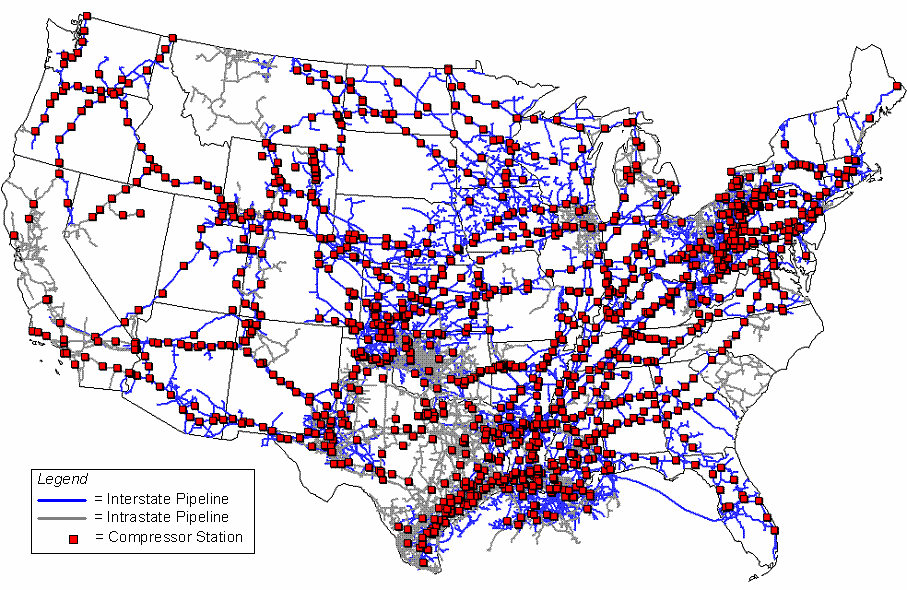
A gas line explosion on June 7 in North Texas killed one person and injured seven more. The resulting blaze could be seen from 30 miles away.

These are just the latest incidents stemming from the questionable process of using a chemical mix to drive natural gas from shale levels deep below the surface. The mix used in hydraulic fracturing, or fracking, contains more than 85 toxic chemicals, including known carcinogens. Yet state and local government officials across the U.S. seem more interested in the money to be made from gas well leases than in implementing regulations to safeguard residents.

Pennsylvania state officials allowed EOG Resources to restart drilling June 11. Clearwater County Commissioner Mark B. McCracken said the county still wanted a share of the gas boom’s benefits. Commissioners acknowledged that more blowouts were to be expected.

The Texas Railroad Commission, which regulates industry in that state, has reported 102 blowouts of oil and gas wells since 2006, resulting in 10 fires, 12 injuries and two deaths. (Philadelphia Inquirer, June 13) Yet in Fort Worth, wells continue to be built in urban areas, often close to residential areas and even schools.

Upon investigating the natural gas industry, filmmaker Josh Fox encountered Pennsylvania landowners struggling for income in small, rural communities, who gave in to industry pressure and lived to regret their decisions. His investigation led to the documentary “Gasland,” which will air June 21 on HBO.

In western Colorado, Fox found a formerly rural area that had rapidly industrialized, with more than 5,000 wells drilled. Medical researchers from the University of Colorado conducted studies on the air and water and found acute problems as a result of toxic emissions from gas development.

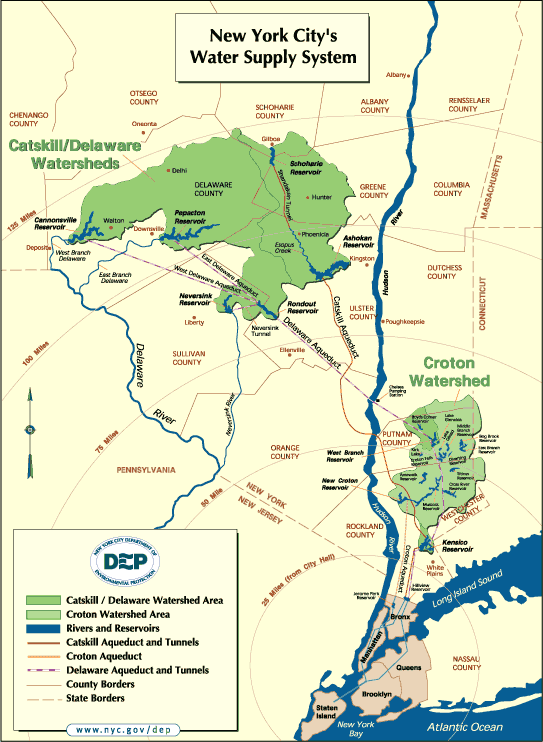
In a March 27 interview, Fox described the pressure the natural gas industry has put on politicians to trade “a short term energy fix and money for the future of our water in America.” (NOW on PBS) More than 200,000 wells are proposed in Pennsylvania and New York state, with 50,000 in the New York City watershed alone, with no additional restrictions placed on drillers.

Fox noted: “I could take a car battery and throw it into a watershed and go to federal prison, but these guys can take the same chemicals and inject them by the thousands of gallons and they’re exempt.”


Articles copyright 1995-2010 Workers World. Verbatim copying and distribution of this entire article is permitted in any medium without royalty provided this notice is preserved.

DEMAND ACCOUNTABILITY!

Monday, May 10, 2010

Hydraulic fracking spells disaster

Workers World
May 6, 2010

Despite industry claims that the rapidly expanding practice of hydraulic fracturing to extract natural gas from deep underground shale layers is “perfectly safe,” on April 15 the Pennsylvania Department of Environmental Protection fined Houston-based Cabot Oil and Gas $240,000 for causing the contamination of 14 residential water wells in Dimock Township, Pa.

The company was also ordered to plug three gas wells it was operating in the town, which sits atop the Marcellus Shale formation, and was banned from drilling in the area. One water well in Dimock exploded last year, and DEP inspectors witnessed gas bubbling up at the base of eight other wells in March. Despite the ruling, Cabot has plans to drill 100 new wells in Dimock this year.

Independent newsroom ProPublica has reported on 50 similar cases across Pennsylvania, including reports of fish kills, water and air pollution, fires, out-of-control flaring, human illnesses and animal deaths.

The concern over the safety of hydraulic fracturing has prompted calls for a moratorium on drilling in Pennsylvania. In the process, often referred to as fracking, 2 to 9 millions of gallons of water, mixed with sand and up to 250 chemicals, are pushed into underground shale layers to release natural gas.

In January the Pennsylvania state Legislature opened up 32,000 additional acres of state forest land to be leased for drilling. As a result, 692,000 acres of the 2.1 million acres of state forest land are now open for gas wells. During a recent push to expand the practice into the Delaware River basin, the Philadelphia City Council was pressured to pass a resolution on March 25 calling for an environmental impact statement before any new permits are issued.

Fracking has been in use for a number of years throughout the U.S., particularly in the Southwest. Five natural gas sites border the town of Dish, Texas, in a quarter-mile complex. In nearby Fort Worth, Texas, 1,400 wells have been drilled in urban areas, many near schools and residential centers.

Speaking at a meeting at Temple University’s Department of Civil and Environmental Engineering on April 16, Dish Mayor Calvin Tillman described how carcinogenic air pollution from natural gas drilling has damaged the quality of life in his town of 180 residents. The town sits atop the Barnett Shale, a geological formation similar to the Marcellus Shale.

Using his own money, Tillman has been traveling to Pennsylvania and New York to warn about the dangers of the gas boom. In his small town, trees are dying on a 30-acre farm that adjoins a labyrinth of small underground pipelines used to transport fuel from the fracking wells to outside markets. Horses have also fallen ill. Residents report problems with frequent nausea, severe headaches, breathing difficulties, chronic eye irritation, allergies, throat irritations and even brain disorders.

When Texas state inspectors, who are usually linked to the drilling companies, reported they could not find any problem with the wells, Dish town officials hired an environmental firm to collect one-day air samples near the compressors. Their study found high levels of 15 chemicals, including benzene, a known carcinogen. As a result the Texas Commission on Environmental Quality conducted air studies at 94 sites in the region. They found two sites with very high levels of benzene and 19 others with levels that raised concern.

In April, blood and urine testing of 28 adult Dish residents revealed that half the residents had slightly elevated levels of benzene and other contaminants. Four residents tested positive for benzene, including Tillman. Tillman noted that no testing was done on children, pregnant women or the elderly — groups likely to be most susceptible to the contaminants. Tillman’s water also tested positive for traces of styrene, ethyl benzene and xylene.

Growing concern over the danger of fracking has led to a push for legislation in Pennsylvania that would require drillers to disclose chemical ingredients in hydraulic fracturing fluids. Other proposed legislation calls for a moratorium on drilling until environmental impact studies can be performed. Both bills have yet to be passed and face mounting opposition from the natural gas industry.

Nationally, the oil and gas industry won exemption from major provisions of the Safe Drinking Water Act, the Clean Water Act and other federal environmental laws with the passage of the 2005 Energy Bill. The bill’s “Halliburton loophole” protected the company from having to reveal the composition of their fracturing fluid, despite the fact that the list of hazardous substances compiled by the Environmental Protection Agency’s Superfund — the program established to address abandoned hazardous waste sites — includes toxic profiles on benzene, styrene, toluene and other agents known to be in the mix. Efforts are also underway to challenge this legislation.

The EPA announced it will spend $4.4 million to start a study on the impact of fracturing in October, but Dr. Michel Boufadel, director of the Environmental Hydrology and Hydraulics Laboratory at Temple University College of Engineering, expressed concerns that the EPA’s study does not go far enough.

Speaking at the April 16 meeting, Boufadel noted that very few scientific studies on fracking have been conducted by researchers not connected to the drilling industry. He also pointed out that most studies assume that any leak of water contaminated by fracturing fluids would spread horizontally from a holding tank and be detected by ground level monitors.

Boufadel explained that the 250 chemicals contained in the fracturing fluid create “gooey, high density water” — a gel that suspends the sand particles needed to work into cracks in the shale layers. The result is “radioactive water six times more saline than sea water and containing known carcinogens.”

“If you don’t account for this heavy density you would expect water to move outward, but the reality is that it moves down,” Boufadel stressed. “If you only use existing traditional models of monitoring wells at ground level, you won’t detect contamination until it’s too late.”

LINK


Articles copyright 1995-2010 Workers World. Verbatim copying and distribution of this entire article is permitted in any medium without royalty provided this notice is preserved.
DEMAND ACCOUNTABILITY!

Sunday, February 21, 2010

Dish, Texas mayor shares cautionary tale about natural gas drilling

By Jason Whong •jwhong@gannett.com
stargazette.com
February 20, 2010

ELMIRA HEIGHTS -- Calvin Tillman, mayor of Dish, Texas, says New York is in a unique position when it comes to getting natural gas.

"What I'm proposing is you look at the negative impacts we've had and do it better here," Tillman told a crowd that packed the Heights Theater on Saturday morning for his address.

Tillman says he does not oppose drilling for natural gas. Rather, he supports using gas production and distribution methods that have minimal environmental impact.

"We have air quality issues in Dish," Tillman said before the presentation. "There's a lot of things that can be put in place ... that would eliminate a lot of those problems."

Tillman said the older technology compressor stations in and around Dish, which compress natural gas and remove impurities for transport through pipelines, would pollute less if they were updated.

...

A recent environmental study of Dish shows excessive levels of benzene and other carcinogens and neurotixins in the air, as well as chemicals associated with natural gas production in the water.

Tillman told reporters what he would do with natural gas in Texas if he could do it all over again:

"I would probably do what New York's doing and I would frankly just slow things down quite a bit and think about things and make sure that everything was done in a responsible, respectful and safe manner," Tillman said.

"We did the 'ready, fire, aim.' We didn't take our time and look at the whole process."

Tillman had many suggestions for what New York and Pennsylvania might consider as gas exploration increases.

Tillman said New York and Pennsylvania are the only two of the 32 states that have had gas exploration but do not charge a severance tax -- which measures the gas and taxes it when it is brought above ground.

Tillman said such a tax could generate funds to pay for road maintenance and hire regulators to watch the industry. Gov. David Paterson proposed such a tax this year.

Tillman recommended strong environmental regulations that mandate the latest green technology in all aspects of drilling and transporting natural gas.

He said stricter regulations likely will not chase away the gas companies.

Tillman also recommended taking the power to permit drilling away from the state, favoring local decision-makers instead.

"The further you go up in government, the less attached officials are," Tillman said.

"Your local officials don't need to ask for (permitting authority); they need to demand it."

...

Noel Sylvester, 62, of Cameron Mills, who has a gas lease agreement with Fortuna Energy, said he wanted to hear about Tillman's experiences in person.

Sylvester said he doesn't oppose drilling for natural gas if it can be done cleanly.

"If we think there's going to be an impact in the next generation or two, there's something wrong with the process. It should be cleaner than that and better than that."

Sylvester said he makes about $500 a year from his gas lease.

CLICK HERE for link to complete article.

DEMAND ACCOUNTABILITY!

Friday, January 29, 2010

Don't Frack with New York! Governor Patterson Poisons the Well to Balance the Budget

Alison Rose Levy
The Huffington Post
January 28, 2010

Former New York State Governor Eliot Spitzer may have had his sexual peccadilloes but he knew how to stand up to corporate interests that threatened the public good. It was a big boost for oil companies, planning to despoil New York State, when the powerhouse Spitzer was replaced by his easily rolled-over successor.

While belt-tightening throughout the state budget, Governor Patterson added $3 million to fast track harmful gas drilling practices--a quick fix economic solution with tragic long-range health, economic, and environmental consequences.

On Monday, a statewide coalition of New York state residents, businesses, and environmental groups rallied in the state capital of Albany to ask legislators to oppose Patterson's plans to contaminate state-wide water supplies (including New York City's) by permitting a damaging form of gas drilling, known as "fracking," or hydraulic fracturing.

Thanks to lobbying by Halliburton and other energy companies, under the Bush-Cheney administration, fracking got exempted from the Clean Water Act even though it releases large quantities of undisclosed carcinogens and toxic chemicals into the earth and water supply.

According to a recent study, conducted by the Environmental Working Group (EWG), just one drilling site deploys harmful chemicals sufficient "to contaminate more than 100 billion gallons of drinking water to unsafe levels ... more than 10 times as much water as the entire state of New York uses in a single day."

The chemicals used in fracking "pose a serious threat to the nation's water supplies, but those risks have been largely ignored," says the report. "Drinking water contamination and property damage have been linked to hydraulic fracturing in four states--Colorado, Ohio, Pennsylvania and Wyoming. In one incident that polluted a Colorado creek, the drilling company is still trying to clean it up--four years later."

Nor does the drilling create local jobs or business. Instead, companies bus in workers from Texas, housing them in "man camps," sites where reportedly alcohol and drug abuse, and sexual predation abound. While no one wants a "man camp" next door, a gas well also ruins the neighborhood. If one owner sells property for drilling, all neighboring land can be conscripted for leasing, with no rights of refusal. Fracking also releases chemicals into the air; an army of trucks must carry over roads and New York State highways up to four million gallons of contaminated water (per well)-- which amps up air pollution and costly highway repairs. There is currently no way to effectively decontaminate the high quantities of waste water produced by fracking.

"We can't let the gleam of potential profits leave us with a legacy of polluted water and industrialized landscapes," said Wes Gillingham, program director of Catskill Mountainkeeper.

Last month, New York City's Department of Environmental Protection issued a report urging a halt to gas drilling since, "Natural gas drilling and exploration are incompatible with the operation of New York City's unfiltered water supply system and pose unacceptable risks for more than nine million New Yorkers in the City and State." They noted that drilling entails "invasive industrialization and creates a substantial risk of chemical contamination, and infrastructure damage."

This week, Mayor Bloomberg chimed in, "The consequences are so severe that it is not a risk that I think we should run. I do not think that we should allow fractured drilling anywhere near our water supply."

Although land can be fenced in, water can't be. It flows underground, it rises into clouds, it's borne by the winds, and released by the rains, far from its source.

While the Mayor nobly aims to protect the immediate area surrounding the city's upstate water reservoir, so far no studies have investigated how far water-born contaminants from throughout the state could flow downstream to impact NYC, or it's water supply. Fracking originated in arid western regions, and its proponents don't know the extent of pollution possible in a region of interconnected rivers and frequent rains like New York and New England.

In New York State, gas drillers hope to use fracking in the regions of the New York City Watershed, the Delaware River, the Finger Lakes, and upstate watersheds, the source of waters that flow downstate to New York, Pennsylvania, New Jersey, and Delaware.

With fresh water resources becoming scarcer worldwide due to population growth and climate change, it's unconscionable for a short-term Governor to short-sell a precious resource to balance his budget. Perhaps the soon to declare gubernatorial candidate, Andrew Cuomo, will like his popular father, Governor Mario Cuomo, become a successful champion.

To take action, sign up with the Environmental Advocates NY Citizens for Safe Energy http://www.catskillcitizens.org/ The Environmental Working Group proposes a national ban or better regulation. Or join No Fracking Way on Facebook. Or cut to the chase, and ask soon to declare candidate, Andrew Cuomo to make New York State a model for future-oriented policies, rather than a disastrous object lesson in the costs of short-sighted gain.

DEMAND ACCOUNTABILITY!

Wednesday, October 21, 2009

Delaware River Impacts From Natural Gas Drilling

Delaware River Basin Commission "Doesn’t Ask" what will happen to hundreds of millions of gallons of toxic wastewater when deciding on million gallon a day water withdrawal permit
By Iris Marie Bloom
Community Contributor
(Phila.) Weekly Press
21 Oct. 09

Upstate, some folks have started putting spikes in the roads to block trucks related to the natural gas industry. Downstate, meetings have stayed polite but tense, so far.

In New York, the Executive Committee of the Sierra Club decided on October 17, looking at the damage across the river in Pennsylvania so far, to ask New York State to ban hydraulic extraction, the water-intensive new natural gas technology, outright. But in Pennsylvania last week, the state legislature decimated its own environmental regulatory agency, the Department of Environmental Protection, with 27% cuts, while protecting the natural gas industry from a severance tax that would have given state coffers 90 million dollars this year, according to its sponsor. As soon as that was accomplished, Rendell’s point man on the issue went to work for the industry.

Nationally, clean water advocates are working to pass the FRAC Act, a bill to restore the Clean Drinking Water Act. The FRAC Act would close a loophole exempting hydraulic extraction – which has contaminated drinking water with toxic substances in at least three states so far, including Pennsylvania – from federal regulation.

What’s that all got to do with Philadelphia? Here, it’s all about drinking water.

The Delaware River Basin Commission (DRBC) indicated at a meeting sponsored by the American Water Resources Association in Center City on October 15th that it will likely approve a massive withdrawal request for a million gallons of water per day from the Upper Delaware River. Off the record, some officials indicated that public outcry and "TV cameras" might make a difference. All of the water will be mixed with toxic chemicals at a ratio of about 7,500 chemicals per million and a half gallons of water, according to the natural gas industry. Both the industry and the DRBC concur that no plan currently exists to treat the resulting heavily polluted wastewater. Hundreds of millions of gallons of wastewater will be brought back to the surface from natural gas drilling operations and stored in pits (some open, some closed), with a certain amount of inevitable spills, until industry officials and regulators figure out what to do with it.

That could take years. There are currently no treatment plants in Pennsylvania capable of adequately treating the heavily polluted wastewater. Building new plants capable of doing so is extremely expensive, and officials estimate it would take about 50 such plants to handle the anticipated discharge. There is no information available about what might happen to the 40% to 70% of the contaminated water left behind, deep in the ground.

Meanwhile, Carol Collier, Executive Director of the DRBC, commented on October 15 that perhaps the wastewater would be "trucked downstream to where TDS (total dissolved solids, the most measurable and obvious component of frac wastewater) is not such an issue." Translated into simple language, that apparently means discharging the water in the Delaware River far south of where it is being trucked (200 trucks a day, leaving every 7 to 8 minutes) to natural gas pads in northern Pennsylvania. South of Trenton, the Delaware River has a greater volume of water to dilute the pollution. North of Trenton, the Delaware is better protected from severe pollution under the environmental designation, "Special Protection Waters."

Fifty percent of Philadelphia’s drinking water comes from the Delaware River; fifty percent comes from the Schuylkill River, which may also be impacted.

What’s in those chemicals? The exact formulas are not disclosed, at least as long as the process remains exempt from the Safe Drinking Water Act. But EPA officials and other scientists have identified 54 to 300 components of "frac fluid" and wastewater resulting from hydraulic fracturing for natural gas in deep shale layers, such as the Marcellus Shale in Pennsylvania.

The components include known carcinogens and powerful fish pesticides, and the wastewater includes radioactive material from underground as well as heavy metals and extreme amounts of salt from ancient oceans.

The DRBC is still accepting public comment about the proposal from Chesapeake Appalachia, LLC to withdraw a million gallons a day in Wayne, PA, and may make their decision about the proposal and other proposals pending in November. The agency is under tremendous pressure to approve the proposal. Appalachia has taken out ads in northern Pennsylvania blaming the DRBC for keeping landowners from getting the royalties they expect after leasing their lands to gas companies. Hostility towards the DRBC from landowners is mounting accordingly.

In related recent news, one to three spills of frac fluid, from 5,000 to 8,000 gallons, occurred last week in Dimock, PA. Last month, 161 species completely died off in Dunkard Creek in Southwestern PA, creating a mystery that investigators have still not solved. Last week the DEP issued drinking water notices again for the Monongahela River due to unacceptable levels of total dissolved solids (TDS), a result of hydraulic fracturing wastewater being discharged into the river. The Monongahela River provides drinking water to 350,000 people in Pennsylvania.

In August, the EPA confirmed the presence of 2-BE (butoxyethanol), which is associated with kidney damage, harm to the adrenal gland, and reproductive problems, in drinking water both in Colorado and in Pavillion, Wyoming, in association with hydraulic extraction for natural gas there. Butoxyethanol is a known constituent of fracing fluid.

Citizens in both states complaining of adrenal cancer, seizures, birth defects and miscarriages have called for a halt to hydraulic fracturing in their regions after 2-BE contamination in their drinking water was confirmed by the EPA.

At the October 15 public meeting, DRBC director Collier was asked whether existing treatment plants in Pennsylvania have the capacity to treat chemicals such as 2-BE. She answered, "I don’t know."

Collier was also asked for clarification: "Are you saying that you plan to approve the withdrawal of a million gallons a day from the Delaware River without any plan to treat the resulting wastewater?"

The answer was yes: "We don’t ask that question [what will happen to the wastewater] when we are approving water withdrawal proposals."

To continue reading this article, CLICK HERE.

DEMAND ACCOUNTABILITY!

Wednesday, October 14, 2009

Highlights from "Sacrificed to Shale"

The energy crisis facing our nation has many facets. One that has been downplayed by the oil and gas industry, regulatory governmental overseers, and hopeful leaseholders, for obvious rea$ons, is the enormous cost in terms of individual, public and environmental safety, health and well-being. However, things are beginning to change. The toxic damage being done can no longer be minimized or brushed aside. Awareness is growing and concern is mounting.

The cover story in the Oct. 14 Fort Worth Weekly is an in depth look at the health, safety and quality of life problems facing DISH,TX on almost every level. The heart of the problem seems to be bad regulation on the part of the government and its agencies. (It should be, by now, a foregone conclusion that industry does not self regulate with the greater good in mind.)
The concerns of the people of DISH demand accountability! People everywhere deserve protection from this kind of rampant disregard for Life Itself.
Following are excerpts from "Sacrificed to Shale", the excellent, comprehensive five page exposé, written by Peter Gorman:

...the gas industry has picked DISH and a few acres just outside its city limits as a perfect place for not one or two but eleven compression stations, to which gas is piped from wells all over northern Tarrant and Denton counties, to be treated, compressed, and sent out into bigger transmission lines. Residents say the veritable industrial corridor thus created emits hydrocarbons that kill trees, sicken and endanger animals and people, and are making their properties worthless.
...
Losing the use of land is only one of the issues posed by pipelines. Gas running through gathering lines is generally filled with chemicals and water that corrode the pipes; it's also generally unodorized until it reaches the compressor - which means people nearby won't know they are in danger if a leak develops. Companies have mechanisms to alert them to weakening pipes, but leaks and explosions in the Barnett Shale have shown those systems aren't foolproof.
...
The compressor stations also regularly release noxious chemical fumes. The acrid smell burns the throat and nose and sears the eyes. "Some days you can hardly breathe anywhere in DISH," Tillman said. "And then the trees started dying, so we wondered what was actually in those fumes."
... "We've lost a lot of trees in DISH. And a number of them were cedar trees, which are almost impossible to kill. Those trees breathe just like we do, so when they start dying, you've got to pay attention," he said. "They're the canary in the coal mine for our air." Thus far, dozens of trees in the little town and right outside it have died.
...
"We knew something was terribly wrong," Tillman said. But their repeated complaints to the state agencies fell on deaf ears. The agencies "basically asked the companies to investigate themselves," said Tillman, "and they came up clean every time."
...
According to an analysis of the [independently contracted] Wolf Eagle air study done by chemist and microbiologist Wilma Subra, the air samples from DISH contained the kind of chemical cocktail that would have been expected near refineries. Subra, who has been studying oil and gas field waste since the 1970s, said the DISH air samples included varying combinations of the carcinogens benzene and trimethylbenzene; napthalene, which is considered a potential human carcinogen; carbon disulfide, which can be absorbed through the skin and affects the central nervous system and many other bodily systems; and xylene compounds, which are neurotoxins. Subra is a member of the board of Earthworks, a nonprofit group that works with communities to address the destructive impacts of mineral development.
...
Even worse, she said, "No one can tell you what happens when you add these compounds together. It might be that in some cases they cancel each other out. Or they might be exponentially worse when you have a mix like that. And with what we know about chemicals, it's probably exponentially worse."
...
[Re: Long term exposure, Wilma Subra said:]
"Two years is sufficient time to cause neurological damage." ...
"You will not be automatically safe from the chronic, long-term health conditions just because you remove yourself from exposure to those chemicals," Subra said. "The damage could have already been done or could still show itself down the line, years later."
...
Tillman said that each of the companies that has a gas compressor at DISH has told him that their emissions are within acceptable levels established by the federal Environmental Protection Agency. "And that might be so," said Tillman. "But what happens when you have 11 of these things sitting next to each other? Even if each one individually is acceptable, add them up, and you wind up with nearly 11 times the acceptable level of toxins being released into our air."
...
DISH officials and residents aren't opposed to all gas drilling or the kinds of industrial activities that come with it. But many of them are furious at how it's been handled in their town and at the state's part in what has happened.
"I am against the way these people have elected to operate - quick and dirty methods, cheap methods," Cisco, the town commissioner said. "It's regrettable that the Railroad Commission and TCEQ have hoodwinked us into thinking they are protecting the citizens of our community when it seems more like they're on the payroll of these companies."
Tillman agreed. "How on earth could the people of this town suffer and complain about the air quality for so long, and I am the first one to do an air quality study?" he said. "This is squarely on the shoulders of TCEQ, and they let this happen to us. I just feel betrayed by the state."

DEMAND ACCOUNTABILITY!

Tuesday, October 13, 2009

DISH IS DESPERATE! MAYOR TILLMAN PLEADS FOR HELP

I just received this email from the mayor of DISH, TX:
(for background, see today's earlier posts: DEAD TREES... and INDEPENDENT STUDY...)

The news that I continually get makes this nightmare worse and worse. I have yet another twenty something young lady who has undiagnosed neurological problems that started when she moved here. She has been shipped out of state for testing on a number of occasions, and they have been unable to diagnose the problems she is having. I am having a difficult time in know what the next move should be. I wonder if there is a medical doctor out there who may come to help us here? Maybe there would be someone who could perform toxicology tests on the citizens. Please give me any input you may have, and if you know of anyone who may be willing to help, please let us know. Maybe you could post something on your websites or blogs soliciting help. Together I know you reach thousands of people. Thanks.

Calvin Tillman
Mayor, DISH, TX
(940) 453-3640

HAD ENOUGH YET? ...Think these are just flukes? HERE'S MORE!

Fears of tainted water well up in western Colorado

He was thirsty the afternoon of May 30, 2008, after he and his wife, Dollie, drove up the dusty, steeply kinked road to their cabin an hour northeast of DeBeque. He went to the sink and filled a glass with water.

"I tipped it up just like this and just started guzzling — like an idiot. I didn't know it was bad until I drank two- thirds of the cup," said the 61-year-old outfitter as he retraced his actions that day.

His throat burned. His head pounded. His stomach hurt. He felt like he was going to suffocate.

Tests would show the water from a spring he has drank from for decades was heavily contaminated with a carcinogenic and nervous system-damaging chemical stew known as BTEX — benzene, toluene, ethylbenzine and xylene. BTEX and other volatile organic compounds come to the surface in the production water from oil and gas wells.

Don't miss the rest of this compelling article: CLICK!

DEMAND ACCOUNTABILITY!

RURAL IMPACT VIDEOS, 6 parts

Natural gas development in Colorado, the impacts on communities, environment and public health. A primer for public servants and residents of counties that care for their lifestyles.

Drilling for Gas in Bradford County, PA ... Listen!

Cattle Drinking Drilling Waste!

EPA... FDA... Hello? How many different ways are we going to have to eat this? ... Thank you TXSharon for all you do! ... Stay tuned in at http://txsharon.blogspot.com

Landfarms

A film by Txsharon. Thank you Sharon for all you do. Click HERE to read the complete article on Bluedaze: Landfarms: Spreading Toxic Drilling Waste on Farmland

SkyTruth: Upper Green River Valley - A View From Above