Showing posts with label NOISE POLLUTION. Show all posts

Friday, February 19, 2010

Mayor Tillman Talks about the Effects of Drilling in DISH, TX

Sarah Blazonis
Fox 40 WICZ TV
Friday, February 19, 2010


Mayor Calvin Tillman says town officials in DISH, TX, had big ideas about what natural gas wells like these could bring to the area.

"Jobs, prosperity -- most of the things the folks in the Marcellus Shale are probably thinking about right now," said Tillman.

Tillman says drilling into the Bartlett Shale has cost the town as much as it's gained.

DISH's web site provides information about about its noise problem and air quality study -- which found several toxins related to gas production.

Sixty percent of residents who filled out a health questionnaire reported symptoms known to be related to those toxins.

"Watery eyes, sore throat, severe headaches, nausea, neurological problems," Tillman said.

Tillman was invited to the area by the Binghamton Regional Sustainability Coalition. He plans to talk to residents about urging state lawmakers to pass regulations to protect the environment if drilling is approved in New York.

A local environmental defense lawyer says getting these regulations passed depends on team work from both sides of the issue.

"The economy vs. the environment, landowners vs. everyone else -- these are false dichotomies, and there's one water table that everyone's drinking from," said Helen Slottje, a managing attorney with the Community Environmental Defense Council, Inc.

Above all, DISH's mayor says the Southern Tier shouldn't rush into drilling.

"Slow down," said Tillman. "Slow down and think about it. Think it through, make sure that you put every precaution in place you can before you start."

It's a lesson Tillman says his town learned the hard way.
Residents voted just this week for a 90-day moratorium on new drilling permits.
LINK

DEMAND ACCOUNTABILITY!

Thursday, November 5, 2009

LISTEN TO THIS!!!


DEMAND ACCOUNTABILITY!

Wednesday, October 14, 2009

Highlights from "Sacrificed to Shale"

The energy crisis facing our nation has many facets. One that has been downplayed by the oil and gas industry, regulatory governmental overseers, and hopeful leaseholders, for obvious rea$ons, is the enormous cost in terms of individual, public and environmental safety, health and well-being. However, things are beginning to change. The toxic damage being done can no longer be minimized or brushed aside. Awareness is growing and concern is mounting.

The cover story in the Oct. 14 Fort Worth Weekly is an in depth look at the health, safety and quality of life problems facing DISH,TX on almost every level. The heart of the problem seems to be bad regulation on the part of the government and its agencies. (It should be, by now, a foregone conclusion that industry does not self regulate with the greater good in mind.)
The concerns of the people of DISH demand accountability! People everywhere deserve protection from this kind of rampant disregard for Life Itself.
Following are excerpts from "Sacrificed to Shale", the excellent, comprehensive five page exposé, written by Peter Gorman:

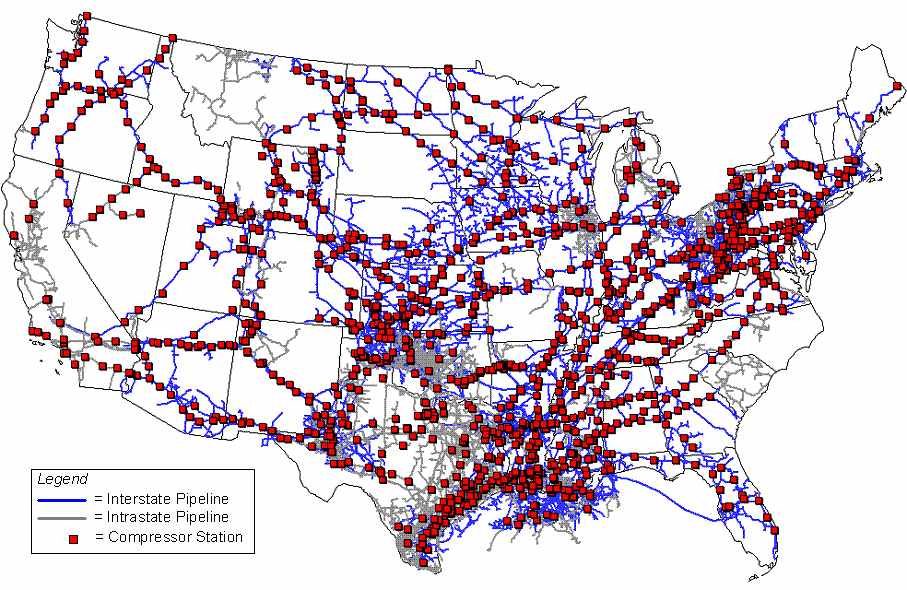
...the gas industry has picked DISH and a few acres just outside its city limits as a perfect place for not one or two but eleven compression stations, to which gas is piped from wells all over northern Tarrant and Denton counties, to be treated, compressed, and sent out into bigger transmission lines. Residents say the veritable industrial corridor thus created emits hydrocarbons that kill trees, sicken and endanger animals and people, and are making their properties worthless.
...
Losing the use of land is only one of the issues posed by pipelines. Gas running through gathering lines is generally filled with chemicals and water that corrode the pipes; it's also generally unodorized until it reaches the compressor - which means people nearby won't know they are in danger if a leak develops. Companies have mechanisms to alert them to weakening pipes, but leaks and explosions in the Barnett Shale have shown those systems aren't foolproof.
...
The compressor stations also regularly release noxious chemical fumes. The acrid smell burns the throat and nose and sears the eyes. "Some days you can hardly breathe anywhere in DISH," Tillman said. "And then the trees started dying, so we wondered what was actually in those fumes."
... "We've lost a lot of trees in DISH. And a number of them were cedar trees, which are almost impossible to kill. Those trees breathe just like we do, so when they start dying, you've got to pay attention," he said. "They're the canary in the coal mine for our air." Thus far, dozens of trees in the little town and right outside it have died.
...
"We knew something was terribly wrong," Tillman said. But their repeated complaints to the state agencies fell on deaf ears. The agencies "basically asked the companies to investigate themselves," said Tillman, "and they came up clean every time."
...
According to an analysis of the [independently contracted] Wolf Eagle air study done by chemist and microbiologist Wilma Subra, the air samples from DISH contained the kind of chemical cocktail that would have been expected near refineries. Subra, who has been studying oil and gas field waste since the 1970s, said the DISH air samples included varying combinations of the carcinogens benzene and trimethylbenzene; napthalene, which is considered a potential human carcinogen; carbon disulfide, which can be absorbed through the skin and affects the central nervous system and many other bodily systems; and xylene compounds, which are neurotoxins. Subra is a member of the board of Earthworks, a nonprofit group that works with communities to address the destructive impacts of mineral development.
...
Even worse, she said, "No one can tell you what happens when you add these compounds together. It might be that in some cases they cancel each other out. Or they might be exponentially worse when you have a mix like that. And with what we know about chemicals, it's probably exponentially worse."
...
[Re: Long term exposure, Wilma Subra said:]
"Two years is sufficient time to cause neurological damage." ...
"You will not be automatically safe from the chronic, long-term health conditions just because you remove yourself from exposure to those chemicals," Subra said. "The damage could have already been done or could still show itself down the line, years later."
...
Tillman said that each of the companies that has a gas compressor at DISH has told him that their emissions are within acceptable levels established by the federal Environmental Protection Agency. "And that might be so," said Tillman. "But what happens when you have 11 of these things sitting next to each other? Even if each one individually is acceptable, add them up, and you wind up with nearly 11 times the acceptable level of toxins being released into our air."
...
DISH officials and residents aren't opposed to all gas drilling or the kinds of industrial activities that come with it. But many of them are furious at how it's been handled in their town and at the state's part in what has happened.
"I am against the way these people have elected to operate - quick and dirty methods, cheap methods," Cisco, the town commissioner said. "It's regrettable that the Railroad Commission and TCEQ have hoodwinked us into thinking they are protecting the citizens of our community when it seems more like they're on the payroll of these companies."
Tillman agreed. "How on earth could the people of this town suffer and complain about the air quality for so long, and I am the first one to do an air quality study?" he said. "This is squarely on the shoulders of TCEQ, and they let this happen to us. I just feel betrayed by the state."

DEMAND ACCOUNTABILITY!
Monday, June 29, 2009

A Call for Caution: Safety and Responsibility vs. Gas Rush Fever

by Chris Burger, former Broome County legislator, chair of Binghamton Regional Sustainability Coalition.

Everything about gas drilling cries for caution, due diligence and patience. Its monetary benefits seem obvious, but the costs and risks are far from fully identified, much less comprehended. If there ever is a time for a serious, hardnosed cost-benefit analysis, this situation surely qualifies. It is hard to understate the disastrous consequences if we get it wrong. It is extremely difficult and expensive to address negative health, socio-economic and environmental impacts after the fact.
...
No one is volunteering to do the socio-economic cost-benefit analysis required for good decision making. ... As important as looking at individual gas wells is, no one is looking at the impact of a "gas field," which is the more relevant question from a community perspective.
One does not need to be against gas drilling to ask these basic questions:

• What well density do we consider acceptable?

• What damage will our drinking water sources sustain?

• How will we dispose of the toxic wastewater generated by the drilling and fracturing?

• What are the effects on agriculture, hunting, and fishing?

• What are the effects on our wildlife in general?

• How will this affect tourism?

* How will it affect our ability to attract young people to our area?

• What air quality and noise levels do we consider acceptable?

• What are the effects on our infrastructure?

• What are the effects on our ability to control flooding?

• How will the many natural faults in our geography impact the safety of the technology?

* How can we eliminate liability for the landowner?

• What regulation is needed to hold the industry fully accountable for all costs associated with drilling?

These questions need to be answered in the context of a fully developed gas field, not a single well.

The saddest refrain emanating from our neighbors just to the south is "if only we knew what we were getting ourselves into." Families have lost water wells to pollution, there have been gas explosions, and home values have plummeted. We need to ask hard questions because drilling will not be restricted to rural areas. It can occur in our suburbs and cities, just as it is happening now under downtown Fort Worth, Texas. A fully developed gas field will affect us all.
Click HERE to read this article in its entirety.
Click HERE, or in the DON'T MISS column (right sidebar) to watch Chris Burger's excellent video overview on drilling for gas in Essential Dissent: Marcellus Shale Play.

DEMAND ACCOUNTABILITY!

Monday, June 8, 2009

Considering the Impact of Gas Wells and Gas Fields

by Chris W. Burger, Chair
Binghamton Regional Sustainability Coalition


In November of 2008, Broome County government took a courageous stand against unbridled gas drilling. They were soon joined by towns and villages across the region, along with groups like Binghamton Regional Sustainability Coalition (BRSC). The County was not against gas drilling per se. It was simply calling for safety and responsibility in the face of a growing “gas rush fever” where caution was in short supply. BRSC was established, in part, to foster economic development, yet along with the County, we understand that, if not done safely and responsibly, gas drilling could easily undermine the community’s sustainability – its long-term health and economic viability.

Everything about gas drilling cries for caution, due diligence, and patience. Its monetary benefits seem obvious, but the costs and risks are far from fully identified, much less comprehended. If there ever is a time for a serious, hardnosed cost-benefit analysis, this situation surely qualifies. It is hard to understate the disastrous consequences if we get it wrong. It is extremely difficult and expensive to address negative health, socio-economic, and environmental impacts after the fact.

We have been granted an extraordinary gift of time. The gas craze was just getting started in New York when natural gas prices fell and venture capital dried up. A short time before, behind closed doors, the Oil and Gas Industry (O&G) had pressured the Federal government to exempt its activities from most of the laws the public takes for granted to protect them; such laws as the Clean Air Act, Clean Water Act, storm water rules, and the Safe Drinking Water Act.

At the state level, quiet lobbying by O&G has stripped local communities of “home rule” when it comes to gas drilling. Listed as an industrial activity, the state, in effect, can declare our entire
county an “industrial zone’ for gas drilling activity. O&G now has the power to force landowners into “spacing units” for the purposes of extracting gas from their property. An environmental impact study will not be done for our particular community, but we will be regulated under a “generic” study for the entire state.

Landowner groups have been portrayed as uncaring, money grubbers, but if the truth be told, most landowners feel abandoned by their government and have had to band together for protection. Stripped of protection by law, they are seeking it by lease. Yet, many landowners are uneasy. They have observed a pattern of denial by O&G when it comes to taking responsibility. There is a growing, sickening realization that no matter how tight and comprehensive the lease, they will have to sue for lease enforcement and without the government on their side, they will be hopelessly “out gunned.” Even when landowners are upheld, they have witnessed a pattern of seemingly endless appeals to delay restitution.

Sooner or later, gas prices will rise again and venture capital will
again be available. We have been given time, but we are squandering
it. The NY Department of Environmental Conservation (DEC) is
supposedly looking at the impact of “horizontal hydofracing” the
technology required to get the gas from tight shale formations like
Marcellus, yet their “scoping document” (list of issues it is
studying) is limited and no one has stepped in to pick up the slack.
No one is volunteering to do the socio-economic cost-benefit analysis
required for good decision making (We feel the counties are best
positioned to do this). As important as looking at individual gas
wells is, no one is looking at the impact of a “gas field;” the more
relevant question from a community perspective.

One does not need to be against gas drilling to ask these basic
questions:
  • What well density do we consider acceptable?
  • What damage will our drinking water sources sustain?
  • How will we dispose of the toxic waste water generated by the drilling and fracing?
  • What are the effects on agriculture, hunting, and fishing?
  • What are the effects on our wildlife in general?
  • How will this affect tourism?
  • How will it affect our ability to attract young people to our area?
  • What air quality and noise levels do we consider acceptable?
  • Already stressed, what are the effects on our infrastructure roads, bridges, sewage treatment plants, emergency responders, etc.?
  • What are the effects on our ability to control flooding?
  • How will the many natural faults in our geography impact the safety of the technology?
  • How can we eliminate liability for the landowner?
  • What regulation is needed to hold O&G fully accountable for all costs associated with drilling?
These questions need to be answered in the context of a fully developed gas field, not a single well.

The saddest refrain emanating from our neighbors just to the south is
“if only we knew what we were getting ourselves into.” Families have
lost their water wells to pollution, there have been gas explosions,
and home values have plummeted. We need to ask hard questions because drilling will not be restricted to rural areas. It can occur in our suburbs and cities, just as it is happening now under downtown Fort Worth , Texas. A fully developed gas field will affect us all.

*Don't Miss Chris Burger's excellent video on the Marcellus Shale Play!

DEMAND ACCOUNTABILITY!

RURAL IMPACT VIDEOS, 6 parts

Natural gas development in Colorado, the impacts on communities, environment and public health. A primer for public servants and residents of counties that care for their lifestyles.

Drilling for Gas in Bradford County, PA ... Listen!

Cattle Drinking Drilling Waste!

EPA... FDA... Hello? How many different ways are we going to have to eat this? ... Thank you TXSharon for all you do! ... Stay tuned in at http://txsharon.blogspot.com

Landfarms

A film by Txsharon. Thank you Sharon for all you do. Click HERE to read the complete article on Bluedaze: Landfarms: Spreading Toxic Drilling Waste on Farmland

SkyTruth: Upper Green River Valley - A View From Above