Showing posts with label RADIOACTIVITY. Show all posts

Monday, May 10, 2010

Hydraulic fracking spells disaster

Workers World
May 6, 2010

Despite industry claims that the rapidly expanding practice of hydraulic fracturing to extract natural gas from deep underground shale layers is “perfectly safe,” on April 15 the Pennsylvania Department of Environmental Protection fined Houston-based Cabot Oil and Gas $240,000 for causing the contamination of 14 residential water wells in Dimock Township, Pa.

The company was also ordered to plug three gas wells it was operating in the town, which sits atop the Marcellus Shale formation, and was banned from drilling in the area. One water well in Dimock exploded last year, and DEP inspectors witnessed gas bubbling up at the base of eight other wells in March. Despite the ruling, Cabot has plans to drill 100 new wells in Dimock this year.

Independent newsroom ProPublica has reported on 50 similar cases across Pennsylvania, including reports of fish kills, water and air pollution, fires, out-of-control flaring, human illnesses and animal deaths.

The concern over the safety of hydraulic fracturing has prompted calls for a moratorium on drilling in Pennsylvania. In the process, often referred to as fracking, 2 to 9 millions of gallons of water, mixed with sand and up to 250 chemicals, are pushed into underground shale layers to release natural gas.

In January the Pennsylvania state Legislature opened up 32,000 additional acres of state forest land to be leased for drilling. As a result, 692,000 acres of the 2.1 million acres of state forest land are now open for gas wells. During a recent push to expand the practice into the Delaware River basin, the Philadelphia City Council was pressured to pass a resolution on March 25 calling for an environmental impact statement before any new permits are issued.

Fracking has been in use for a number of years throughout the U.S., particularly in the Southwest. Five natural gas sites border the town of Dish, Texas, in a quarter-mile complex. In nearby Fort Worth, Texas, 1,400 wells have been drilled in urban areas, many near schools and residential centers.

Speaking at a meeting at Temple University’s Department of Civil and Environmental Engineering on April 16, Dish Mayor Calvin Tillman described how carcinogenic air pollution from natural gas drilling has damaged the quality of life in his town of 180 residents. The town sits atop the Barnett Shale, a geological formation similar to the Marcellus Shale.

Using his own money, Tillman has been traveling to Pennsylvania and New York to warn about the dangers of the gas boom. In his small town, trees are dying on a 30-acre farm that adjoins a labyrinth of small underground pipelines used to transport fuel from the fracking wells to outside markets. Horses have also fallen ill. Residents report problems with frequent nausea, severe headaches, breathing difficulties, chronic eye irritation, allergies, throat irritations and even brain disorders.

When Texas state inspectors, who are usually linked to the drilling companies, reported they could not find any problem with the wells, Dish town officials hired an environmental firm to collect one-day air samples near the compressors. Their study found high levels of 15 chemicals, including benzene, a known carcinogen. As a result the Texas Commission on Environmental Quality conducted air studies at 94 sites in the region. They found two sites with very high levels of benzene and 19 others with levels that raised concern.

In April, blood and urine testing of 28 adult Dish residents revealed that half the residents had slightly elevated levels of benzene and other contaminants. Four residents tested positive for benzene, including Tillman. Tillman noted that no testing was done on children, pregnant women or the elderly — groups likely to be most susceptible to the contaminants. Tillman’s water also tested positive for traces of styrene, ethyl benzene and xylene.

Growing concern over the danger of fracking has led to a push for legislation in Pennsylvania that would require drillers to disclose chemical ingredients in hydraulic fracturing fluids. Other proposed legislation calls for a moratorium on drilling until environmental impact studies can be performed. Both bills have yet to be passed and face mounting opposition from the natural gas industry.

Nationally, the oil and gas industry won exemption from major provisions of the Safe Drinking Water Act, the Clean Water Act and other federal environmental laws with the passage of the 2005 Energy Bill. The bill’s “Halliburton loophole” protected the company from having to reveal the composition of their fracturing fluid, despite the fact that the list of hazardous substances compiled by the Environmental Protection Agency’s Superfund — the program established to address abandoned hazardous waste sites — includes toxic profiles on benzene, styrene, toluene and other agents known to be in the mix. Efforts are also underway to challenge this legislation.

The EPA announced it will spend $4.4 million to start a study on the impact of fracturing in October, but Dr. Michel Boufadel, director of the Environmental Hydrology and Hydraulics Laboratory at Temple University College of Engineering, expressed concerns that the EPA’s study does not go far enough.

Speaking at the April 16 meeting, Boufadel noted that very few scientific studies on fracking have been conducted by researchers not connected to the drilling industry. He also pointed out that most studies assume that any leak of water contaminated by fracturing fluids would spread horizontally from a holding tank and be detected by ground level monitors.

Boufadel explained that the 250 chemicals contained in the fracturing fluid create “gooey, high density water” — a gel that suspends the sand particles needed to work into cracks in the shale layers. The result is “radioactive water six times more saline than sea water and containing known carcinogens.”

“If you don’t account for this heavy density you would expect water to move outward, but the reality is that it moves down,” Boufadel stressed. “If you only use existing traditional models of monitoring wells at ground level, you won’t detect contamination until it’s too late.”

LINK


Articles copyright 1995-2010 Workers World. Verbatim copying and distribution of this entire article is permitted in any medium without royalty provided this notice is preserved.

DEMAND ACCOUNTABILITY!

Wednesday, May 5, 2010

Water woes aired in Burlington: a Daily Review Report...

BY ERIC HRIN (STAFF WRITER)
thedailyreview.com
May 5, 2010

BURLINGTON - Some residents in Burlington Borough are dealing with a water mystery.

The matter came to the surface at the borough council meeting Tuesday.

According to council member Jerri Renzo, at least five residents on the Berwick Turnpike have been dealing with the problem for a year.

"We're finding like a grit in the bottom of our tub, which we never had before," she said. "We've always had iron, but we learned to live with that. But we've had problems with our water softener, so we had someone come and check it, and they said it was the water ... it wasn't that we needed a new one or anything like that."

She said her water was tested, and it showed high levels of magnesium and strontium. Now, she said they're buying bottled water to drink, noting it's an inconvenience and can be costly.

She said they just don't know what's causing it. "We don't know," she said. "We want to find out."

According to Renzo, the state Department of Environmental Protection (DEP) advised the residents not to drink it or brush their teeth or cook with it, so they're not ingesting it.

"We've never had good water in this town, no one has, but over the past year, it's gotten worse," she said.

Judy Parmenter said a test showed high levels of manganese, iron, sodium, and chloride in her water.

During the meeting, she showed a cup with a dark-colored residue in it from her water.

She thought about 10 people were affected in the borough.

But the residents may have an answer soon.

According to Parmenter, someone from state Sen. Gene Yaw's office informed her that John Hanger, DEP secretary, is reviewing the situation and maybe already delegating it to the proper people.

"We should be hearing from them in a week, we hope," she said.

"It's gets to be very smelly," she said of the water. "The smell is terrible, it goes through the whole house. It sometimes makes you nauseated. When you take a shower, sometimes it burns, sometimes it itches."

Hmmm... sounds familiar!

"Some people got a rash, not all of us."

Parmenter said the whole experience has been inconvenient with having to get bottled water to use.

"I'm hoping they're (DEP) going to tell me that they're going to send in officials to help us find the cause, to help us find a way to clear it up and stop it from going to other residents."

LINK

and now... some things the Daily Review hasn't been reporting!

According to a report dated April 30, 2010, titled New York State Senator Antoine Thompson Makes a Second Fact Finding Trip to Towanda and Dimock, PA, on Thursday, April 29 Senator Thompson, Chair of the NY Senate Environmental Conservation Committee, went on a second fact finding trip to gas drilling sites in northern PA, heading a group of state senators, NYC DEP officials and an assembly person.

"As on the first trip, the morning was devoted to a Chesapeake-guided tour of one of their model well sites near Towanda PA. Mayor Calvin Tillman of DISH, Texas had been invited to join the group. At the 11th hour, the Senator's office received a call from Chesapeake, reportedly at the behest of influential NY O&G lawyer Tom West http://www.westfirmlaw.com/ that Mayor Tillman would not be welcome.

Michael Lebron, a principal of New Yorkers for Sustainable Energy Solutions State Wide (NYSESS) and a board member of Damascus Citizens for Sustainability (DCS), stepped in and took Mayor Tillman on a different tour: to locations where water well contamination has occurred in association with gas drilling activity by Chesapeake in Bradford County. In each instance, a pattern of contamination was described as follows: tap water would first turn black, then it would acquire a foul odor, and then methane levels increased to the point where the water could be lit. In one instance, the contamination occurred after a gas well was drilled one mile away. In another, it was reported that a one acre pond turned black, then became bubbly, and that electrical had to be cut off from a woodworking shop and a utility transformer moved across the street because methane levels risked an explosion."

CONTAMINATION: PLANK ROAD and VICINITY, TOWANDA, BRADFORD CO. PA

REPLACEMENT WATER TANK, LUCE PROPERTY, MAHONEY RD., TOWANDA

PLANK ROAD HOME WITH 2 "WATER BUFFALOS" AND 10' WELL VENT PIPE

The people of Towanda, and other communities in Bradford County NEED to know when and where wells and aquifers are being contaminated. This is a matter of public health and safety. And yet... the facts are not being reported to the public.
These are not the only instances of contamination in Bradford County. Why aren't they being reported?
Subsurface contamination can and does migrate. It can and has affected water wells at unpredictable distances from the gas drilling site. People, domestic animals and wildlife have become sickened or died of contamination resulting from gas drilling. This is a serious matter. It is hard to conceive that the daily newspaper is not striving to be vigilant and intent on keeping the people in the communities it serves informed and aware of potential dangers...

DEMAND ACCOUNTABILITY!

Wednesday, February 17, 2010

Fracking oversight OK says EPA water chief

(Drawing Distinctions)

NewsWatch:Energy
Tom Fowler
February 17, 2010

Hydraulic fracturing has been the source of much anxiety and anger as drilling in the Marcellus Shales in New York and Pennsylvania picked up in recent years. A lack of direct federal involvement in oversight of the process and incidents of residential water supplies near drill sites becoming contaminated have been the main rallying points for opponents.

But one official at the Environmental Protection Agency says he's confident state regulators are doing a good job watching over fracking and that it has not yet been linked to any water contamination, reports Dow Jones:

"I have no information that states aren't doing a good job already," Steve Heare, director of EPA's Drinking Water Protection Division said on the sidelines of a state regulators conference here [Washington]. He also said despite claims by environmental organizations, he hadn't seen any documented cases that the hydro-fracking process was contaminating water supplies.

In its 2011 budget, the EPA is seeking to spend $4 million to study the environmental impacts of the process.

Bill Kappel, a U.S. Geological Survey official, said contamination of water supplies is more likely to happen as companies process the waste water from hydrofracking. In some instances, municipal water systems that treat the water have reported higher levels of heavy metals and radioactivity.

"Treatment of the [waste] water hasn't caught up with the hydro-fracking technology," Kappel said.

But both re-injection of that waste water and water treatment at the surface is already regulated by the federal government under the Safe Drinking Water and Clean Water Acts.

It seems poor well completion work is also to blame in some of the instances where there has been contamination as well. That's a pretty important distinction to make because it narrows the possible areas where errors/accidents can occur and should focus people on what part of the process has the greater risks.
LINK
Editorial comments by Splashdown in red.

DEMAND ACCOUNTABILITY!

Saturday, January 9, 2010

MARTHA SPEAKS:

The village of Martha, Kentucky is polluted with radioactive waste. Ashland Inc. refuses to do the right thing. We would like the world to know what has happened here so that it won't happen again.

Find out more! CLICK HERE!

DEMAND ACCOUNTABILITY!

The Last Resort of Scoundrels

Reader Submitted by Donald Allen
pressconnects.com
January 7, 2010, 7:10 am

"Patriotism is the last resort of scoundrels”. That quote, attributed to Benjamin Franklin, is as true today as it was in the time of our founding fathers. When someone is trying to sell the general citizenry on an idea that benefits the seller at the expense of that citizenry, they will often resort to phrasing their sales pitch in terms of the ‘good of the nation'. Whenever you hear something of that nature; put your hand on your wallet and run the other way.

Residents of the southern tier of New York State are now in the crosshairs of such a sales pitch. An ongoing series of television ads are currently running which are trying to tie the idea of domestic production of natural gas to the concept of a patriotic cause. They show ugly “foreign” oil tankers as the cause of our woes, and use the phrase ‘blue sky' to refer to themselves in their pitch. They imply, as a corollary of their pitch, that anyone against drilling for gas under our homes, schools and businesses would be all but a traitor.

In fact, their entire ad campaign is mixture of un-truths and un-stated truths designed to make their greed seem like patriotism. First; most of our “foreign” oil comes from Canada and Mexico, not Jihadist states of the Middle East as implied. Second; while the result of gas drilling might appear to keep the skies ‘blue' (CO2 & Methane are invisible gaseous toxins), the greatest danger caused by gas drilling is out of sight below the ground. It is the poisoning of our water supply!

How do they have the nerve to try and sell the idea that; poisoning their neighbor's water and destroying their neighbor's property value, so that they can get rich, is somehow patriotic? No, it is just plain and simple greed.

The huge amount of money the Gassers are spending to convince us of the “patriotism” of their greed tells us how much profit they expect to make. The lack of any true disclosure of the dangers of fracking tells us how morally bankrupt they are. When huge profit (not patriotism) is the motive, you can bet dollars to doughnuts that cheap and dirty will be the modus operandi. When lack of regard for one's neighbor is apparent from the get-go, you can also bet that the Gassers will try and avoid any responsibility for the disastrous consequences of the fracking. They will take their money and run from the polluted environment, the broken infrastructure and the destroyed property value they have caused. No amount of advertising can convince anyone who has thought about the facts of things that the Gassers are the good guys here and those opposed to their greedy schemes are the in the wrong.

The Gassers are the gas corporations and a small number of gas drilling lease holders; less than 10% of the area's population. The rest of us; the victims of their greed, who will not profit a penny in this deal, make up over 90%. In any definition of “democracy” an overwhelming majority has the right to protect themselves from predation by a small minority and their out of the area corporate partners.

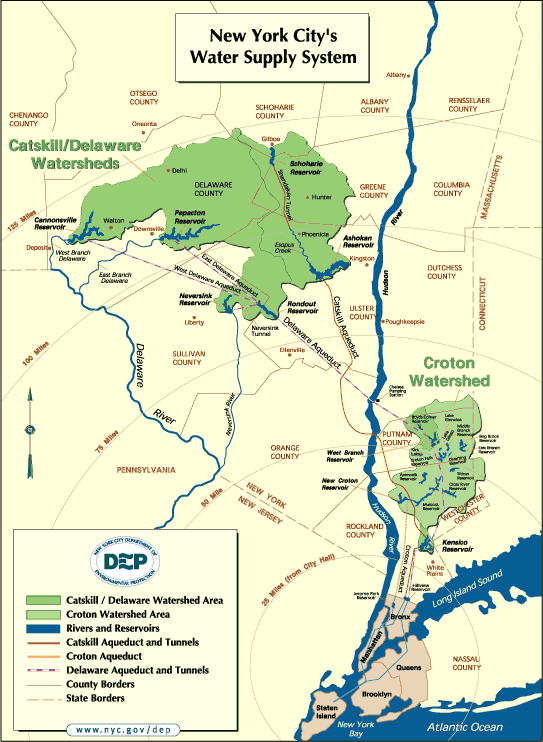
The residents of New York City obviously know that eight million citizens have much more of a right to protect their vital resources than do a few lease holders and their Texas and Oklahoma gasmen partners. New York City won't let the Gassers get anywhere near their upstate water supply, and for good reason. Fracking poisons the water with dozens of known toxic chemicals, and can release other toxins from the ground, including radioactive ones.

If the poisoned water from fracking is an obvious danger to the well being and health of the people of New York City, is it not as obvious and dangerous to the well being and health of men, women and children of the of the Southern Tier? You bet your life (perhaps literally) it is!

Real patriotism is the defense and preservation of the liberties and rights we are entitled to as members of a democracy. In a democracy; a vast a majority should not be put in danger and deprived of their rights by a small (but well funded) minority for that minority's sole economic benefit. In a democracy a vast majority of property owning, taxpaying citizens have the ultimate right and liberty to control our own choices of environmental protection, not the political hacks at DEC, locally, or in Albany. The at risk citizenry of the Southern Tier outnumber the Gassers 10 to 1. In a democracy such as ours is designed to be, we the people have the true power, the right and the responsibility to control and protect our essential water resources. Our political leaders had better learn and remember this right now, or they will be replaced by people who do know it, very soon. Protecting the rights and serving the best interest of the vast majority of citizens is how true patriotism is expressed in a real democracy!

DEMAND ACCOUNTABILITY!

Sunday, January 3, 2010

The rush is on

Bradford County leads state in Marcellus Shale drilling permits in 2009
by Steve Reilly, Staff Writer
Morning Times
Saturday, January 2, 2010

The natural gas rig looming over a hundred feet over the Eileen property in Smithfield Township is one of 92 drilled in Bradford County in 2009 — over six times the number drilled in 2008.

Like many Bradford County rigs, the massive structure has become somewhat of a roadside attraction for curious passers-by.

But if current trends continue, it could be only a matter of time before such rigs jutting out from the rural landscape become less a novelty and more a part of the county’s everyday scenery.

If Pennsylvania was the primary target for gas exploration in the Marcellus Shale in 2009, Bradford County was its bulls-eye.

At the end of 2008, there were a total of 63 permits to drill wells into the Marcellus Shale in Bradford County, 17 of which had actually been drilled.

In 2009, according to statistics released on Nov. 30, there were a total of 383 Marcellus Shale drilling permits granted in Bradford County — more than any in other county in Pennsylvania.

With over 300 permitted wells yet to be drilled in the county, and with the torrid pace at which permits are granted showing no signs of stopping, all indications point to 2010 as a year in which the natural gas industry could forever transform the landscape of Bradford County.

The rush to drill in 2009

Until 2008, few had heard of the Marcellus Shale, a rock formation buried 5,000 feet deep stretching across 95,000 acres of a four-state region from New York to West Virginia. But two events in the last decade combined to unleash the hidden potential of the shale bed and make “the Marcellus” a household name.

In 2005, natural gas companies began exploiting the Barnett Shale in the Fort Worth, Texas area using a combination of hydraulic fracturing, or “hydrofracking,” and newly-pioneered horizontal drilling techniques to extract natural gas from the shale. The tremendously profitable gas extraction operations in Texas led to a hunt for similar formations across the country, and eventually to the establishment of relatively smaller natural gas economies in Arkansas’ Fayetteville Shale and Louisiana’s Haynesville Shale.


Then, in January 2008, Penn State geosciences professor Terry Engelder and SUNY-Fredonia geology professor Gary Lash released a study that estimated the size of the Marcellus Shale at 168 trillion to 516 trillion cubic feet — 80 to 250 times the previous U.S. Geological Survey estimate. In terms of geographic area, the Marcellus Shale is estimated to be 19 times larger than the Barnett Shale.

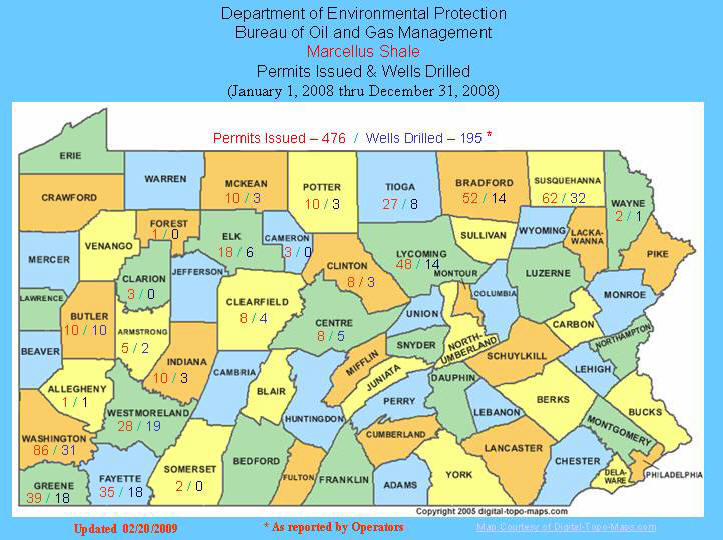
Both of these factors — the development of new drilling technology and new geological insights into the size of the Marcellus Shale — combined to set the stage for an exploratory phase that saw a cadre of multinational gas companies to flock to the area in 2008. That year, the Pennsylvania Department of Environmental Protection (DEP) granted permits to various gas companies to drill in the Marcellus Shale at 476 sites across the state, the majority in later half of 2008.

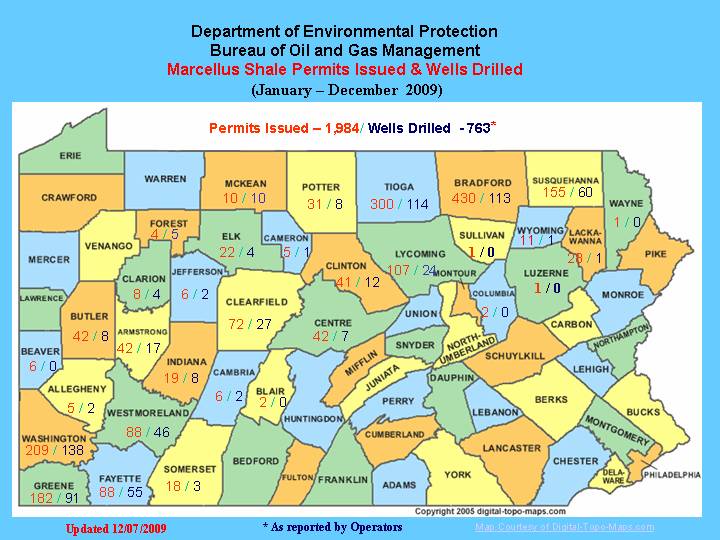
But in 2009, activity took off in earnest. DEP granted 1,742 Marcellus Shale drilling permits state-wide as of Nov. 30, with promises of even more in the pipeline for 2010.

DEP press secretary Teresa Candori stated that although there will continue to be many permits in 2010, she doesn’t necessarily expect the number of permits the agency grants to triple again next year.

...

Candori stated that DEP recently hired 37 new staff members specifically to handle the growing Marcellus Shale workload at the agency. Their salaries, she said, will be drawn directly from a recent hike in permitting fees.

Economic impact

...

“It’s pretty amazing, statewide,” said Mark Scheuerman, chief general counsel and media relations manager for Fortuna Energy. “I think the numbers that the Marcellus Shale Coalition, through their economic development analysis they did through Penn State, account for about 26,000 new jobs in Pennsylvania since about a year ago, all attributed to Marcellus development, (and) we think that will continue.”

“(In) areas like the Barnett Shale in Texas, in the Fort Worth area, in about three to five years there were almost 100,000 new full-time jobs associated with Barnett Shale exploration and the production. That’s a formation that is about 5,000 square miles. The Marcellus — and, of course, it covers a four-state area — is about 95,000 square miles. And Pennsylvania has the biggest chunk of it. So if you can extrapolate from those numbers, it gives you kind of breathtaking forecast of what the economic impact will be from a jobs standpoint,” Scheuerman added.

...

Brian Driscoll, countywide economic development manager of the Central Bradford Progress Authority stated that the economic impact has been noticeable, but difficult to quantify “just because it’s so tough to track that with so many different companies involved, and there are subcontractors involved, and all different dynamics.”

“It’s no secret to anybody there’s a lot of activity more going on,” he said. “There are some employment impacts. A lot of the employment seems to be going to folks from outside of the area. But that has created a tremendous demand for hotel space as well as residential rental units, like apartment-type dwellings. So there’s been a real increase in demand for housing, both temporary and longer-term.”

“You (also) see a lot of activity at restaurants and service-related activity,” Driscoll added. “So I think the spectrum’s pretty wide-ranging.”

But, according to Driscoll, the idea of gas industry profits falling into county resident’s hands hasn’t quite come to fruition yet.

“What we don’t see at this point is a lot of revenue coming directly into residents’ hands through royalty payments or anything like that, because the process isn’t quite far enough along. A lot of folks have gotten lease payments, but aren’t in the royalty cycle yet,” he explained.

Driscoll also pointed to the secondary aspects economy that are indirectly benefiting from the increase in population and the growing numbers of transient workers.

“I know that there are existing businesses in the Valley and elsewhere in the county that you might not think would be totally related (that are benefiting). I know hardware stores have been selling components to these folks. We know of a company that sells cleaning supplies that has been inundated with requests for their materials, just based on additional people in residential units. Flower shops (are benefiting because) guys from Texas are sending flowers back home to their wives. Stuff like that that you just wouldn’t think of has become impacted as well,” Driscoll said.

However, the expected increase in population will probably cause some speed bumps that must be dealt with along the way, according to Bradford County Commissioner Mark Smith.

“The increase in the population and the increase in human services is going to have an impact. Our correctional facility and services such as children and youth, and drug and alcohol services, and the school systems — the issues and problems that arise naturally from having more people in the county will have to be dealt with as the changes develop," Smith stated.

Another issue prominent in the minds of local officials is the prospect of a state-mandated severance tax on oil and gas revenue in Pennsylvania that would send portions of the gas companies back to the state’s general fund.

Many local officials, such as Bradford County Commissioner Doug McLinko and state Rep. Tina Pickett, have been vocal in their opposition to the proposed severance tax on the grounds that it would take tax revenue away from municipalities where most of the drilling is occurring and send it back to the state government.

Pickett stated that a better way to raise revenue from Marcellus Shale activity would be to lease selected portions of state property to gas companies.

Splashdown: Maybe she'll explain that...

Proponents of the tax argue that 14 of the other top 15 gas-producing states in the country have such a tax.

Natural gas and the Valley: ‘A very busy year’

As the natural gas industry takes its foothold across the county, it seems to have skipped over the Valley in terms of permits granted and rigs constructed. But the central location and developed nature of the Valley have made it a prime target of gas companies during the past year in their search for a place to locating their infrastructure.

Tunkhannock-based Somerset Regional Water Solutions’ proposed water treatment facility on Mile Line Road, voted down by the Athens Township Board of Supervisors in November due to it’s failure to correct a number of deficiencies in the original plans, was one example of a failed venture this year. Documents attached to the proposal for the treatment plant indicated that incoming wastewater would potentially be radioactive, and that excess water would be dumped into the Chemung River.

Two successes for the gas industry, however, were achieved in the Tannery Curve area of Athens Township. There, a 50-truck parking lot and a water withdrawal site were approved and are now currently being developed to feed Chesapeake Energy’s drilling operations throughout the county, taking advantage of the site’s proximity to Route 220.

Two other projects — a 60-person temporary housing quarters, or “man camp” on Round Top Road, and an East Athens water withdrawal facility — were nixed by gas companies themselves in the middle of the approval process. Reports indicate that another site for the “man camp” is being sought by Nomac, Chesapeake Energy’s drilling subsidiary.

...

Looking ahead: ‘It depends on the rocks’

Although forecasts indicate that 2010 will be a pivotal year, and many in the area are counting on the quick growth of the fledgling industry, the pace at which the industry develops is dependent on one thing that is out of anyone’s control: nature itself.

...

“From our perspective, about a year ago we had zero production in the Marcellus. Now we’re at about 30 wells and we’re producing just at about 70 million (cubic feet) out of our Marcellus wells in Northern Pennsylvania. It’s been quite a satisfying accomplishment and we’re looking to expand on that in 2010,” [Fortuna's] Scheuerman said.

“But there’s always a lot of factors that go into exactly where you conduct operations — whether it’s exploration or development — and then production is always a question of mother nature,” he added.

“It depends on the rocks, as they say.”

For complete article, CLICK HERE.

DEMAND ACCOUNTABILITY!

Friday, November 20, 2009

Pa. needs assurances that 'fracking' is safe

OPINION
The Philadelphia Inquirer
philly.com
Nov. 19, 2009


In "Money, it's a gas" (Nov. 11), The Inquirer rightly tongue-lashed the state legislature and Gov. Rendell for caving in to Big Gas. A separate story that day reported a great leap backward: 32,000 more acres of state forest lands are leased for gas drilling.

Natural gas is 95 percent methane, a greenhouse gas already responsible for one-third of global warming.

Adding injury to injustice, Big Gas uses toxic technology: horizontal drilling combined with hydraulic fracturing - "fracking" - to extract the gas.

Four facts:

Fracking operations use millions of gallons of water per gas well.

Companies mix "acutely toxic" (Environmental Protection Agency designation) chemicals into the water. It is forced underground to fracture the Marcellus Shale, which lies under 63 percent of Pennsylvania.

There is no way to safely treat the wastewater, which also contains metals from deep underground and radioactive materials.

Fracking is exempt from major provisions of the federal Safe Drinking Water Act.

Since key federal regulations do not apply, and the state Department of Environmental Protection can't regulate this rush, we must demand an environmental impact statement for Pennsylvania from the EPA. Until that's done, we need a fracking moratorium in Pennsylvania.

Iris Marie Bloom

Philadelphia

DEMAND ACCOUNTABILITY!

Wednesday, November 18, 2009

Radioactivity Rising... Along with Concern

Schuyler’s Hot

By Peter Mantius
The Odessa File

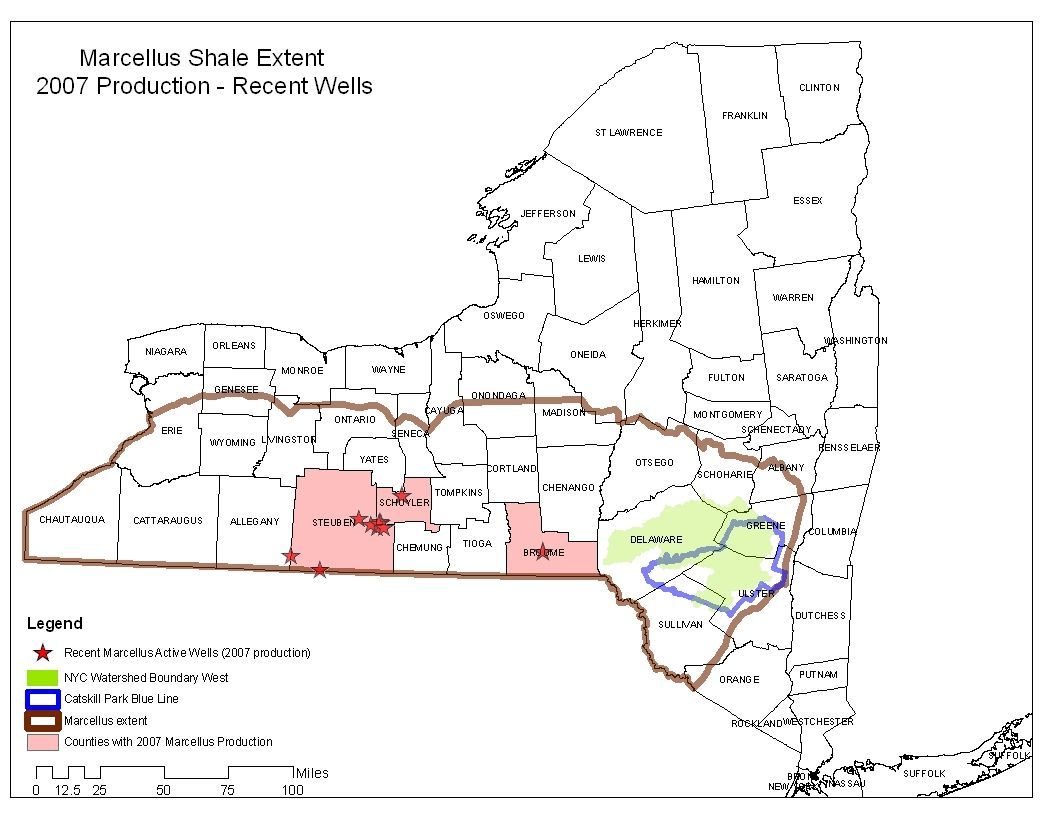
BURDETT, Nov. 13 -- When the state recently tested brine extracted from all 12 of New York’s active Marcellus Shale natural gas wells, several of the samples were highly radioactive.

Six of those tested wells, including the four found to be the most contaminated, are located in Schuyler County.

The tests conducted between October 2008 and April 2009 found that wastewater from the six deep vertical wells in Orange, Dix and Reading showed concentrations of Radium 226 ranging from 60 to 260 times the legal limit for discharge into the environment.

The results could complicate plans for aggressive natural gas drilling locally and lead to calls for more active radiological monitoring throughout the Marcellus Shale drilling region, including Pennsylvania.

“Whatever entity produces those kinds of numbers will have to be licensed by the state,” said Theodore G. Adams, a radiological and environmental consultant in suburban Buffalo. “The waste will have to be managed, treated and disposed of (to avoid human contact).”

Radium 226, which is intensely radioactive, has a half-life of 1602 years and decays into radon gas.

In July, the state Department of Health expressed concerns about the test results in a confidential letter to the Department of Environmental Conservation, which conducted the tests.

Existence of the letter was recently reported by the website ProPublica. DEC confirmed that it received the letter but denied my repeated requests for a copy.

So far, the agency isn’t raising alarms about the test results, saying radioactivity readings can vary widely at any given site.

But if further testing confirms that the readings are roughly accurate indicators of current radioactivity levels, it could significantly drive up the cost of extracting natural gas.

Sites that consistently turn in high radiological readings for their brine would need to obtain special licenses, said Adams, a former federal Department of Energy radiation inspector who runs his own firm that serves clients such as Westinghouse and Alcoa.

Adams noted that wastewater or sludge from such wells would likely require expensive special handling.

Fortuna Energy Inc. of Horseheads operates several of the wells that showed high radioactivity readings, ProPublica has reported. But Mark Scheuerman, Fortuna’s general counsel, declined Friday to confirm or deny the company’s involvement. He said the company planned to address a myriad of drilling issues in written comments to the DEC by yearend.

The DEC conducted extensive radiological tests of New York State natural gas wells in 1999 and found little cause for concern. But none of those were Marcellus wells. In contrast, all of the recent tests were Marcellus wells (six in Schuyler, five in Steuben County and one in Chenango County), and several of them showed much higher readings than any of the 1999 tests.

The results are buried deep in an appendix to the state’s draft Generic Environmental Impact Statement for gas drilling. The charts are presented without any explanation or footnotes.
But the simple numbers speak powerfully, according to Adams.

For example, one well in Orange showed Radium 226 concentrations of 16,030 picocuries per liter. Adams said the state and federal limit for legal discharges into the environment is 60 picocuries per liter.

The legal limit for drinking water is 5 picocuries per liter. The limit for water treated at a sewage treatment plant is 600 picocuries per liter.

Three other Schuyler County wells also showed readings of more than 10,000 picocuries per liter. The highest reading detected outside Schuyler County was 7,885 picocuries per liter at a well in Steuben County. (The findings were reported with uncertainty levels of roughly 25 percent).

All 12 of the tested wells were drilled vertically in the Marcellus Shale, a rock formation several thousand feet below the surface that extends through most of the Southern Tier, Pennsylvania and parts of West Virginia and Ohio.

...

Although previous public hearings on drilling have touched on a host of environmental issues, radioactivity hasn’t been a prime concern.

Yancey Roy, a spokesman for the DEC, ...said the 12 tested wells were the only active Marcellus Shale wells in the state. And while more radiological testing is needed, he said, that can’t occur until new drilling operations get underway.

Once fracking begins in New York, “decisions will be made, based on the results, as to the proper handling and disposal of waste materials,” he added.

In the past, brine has been used on state roads to help melt snow. (!!!)

An appendix to the proposed DEC drilling rules says: “The modeling showed that the most common method of brine disposal in New York State, spreading it on the roads to control ice and snow, does not present significant (radiation) doses to the public.”

Roy noted that the DEC is concerned about potential buildup of radioactivity in pipes and other drilling equipment and said that equipment may have to be monitored. NORM is also apt to accumulate in sludge that is a byproduct of well wastewater.

For the complete report, CLICK HERE.

DEMAND ACCOUNTABILITY!

Tuesday, November 10, 2009

Is New York's Marcellus Shale Too Hot to Handle?

by Abrahm Lustgarten, ProPublica
November 9, 2009

As New York gears up for a massive expansion of gas drilling in the Marcellus Shale, state officials have made a potentially troubling discovery about the wastewater created by the process:
It's radioactive.
And they have yet to say how they'll deal with it.

The information comes from New York's Department of Environmental Conservation, which analyzed 13 samples of wastewater brought thousands of feet to the surface from drilling and found that they contain levels of radium-226, a derivative of uranium, as high as 267 times the limit safe for discharge into the environment and thousands of times the limit safe for people to drink.

The findings, if backed up with more tests, have several implications: The energy industry would likely face stiffer regulations and expenses, and have more trouble finding treatment plants to accept its waste -- if any would at all. Companies would need to license their waste handlers and test their workers for radioactive exposure, and possibly ship waste across the country. And the state would have to sort out how its laws for radioactive waste might apply to drilling and how the waste could impact water supplies and the environment.

...

The radium-laden wastewater would almost certainly need to be carefully treated by plants capable of filtering out the radioactive substances. Kessy, the Fortuna manager, which operates five of the wells with spiked readings in New York, said the levels are higher than he has seen elsewhere. Treatment plants in Pennsylvania are accepting Fortuna wastewater with much lower levels of radioactivity from the company's wells there, Kessy said, but if plants can't take the higher concentrations, it could be crippling.

"In the event that they were not able to comply due to high radioactivity, they would reject the water," Kessy said. "And if we did not have a viable option for it, our operations would just shut down. There is no other option."

...

Filtering the water is just one of several problems. Plants that can filter out the radioactive materials are left with a concentrated sludge that has substantially higher radioactivity than the wastewater. Sludge can also collect inside the pipes at well sites, in waste pits and in holding tanks.

...

Experts who reviewed the concentrations of radioactive metals found in New York's wastewater said the leftover sludge is likely to exceed the legal limits for hazardous waste and would need to be shipped to Idaho or Washington, to some of the only landfills in the country permitted to accept it.

Fortuna's Kessy said that's an acceptable cost of doing business. "We'll be willing, of course, to fund the necessary disposal means," he said.

For the full story, CLICK HERE.

DEMAND ACCOUNTABILITY!

Tuesday, October 20, 2009

Radioactive Wastes from Oil and Gas Drilling

Saturday's post regarding the proposed wastewater treatment facility in Athens Twp., PA raised the issue of radioactive waste, a topic which is minimalized or not often referred to, but is, nonetheless a topic of significant concern, particularly as levels accumulate.
"The permit application states “Radium 226, Radium 228, Gross Alpha, and Gross Beta radiation” are present in the water incoming for treatment, and because of this, “SRWR is concerned that concentrations (of radioactive materials) will accumulate in the clarifier sludge, rendering the sludge a radioactive waste.
The document adds that SRWR is considering two different methods to help reduce the radioactivity of the sludge, and that “evaluation is continuing to determine the optimum location for this process and the most appropriate and safest* means for handling and disposing of the waste that would be generated.”
*Remember, "safest" doesn't mean safe. It merely means least dangerous.

Here then is the EPA publication on the subject:

Overview

The oil and gas industry provides three-fifths of the energy for the United States. When most of us drive a car, turn on a light bulb, or cook on a stove, a large portion of the energy we use comes from the fossils of plants and animals. While fossil fuels are chemical sources of energy, the processes used to extract them from the earth often generate radioactive waste.

Even though we use them on a daily basis, most people know little about the processes that take oil and gas from the ground to produce energy. These processes may leave behind waste containing concentrations of naturally-occurring radioactive material (NORM) from the surrounding soils and rocks. Once exposed or concentrated by human activity, this naturally-occurring material becomes Technologically-Enhanced NORM or TENORM. Radioactive materials are not necessarily present in the soils at every well or drilling site. However in some areas of the country, such as the upper Midwest or Gulf Coast states, the soils are more like to contain radioactive material.

Radioactive wastes from oil and gas drilling take the form of produced water, drilling mud, sludge, slimes, or evaporation ponds and pits. It can also concentrate in the mineral scales that form in pipes (pipe scale), storage tanks, or other extraction equipment. Radionuclides in these wastes are primarily radium-226, radium-228, and radon gas. The radon is released to the atmosphere, while the produced water and mud containing radium are placed in ponds or pits for evaporation, re-use, or recovery.

The people most likely to be exposed to this source of radiation are workers at the site. They may inhale radon gas which is released during drilling and produced by the decay of radium, raising their risk of lung cancer. ...

Who is protecting you

U.S. Environmental Protection Agency (EPA)

EPA is responsible for setting federal radiation standards for exposure to NORM and TENORM.

EPA develops standards for the oil and gas extraction and production industry under the Clean Air Act, Clean Water Act, Safe Drinking Water Act*, Resource Conservation and Recovery Act and the Comprehensive Environmental Response, Compensation, and Liability Act.

*Please urge Congress to vote for the FRAC Act, removing industry exemptions for hydraulic fracturing! (see sidebar at left)

The States

Each state has one or more programs that address both NORM and TENORM.
Some states have established or set limits to control to TENORM. These limits apply to the oil and gas drilling industry. Most states also control public exposure to radiation through programs implementing the federal Clean Air Act, Clean Water Act and other environmental laws authorized by the EPA.

U.S. Department of Labor (DOL), Occupational Safety and Health Administration (OSHA)

DOL’s Occupational Health and Safety Administration (OSHA) establishes health and safety regulations for the oil and gas extraction, production, and servicing industry. OSHA also issues hazardous information bulletins to inform staff and the public of significant occupational safety and health issues including radiation hazard recognition, evaluation, and control in the workplace.

U.S. Department of Energy (DOE)

DOE provides grants for research on the use and disposal of radioactive materials related to the development of energy sources.

What you can do to protect yourself

Government organizations continue to address potential threats from oil and gas drilling and production for the public health and safety but you can take actions as well for your own health and safety.

Workers in the industry have the potential for overexposure to radioactive material and must stay up-to-date on federal, state, and industry health and safety guidelines. Following these procedures will reduce total on-site exposure. Workers also need to take precautions to avoid bringing radioactive material residue on their clothes and shoes home to their families and neighborhoods.

  • Change out of potentially contaminated clothes and shoes before returning to the family car and to your home or office.
  • Do not re-use or bring home discarded equipment or material such as pipes, devices, bricks, rocks, or water.

Members of the public should contact their local state geological survey or bureau of health to determine if there is a likelihood of NORM and TENORM occurrence associated with oil and gas production in their state, or area where they live. Until then:

  • Limit exposures and disturbance of the production site and any abandoned equipment.
  • Do not handle, dispose or re-use abandoned equipment used at drilling sites.
For Resources and the complete report, CLICK HERE.

DEMAND ACCOUNTABILITY!

Saturday, October 17, 2009

Athens PA Township: Questions arise over wastewater treatment plant

By Steve Reilly
Staff Writer
Article reprinted from
Morning Times, Sayre, PA
Saturday, October 17, 2009

ATHENS TOWNSHIP— One of the most challenging pieces of the area’s gas drilling puzzle is the question of what will be done with “flowback water” — the millions of gallons of contaminated water that will travel back to the surface of each well after it is hydraulically fractured.

One possible solution is the wastewater treatment plant that a Tunkhannock-based Somerset Regional Water Resources LLC (SRWR) is hoping to construct in Athens Township.

The plant is being proposed for development at a site in the Valley Industrial Park on Mile Lane Road, which is zoned “industrial” under the Athens Township code. But because the plant does not fit the criteria for the “industrial” zoning, SRWR’s plans are currently going through a conditional use permitting process.

A copy of the conditional use permit application obtained by the Morning Times provides details about how the plant will be used.


“The anticipated volume of water that will be offloaded to the facility on a daily basis will be 1.5 million gallons,” it states.

The document indicates that trucks carrying the flowback water will arrive at an offloading station where the water will be pumped into a series of “skim ponds.” In these ponds, oil and grease will be taken off of the surface of the water and shipped away from the site for disposal.

After the skimming process, water will be stored in “lined earthen impoundments” in accordance with DEP requirements. The aeration provided by the open-air storage will help remove minerals including iron and sulfides from the water.

Then the water will go through a process designed to remove and condense the chemicals in the water to a solid “sludge” that will be shipped off-site to an approved landfill. This will involve the use of caustic soda and hydrated lime to settle the solids in the water, as well as the use of a “hydrocyclone” — a cone-shaped centrifuge used for separating mixed liquids.

The permit application states “Radium 226, Radium 228, Gross Alpha, and Gross Beta radiation” are present in the water incoming for treatment, and because of this, “SRWR is concerned that concentrations (of radioactive materials) will accumulate in the clarifier sludge, rendering the sludge a radioactive waste.”

The document adds that SRWR is considering two different methods to help reduce the radioactivity of the sludge, and that “evaluation is continuing to determine the optimum location for this process and the most appropriate and safest means for handling and disposing of the waste that would be generated.”


Finally, the document details how the water would be dealt with after the sludge is separated and removed. At this point, it would still have an extremely high concentration of salt and other concentrated organic materials.

Through a “reverse osmosis” process — the same that is used to remove the salt from seawater in some Middle Eastern countries — salt would be removed from the water until it fell below limits set by the EPA’s National Pollution Discharge Elimination System program.

The salt would then go through a process that would make it available for commercial reuse. The processed water would be put in holding ponds from which it will be picked up by trucks for reuse as fracing fluid at natural gas wells.

Any excess water not trucked away for reuse at natural gas wells is to be discharged through a pump station into the Chemung River. The document states that an effluent monitoring station will be in place at the discharge site to ensure regulatory compliance.

It takes approximately 3.5 million gallons of water to hydraulically fracture an average well in the Marcellus Shale. According to Bryan Swistock, a water resources extension associate with Penn State Cooperative Extension, 30 to 40 percent of this water flows back to the surface immediately after the well is fractured, and much of of the rest returns gradually along with the natural gas.

At a recent natural gas summit in Wysox, Swistock stated that while many elements of the hydraulic fracturing process have been mastered in western states such as Colorado and Wyoming, the treatment of flowback water is not one of them.

Pennsylvania’s climate and geography, Swistock said, give the state a “limited capacity” to treat the water with evaporation or underground injection methods that were used in western states.

Swistock stated that before treatment, flowback water contains concentrations of materials such as barium, lead, and arsenic that, “compared to drinking water standards, are quite high.”

A public hearing on the proposed wastewater treatment facility will be held on Nov. 18 at 7 p.m. in the township municipal building on Herrick Avenue.

DEMAND ACCOUNTABILITY!

Thursday, July 2, 2009

Effects of Marcellus Shale Gas Drilling on Local Water Sources


This video, from a public forum held in Bath, NY on June 22, presents a comprehensive overview of the problems (dangers) accompanying drilling for gas in the Marcellus Shale.

DEMAND ACCOUNTABILITY!

Wednesday, June 24, 2009

Drilling in Marcellus Shale needs Scrutiny

Contamination of Drinking Water Feared

By Stacey Shackford • sshackford@gannett.com

Staff Writer • ithacajournal.com

June 24, 2009


The woman who has helped the U.S. Environmental Protection Agency review and monitor state oil and gas drilling policies warned that New York is seriously lacking oversight and is long overdue an assessment.

Speaking Tuesday at the Museum of the Earth, with the skeleton of giant prehistoric creature looming above her head, Wilma Subra said now is the time for the state to take a hard look at its current and future drilling policies, with the specter of large-scale hydrofracking of natural gas reserves in the Marcellus Shale looming over its head.

Subra, a chemistry expert and recipient of the MacArthur Fellowship Genius Award for her work as a community organizer, has gone into several states to assess oil and gas exploration policies as a member of the EPA National Environmental Justice Advisory Council. New York was last assessed in 1994, she said.

"We need to go in and do another review because this is the only oversight we have," she said.

Around 60 people crowded into the museum, most of them furiously scribbling in notebooks as they were bombarded with information.

Horizontal hydro-fracking - pumping a mixture of high-pressure water, sand and chemicals deep into the ground to fracture shale and capture the natural gas there - continues in Pennsylvania and elsewhere, but has paused in New York while the DEC writes a supplement to its environmental impact statement on gas drilling.

Subra warned of depletion of water aquifers, the contamination of groundwater, soil and air with potentially toxic materials, the possibility of radioactive scaling in drill wells and pipes and the inability of local wastewater treatment facilities to dispose of the amount of waste involved in large-scale drilling. She also noted that other formerly drilled, uncapped wells in the area could pose serious risks if fracking fluids find their way into them as they could then easily flow into the groundwater supply.

Wes Gillingham, of event organizers Catskill Mountainkeeper, also showed aerial photos of a rural Pennsylvania drilling site that confirmed many of their fears - drilling sites and gravel pits popping up in a seemingly random pattern alongside houses, farms and churches; pipelines and access roads zigzagging across the landscape; holding ponds overflowing its potentially chemically contaminated waste water; and dozens of large freight trucks lined up in fields.

Subra urged those gathered to educate themselves and get involved, and pointed out that citizen outcry in her native Louisiana successfully led to the phasing out of drilling pits in favor of a more environmentally sound "closed-loop system."

"You have a large amount of work ahead of you," she added.

DEMAND ACCOUNTABILITY!

RURAL IMPACT VIDEOS, 6 parts

Natural gas development in Colorado, the impacts on communities, environment and public health. A primer for public servants and residents of counties that care for their lifestyles.

Drilling for Gas in Bradford County, PA ... Listen!

Cattle Drinking Drilling Waste!

EPA... FDA... Hello? How many different ways are we going to have to eat this? ... Thank you TXSharon for all you do! ... Stay tuned in at http://txsharon.blogspot.com

Landfarms

A film by Txsharon. Thank you Sharon for all you do. Click HERE to read the complete article on Bluedaze: Landfarms: Spreading Toxic Drilling Waste on Farmland

SkyTruth: Upper Green River Valley - A View From Above