Showing posts with label PERMITS. Show all posts

Thursday, May 6, 2010

GAS PAINS

Pennsylvania, reeling from a budget crisis, exploits—at any and all costs—what might be the largest U.S. natural gas deposit. The results could be disastrous.
By Ted Williams
http://www.audubonmagazine.org/incite/incite1005.html

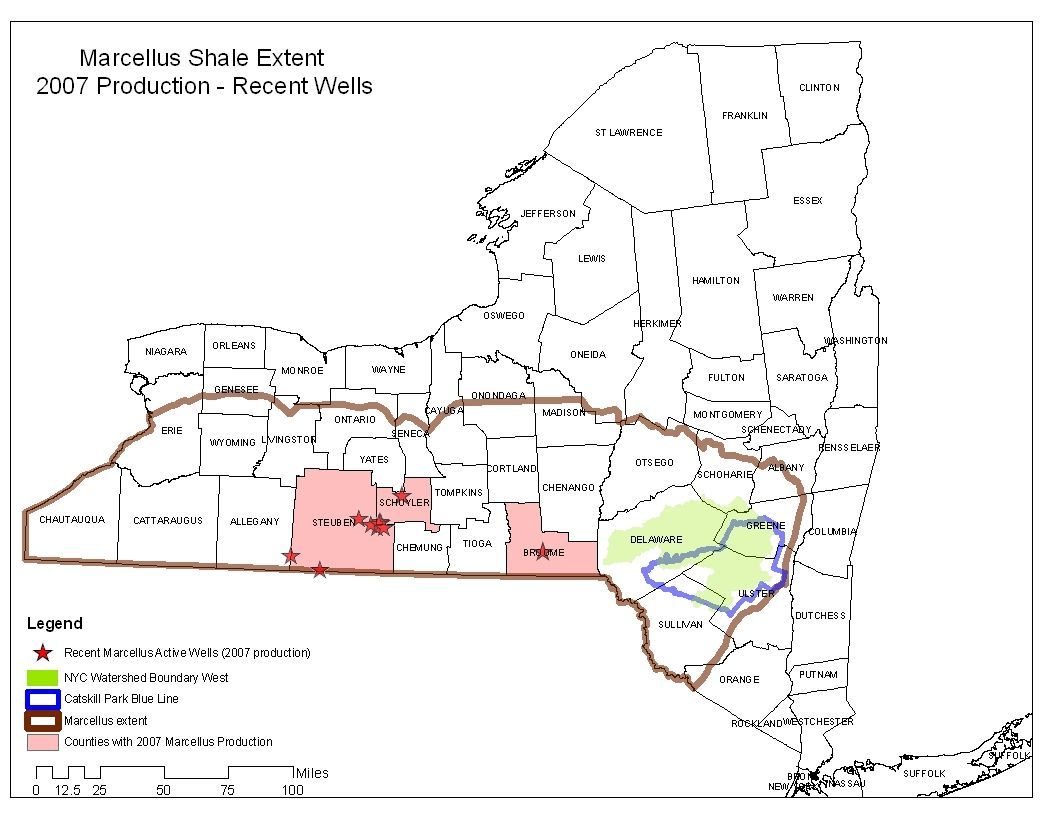
Earth hadn’t seen its first dinosaur when an enormous river system finished dumping its sediments over what is now Pennsylvania, West Virginia, southern New York State, western Maryland, and eastern Ohio. In the 350 million years or so that followed, other sediments piled up on the delta, sometimes to depths of 8,000 feet. As the river’s organic leavings were compressed and heated, hydrocarbons proliferated. Today the 48,000-square-mile Marcellus shale formation contains one of the largest known gas deposits in the United States.

Measured in immediate dollars and without subtracting the real costs of extraction, the windfall is dazzling. A Penn State study that does exactly this predicts that Marcellus gas will inflate Pennsylvania’s economy by at least $8 billion in just 2010. Farmers are now signing away mineral rights—for as much as $5,500 per acre, then getting royalties as high as 20 percent on the gas recovered.

That news would be better if Marcellus gas was recovered in a regulated, responsible fashion and with coordinated resource-agency oversight. After all, natural gas is the least polluting of all fossil fuels. It can even be rendered into cleaner-burning forms of gasoline and diesel fuel. And as a replacement for coal it has the potential to slow global warming because it releases only half as much carbon. But because the technology to extract the gas is younger than the 21st century, no one yet knows how to do it without simultaneously sacrificing the forests, waters, fish, and wildlife that, over time, are worth far more than any finite energy fix. That’s why New York State has placed a moratorium on Marcellus drilling while it struggles to devise effective regulations.

And that’s why some officials in Ohio, Maryland, and West Virginia are scrambling to get protections in place before the onslaught. So far they haven’t had much success. In an effort invoking the image of Oliver Twist requesting seconds on gruel, West Virginia lawmakers twice tried to pass legislation requiring companies merely to alert property owners before they get permits to hack and gouge their land. Both times the gas lobby shouted it down. Such is its stranglehold on the political process.

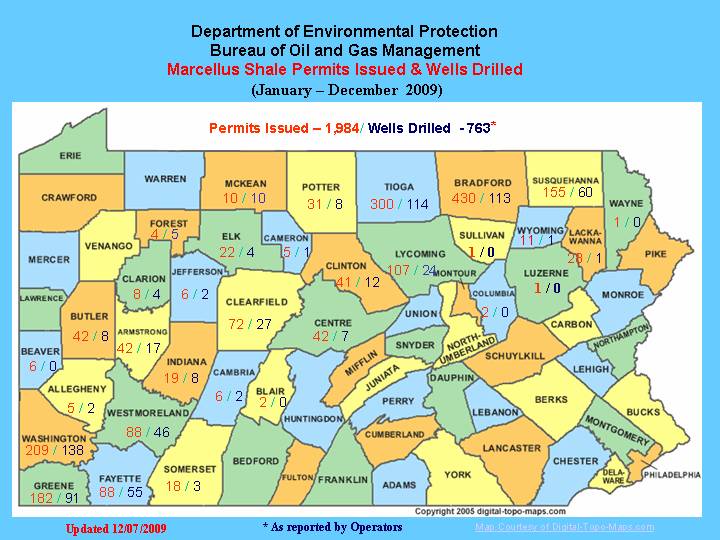
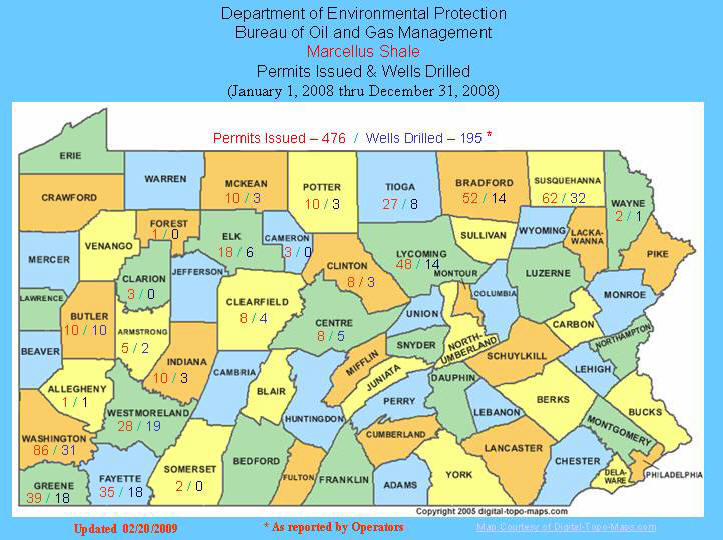
Almost all the development has been in Pennsylvania, which squats on the main chunk of the deposit. One might suppose that Pennsylvania would proceed cautiously, with 4,600 miles of its streams already contaminated by abandoned mines to the point of becoming lifeless acid seeps and having allowed the timber industry to denude the entire state a century ago. But no. The scene here resembles a wagon race of whooping, whip-flailing homesteaders. In 2008 Pennsylvania issued 476 Marcellus shale deposit drilling permits. In 2009 the figure was 1,984, and the industry expects to acquire 5,200 additional permits in 2010.

It’s not just native ecosystems that are being violated, it’s Pennsylvania’s constitution, which states: “The people have a right to clean air, pure water, and to the preservation of the natural, scenic, historic and esthetic values of the environment. Pennsylvania’s public natural resources are the common property of all the people, including generations yet to come. As trustee of these resources, the Commonwealth shall conserve and maintain them for the benefit of all the people.” What most alarms and outrages fish and wildlife advocates is that the state’s equally alarmed and outraged professional resource managers have been sidelined by big-money politics.

Pennsylvania’s wildest woods and most pristine streams are managed by the Department of Conservation and Natural Resources (DCNR). This 2.3-million-acre state forest system is among the largest publicly owned pieces of real estate east of the Mississippi River, and it is almost unique among state holdings in that it has been certified as “sustainable” by the Forest Stewardship Council. But in many places the agency can’t protect that sustainability because it doesn’t control mineral rights. In an attempt to marginally protect these areas, the DCNR had been requiring gas companies to sign surface-use agreements. But last May the companies got a state court to end even this.

If the current orgy is allowed to continue and if it becomes a model for the other Marcellus states, vast swaths of the East’s best forests will be fragmented, groundwater and surface water polluted, and fish and wildlife wiped out on a scale that would dwarf the recent tragedy seen in the gas fields of Wyoming, Colorado, and New Mexico.

For remainder of this excellent article, CLICK HERE.

DEMAND ACCOUNTABILITY!

Saturday, March 27, 2010

Protecting Our Waters Hails Philadelphia Weighing In Against Fracking In Delaware Basin

PRESS RELEASE
Says DRBC Should Heed City Position - Reject Stone Energy Permits

Philadelphia, PA -
Environmental groups from across the region hailed passage of a Philadelphia City Council Resolution yesterday calling on the Delaware River Basin Commission (DRBC) to reject all permits related to hydraulic fracturing, or fracking, until a full environmental impact assessment is complete. The groups said the DRBC should follow the Council's direction and not allow this environmentally destructive drilling practice to occur in the Delaware River Basin.

"We are extremely happy that City Council took its first strong step towards protecting Philadelphia's watershed from shale gas drilling," said Iris Marie Bloom, Campaign Director of Protecting Our Waters, a grassroots Philadelphia organization that opposes shale gas drilling. "Thanks to this resolution, the Delaware River Basin Commission now knows that Philadelphia's elected officials don't want any arsenic, benzene, radium 226 or hundreds of other Marcellus Shale fracking contaminants anywhere near our drinking water!"

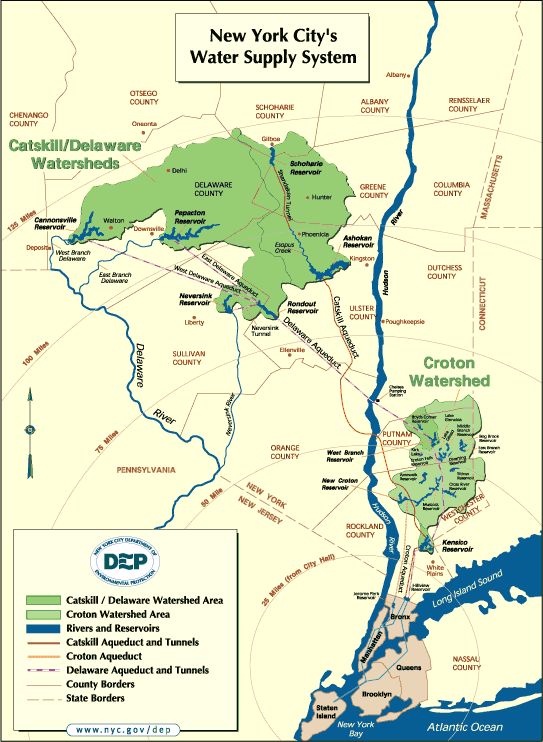
"The Delaware River Watershed provides drinking water to 15 million people who will all be affected if shale gas drilling moves ahead in the River's headwaters, 1.5 million of them here in Philadelphia," noted Maya van Rossum, the Delaware Riverkeeper. "Until comprehensive analysis of the cumulative impacts of this new industrial activity is complete and protective regulations are in place, we will continue to fight to prevent shale gas extraction in our watershed".

So far, no gas drilling has occurred in the Delaware River Basin but many companies are poised to drill if they can obtain permits. Two applications from Stone Energy, one to frack the first well in the Delaware River watershed and one to withdraw up to 700,000 gallons per day from the West Branch Lackawaxen River, for five years, are pending. How DRBC rules on the Stone Energy permits will be considered a bellwether for gas exploration in the region. The DRBC Public Comment Period on the Stone Energy permits ends on April 12, 2010 and a decision could come in May.

"There are some places that simply are too sensitive and too important to allow any drilling at all, and the Delaware River Basin is one of those places." said Deborah Goldberg,
Managing Attorney for Earthjustice, a national environmental organization with offices in New York.

Stone Energy's water withdrawal permit would allow them to withdraw up to one billion, 277 million gallons of fresh, clean water from the West Branch Lackawaxen River over the next five years. If permitted, all of that water would be mixed with a toxic cocktail of fracking chemicals including methanol, formaldehyde, 2-butoxyethanol, and other known carcinogens. Fracking technology is exempt from major provisions of five federal environmental laws. The EPA recently announced a two year environmental review of the technology. New York City commissioned a scientific study which concluded there should be no shale gas drilling within 7 miles of New York City's watershed.

"There is no doubt that tremendous pollution of our water and air would result if these permits are granted" concluded Bloom, adding, "The net impact on climate change appears to be negative. This tiny, healthy tributary to the Lackawaxen River, Pennsylvania's 2010 River of the Year, spawns tremendous biodiversity and keeps the water flowing down to the mainstream Delaware River clean and fresh."

DEMAND ACCOUNTABILTY!

Friday, February 19, 2010

Mayor Tillman Talks about the Effects of Drilling in DISH, TX

Sarah Blazonis
Fox 40 WICZ TV
Friday, February 19, 2010


Mayor Calvin Tillman says town officials in DISH, TX, had big ideas about what natural gas wells like these could bring to the area.

"Jobs, prosperity -- most of the things the folks in the Marcellus Shale are probably thinking about right now," said Tillman.

Tillman says drilling into the Bartlett Shale has cost the town as much as it's gained.

DISH's web site provides information about about its noise problem and air quality study -- which found several toxins related to gas production.

Sixty percent of residents who filled out a health questionnaire reported symptoms known to be related to those toxins.

"Watery eyes, sore throat, severe headaches, nausea, neurological problems," Tillman said.

Tillman was invited to the area by the Binghamton Regional Sustainability Coalition. He plans to talk to residents about urging state lawmakers to pass regulations to protect the environment if drilling is approved in New York.

A local environmental defense lawyer says getting these regulations passed depends on team work from both sides of the issue.

"The economy vs. the environment, landowners vs. everyone else -- these are false dichotomies, and there's one water table that everyone's drinking from," said Helen Slottje, a managing attorney with the Community Environmental Defense Council, Inc.

Above all, DISH's mayor says the Southern Tier shouldn't rush into drilling.

"Slow down," said Tillman. "Slow down and think about it. Think it through, make sure that you put every precaution in place you can before you start."

It's a lesson Tillman says his town learned the hard way.
Residents voted just this week for a 90-day moratorium on new drilling permits.
LINK

DEMAND ACCOUNTABILITY!

Monday, January 11, 2010

Bradford, Susquehanna and Tioga Co. Drilling Permits...

CLICK HERE to have a look!

DEMAND ACCOUNTABILITY!

Sunday, January 3, 2010

The rush is on

Bradford County leads state in Marcellus Shale drilling permits in 2009
by Steve Reilly, Staff Writer
Morning Times
Saturday, January 2, 2010

The natural gas rig looming over a hundred feet over the Eileen property in Smithfield Township is one of 92 drilled in Bradford County in 2009 — over six times the number drilled in 2008.

Like many Bradford County rigs, the massive structure has become somewhat of a roadside attraction for curious passers-by.

But if current trends continue, it could be only a matter of time before such rigs jutting out from the rural landscape become less a novelty and more a part of the county’s everyday scenery.

If Pennsylvania was the primary target for gas exploration in the Marcellus Shale in 2009, Bradford County was its bulls-eye.

At the end of 2008, there were a total of 63 permits to drill wells into the Marcellus Shale in Bradford County, 17 of which had actually been drilled.

In 2009, according to statistics released on Nov. 30, there were a total of 383 Marcellus Shale drilling permits granted in Bradford County — more than any in other county in Pennsylvania.

With over 300 permitted wells yet to be drilled in the county, and with the torrid pace at which permits are granted showing no signs of stopping, all indications point to 2010 as a year in which the natural gas industry could forever transform the landscape of Bradford County.

The rush to drill in 2009

Until 2008, few had heard of the Marcellus Shale, a rock formation buried 5,000 feet deep stretching across 95,000 acres of a four-state region from New York to West Virginia. But two events in the last decade combined to unleash the hidden potential of the shale bed and make “the Marcellus” a household name.

In 2005, natural gas companies began exploiting the Barnett Shale in the Fort Worth, Texas area using a combination of hydraulic fracturing, or “hydrofracking,” and newly-pioneered horizontal drilling techniques to extract natural gas from the shale. The tremendously profitable gas extraction operations in Texas led to a hunt for similar formations across the country, and eventually to the establishment of relatively smaller natural gas economies in Arkansas’ Fayetteville Shale and Louisiana’s Haynesville Shale.


Then, in January 2008, Penn State geosciences professor Terry Engelder and SUNY-Fredonia geology professor Gary Lash released a study that estimated the size of the Marcellus Shale at 168 trillion to 516 trillion cubic feet — 80 to 250 times the previous U.S. Geological Survey estimate. In terms of geographic area, the Marcellus Shale is estimated to be 19 times larger than the Barnett Shale.

Both of these factors — the development of new drilling technology and new geological insights into the size of the Marcellus Shale — combined to set the stage for an exploratory phase that saw a cadre of multinational gas companies to flock to the area in 2008. That year, the Pennsylvania Department of Environmental Protection (DEP) granted permits to various gas companies to drill in the Marcellus Shale at 476 sites across the state, the majority in later half of 2008.

But in 2009, activity took off in earnest. DEP granted 1,742 Marcellus Shale drilling permits state-wide as of Nov. 30, with promises of even more in the pipeline for 2010.

DEP press secretary Teresa Candori stated that although there will continue to be many permits in 2010, she doesn’t necessarily expect the number of permits the agency grants to triple again next year.

...

Candori stated that DEP recently hired 37 new staff members specifically to handle the growing Marcellus Shale workload at the agency. Their salaries, she said, will be drawn directly from a recent hike in permitting fees.

Economic impact

...

“It’s pretty amazing, statewide,” said Mark Scheuerman, chief general counsel and media relations manager for Fortuna Energy. “I think the numbers that the Marcellus Shale Coalition, through their economic development analysis they did through Penn State, account for about 26,000 new jobs in Pennsylvania since about a year ago, all attributed to Marcellus development, (and) we think that will continue.”

“(In) areas like the Barnett Shale in Texas, in the Fort Worth area, in about three to five years there were almost 100,000 new full-time jobs associated with Barnett Shale exploration and the production. That’s a formation that is about 5,000 square miles. The Marcellus — and, of course, it covers a four-state area — is about 95,000 square miles. And Pennsylvania has the biggest chunk of it. So if you can extrapolate from those numbers, it gives you kind of breathtaking forecast of what the economic impact will be from a jobs standpoint,” Scheuerman added.

...

Brian Driscoll, countywide economic development manager of the Central Bradford Progress Authority stated that the economic impact has been noticeable, but difficult to quantify “just because it’s so tough to track that with so many different companies involved, and there are subcontractors involved, and all different dynamics.”

“It’s no secret to anybody there’s a lot of activity more going on,” he said. “There are some employment impacts. A lot of the employment seems to be going to folks from outside of the area. But that has created a tremendous demand for hotel space as well as residential rental units, like apartment-type dwellings. So there’s been a real increase in demand for housing, both temporary and longer-term.”

“You (also) see a lot of activity at restaurants and service-related activity,” Driscoll added. “So I think the spectrum’s pretty wide-ranging.”

But, according to Driscoll, the idea of gas industry profits falling into county resident’s hands hasn’t quite come to fruition yet.

“What we don’t see at this point is a lot of revenue coming directly into residents’ hands through royalty payments or anything like that, because the process isn’t quite far enough along. A lot of folks have gotten lease payments, but aren’t in the royalty cycle yet,” he explained.

Driscoll also pointed to the secondary aspects economy that are indirectly benefiting from the increase in population and the growing numbers of transient workers.

“I know that there are existing businesses in the Valley and elsewhere in the county that you might not think would be totally related (that are benefiting). I know hardware stores have been selling components to these folks. We know of a company that sells cleaning supplies that has been inundated with requests for their materials, just based on additional people in residential units. Flower shops (are benefiting because) guys from Texas are sending flowers back home to their wives. Stuff like that that you just wouldn’t think of has become impacted as well,” Driscoll said.

However, the expected increase in population will probably cause some speed bumps that must be dealt with along the way, according to Bradford County Commissioner Mark Smith.

“The increase in the population and the increase in human services is going to have an impact. Our correctional facility and services such as children and youth, and drug and alcohol services, and the school systems — the issues and problems that arise naturally from having more people in the county will have to be dealt with as the changes develop," Smith stated.

Another issue prominent in the minds of local officials is the prospect of a state-mandated severance tax on oil and gas revenue in Pennsylvania that would send portions of the gas companies back to the state’s general fund.

Many local officials, such as Bradford County Commissioner Doug McLinko and state Rep. Tina Pickett, have been vocal in their opposition to the proposed severance tax on the grounds that it would take tax revenue away from municipalities where most of the drilling is occurring and send it back to the state government.

Pickett stated that a better way to raise revenue from Marcellus Shale activity would be to lease selected portions of state property to gas companies.

Splashdown: Maybe she'll explain that...

Proponents of the tax argue that 14 of the other top 15 gas-producing states in the country have such a tax.

Natural gas and the Valley: ‘A very busy year’

As the natural gas industry takes its foothold across the county, it seems to have skipped over the Valley in terms of permits granted and rigs constructed. But the central location and developed nature of the Valley have made it a prime target of gas companies during the past year in their search for a place to locating their infrastructure.

Tunkhannock-based Somerset Regional Water Solutions’ proposed water treatment facility on Mile Line Road, voted down by the Athens Township Board of Supervisors in November due to it’s failure to correct a number of deficiencies in the original plans, was one example of a failed venture this year. Documents attached to the proposal for the treatment plant indicated that incoming wastewater would potentially be radioactive, and that excess water would be dumped into the Chemung River.

Two successes for the gas industry, however, were achieved in the Tannery Curve area of Athens Township. There, a 50-truck parking lot and a water withdrawal site were approved and are now currently being developed to feed Chesapeake Energy’s drilling operations throughout the county, taking advantage of the site’s proximity to Route 220.

Two other projects — a 60-person temporary housing quarters, or “man camp” on Round Top Road, and an East Athens water withdrawal facility — were nixed by gas companies themselves in the middle of the approval process. Reports indicate that another site for the “man camp” is being sought by Nomac, Chesapeake Energy’s drilling subsidiary.

...

Looking ahead: ‘It depends on the rocks’

Although forecasts indicate that 2010 will be a pivotal year, and many in the area are counting on the quick growth of the fledgling industry, the pace at which the industry develops is dependent on one thing that is out of anyone’s control: nature itself.

...

“From our perspective, about a year ago we had zero production in the Marcellus. Now we’re at about 30 wells and we’re producing just at about 70 million (cubic feet) out of our Marcellus wells in Northern Pennsylvania. It’s been quite a satisfying accomplishment and we’re looking to expand on that in 2010,” [Fortuna's] Scheuerman said.

“But there’s always a lot of factors that go into exactly where you conduct operations — whether it’s exploration or development — and then production is always a question of mother nature,” he added.

“It depends on the rocks, as they say.”

For complete article, CLICK HERE.

DEMAND ACCOUNTABILITY!

Wednesday, October 28, 2009

DEP Revokes Erosion and Sedimentation Control Permits for Two Gas Companies

N E W S R E L E A S E COMMONWEALTH OF PENNSYLVANIA

Agency Also Issues Notice of Violation Letters to Three Licensed Professionals

Williamsport – The Department of Environmental Protection has revoked three erosion and sedimentation control general permits previously issued to Ultra Resources Inc. and Fortuna Energy Inc. due to technical deficiencies, and has sent notice of violation letters to the three licensed professionals who prepared the applications.

“DEP took this action because of numerous technical deficiencies discovered after our approval of the permits,” said DEP Northcentral Regional Director Robert Yowell.

The erosion and sedimentation control general permits are required whenever more than five acres of earth will be disturbed during construction of natural gas well drilling pads or natural gas pipelines.

As part of an expedited permit review process that DEP announced earlier this year, a licensed professional engineer, surveyor, geologist or landscape architect must submit a notice of intent and supporting documentation to DEP, including a certification that the information submitted meets the permit requirements.

DEP staff performs an administrative completeness review, but relies on the professional’s certification that the application is technically correct and meets all the permit requirements.

The technical deficiencies in both permits included inaccurate calculations, failure to provide best management practices where required, and lack of proper technical detail.

The permit revocations mean that Ultra Resources and Fortuna Energy must immediately halt all earth disturbance activities at the sites except those necessary to install or maintain erosion and sediment control or post-construction and site restoration best management practices.

The Ultra Resources permit was for sites in Gaines and Elk townships, Tioga County, and Pike and Abbott townships, Potter County. The Fortuna permit covered sites in Ward and Jackson townships, Tioga County.

DEP has revoked permit for this site
Toxic sludgepit, Tioga State Forest, Ward Township - Fortuna Energy
(Note red pickup truck {dot} for scale)

Neither company is eligible to re-submit notices of intent requesting the expedited permit process for those locations.

The three permits were appealed to the state Environmental Hearing Board by the Chesapeake Bay Foundation in August and September, prompting DEP officials to re-examine the permits to determine if they met the regulatory requirements.

In its letter to the three licensed professionals, DEP warns that additional enforcement action may be taken against them, including possible referral to the Department of State, Bureau of Professional and Occupational Affairs for disciplinary action.

The licensed professionals receiving the letters include James Gensel of Fagan Engineers in Elmira, N.Y.; Karl Matz of Larson Design Group Inc. in Williamsport; and K. Robert Cunningham of Cunningham Surveyors in Wellsboro.

For more information, call 570-327-3659 or visit www.depweb.state.pa.us keyword: Oil and gas.

DEMAND ACCOUNTABILITY!

DEP Announces New Oil and Gas Well Permit Application Fees Will Cover Cost of Permitting, Enforcement


N E W S R E L E A S E COMMONWEALTH OF PENNSYLVANIA


First Fee Increase since 1984 Affects All New, Non-Marcellus Shale Wells

Harrisburg – The Department of Environmental Protection has begun collecting higher permit application fees for all traditional vertical non-Marcellus Shale oil and natural gas wells drilled in Pennsylvania to cover the cost of the agency’s permitting and enforcement work.
According to Secretary John Hanger, the new fees based on well length and type replace a flat $100 fee established in 1984.

Under the new structure, which went into effect Oct. 26, vertical wells with a bore length up to 2,000 feet will now have a base permit cost of $250 with an additional $50 applied for each additional 500 feet of length.

“We have seen record growth in the number of oil and natural gas drilling permit applications over the past six years, and with the rapid development of the Marcellus Shale formation, we needed to establish a permit fee structure that will support the cost of permitting and inspecting both types of drilling operations,” Hanger said. “The money generated from the new permit fees is allowing us to hire new staff at our Pittsburgh, Meadville and Williamsport offices to better manage and monitor the drilling industry as it expands into new areas of the state.”

The new fee structure for traditional vertical wells follows new fees the department imposed for Marcellus Shale wells in April. Marcellus Shale wells employ a horizontal drilling technology and, as such, are not considered vertical wells.

Marcellus Shale and non-vertical wells have a base permit cost of $900 for the first 1,500 feet of bore, with an additional cost of $100 for every 500 feet beyond that length.

Through Oct. 23, DEP issued 5,333 oil and natural gas drilling permits this year—1,516 of which are for the Marcellus Shale formation.

Of the 1,944 wells drilled in 2009, 403 are Marcellus Shale wells. The department has performed 10,365 inspections of drilling sites during that period.

Since 2005, DEP has issued 2,112 Marcellus Shale permits and there have been a total of 660 Marcellus Shale wells drilled.


DEMAND ACCOUNTABILITY!

RURAL IMPACT VIDEOS, 6 parts

Natural gas development in Colorado, the impacts on communities, environment and public health. A primer for public servants and residents of counties that care for their lifestyles.

Drilling for Gas in Bradford County, PA ... Listen!

Cattle Drinking Drilling Waste!

EPA... FDA... Hello? How many different ways are we going to have to eat this? ... Thank you TXSharon for all you do! ... Stay tuned in at http://txsharon.blogspot.com

Landfarms

A film by Txsharon. Thank you Sharon for all you do. Click HERE to read the complete article on Bluedaze: Landfarms: Spreading Toxic Drilling Waste on Farmland

SkyTruth: Upper Green River Valley - A View From Above