Showing posts with label SALT. Show all posts

Sunday, July 18, 2010

State rule targets chloride levels

Monday, May 10, 2010

Hydraulic fracking spells disaster

Workers World
May 6, 2010

Despite industry claims that the rapidly expanding practice of hydraulic fracturing to extract natural gas from deep underground shale layers is “perfectly safe,” on April 15 the Pennsylvania Department of Environmental Protection fined Houston-based Cabot Oil and Gas $240,000 for causing the contamination of 14 residential water wells in Dimock Township, Pa.

The company was also ordered to plug three gas wells it was operating in the town, which sits atop the Marcellus Shale formation, and was banned from drilling in the area. One water well in Dimock exploded last year, and DEP inspectors witnessed gas bubbling up at the base of eight other wells in March. Despite the ruling, Cabot has plans to drill 100 new wells in Dimock this year.

Independent newsroom ProPublica has reported on 50 similar cases across Pennsylvania, including reports of fish kills, water and air pollution, fires, out-of-control flaring, human illnesses and animal deaths.

The concern over the safety of hydraulic fracturing has prompted calls for a moratorium on drilling in Pennsylvania. In the process, often referred to as fracking, 2 to 9 millions of gallons of water, mixed with sand and up to 250 chemicals, are pushed into underground shale layers to release natural gas.

In January the Pennsylvania state Legislature opened up 32,000 additional acres of state forest land to be leased for drilling. As a result, 692,000 acres of the 2.1 million acres of state forest land are now open for gas wells. During a recent push to expand the practice into the Delaware River basin, the Philadelphia City Council was pressured to pass a resolution on March 25 calling for an environmental impact statement before any new permits are issued.

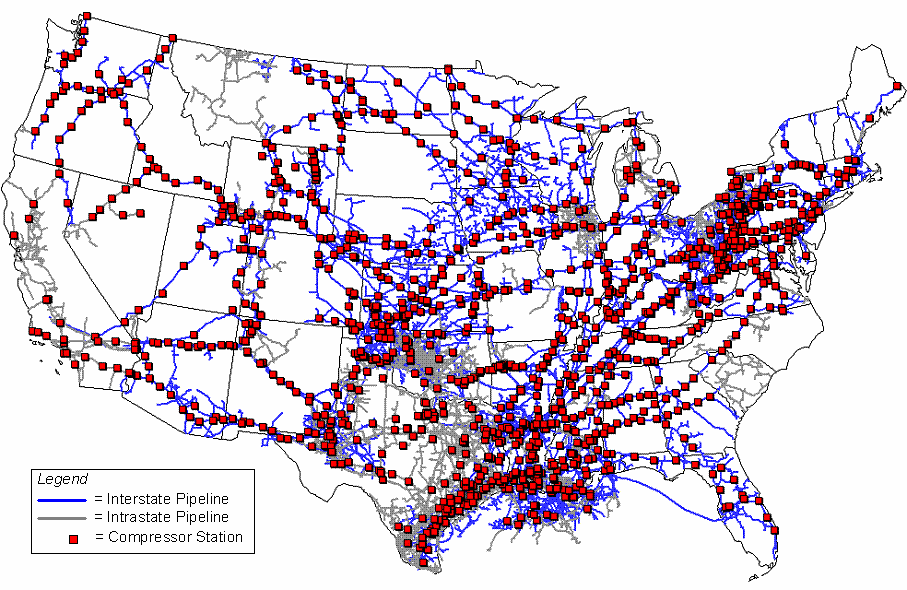
Fracking has been in use for a number of years throughout the U.S., particularly in the Southwest. Five natural gas sites border the town of Dish, Texas, in a quarter-mile complex. In nearby Fort Worth, Texas, 1,400 wells have been drilled in urban areas, many near schools and residential centers.

Speaking at a meeting at Temple University’s Department of Civil and Environmental Engineering on April 16, Dish Mayor Calvin Tillman described how carcinogenic air pollution from natural gas drilling has damaged the quality of life in his town of 180 residents. The town sits atop the Barnett Shale, a geological formation similar to the Marcellus Shale.

Using his own money, Tillman has been traveling to Pennsylvania and New York to warn about the dangers of the gas boom. In his small town, trees are dying on a 30-acre farm that adjoins a labyrinth of small underground pipelines used to transport fuel from the fracking wells to outside markets. Horses have also fallen ill. Residents report problems with frequent nausea, severe headaches, breathing difficulties, chronic eye irritation, allergies, throat irritations and even brain disorders.

When Texas state inspectors, who are usually linked to the drilling companies, reported they could not find any problem with the wells, Dish town officials hired an environmental firm to collect one-day air samples near the compressors. Their study found high levels of 15 chemicals, including benzene, a known carcinogen. As a result the Texas Commission on Environmental Quality conducted air studies at 94 sites in the region. They found two sites with very high levels of benzene and 19 others with levels that raised concern.

In April, blood and urine testing of 28 adult Dish residents revealed that half the residents had slightly elevated levels of benzene and other contaminants. Four residents tested positive for benzene, including Tillman. Tillman noted that no testing was done on children, pregnant women or the elderly — groups likely to be most susceptible to the contaminants. Tillman’s water also tested positive for traces of styrene, ethyl benzene and xylene.

Growing concern over the danger of fracking has led to a push for legislation in Pennsylvania that would require drillers to disclose chemical ingredients in hydraulic fracturing fluids. Other proposed legislation calls for a moratorium on drilling until environmental impact studies can be performed. Both bills have yet to be passed and face mounting opposition from the natural gas industry.

Nationally, the oil and gas industry won exemption from major provisions of the Safe Drinking Water Act, the Clean Water Act and other federal environmental laws with the passage of the 2005 Energy Bill. The bill’s “Halliburton loophole” protected the company from having to reveal the composition of their fracturing fluid, despite the fact that the list of hazardous substances compiled by the Environmental Protection Agency’s Superfund — the program established to address abandoned hazardous waste sites — includes toxic profiles on benzene, styrene, toluene and other agents known to be in the mix. Efforts are also underway to challenge this legislation.

The EPA announced it will spend $4.4 million to start a study on the impact of fracturing in October, but Dr. Michel Boufadel, director of the Environmental Hydrology and Hydraulics Laboratory at Temple University College of Engineering, expressed concerns that the EPA’s study does not go far enough.

Speaking at the April 16 meeting, Boufadel noted that very few scientific studies on fracking have been conducted by researchers not connected to the drilling industry. He also pointed out that most studies assume that any leak of water contaminated by fracturing fluids would spread horizontally from a holding tank and be detected by ground level monitors.

Boufadel explained that the 250 chemicals contained in the fracturing fluid create “gooey, high density water” — a gel that suspends the sand particles needed to work into cracks in the shale layers. The result is “radioactive water six times more saline than sea water and containing known carcinogens.”

“If you don’t account for this heavy density you would expect water to move outward, but the reality is that it moves down,” Boufadel stressed. “If you only use existing traditional models of monitoring wells at ground level, you won’t detect contamination until it’s too late.”

LINK


Articles copyright 1995-2010 Workers World. Verbatim copying and distribution of this entire article is permitted in any medium without royalty provided this notice is preserved.

DEMAND ACCOUNTABILITY!

Wednesday, February 3, 2010

Scientists search for the best treatment

Industry needs effective way to handle frac water

By DAVID THOMPSON
(Williamsport, PA) sungazette.com
February 1, 2010

Pennsylvania has its work cut out for it regarding the treatment and disposal of flowback fluids from drilling in the Marcellus Shale, it was revealed during a summit Friday at Lycoming College.

That was one of several topics discussed at "The Science of the Marcellus Shale" summit, a daylong event sponsored by the college's Clean Water Institute, the Susquehanna Heartland Coalition for Environmental Studies, Northcentral Pennsylvania Conservancy and Foundation for Pennsylvania Watersheds.

...

The gas industry requires large amounts of water - several million gallons per well - to extract gas from the Marcellus Shale.

Although much of that water will remain in the ground, the industry still faces challenges in finding efficient and cost effective ways to treat and dispose of the water that does return to the surface.

Each well drilled in the Marcellus Shale will produce from 200,000 to 1 million gallons of flowback water, according to Tim Keister, founder and chief chemist of Brockway-based ProChem Tech, a company that makes chemicals for wastewater treatment.

Treatment capacity limited

The capacity for treating that water in Pennsylvania is limited, Keister said.

Frac water is water with a number of materials added to it, he said. The most problematic of the ingredients is a biocide used to prevent micro-organisms from growing in the well, he said.

"Biocides kill things," Keister said.

Unfortunately, there is "a big shortfall" in the state's capacity to treat gas drilling wastewater," Keister said.

The industry will produce an estimated 7 billion gallons of wastewater a year, while the state's capacity for handling the water is about 550 million gallons - 6,450 million gallons "you have to find a home for," he said.

Treatment technologies include pretreatment so conventional wastewater treatment processes can efficiently treat the waste; chemical precipitation, which involves adding chemicals to the wastewater to form particles that settle and remove contaminants; and evaporation, an expensive process.

Marcellus Shale flowback water contains very high levels of salt, which cannot be removed through normal wastewater treatment processes, said Kevin Gilmore, a professor at Bucknell University.

Gilmore discussed technologies being explored to treat flowback water, such as a process in which the water is pushed through a non-porous membrane and permeates through the other side. It is yet to be seen if the process can be applied on a scale that can benefit the gas industry, he said.

A similar process, reverse osmosis, is energy intensive and does not get water to the point at which it can be discharged, he said.

Richard Adams, senior environmental adviser for Texas-based Chief Oil and Gas, said his company has drilled 45 wells in the shale, 13 of which are producing commercially. The company has 550,000 acres leased in the shale region, he said.

The company is withdrawing about 100,000 gallons of water a day from various creeks and public water supplies in the area, Adams said.

An average of about 20,000 gallons of wastewater must disposed of each day, he said. The wastewater is treated at a public treatment facility in Sunbury and at a private facility in Williamsport, where it is pre-treated before being discharged into the city sanitary sewer system.

Adams, who worked for more than 30 years for the state Department of Environmental Protection, said managing gas industry wastewater is complicated. Wastewater can be pre-treated, treated at a high-tech centralized treatment facility, treated on-site by a mobile treatment facility or, in the case of solids removed from the water, buried in an approved landfill.

Because it is expensive to transport wastewater to treatment facilities, gas companies are looking more and more to recycling and reusing the water, Adams said.

Recycling can save gas companies "tens of thousands of dollars ... per well," he said.

To recycle flowback water, it is kept at the well pad, reconditioned with an additive and reused to frac the next well by blending it with fresh water, he said.

Recycling and reuse is the least expensive method of dealing with wastewater, Adams said. However, there are concerns using recycled frac water to stimulate a well may adversely impact the well's production capabilities.

Adams said the majority of Chief's drilling operations are using flowback recycling "in one form or another."

Recycling also reduces the industry's need for fresh water, he said.

"You are going to see increased levels of reuse," he said. "It just makes sense."

Even with recycling, there still will be a need to treat and dispose of frac water and materials removed from the water, he said. A time will come when recycled water is no longer fit to be used, or there may not be another well ready to be fraced.

Although there are several options available to treat and dispose of flowback, one that is not available is injection wells.

The state's injection wells simply do not have the capacity for the large volume of flowback fluids anticipated from developing the Marcellus Shale, said Karen Johnson, chief of Groundwater and Enforcement Branch of the U.S. Environmental Protection Agency's Underwater Injection Control Program. The EPA oversees the underground injection well program in Pennsylvania, she said.

Private well testing urged

Bryan Swistock of Penn State Cooperative Extension discussed private water well testing. There are about 3 million property owners in the state who use a private well or spring as a drinking water supply, Swistock said.

Swistock said the extension has been "begging and pleading" for homeowners to have their water tested, but not many did. Since the Marcellus Shale began being developed, 2 million wells have been tested, he said.

Depending on what a homeowner desires, testing can be inexpensive or cost hundreds of dollars "to have everything tested," he said.

Swistock said a good basic and inexpensive test could include total dissolved solids, pH content, chloride and methane.

Swistock said homeowners should learn where and when drilling will occur and then monitor their wells if it is occurring nearby. They should understand the type of testing they should have done, he said.

"Focus on what is most likely to occur for the least cost," he said.

According to Swistock, if a private water supply within 1,000 feet of a gas well becomes adversely impacted within six months of the well being drilled, the law automatically presumes the gas well caused the problem.

However, the homeowner must have had the well tested by an independent lab prior to the well being drilled, he said.

No "presumed responsibility" law exists regarding a stream, pond or lake, Swistock said. However, a landowner can stipulate those protections into a gas lease.

Concerns about water treatment are coupled with concerns about the amount of water the industry needs to develop the shale.

The Susquehanna River Basin Commission is a multi-state compact that regulates and enforces water withdrawal and consumptive use of water in the states in the watershed.

Consumptive use is defined as any use in which water is not returned to its source.

The commission requires a permit for the consumption of an average of 100,000 gallons per day over 30 days, according to Jennifer Hoffman, of the commission.

That rule applies to any person or industry wishing to use that amount of water, Hoffman said. No such threshold exists for gas development in the Marcellus Shale.

"For Marcellus activities, we start regulating at drop one," Hoffman said.

So far, all permits issued for withdrawal by gas companies has been for surface water, such as streams, lakes and rivers, Hoffman said. No groundwater withdrawal permits have been issued.

For a permit to be issued, an environmental screening must be performed to determine whether the withdrawal will impact the body of water.

The commission also has water intake standards to prevent fish from being drawn into the intake pipes and metering plans to ensure companies withdraw only the amount permitted, Hoffman said.

Allowed withdrawals are based on what is called "Q 7,10" - or the lowest average flow a stream could experience over seven consecutive days during a 10-year span. Only a fraction of the Q 7,10 level for any given body of water can be withdrawn, Hoffman said.

Certain high-quality streams, particularly coldwater trout streams, have an assigned "passby level," which protects streams during times of low volume. Passby is the level of water flow that must be maintained downstream from an intake pipe, Hoffman said.

Once a stream reaches the predetermined passby level, "water can't be withdrawn anymore," she said.

Although the gas industry requires large amounts of water, the total used by the entire industry pales in comparison to a single nuclear power plant, which can use more than 40 million gallons of water every day, Hoffman said.

Trout stream worries

Deb Nardone, of the Pennsylvania Council of Trout Unlimited, said many of the organization's members are concerned about the industry's impact on trout stream habitat.

The organization's position on gas exploration is "let's do it, but let's do it right," Nardone said.

"We understand (gas) is not going away ... and it will require a whole lot of water," she said.

Nardone said the presence of trout in a stream is "the canary in the coal mine" that can be indicative of a healthy ecosystem.

Better regulatory protections are in place for trout streams and connected wetlands, Nardone said.

There are concerns withdrawing water may open a stream up to invasive species and diseases transported from tanker trucks from one stream to another.

There also are concerns with withdrawing water during certain times of the year, such as when eggs are being incubated or trout are spawning, she said.

Nardone said the organization is recommending seasonal restrictions on water consumption, technologies and methods to reduce consumption, mandatory flow monitoring devices, assessing streams prior to withdrawals, metered intakes, water pumps designed to prevent stream disturbance and fish mortality, and disinfection protocols to prevent the spread of disease and invasive species.

To read more, CLICK HERE.

DEMAND ACCOUNTABILITY!

Wednesday, January 20, 2010

Hold the salt, if you please


The snow was beautiful, so beautiful. The salt dumped on sidewalks and roads to de-ice it was dangerous, so dangerous. "Chloride concentrations are increasing at a rate that threatens the availability of fresh water in the northeastern U.S.," according to Dr. Sujay Kaushel, who will speak at an event open to the public at the Philadelphia Water Department, 1101 Market Street, 5th Floor, on Thursday, January 21st. His lunchtime presentation is at 12 noon this Thursday; doors open at 11:30 AM.

This extraordinary salinization of fresh rivers and streams coincides with the ongoing drilling of the Marcellus Shale for natural gas. Marcellus Shale wastewater comes up from deep underground full of toxic contaminants ranging from arsenic and benzene to 2-butoxyethanol, methanol, and radium 226. It is also three to six times saltier than the ocean. Although Pennsylvania has no plan to treat this wastewater safely, drilling permits are being fast-tracked by the Department of Environmental Protection, which benefits from permit fees. It is currently legal to use Marcellus Shale waste brines to de-ice roads in Pennsylvania, according to the watchdog environmental group Damascus Citizens for Sustainability.

Dr. Kaushel reports, "Increases in roadways and deicer use are now salinizing fresh waters, degrading habitat for aquatic organisms, and impacting large supplies of drinking water for humans throughout the region." Dr. Sujay Kaushal is a scientist with Chesapeake Biological Laboratory, University of University of Maryland Center for Environmental Science (no relation to the multinational energy corporation, Chesapeake Energy).

"Our analysis shows that if salinity were to continue to increase at its present rate due to changes in impervious surface coverage and current management practices, many surface waters in the northeastern U.S. would not be potable for human consumption and would be toxic to freshwater life within the next century," concludes an online summary of the Laboratory’s findings. At the Thursday, January 21 event at the Philadelphia Water Department, Dr. Kaushel will also discuss new results "regarding the effects of increasing climate variability/change on road salt dynamics, and the effects of road salt on stream and river restoration efforts."

More information, and pre-registration, regarding this event, "Increased salinization of freshwater in the northeastern U.S.," is available online from the American Water Resources Association at awra-pmas.memberlodge.org – go to "view events."

Connecting The (Salty, Toxic) Dots

Ordinary citizens are not invited to testify at the PA Senate Committee on Environmental Resources and Energy hearing on Marcellus Shale waste treatment in Harrisburg on January 27, 2010 at 9 AM. Only the Marcellus Shale industry, state DEP officials, and one environmental group are invited to testify. However, this hearing is open to the public. It will be the last public governmental meeting to take place before the regulations which will determine Pennsylvania’s water quality standards for years to come are put into place. Marcellus waste also releases hazardous pollutants into the air. Citizens may attend the hearing and may also submit written [email] testimony to: energy@pasen.gov

Separately, the Department of Environmental Protection is also accepting written testimony regarding clean water standards in the state of Pennsylvania. The DEP does not plan to test for the majority of toxic chemicals present in Marcellus Shale wastewater (it may not test for any, depending on which standards it adopts). Marcellus Shale waste is exempt from federal environmental standards due to the "Halliburton Loophole" passed in 2005. The public comment period closes in early February; details are available from Clean Water Action.

In the name of Life Itself, DON'T SIT IDLY BY!!! WRITE to the PA Senate Committee on Environmental Resources and Energy AND to the DEP!

DEMAND ACCOUNTABILITY!

RURAL IMPACT VIDEOS, 6 parts

Natural gas development in Colorado, the impacts on communities, environment and public health. A primer for public servants and residents of counties that care for their lifestyles.

Drilling for Gas in Bradford County, PA ... Listen!

Cattle Drinking Drilling Waste!

EPA... FDA... Hello? How many different ways are we going to have to eat this? ... Thank you TXSharon for all you do! ... Stay tuned in at http://txsharon.blogspot.com

Landfarms

A film by Txsharon. Thank you Sharon for all you do. Click HERE to read the complete article on Bluedaze: Landfarms: Spreading Toxic Drilling Waste on Farmland

SkyTruth: Upper Green River Valley - A View From Above