Showing posts with label STATE FORESTS. Show all posts

Monday, May 10, 2010

Hydraulic fracking spells disaster

Workers World
May 6, 2010

Despite industry claims that the rapidly expanding practice of hydraulic fracturing to extract natural gas from deep underground shale layers is “perfectly safe,” on April 15 the Pennsylvania Department of Environmental Protection fined Houston-based Cabot Oil and Gas $240,000 for causing the contamination of 14 residential water wells in Dimock Township, Pa.

The company was also ordered to plug three gas wells it was operating in the town, which sits atop the Marcellus Shale formation, and was banned from drilling in the area. One water well in Dimock exploded last year, and DEP inspectors witnessed gas bubbling up at the base of eight other wells in March. Despite the ruling, Cabot has plans to drill 100 new wells in Dimock this year.

Independent newsroom ProPublica has reported on 50 similar cases across Pennsylvania, including reports of fish kills, water and air pollution, fires, out-of-control flaring, human illnesses and animal deaths.

The concern over the safety of hydraulic fracturing has prompted calls for a moratorium on drilling in Pennsylvania. In the process, often referred to as fracking, 2 to 9 millions of gallons of water, mixed with sand and up to 250 chemicals, are pushed into underground shale layers to release natural gas.

In January the Pennsylvania state Legislature opened up 32,000 additional acres of state forest land to be leased for drilling. As a result, 692,000 acres of the 2.1 million acres of state forest land are now open for gas wells. During a recent push to expand the practice into the Delaware River basin, the Philadelphia City Council was pressured to pass a resolution on March 25 calling for an environmental impact statement before any new permits are issued.

Fracking has been in use for a number of years throughout the U.S., particularly in the Southwest. Five natural gas sites border the town of Dish, Texas, in a quarter-mile complex. In nearby Fort Worth, Texas, 1,400 wells have been drilled in urban areas, many near schools and residential centers.

Speaking at a meeting at Temple University’s Department of Civil and Environmental Engineering on April 16, Dish Mayor Calvin Tillman described how carcinogenic air pollution from natural gas drilling has damaged the quality of life in his town of 180 residents. The town sits atop the Barnett Shale, a geological formation similar to the Marcellus Shale.

Using his own money, Tillman has been traveling to Pennsylvania and New York to warn about the dangers of the gas boom. In his small town, trees are dying on a 30-acre farm that adjoins a labyrinth of small underground pipelines used to transport fuel from the fracking wells to outside markets. Horses have also fallen ill. Residents report problems with frequent nausea, severe headaches, breathing difficulties, chronic eye irritation, allergies, throat irritations and even brain disorders.

When Texas state inspectors, who are usually linked to the drilling companies, reported they could not find any problem with the wells, Dish town officials hired an environmental firm to collect one-day air samples near the compressors. Their study found high levels of 15 chemicals, including benzene, a known carcinogen. As a result the Texas Commission on Environmental Quality conducted air studies at 94 sites in the region. They found two sites with very high levels of benzene and 19 others with levels that raised concern.

In April, blood and urine testing of 28 adult Dish residents revealed that half the residents had slightly elevated levels of benzene and other contaminants. Four residents tested positive for benzene, including Tillman. Tillman noted that no testing was done on children, pregnant women or the elderly — groups likely to be most susceptible to the contaminants. Tillman’s water also tested positive for traces of styrene, ethyl benzene and xylene.

Growing concern over the danger of fracking has led to a push for legislation in Pennsylvania that would require drillers to disclose chemical ingredients in hydraulic fracturing fluids. Other proposed legislation calls for a moratorium on drilling until environmental impact studies can be performed. Both bills have yet to be passed and face mounting opposition from the natural gas industry.

Nationally, the oil and gas industry won exemption from major provisions of the Safe Drinking Water Act, the Clean Water Act and other federal environmental laws with the passage of the 2005 Energy Bill. The bill’s “Halliburton loophole” protected the company from having to reveal the composition of their fracturing fluid, despite the fact that the list of hazardous substances compiled by the Environmental Protection Agency’s Superfund — the program established to address abandoned hazardous waste sites — includes toxic profiles on benzene, styrene, toluene and other agents known to be in the mix. Efforts are also underway to challenge this legislation.

The EPA announced it will spend $4.4 million to start a study on the impact of fracturing in October, but Dr. Michel Boufadel, director of the Environmental Hydrology and Hydraulics Laboratory at Temple University College of Engineering, expressed concerns that the EPA’s study does not go far enough.

Speaking at the April 16 meeting, Boufadel noted that very few scientific studies on fracking have been conducted by researchers not connected to the drilling industry. He also pointed out that most studies assume that any leak of water contaminated by fracturing fluids would spread horizontally from a holding tank and be detected by ground level monitors.

Boufadel explained that the 250 chemicals contained in the fracturing fluid create “gooey, high density water” — a gel that suspends the sand particles needed to work into cracks in the shale layers. The result is “radioactive water six times more saline than sea water and containing known carcinogens.”

“If you don’t account for this heavy density you would expect water to move outward, but the reality is that it moves down,” Boufadel stressed. “If you only use existing traditional models of monitoring wells at ground level, you won’t detect contamination until it’s too late.”

LINK


Articles copyright 1995-2010 Workers World. Verbatim copying and distribution of this entire article is permitted in any medium without royalty provided this notice is preserved.

DEMAND ACCOUNTABILITY!

Monday, April 26, 2010

Help Save PA's Wild Forests


By David Masur, PennEnvironment Director
NorthcentralPA.com
April 26, 2010

From Pennsylvania's Sproul State Forest to Tioga State Forest (home to the Pennsylvania Grand Canyon), our state forests are well-known destinations for hiking, fishing, camping and other outdoor activities.

Most Pennsylvanians would be shocked to hear that they're often sold off to the highest bidder for destructive practices that will do irreparable harm to our forests. It's sad but true -- dangerous gas drilling is placing hundreds of thousands of acres of Pennsylvania forestland at risk.

This week the Legislature is deciding whether to protect our remaining state forestlands from gas drilling. Click here to help make sure our state representatives make the right choice for our state forests today.

Already, state officials have opened up 700,000 acres of our state forests for gas drilling in the Marcellus Shale region -- that's more than 40 percent of our forests over the Marcellus Shale.

More drilling means more roads, pipelines, wells and trucks in our state forests, destroying habitat and polluting our streams.

Luckily, there is a proposal to halt further gas drilling leases in our state forests. If passed, House Bill 2235 will implement a 5-year moratorium on further drilling leases in our state forests.

HB 2235 is expected to be voted on this week. Without your support for this bill, the trend of selling off our state forests to the highest bidder may continue. Let's make sure that we keep our forests protected now and for future generations of Pennsylvanians. Click the link below to e-mail your state representative today -- and help protect Pennsylvania's state forests. http://www.pennenvironment.org/action/our-natural-heritage/moratorium?id4=ES

DEMAND ACCOUNTABILITY!

Tuesday, April 20, 2010

Pittsburgh protesters call for Marcellus freeze, severance tax

By Rick Stouffer,
PITTSBURGH TRIBUNE-REVIEW
Tuesday, April 20, 2010


Protesters gathered Downtown today to lobby Gov. Ed Rendell and state lawmakers to freeze new Marcellus Shale drilling leases in state forests and pass a severance tax on removing natural gas from Pennsylvania land.

"It's time for the governor and the Legislature to step up and protect the most environmentally sensitive areas of state forestlands," said Jan Jarrett, CEO of Citizens for Pennsylvania's Future, or PennFuture — sponsor of the "Save the Forest" rally outside Piatt Place on Fifth Avenue.

...

Rendell proposed the severance tax in February 2009, but it was pulled from consideration in September because the governor said he wanted to give the fledgling Marcellus Shale industry time to get its "sea legs."

But in January, Rendell, faced with a projected $450 million revenue deficit for fiscal 2010-11, said he wants to raise at least $100 million a year from the tax on drilling, to take effect in July. Last year, Rendell proposed a 5 percent tax at the wellhead and 4.7 percent on every 1,000 cubic feet of gas produced.

Jarrett said ... the money is needed by communities impacted by Marcellus activity, for environmental protection and to help fund the state game commission and fish and boat commission.

...

Jim Shantz of Zelienople, Butler County, said he has seen the drawbacks of strip mining and supports the requested changes.

"We're now as taxpayers paying for those problems," he said. "As citizens of the state, I don't think we have to pay to reclaim the lands impacted by drilling or for the huge amount of water drilling requires."

LINK

Hard-working, law-abiding, tax-paying citizens are being asked to enable or bail out high-handed, covert and greedy corporate/industrial gambles time and again these days, bringing every kind of ruin down on our society. It's about time our government represented us, 'the people' it was designed to serve, and put some meaningful safeguards in place to protect our quality of life and the world we live in and leave to our children. -Splashdown

DEMAND ACCOUNTABILITY!

Thursday, April 1, 2010

Contaminated mud from Marcellus Shale gas drilling spills in state forest; Rendell may be changing mind on additional leasing


posted by Isaiah Thompson


Just a week ago, the Pennsylvania House of Representatives passed a budget which relies on more than $100 million in revenue from new leasing of state forest for drilling in the Marcellus Shale (a third of the state forest has already been leased for drilling).

That decision, as I reported in February, ran contrary to the advice of former Department of Conservation and Natural Resources secretary Michael DiBerardinis, who warned shortly before resigning that further leasing would "scar the economic, scenic, ecological, and recreational values of the forest," as well as overburden the Department's limited staff.

Among the dangers associated with Marcellus Shale drilling is the potential for spills — a danger heightened by the rapid pace at which the industry has developed.

Yesterday, the Scranton Times-Tribune reported that 8,000 to 12,000 gallons of contaminated mud were spilled at Sproul state forest in Clinton County, Pa. — a site operated by Anadarko E&P Co. Inc. that was part of the governor's most recent lease of forest land for drilling, in January.

While about half of the mud spilled over the boundary of the well pad, it didn't spread far enough to contaminate any surface waters, ground water or wetlands in the area, said Mr. Spandoni. A contractor began cleanup work Friday night. DEP officials have taken mud samples to determine a proper disposal method.

The mud is used as a cooling agent in drilling operations. Since the mud that spilled is synthetic-based, it doesn't contain any diesel fluids as some other agents do, said Mr. Spandoni.

Comforted yet?

(Uh-oh. Uh-oh. Did he say DIESEL fluids???)

This certainly isn't the first case of "errors" resulting from hydraulic fracturing operations: There were 56 "illegal discharges" in 2008 and 2009.

...

These spills resulted in impacts to Alex Branch and Little Laurel Run streams, which are wild trout fisheries, and a freshwater spring used by local hunters.

Representative Greg Vitali, working with a coalition of environmentally-minded House representatives, has sponsored a bill calling for a moratorium on the leasing of more state land for drilling.

Despite what he says was a deal made between House "green dog" Democrats, who opposed such leasing, House leadership, and Governor Ed Rendell, the governor came out in favor of leasing additional land for this year's budget.

But, according to the Times-Tribune, he was singing a different tune yesterday:

Mr. Rendell expressed optimism Monday the state can meet next year's revenue target without leasing additional acreage of state forest land. He said more details will be forthcoming. Mr. Rendell also said for the first time he supports a moratorium bill.

If this is true, it's big news. Maybe Rendell has decided he doesn't want his legacy to have been pillaging the state forest to plug budget holes, after all.

(Or, Splashdown wonders... maybe he's catching on that it's pointless to try to play ball with an industry that doesn't play ball with anybody... maybe he feels had. Heh.)
LINK

DEMAND ACCOUNTABILITY!

Saturday, March 27, 2010

PA Forests 'Significantly Threatened' by Gas Drilling

Vote on Rep. Vitali’s 5-year Moratorium Expected this Week
By Iris Marie Bloom
Philadelphia Weekly Press
24.MAR.10

The Pennsylvania legislature may vote this week to allow Governor Rendell to force the Department of Conservation and Natural Resources (DCNR) to lease yet another huge chunk of Pennsylvania state forests. At a Temple University teach-in attended by over 200 people last Thursday, DCNR Secretary John Quigley stated that Pennsylvania’s forests are "significantly threatened by this uncontrolled gold rush to extract natural gas from the Marcellus Shale."
The forest land already leased is one third of all Pennsylvania’s state forest land. All the state forest land left is sensitive and deserves special protection, according to the Pennsylvania Forest Coalition, PennFuture, Trout Unlimited, and other members of a wide-ranging coalition springing up to defend Pennsylvania’s forests and rivers.
Pennsylvania Representative Greg Vitali (D-Delaware) has introduced a resolution, HB 2235, which would require a five-year moratorium on any further leasing of forest lands. Supporters have become more vocal and active this week, expecting the vote any day. In a March 22nd editorial, "Stop, Look, Assess Drilling’s Full Effects," the Pocono Record advocated for HB 2235: "Pennsylvania should not risk the integrity of the beautiful forests that gave the state its name… Pennsylvania has already leased…a whopping 700,000 acres. Let’s see how that goes before opening the remainder of this valuable public land to energy companies." Over 145 people attended a Poconos forum on Marcellus Shale drilling last month, sponsored by the League of Women Voters out of growing concern about forest fragmentation, water quality and other impacts.

Vitali’s bill would also authorize DCNR, rather than the governor, to decide whether to authorize further drilling after the five-year moratorium.

Legislators not particularly known for environmental advocacy may favor the moratorium for economic reasons: tourism is Pennsylvania’s second most lucrative industry, and that’s not all about people standing in line to see the Liberty Bell. According to the Appalachian Mountain Club, Pennsylvania has more maintained hiking trails than any other state.

The Pocono Record commented, "Responsible legislators also must weigh [shale gas drilling’s] substantial risks, which include chemical spills, water pollution, the incursion of new roads in pristine remote land and heavier traffic in rural areas. Our legislators have a sworn duty to protect Pennsylvania’s natural resources." The Record concluded, "Don’t let our historic forests become a cash cow for drillers."
LINK to complete article.

DEMAND ACCOUNTABILITY!

Saturday, March 13, 2010

Lawmakers urge against Marcellus Shale permits

...and propose a heartening series of environmentally proactive bills for Pennsylvania

Alex Rose
Main Line Media News
March 12, 2010


State Rep. Greg Vitali, D-166, of Haverford, recently joined legislators and environmentalists asking that Gov. Ed Rendell stop granting permits to drill in state forest land over the Marcellus Shale region, a huge deposit of natural gas lying under much of the state.
“We already have made available 692,000 acres and there could potentially be thousands of wells drilled to extract the gas,” said Vitali in a release. “We cannot lease any further state forest acreage without encroaching on the most sensitive lands, which include old-growth forests, habitat for endangered species and fragile ecosystems.”
Rendell spokesman Gary Tuma previously said a requirement of passing the last state budget was generating enough recurring revenue to help balance the budget for two fiscal years. That included $180 million worth of drilling leases in the 2010-11 budget, he said.

Vitali has entered legislation that would place a five-year moratorium on those leases. The State Forest Natural Gas Lease Moratorium Act would also confer sole discretion for additional leases to the state Department of Conservation and Natural Resources when the moratorium ends, and would require the DCNR to conduct an annual report on the impact gas drilling has on state forests.

State Rep. Bryan Lentz, D-161, of Swarthmore, meanwhile, introduced his own legislation this week that would establish a severance tax on natural gas and put the proceeds toward tax exemptions for green businesses.

Lentz’s bill would authorize the state Department of Community and Economic Development to establish 15 Keystone Green Zones in the state, similar to the Keystone Opportunity Zones that offer businesses a bevy of tax breaks for setting up shop.

In this instance, those breaks would go to businesses that manufacture energy-efficient products or products used in the renewable energy industry.

“I am proposing that we give companies a financial incentive to do business in Pennsylvania, which will produce good-paying jobs and brand the state a hot spot for this growing industry,” said Lentz, a Democratic candidate in the 7th Congressional District. “All the while, we’ll be reducing our impact on the environment and surrounding communities, and improving the quality of life for residents across Pennsylvania.”

Environmental attorney Gail Conner, another Democratic contender in the 7th Congressional District, also called for the closure of the so-called “Halliburton loophole” in the Safe Drinking Water Act that bars the Environmental Protection Agency from regulating hydraulic fracturing being used to mine natural gas in the Marcellus Shale region.

“The Safe Drinking Water Act in its current form allows the oil and gas industry to inject ‘undisclosed’ hazardous materials directly into or adjacent to our nation’s water supplies during the process of fracturing rock through drilling to release gas reserves,” said Conner. “These fracturing fluids pose a potential threat to human health and drinking water supplies.”

Like Vitali, Conner is calling for the restoration of jobs cut at the DEP and DCNR last year, as well as a moratorium on drilling leases.

She has also proposed a slew of permit application requirements, including full disclosure of chemicals used in fracking, and specifying locations for the source of water used and disposal of waste water.

Conner also said the public needs to be informed of a spill or other contamination within 24 hours and some financial remedy should be available for residents whose property is damaged by drilling.

“Protecting our environment and natural resources, and providing a voice for the residents in our communities, should not take a back seat to special interests,” said Conner. “The citizens of the commonwealth have a state constitutional right to clean air and water. I hope that our state leaders will uphold those rights intended to protect the citizens and our communities.”
LINK to source.

Commentary by Splashdown in red.

DEMAND ACCOUNTABILITY!

Monday, February 22, 2010

Gas well foes vow to fight Rendell!

Lawmakers line up against governor's forest leasing plan
Monday, February 22, 2010

A caucus of 37 "green dog" and "hunting dog" legislators is barking mad about a Rendell administration budget proposal that would seek to raise $180 million by leasing more state forest land for Marcellus shale gas well drilling.

State Rep. David Levdansky, D-Forward, said the pro-environment and pro-hunting Democratic legislators in the conservation caucus are strongly opposed to leasing what could be another 50,000 to 80,000 acres of the state's forests for deep gas drilling beginning in July and will not compromise that position in upcoming budget negotiations.

"We're doing everything we can to stop this," said Mr. Levdansky, a member of the House Game and Fisheries Committee and chairman of the House Finance Committee. "To me this could be the worst environmental catastrophe I've seen in my 25 years in Harrisburg."

In a Feb. 3 letter to the governor, the legislators called for a moratorium on state forest land leasing until the "long-term environmental, fiscal, economic and social impacts" are studied and reviewed and requested a meeting with the governor on the issue.

According to the legislator's letter, at least 100 wells already are slated for drilling in state forests this year. And another 1,500 well pads containing 5,000 to 6,000 wells could be drilled in the next 10 years on the forest land leased in the last two years.

Mr. Levdansky said the proposed widespread drilling will fragment the forests with a checkerboard of drilling pads, pipelines and service roads, make the forests more susceptible to disease, damage endangered species habitat and allow invasive species to enter the state's forest ecosystems.

"Our state forests are the envy of the other states in the nation, a wonderful system, and now the governor wants to open them up for a short-term revenue gain. It's a travesty," he said.

Last year the state leased almost 32,000 acres of state forest land for gas well drilling, raising $60 million for the general fund and $68 million to the oil and gas fund. In 2008 the state broke a five-year moratorium on forest land leasing and auctioned off 74,000 acres of drilling rights for $166 million.

All told, a total of 660,000 acres of the state's 2.1 million-acre forest system already have already been leased for both shallow and deep gas and oil drilling.

Gary Tuma, a spokesman for the governor, said the plan to lease more state forest land was part of a two-year deal on gas rights leasing agreed to by the state's Republican and Democratic legislative caucuses last fall to generate needed general fund revenues. He said the governor agreed to it after the Legislature failed to support proposals to increase the personal income tax and a severance tax on natural gas from the Marcellus shale.

"The governor wasn't excited about leasing the state forest land," Mr. Tuma said. "But the decision has been made absent some other alternative revenue source."

But Mr. Levdansky said that, although the governor asked for a second year of forest leases in last year's budget negotiations, House Democratic leaders did not agree to that.

"If the governor isn't excited about leasing more forest land he shouldn't do it," Mr. Levdansky said. "He has other options. Let's get serious about putting a gas severance tax in place, that according to the governor could bring in $160 million to $180 million next year."

The legislators' letter praised the governor for once again supporting a severance tax on natural gas pumped from the Marcellus shale and said they would "fervently support" enactment of that tax. Mr. Rendell originally supported such a tax early last year but dropped his support during budget negotiations in the fall. Thirty-nine other states impose such a tax.

About 1.5 million acres of the 2.1 million acres of state forests are in the "Marcellus Zone" above the 5,000- to 8,000-foot-deep shale layer that underlies three-quarters of the state and could hold as much as 363 trillion cubic feet of natural gas, enough to supply U.S. gas demands for 10 to 15 years.

Last month, Trout Unlimited, a national fishing and conservation organization, criticized Pennsylvania for last year's lease of 32,000 acres, calling it a "failure to protect public resources" that could have a detrimental effect on fish and wildlife habitat.

"We have already seen detrimental effects to water quality on our state forests and find this unacceptable," David Rothrock, president of the Pennsylvania Council of TU, said in a press release last month. "The state budget should not be balanced at the expense of hunters and anglers."

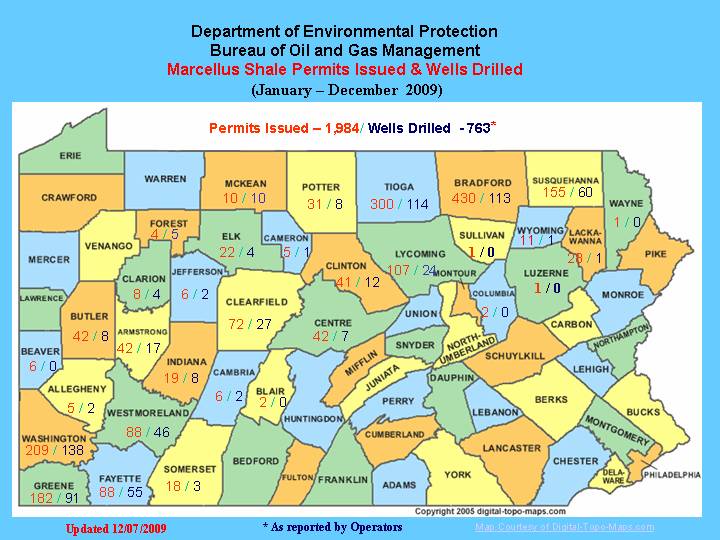
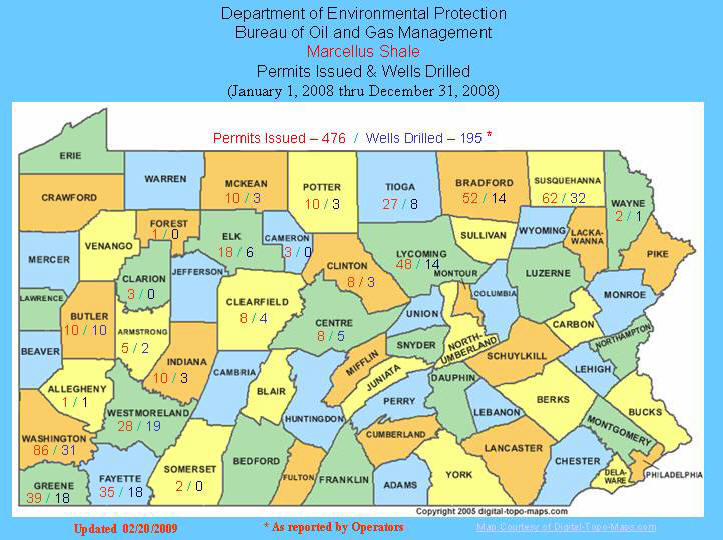
Statewide, approximately 2,500 Marcellus shale gas well drilling permits were issued from 2007 through 2009 by the state Department of Environmental Protection, which projects another 5,000 permits will be issued this year.

Developing the gas could bring billions of dollars into the state and create thousands of jobs, according to the gas industry and some state officials.

LINK

DEMAND ACCOUNTABILITY!

Sunday, February 14, 2010

The Marcellus Memos: Privately, Rendell’s State Forest tsars expressed deep concern over leasing state forest for drilling


A few days ago, we reported (and the Inquirer re-reports today) that Governor Rendell is considering authorizing yet another lease of state forest land for drilling into the Marcellus Shale, a geologic structure containing billions (if not trillions) of dollars worth of natural gas.

If he does, it will be the third such sale in three years –before 2008, state land hadn't been leased for drilling since 2002.

There are a few reasons to ask whether this is a good move. For one thing, fully one-third of our state forest has already been leased for drilling. For another, while only four Marcellus wells are currently active on forest land right now, at least 40 wells are expected to be in production by the end of the year and DCNR officials say that we could see over a thousand in the next decade – all that on land already leased.

We have, in other words, barely begun to see what impact drilling will have on the state forests already leased – leasing even more of it now could be risky indeed.

But don't take my word for it: Rendell's own state forest officials have made their concerns very clear – albeit mostly in private.

Memos and emails obtained by City Paper show that both former DCNR Secretary Michael Diberardinis and Acting Secretary John Quigley have repeatedly cautioned Rendell against leasing additional state forest for Marcellus Shale drilling.

So, in a CP exclusive, we bring you excerpts from said documents in . . . The Marcellus Memos

Background: in 2008, Governor Rendell authorized the first leasing of state forest for gas drilling since 2002. He did so at the suggestion of then-Secretary Michael DiBerardinis, who suggested leasing the land as a way of preventing the state legislature, hungry for revenue, from usurping the authority to do so from DCNR.

Perhaps to Diberardinis' surprise (he has declined comment), Rendell shortly thereafter asked DCNR to perform yet another leasing of state forest for drilling. On March 11, 2009, Rendell's office announced Sec. DiBerardinis' resignation. The following memo (abridged) was written just a week before Mr. DiBerardinis' last day of work.

Memo – March 27, 2009, Sec. DiBerardinis to Gov. Rendell

"Wholesale leasing will damage our State Forest landscape. It would scar the economic, scenic, ecological, and recreational values of the forest – especially the most wild and remote areas of our state in the Pennsylvania Wilds. Your years of work and investments in rural economic revitalization through outdoor experiences in the Pennsylvania Wilds could be erased."

" . . . A rush to drill threatens the certification of our State Forests as sustainably managed. . . Our ability to sustainably manage our State Forests is threatened by unplanned, excessive leasing activity."

". . . Finally, and perhaps most important of all is the environmental legacy you want to leave. I'm deeply concerned that your tireless work [for the environment] will be in jeopardy with large scale leasing."

"One hundred years ago, the land that would become the state's forests was a denuded landscape that was scarred by rampant resource extraction. Our State Forest system – the largest swath of publicly owned land east of the Mississippi River – grew from a visionary effort to reclaim this landscape and restore to Pennsylvania's citizens their natural birthright . . . A rush to drill places the state forest and all its benefits at great risk. . . "

*

Background: In this email, Acting Sec. Quigley says that DCNR is comfortable leasing only 40,000 more acres for Marcellus Shale drilling. As you'll see int he next email, within 2 days, Rendell's staff would ask DCNR to double that acreage.

Email – May 4, 2009, Acting Sec. John Quigley to Gov. Rendell

"It is important to emphasize that we cannot lease 620,000 more acres. We are approaching questionable territory with future lease sales. We are comfortable with a maximum of 40K acres for an additional lease sale . . ."

*

Background: Pennsylvania is one of just a handful of forests in the United States certified by the Forest Stewardship Council as a sustainable forest. Here, Acting Secretary John Quigley warns Rendell that that certification could be in danger if more state forest is leased.

Memo – May 6, 2009, Acting Sec. John Quigley to Scott Roy, Mary Soderberg (Gov. Rendell's office)

"You have asked DCNR to be prepared to offer at least a total of 80,000 acres of state forest lands for Marcellus gas development in 2009. . ."

"I want to be very explicit about the situation that this will place us in. These would likely be the last gas lease sales on State Forest land that we could manage within the context of our sustainable certification for the foreseeable future."

LINK

DEMAND ACCOUNTABILITY!

Saturday, February 13, 2010

We have leased enough state forests for Marcellus Shale gas drilling

Patriot-News Op-Ed
By State Rep. Greg Vitali
February 12, 2010
pennlive.com
Gov. Rendell plans to lease — perhaps as early as this spring — more Pennsylvania state forest land for Marcellus Shale gas drilling. This would be in addition to the almost 700,000 acres of state forest land already available for Marcellus drilling. No one knows what the impact of the anticipated drilling will be. That’s why I have introduced legislation to impose a moratorium on further leasing until we know more. The governor plans to raise an additional $180 million from state forest leasing for the 2010-11 budget. He needs no legislative approval to do this.

One-and-a-half-million acres of Pennsylvania state forest land sits atop the Marcellus Shale formation. With the leasing of 32,000 acres in January, 692,000 acres of state forest land is now available for drilling. Yet the governor wants to lease more.

...

Fracking a single well typically requires more than a million gallons of water. Several acres of land need to be cleared for the drilling pad. Access roads, a water sediment basin and other infrastructure need to be installed, and a high volume of truck traffic is required to transport drilling equipment and water to and from the drilling site. This activity impacts state forests and puts local water quality at risk.

Presently, there are only three Marcellus wells producing gas on Pennsylvania state forest land. About another hundred wells are being drilled. It is conservatively estimated that about 5,000 to 6,000 Marcellus wells will be drilled in the next 15 years. No one knows what the impact of this drilling will be on state forests or how it will affect the quality of drinking water in the Marcellus region.

We need to stop leasing state forest land until we can better assess the impact of this anticipated drilling. That’s why I have introduced H.B. 2235, The State Forest Natural Gas Lease Moratorium Act. This bill would impose a five-year moratorium on further state forest leasing. The bill also would require the state Department of Conservation and Natural Resources to study the impact of drilling and provide an annual report to the governor and General Assembly.

Instead of leasing more state forest land to balance this year’s budget, Pennsylvania should impose a severance tax on gas drillers. Almost every other state that extracts natural gas imposes such a tax.

The citizens of Pennsylvania need to send a strong message to Gov. Rendell and the General Assembly that our state forests and the quality of our drinking water are too important to compromise.

Greg Vitali is a Democratic state representative from Delaware County and serves on the House Environmental Resources and Energy Committee. He can be reached via www.pahouse.com/Vitali.

LINK

DEMAND ACCOUNTABILITY!

Monday, February 8, 2010

Breaking: Rendell rumored to be considering unilateral leasing of even more state forest for drilling

Governor Rendell is rumored to be considering directing the Department of Conservation and Natural Resources (DCNR) to lease more land for Marcellus Shale gas drilling, even before the 2010-2011 budget, which he proposes tomorrow, passes.

"The fear is that governor will lease out more land in the spring," said State Representative Greg Vitali (D-Delaware). "The governor does not need legislative approval to lease out more land for drilling. He could do it tomorrow."

Vitali has sponsored a bill that would impose a moratorium on further leasing of state forest for drilling.

Some background:

For the past few weeks, rumor had it that the four main caucuses of the General Assembly had made a closed-door agreement to require DCNR to authorize the lease of even more forest land for Marcellus Shale gas drilling to the tune of $180 million.

As I reported in this week's column, Man Overboard ("Uh-oh" 2/3/2010), the legislature included a similar – and totally unprecedented – clause in last year's budget, requiring DCNR to lease $60 million worth of state forest, effectively usurping DCNR Secretary John Quigley's job of determining himself what and whether to lease:

For years, Gov. Ed Rendell and legislators have rubbed their hands in anticipation of this windfall. And during the 2009 budget wars, they did something completely unprecedented: Lawmakers ordered the Department of Conservation and Natural Resources (DCNR), which oversees state forests, to lease land to gas drillers to the tune of $60 million — which the state would keep.

That decision ignored the advice of former DCNR Secretary (and current Philly Parks and Rec czar) Michael DiBerardinis, who in a March 2009 memo warned that too much leasing would "scar the economic, scenic, ecological and recreational values of the forest," and that "a rush to drill threatens the certification of our state forests as sustainably managed."

They did it anyway.

Governor Spokesman Michael Smith confirmed in a phone call with CP last week that Rendell would indeed seek $180 million from "gas drilling revenues of some sort" - but whether that amount would include a possible proposed tax on drilling or include the leasing of state forest – he declined to specify.

That, he said, would be up to the legislature.

But maybe not. If the rumor's true (the governor's office has not yet responded to a call for comment), the Governor may decide to lease state forest for drilling all by himself – effectively letting legislators who might face opposition on such a vote off the hook.

Currently, one-third of all state forest land has already been leased for drilling. And while thousands of wells are expected on the land already leased, only three are operational.

LINK

DEMAND ACCOUNTABILITY!

Monday, January 25, 2010

Forest Fragmentation and Natural Gas Development

PA Environment Digest
Daily Blog
January 24, 2010


Department of Conservation and Natural Resources Acting Secretary John Quigley told the Senate Environmental Resources and Energy Committee recently he was concerned thousands of new natural gas wells and thousands of miles of access roads and related collection pipelines could have a major impact on Pennsylvania's State Forests.
The fragmentation of forest habitats has also been a concern of environmental groups like Pennsylvania Audubon.
Until now it was hard to illustrate how natural gas and oil well development can affect a forest. Recently, however, the website Damascus Citizens circulated aerial photos of gas well sites from all over the country, including in Pennsylvania.
An aerial photo of traditional oil and gas well development in Forest County, Pa in a portion of the Allegheny National Forest just north of the Clear Creek State Forest clearly shows how roads and drilling pads can fragment a forest.
To see it for yourself, enter these coordinates in Google Earth-- 41 degrees, 30 minutes 47.77 seconds North, 79 degrees 11 minutes 16.13 seconds west.
Marcellus Shale well development patterns are different because they use fewer well pads by drilling very deep vertical wells and then drill horizontal wells out in several directions in the natural gas producing strata.
The aerial photo on Google Earth is part of the statewide series made available by the Department of Conservation and Natural Resources' PA Map Program, recently eliminated in this year's state budget.
LINK.
DEMAND ACCOUNTABILITY!

Sunday, January 24, 2010

Franciscan Sisters Focus on Hydraulic Fracturing

from Franciscan Life
Sr. Nora Nash, Director
Office of Corporate Social Responsibilty
Sisters of St. Francis of Philadelphia


...
In the children’s book, The Arm of The Starfish, Madeline L’Engle wrote: “If we are going to care about the fall of the swallow, then we cannot pick and choose among the birds. We must stand for all of them.” The same is true for Corporate Social Responsibility. We must care about all the issues as we seek a more just and sustainable global community—whether it’s here in Pennsylvania or thousands of miles away in the Amazon.

Over the past several months, the issue of hydraulic fracturing has become a very serious one for residents of several states, especially Pennsylvania, New York, and West Virginia. The landscape is changing before our very eyes and as citizens we have an opportunity and a responsibility to challenge our legislators as well as oil and gas companies before there is a seismic crisis. Multi-national gas drillers from around the world are coming to Pennsylvania to extract one of our most valuable natural resources—the natural gas that exists in the vast Marcellus shale formation found under most of the commonwealth, especially the Western area of the state. The trade off is deeply troubling because the scars on the land and the contamination of our drinking water are inevitable.

What is hydraulic fracturing, (hydro fracking or frac’ing)? It is a process used to extract oil and natural gas from tight rock formations. Under high pressure, a mixture of water, chemicals, and sand is injected into the ground to create fractures through which oil or gas can then flow to be collected. Every time a well is fractured, it requires pumping massive volumes of water from our streams and watersheds—one to five million gallons per well. Hydraulic fracturing fluids are laced with chemicals known to include those that are toxic and carcinogenic. The process of frac’ing also generates millions of gallons of polluted wastewater and has the potential to contaminate enormous quantities of groundwater. While required to dispose of the waste, gas drilling companies are not required to release the components of drilling fluids. Disposal of wastewater has raised several new concerns, even for those not living in the areas being explored and fractured. Our local wastewater plant in Delaware County was a candidate for this waste until local citizens protested.

The Energy Policy Act of 2005 hasn’t helped. It essentially deprives the U.S. EPA of its right to monitor hydraulic fracturing under the authority of the Safe Drinking Water Act. According to the Washington Analysis Energy Update of October 2009, the EPA will begin a new study on the relationship between hydraulic fracturing and safe drinking water. However, according to Abrahm Lustgarten (Pro Publica, December 27, 2009), “The government faces stiff pressure from the energy industry to maintain the status quo—in which gas drilling is regulated state by state—as companies race to exploit the nation’s vast shale deposits and meet the growing demand for cleaner fuel. Just this month, Exxon announced it would spend some $31 billion to buy XTO Energy, a company that controls substantial gas reserves in the Marcellus—but only on the condition that congress doesn’t enact laws on fracturing that make drilling “commercially impracticable.”

As of January 2010, we know that 2.1 million acres of state forest in Pennsylvania sit on top of the Marcellus shale and 660,000 acres have been leased to drilling companies. The impact on homeowners, roads, forests, and watesheds is not yet fully known but deserves our urgent attention. We urge you to please write to your governors, state legislators, senators, congress, and President Obama to encourage more scientific-based study on the damages of this industry. Our office and other Investor Environmental Health Network members are pressuring the major oil and gas companies for greater accountability and transparency, especially related to the chemicals being used.

Daniel Ruben (Philadelphia Inquirer, (9/25/09) quoted Andy Losa, executive director of PA Landtrust, saying “Companies are going to come, they’re going to take gas, make a fortune and Pennsylvania will be left to clean up the mess for many decades and prehaps centuries to come. These woods belong to all Pennsylvanians.”

As Sisters of St. Francis of Philadelphia, if we’re going to care about “these woods” and the misuse of our precious resources, then we need to make this issue known in all our local communities and beyond Penn’s woods.

DEMAND ACCOUNTABILITY!

Sunday, November 22, 2009

Seismic rumbles in the forests...

The sheer size and number of Marcellus Shale drill sites and their truck traffic are altering Pa. land use.

By Andrew Maykuth
Philadelphia Inquirer Staff Writer

November 22, 2009

RENOVO, Pa. - For decades, natural-gas drilling has been part of the landscape in Sproul State Forest, a vast timberland in northern Pennsylvania pocked with hundreds of shallow wells and crossed by pipelines.

But Douglas J. D'Amore, the Sproul district forester, was unprepared for the massive size of the drilling operations that have moved into his forest in recent months to tap into the Marcellus Shale, the deep formation whose bountiful yields have triggered a frenzy that is transforming the way Pennsylvania's public lands are managed.

"Just the scale of this Marcellus thing is much bigger than anything I've ever seen," D'Amore said.

Anadarko Petroleum Corp. carved out four acres of red oak and maple forest, leveling a well pad about the size of three football fields to erect a 200-foot-tall drilling rig. The directional rigs are essentially mobile industrial operations: Each requires 80 trucks to transport, and it takes about a month to bore into the shale about 8,000 feet below.

"When you first see the size of the well pad - whoa!" said D'Amore.

Early-season bow hunters returning to their favorite spots this month were shocked to discover that Anadarko had already cleared about a dozen well pads in Sproul. Active rigs are posted as off-limits to hunting, and security staff ask anybody approaching the sites for identification.

"I'm sure I'll have a lot more complaints when deer-hunting season starts," after Thanksgiving, D'Amore said.

This is only the beginning.

Thus far, only three Marcellus wells have been completed on state forestland. But 660,000 acres of state forests are under lease, and state Department of Conservation and Natural Resources officials expect a rapid escalation in drilling.

"A year from now, there probably will be a hundred wells operating where there are only three now," said James R. Grace, DCNR's deputy secretary for parks and forestry.

Foresters, whose staffs were cut last month because of the state budget crisis, are girding for a management nightmare. The forestry bureau now monitors a few dozen drilling operations a year.

MICHAEL S. WIRTZ / Staff Photographer
An Anadarko Petroleum Corp. rig drills for natural gas in Sproul State Forest.

"We're going to go from 30 wells drilled a year to 800 wells a year," Grace said. "It's a whole order of magnitude."

...

Read more of this compelling crime against nature HERE.
And remember, this is Rendell's answer to the budgetary revenue shortfall... instead of a severance tax! Hallelujah!

DEMAND ACCOUNTABILITY!

Friday, November 20, 2009

Pa. needs assurances that 'fracking' is safe

OPINION
The Philadelphia Inquirer
philly.com
Nov. 19, 2009


In "Money, it's a gas" (Nov. 11), The Inquirer rightly tongue-lashed the state legislature and Gov. Rendell for caving in to Big Gas. A separate story that day reported a great leap backward: 32,000 more acres of state forest lands are leased for gas drilling.

Natural gas is 95 percent methane, a greenhouse gas already responsible for one-third of global warming.

Adding injury to injustice, Big Gas uses toxic technology: horizontal drilling combined with hydraulic fracturing - "fracking" - to extract the gas.

Four facts:

Fracking operations use millions of gallons of water per gas well.

Companies mix "acutely toxic" (Environmental Protection Agency designation) chemicals into the water. It is forced underground to fracture the Marcellus Shale, which lies under 63 percent of Pennsylvania.

There is no way to safely treat the wastewater, which also contains metals from deep underground and radioactive materials.

Fracking is exempt from major provisions of the federal Safe Drinking Water Act.

Since key federal regulations do not apply, and the state Department of Environmental Protection can't regulate this rush, we must demand an environmental impact statement for Pennsylvania from the EPA. Until that's done, we need a fracking moratorium in Pennsylvania.

Iris Marie Bloom

Philadelphia

DEMAND ACCOUNTABILITY!

Thursday, November 19, 2009

State identifies 32,000 acres of forest for gas drilling

HARRISBURG - Nearly 32,000 acres of state forest land in north-central Pennsylvania will be opened up next month to potential natural gas drilling under a plan to generate revenue for state government, the Department of Conservation and Natural Resources announced Monday.

Setting minimum bids at $2,000 an acre, DCNR officials anticipate that if all 32,000 acres are leased to private drilling firms it will generate $60 million in gas lease revenue to help support the state budget enacted last month.

The budget requires DCNR to lease enough forest land this fiscal year so it can transfer $60 million to the General Fund. It provides $50 million in future royalties from gas production to help operate and maintain state parks and forests. The lease terms set minimum royalties at 18 percent.

...

DCNR will open six tracts in Elk, Moshannon, Sproul, Susquehanna and Tioga state forests in Cameron, Clearfield, Clinton, Potter and Tioga counties.

"The tracts represent a little more than 1.5 percent of our total state forest land," said Acting DCNR Secretary John Quigley.

The bids will be opened Jan. 12 and awarded a day later.

DCNR officials have spent the past year conducting an environmental review of the land chosen for drilling. The process starts when drillers identify land they are interested in. DCNR officials say their review focuses on how drilling will affect the health of the forests and ecosystems that support wildlife and other permitted uses of forest land such as public recreation and timber cutting. The department sets conditions on how drillers operate. The head of the statewide environmental group PennFuture expressed concern about how the new drilling will affect hikers and hunters.

PennFuture CEO Jan Jarrett said she is aware of anecdotal stories of hikers in the Tioga State Forest finding trails unexpectedly blocked because of drilling operations. She said the state needs to do a more comprehensive study weighing the impact of drilling on forest activities.

About 660,000 acres of the 2.1 million acres of state forest land is leased for gas production. A lot of that acreage is in the traditional shallow gas fields of Northwest Pennsylvania.

Complete story: CLICK HERE.

DEMAND ACCOUNTABILITY!

Saturday, November 14, 2009

Marcellus shale drilling biggest threat to Pennsylvania Wilds


By Patriot-News Op-Ed
November 14, 2009
by Robert Pennell, secretary of the Pennsylvania Council of Trout Unlimited


They call it the “Pennsylvania Wilds,” more than 6 million acres of relatively unspoiled forests and mountains in 12 northern Pennsylvania counties.

The area has long been known for its remnants of virgin forests, pristine mountain streams, abundant wildlife and magnificent vistas. More than 2 million of those acres are public land, an area equivalent to the acreage occupied by Yellowstone National Park.

Today, however, if you were to visit this part of our commonwealth, you would be greeted by a different environment. You would find a proliferation of new roads being cut into the forests, with semis and tanker trucks hauling tons of heavy equipment and water to remote destinations.

Not since the heyday of heavy timbering has there been such an assault on our northern forests.

This is all about the natural gas being extracted from a widespread geological formation known as Marcellus Shale.

...

Unfortunately, we already have witnessed significant negative environmental impacts resulting from the activities of several drilling companies that either chose not to follow the rules or were simply careless in the execution of their efforts.

In the development of a typical Marcellus gas well, an access road must first be constructed or an existing forest road must be improved to handle the heavy truckloads of equipment and water. Next, about 5 acres of forest must be destroyed to make room for a well pad and water retention pond.

Millions of gallons of water must then be hauled to the site for the fracking operation, which also requires the addition of several potentially toxic chemicals. After the fracking operation is complete, the contaminated water flows back to the surface where it must be treated before discharged into a receiving river or stream.

So why should we be concerned over these activities? Construction of roads and pad sites can cause erosion and sedimentation pollution in some of our highest-quality streams. Excessive water withdrawals from smaller streams can result in the loss of aquatic life. Inadequate liner materials in wastewater retention ponds can result in contaminants leaching into groundwater, and more and better off-site treatment plants are needed to handle the ever-increasing volumes of contaminated frack water.

With this in mind, the state Department of Environmental Protection has seemingly shot itself in the foot when it comes to protecting our natural environment from the inevitable problems of rapidly escalating gas extraction activities.

This year, DEP made the decision to dismiss the county conservation districts as the watchdogs over local construction activities, and then instituted a fast-track permitting rule whereby construction plans would no longer be subjected to scrutiny by DEP, as long as the plans are certified by a registered engineer.

This practice already has proved itself ineffective in a recent case in which the DEP-approved engineer’s plans failed to include some of the most basic measures to control erosion and sedimentation at several well sites.

Then there’s the major issue of our state legislators failing to impose a gas severance tax that could pump much-needed General Fund capital into the state coffers and provide a funding source to help pay for future environmental mishaps.

Gov. Rendell proposed such a tax in June to help balance the state budget, but he later backed down. Although every other major natural gas-producing state imposes a severance tax on gas extraction, it is relevant to note that more than $1 million was spent this year by oil and gas lobbyists to help defeat this tax in Pennsylvania.

When the state budget was finally passed, the agencies that suffered the largest cutbacks are the same agencies we depend on to oversee the health of our natural environment: DEP and DCNR.

Now more than ever, it is imperative that our legislators support and pass a gas severance tax that allocates a substantial percentage to our environmental programs. We must keep the “wild” in Pennsylvania Wilds.

Original posting: HERE.

DEMAND ACCOUNTABILITY!

Friday, October 9, 2009

Some Good News: State Forests saved - for now

This just in from PennFuture's Session Daze
with thanks from Splashdown!

The Pennsylvania House of Representatives, led by a core group of "green dog" and "hunting dog" House Democrats, and a strong coalition of conservation, hunting and angling organizations, have staved off a raid on Pennsylvania's State Forest system by the gas drilling industry and their legislative allies. A strong public outcry that included conservationists, hunters, anglers and most of the state's major newspapers helped achieve this reprieve.

The outcome is a significant improvement over a series of proposals to open up hundreds of thousands of acres of state forest land to gas drilling. The original budget agreement would also have rescinded the Oil and Gas Lease Fund that since 1955 has been used to purchase land for state parks and invest in park and forest infrastructure among many uses.

The final package still requires DCNR to raise $60 million from drilling in the State Forests this year, but eliminates any further requirements that the agency lease land for drilling. It also preserves the fundamental integrity of the Oil and Gas Lease Fund.

Heroes of the forests... Thank you!
Anyone who uses and values Penn's Woods owes a debt of gratitude to Representative Dave Levdansky (D-Allegheny) who led the effort to repel the raid on the forest against long odds. We can't name all of the House members who provided assistance, but a few we would like to salute include Representatives Greg Vitali (D-Delaware), Steve Santarsiero (D-Bucks), David Kessler (D-Berks), Ed Staback (D-Lackawanna), Mike Hanna (D-Clinton), Robert Freeman (D-Northampton), Camille "Bud George (D-Clearfield), Tim Briggs (D-Montgomery), Tom Houghton (D-Chester), Barbara McIlvaine Smith (D-Chester), John Siptroth (D-Monroe) and Matt Bradford (D-Montgomery).

A sigh of relief, a call to arms
Citizens who care about public lands can breathe a sigh of relief today, but this is only a temporary reprieve. We must enact a severance tax, just like every other major gas producing state, in order to relieve the pressure to turn our forests into a cash register for the state budget.

DEMAND ACCOUNTABILITY!

Wednesday, September 30, 2009

LTE: Gas Drilling

www.gantdaily.com
OPINIONS/EDITORIALS:
September 30, 2009

The recent chemical spills at natural gas drilling sites in Susquehanna County and subsequent enforcement taken by the Department of Environmental Protection against Cabot Oil & Gas Co. underscores the need for a smart approach to drilling in Pennsylvania. As drilling activity continues to ramp up, more staff is needed to adequately monitor and enforce environmental laws.

DEP did the right thing in taking strong action, but the damage to local streams and wetlands has already been done. A severance tax on natural gas production would provide the state with additional revenue to conduct necessary monitoring, enforcement, and restoration. Yet politicians negotiating the state budget are scrapping the severance tax in favor of opening up more State Forest Lands to drilling.

This is simply the wrong approach.

As these spills show, environmental harm from the drilling will be felt. It is only fair to ask the industry to pay its fair share to help offset environmental and local community impacts from drilling. The environmental scars left by historic coal mining in Pennsylvania are well documented. This time, we need to be wiser in the development of our energy resources.

We cannot afford to leave our children with another costly legacy of environmental damage. Enacting a severance tax, keeping our State Forest Lands off limits to wholesale drilling, and requiring the revenues generated from natural gas taxes and leasing to be invested in conservation are smart ways to balance the budget and protect our natural heritage.

Sincerely,
Matt Ehrhart
Pennsylvania Executive Director
The Chesapeake Bay Foundation

DEMAND ACCOUNTABILITY!

Saturday, September 26, 2009

More Pa. House Democrats opposing plan to expand natural gas drilling in state forests

By MARC LEVY
Associated Press
09/25/09 3:40 PM PDT

HARRISBURG, PA. — A top state House Democrat said Friday that more than two dozen of his colleagues signed a letter to caucus leaders expressing grave concerns over a plan to expand gas drilling in Pennsylvania forests.

Finance Committee Chairman David Levdansky said he did not want to release a copy of the letter or disclose who signed it. He said the letter was signed by 28 representatives, including himself, and three other House Democrats added their signatures after the original was sent.

"Raping our state forest system is not a wise fiscal or environmental choice, and we're sending the message that it needs to be fixed, and it can be," Levdansky said.

The week-old deal struck by Democratic Gov. Ed Rendell and leaders of three of the Legislature's four caucuses includes leasing more land in state forests to gas drilling companies to help fill a multibillion-dollar revenue shortfall.

The agreement anticipates $115 million in revenue from leasing land over two years.

Combined with House Republican opposition to the budget, Levdansky said the letter's signers represent enough votes to defeat the still-evolving budget proposal. There are 104 Democrats in the House, which has 203 seats.

...

Levdansky said the letter's signers oppose the idea of ordering the state's forests department to come up with a set amount of money from leasing land, saying that ignores sound science and forestry conservation practices.

He also said the signers oppose the use of the land-leasing money for the state's general budget needs, instead of putting the money toward state forest and park improvements, as has been the practice for decades.

The signers prefer to see the state impose a severance tax on the exploration companies that are flocking to Pennsylvania to drill into the potentially lucrative Marcellus Shale formation, Levdansky said.

Rendell proposed a natural gas severance tax but backed away from it after Senate Republicans, who control the chamber, rejected the idea on grounds that a tax would hurt the growth of the industry.

Pennsylvania is one of the biggest — if not the biggest — natural-gas producing states that does not tax the methane drawn from its ground.

For the complete report, CLICK HERE.

DEMAND ACCOUNTABILITY!

RURAL IMPACT VIDEOS, 6 parts

Natural gas development in Colorado, the impacts on communities, environment and public health. A primer for public servants and residents of counties that care for their lifestyles.

Drilling for Gas in Bradford County, PA ... Listen!

Cattle Drinking Drilling Waste!

EPA... FDA... Hello? How many different ways are we going to have to eat this? ... Thank you TXSharon for all you do! ... Stay tuned in at http://txsharon.blogspot.com

Landfarms

A film by Txsharon. Thank you Sharon for all you do. Click HERE to read the complete article on Bluedaze: Landfarms: Spreading Toxic Drilling Waste on Farmland

SkyTruth: Upper Green River Valley - A View From Above