Showing posts with label QUALITY OF LIFE. Show all posts

Wednesday, June 9, 2010

Tompkins Legislative Committee Advised on Potential Future Gas Drilling Effects

New York State Preppers Network
June 9, 2010

Members of the Legislature’s Public Safety Committee were told today that local natural gas drilling in the Marcellus shale will likely produce more above-ground emergency incidents—many stemming from human error—and social effects arising from an influx of drilling workers.
Dr. Theodore Them, MD, Chairman of Occupational Medicine at the Guthrie Health Care System in Sayre, PA, also holds Masters degrees in Science and Public Health and a PhD. In an hour-long presentation to the committee, he spoke not only from his background in occupational medicine, but also from many years of experience as a geologist, who is familiar with drilling operations throughout the country and with Marcellus hydraulic fracturing operations during the past decade in nearby Pennsylvania. Public Safety chair Nathan Shinagawa invited Dr. Them to advise the committee on public safety and emergency preparedness issues related to drilling in the Marcellus shale.

The gas drilling, Dr. Them said, boils down to a matter of risk versus benefit. With the highly concentrated natural gas supply in the Marcellus shale, he cautioned that too much political pressure exists for the gas not to be extracted: “The question is not ‘if’, it’s ‘when’,” he said, “…the trick is getting it out safely.” While much focus has been on chemical hazards, the doctor suggested that “most problems will be above ground”—related to aspects includin transportation, deliveries, and dilution of substances. And he predicted that most hazards “are going to be people, rather than chemicals” related to human error, since “mistakes kill.” He advised that the drilling will produce “what you have now, but a lot more of it”—more people, traffic, movement, trucks, and accidents.

Based on his experience in other locations, Dr. Them advised that an
influx of new workers will create social issues such as increased
crime, drug and alcohol problems, traffic, housing shortages, school
overcrowding, poaching, and the related effects to an infusion of new
money to landowners, including an increased number of scam artists. Of the workers who will come in to drill the gas, Them said, “These are hardened, tough, heavy-duty people who are used to a hard life,” with “enough bad apples to create a problem.” ...

LINK to complete post.

DEMAND ACCOUNTABILITY!

Saturday, March 13, 2010

Lawmakers urge against Marcellus Shale permits

...and propose a heartening series of environmentally proactive bills for Pennsylvania

Alex Rose
Main Line Media News
March 12, 2010


State Rep. Greg Vitali, D-166, of Haverford, recently joined legislators and environmentalists asking that Gov. Ed Rendell stop granting permits to drill in state forest land over the Marcellus Shale region, a huge deposit of natural gas lying under much of the state.
“We already have made available 692,000 acres and there could potentially be thousands of wells drilled to extract the gas,” said Vitali in a release. “We cannot lease any further state forest acreage without encroaching on the most sensitive lands, which include old-growth forests, habitat for endangered species and fragile ecosystems.”
Rendell spokesman Gary Tuma previously said a requirement of passing the last state budget was generating enough recurring revenue to help balance the budget for two fiscal years. That included $180 million worth of drilling leases in the 2010-11 budget, he said.

Vitali has entered legislation that would place a five-year moratorium on those leases. The State Forest Natural Gas Lease Moratorium Act would also confer sole discretion for additional leases to the state Department of Conservation and Natural Resources when the moratorium ends, and would require the DCNR to conduct an annual report on the impact gas drilling has on state forests.

State Rep. Bryan Lentz, D-161, of Swarthmore, meanwhile, introduced his own legislation this week that would establish a severance tax on natural gas and put the proceeds toward tax exemptions for green businesses.

Lentz’s bill would authorize the state Department of Community and Economic Development to establish 15 Keystone Green Zones in the state, similar to the Keystone Opportunity Zones that offer businesses a bevy of tax breaks for setting up shop.

In this instance, those breaks would go to businesses that manufacture energy-efficient products or products used in the renewable energy industry.

“I am proposing that we give companies a financial incentive to do business in Pennsylvania, which will produce good-paying jobs and brand the state a hot spot for this growing industry,” said Lentz, a Democratic candidate in the 7th Congressional District. “All the while, we’ll be reducing our impact on the environment and surrounding communities, and improving the quality of life for residents across Pennsylvania.”

Environmental attorney Gail Conner, another Democratic contender in the 7th Congressional District, also called for the closure of the so-called “Halliburton loophole” in the Safe Drinking Water Act that bars the Environmental Protection Agency from regulating hydraulic fracturing being used to mine natural gas in the Marcellus Shale region.

“The Safe Drinking Water Act in its current form allows the oil and gas industry to inject ‘undisclosed’ hazardous materials directly into or adjacent to our nation’s water supplies during the process of fracturing rock through drilling to release gas reserves,” said Conner. “These fracturing fluids pose a potential threat to human health and drinking water supplies.”

Like Vitali, Conner is calling for the restoration of jobs cut at the DEP and DCNR last year, as well as a moratorium on drilling leases.

She has also proposed a slew of permit application requirements, including full disclosure of chemicals used in fracking, and specifying locations for the source of water used and disposal of waste water.

Conner also said the public needs to be informed of a spill or other contamination within 24 hours and some financial remedy should be available for residents whose property is damaged by drilling.

“Protecting our environment and natural resources, and providing a voice for the residents in our communities, should not take a back seat to special interests,” said Conner. “The citizens of the commonwealth have a state constitutional right to clean air and water. I hope that our state leaders will uphold those rights intended to protect the citizens and our communities.”
LINK to source.

Commentary by Splashdown in red.

DEMAND ACCOUNTABILITY!

Tuesday, February 23, 2010

Marcellus drilling creates new world

ATTENTION READERS~
This Viewpoint, by Keith Oberg, Brackney, PA resident, is an eloquent reflection on the situation that lies ahead for communities of folks like you and me living on top of the Marcellus shale... a situation already facing residents of Dimock... Oberg's perspective gives us lots to think about...


stargazette.com
February 23, 2010


Much has been written, and will continue to be written, about the Marcellus shale; on one side about how much money and jobs it will bring, and on the other, about how much environmental damage may result. But this battle of words, being waged by gas development's proponents and opponents, is mostly speculative. There is probably some truth as well as exaggeration coming from both sides, but the argument may be missing the point. Here in Susquehanna County we are beginning to experience the reality - and the reality is very disheartening.

If you own land to which you are not particularly attached, or which represents only an investment - something to log, or quarry, or exploit in some other way - the Marcellus is just another opportunity. But if you live in the country because you love the rural aesthetic, because you seek solitude, or the joy of experiencing the natural world, you are in for a very unpleasant surprise. You are going to be living in the middle of an industrial zone.

In Dimock over the past year, gas well pads have been installed or are being planned at a rate of one for every 80 acres or so, meaning roughly eight gas well pads per square mile. You will inevitably be within eyesight and ear shot of at least one gas well, and will have numerous well sites in and around your community. Each well pad is a prominent graveled work yard of three to five gated acres, including large pits, tanks, pipes, valves, generators and exhaust stacks. Each has a heavy-duty gravel access road, and each has a 30- to 40-foot-wide pipeline swathe going to the next well pad in a continuous network across the countryside. Your rural landscape will be transformed by bulldozers into an industrial complex. Everywhere you look you will see their handiwork.

Once you and your neighbors sign leases, you will no longer be the masters of your lands. The gas exploration companies will take over, first with miles of wire and small dynamite charges every 100 yards to map the rock below, then with road building, pad development, pipeline clearing and drilling. Gas company employees will be polite, but firm about their rights to your land.

While the process of development and drilling goes on, you will be subject to the noise and vibration of a major industrial operation. The coming and going of work crews and the trucking of millions of gallons of frack water, waste water and miles of piping will dominate your roadways. When they flame off the new gas wells, the light from the huge roaring torches will brighten the night sky for miles around. You will feel like you are living in J.R.R. Tolkien's Mordor.

Your world will not return to normal for many, many years to come. They will not simply sweep through an area and then be gone. The gas companies will cap the wells, re-open the wells, re-drill the wells in different directions, add more wells at the same site, or build new sites around you for many years and perhaps decades to come, depending on the market and their own timetable. They will be here until the gas runs out.

Natural gas may be a great benefit to our local economy - and will make a lot of people a lot of money - but for the majority of us who revere the natural world, it represents the loss of the beauty and tranquility that brought us to the countryside in the first place. And for those who live on small rural lots or are tenants, there isn't even any compensation for their loss.

We can argue forever about the pros and cons, but the reality is that our lives, our communities and our natural environment will never be the same.
LINK
DEMAND ACCOUNTABILITY!

Saturday, October 17, 2009

Marcellus Shale Will Impact Pa.’s Rural Landscape

Charlene M. Shupp Espenshade
Special Sections Editor
Lancaster Farming
October 16, 2009

Editorial comments in red by Splashdown.

STATE COLLEGE, Pa. — For generations, Pennsylvania has been known for its coal, which heated homes and fired steel furnaces for more than a century.

However, in the past few years, a new vernacular has crept into the dialog for landowners in northeastern and western Pennsylvania: “Marcellus shale”. With the advent of technology to harvest natural gas from this mineral deposit, Pennsylvania is once again on the verge of tapping an abundant energy resource.

... Tim Kelsey, a Penn State economist, said based on current estimates, the average yield on a gas well will have a value of about $2.25 million. Given current technology and restrictions, the average landowner will have two wells.

“Marcellus can fundamentally transform Pennsylvania communities,” he said.

...

Kelsey and Tom Murphy, an extension educator, said for these rural communities, the flow of cash will be significant.

...

Murphy said Pennsylvania is a part of the second largest shale play. The Northeast and Mid-Atlantic region is also the largest consumer of natural gas. The proximity of supply to demand has brought forward the interest of gas companies to contract available sites.

“There is a lot in the economics that is moving this process along in Pennsylvania. We are looking at 100 year supply of natural gas,” said Murphy. “It’s a really big deal and we need to be thinking about this. We are talking about decades to do the production work.”

One company looking for potential lease opportunities in Bradford, Susquehanna, Sullivan and Wyoming Counties said that more than 83 percent of the available land is under contract.

Looking at Texas and the changes that Barnett shale brought to that region, the panel sees this impacting agriculture as well. According to Murphy, one researcher said, “millionaires don’t milk cows.”

The prediction they see is a change in the type of agriculture. Looking forward, communities will have to look at how to adapt for both the change in farms and its impact on the agriculture infrastructure.

Considering the toxicity associated with drilling, the almost inevitable potential for air, land and water pollution and contamination and the potential for these deadly toxins to enter the food chain, ignoring mounting evidence is like crossing fingers to deal with a time bomb.

CLICK HERE to read the Bluedaze report about how the poisonous air in DISH, TX has already killed livestock and trees, and how "some of the chemicals travel for miles ending up in our soil and water." Pennsylvania farmers need to be concerned. They need to bring these concerns to regulatory authorites who can protect farmers' investments in the land.

Ross Pifer, director of the Ag Law Center at Dickenson School of Law, said the learning curve for landowners is significant. ... [He] stressed that landowners need to seek legal advice before signing a contract to make sure their interests are protected.

The panel also noted working with landowners to address the multi-generational impact of the leases. With an impact extending more than a century, decisions made today will impact the family for two to three generations.

Since the start of drilling wells, the one limiting factor is water and what to do with the waste water that results from the fracturing of the shale to capture the gas.

Bryan Swistock, a Penn State extension associate, said state laws overseeing drilling were crafted in the 1980s and leave to question if the regulations address the current landscape. The other challenge he noted is Pennsylvania does not regulate its private wells. He said that landowners need to understand which party is responsible for the different aspects of monitoring the water supply, which is divided between the gas company and the landowner.

The panel also touched upon the legal battles being resolved in the court system. Most are tied to the early contracts signed for gas leases, which were signed at the fraction of the value of contracts signed more recently. Piffer said the issue has been heard by the state supreme court.

“It’s important for all of us, (to see the bigger picture) and understand the scale and scope of what is happening,” said Murphy. Several of the major gas companies have sold assets in other areas to position themselves to invest in Pennsylvania.

Massive change is barking at our heels and running out in front of us. Clearly we are NOT prepared. We need to dance faster and smarter. Industry has demonstrated again and again and again that it is single minded, and that it is NOT going to consider anything but making the biggest, fastest profit. Making sure they do that in a way that is mindful of individual, public and environmental health and safety and protecting our quality of life and vital lifeline resources, is OUR job.

We need to speak out, press our elected officials for legislation and regulation. We need to:

DEMAND ACCOUNTABILITY!

Thursday, October 15, 2009

Ohio Residents Confront State Officials re: Gas Wells


DEMAND ACCOUNTABILITY!

Proposed waste treatment plant dead in the water

By AMANDA BAIRD
Staff Writer
Morning Times, Sayre, PA
Published:
Thursday, October 15, 2009 9:05 AM EDT
Editorial comments by Splashdown in red.
SOUTH WAVERLY — Much to the relief of the numerous residents who showed up to protest it, a proposed wastewater treatment plant that would have been located at the former Whipple’s Lumber building was effectively shot down by the South Waverly Borough Council during a special meeting Wednesday night.

An unidentified company from Ohio approached the borough’s planning commission recently to put forth the idea of constructing a facility at the corner of Elmira and Loder streets that would clean the contaminated water recovered from the hydraulic fracturing process used to drill natural gas wells.

Residents’ concerns were immediate, numerous, and loud.
(And they were heard!)

Some worried that the light and noise coming from a 24-hour operation would be disruptive to everyone who lives in the area.


Some worried that the tanker truck traffic to and from the plant would further destroy the borough’s already crumbling roads.

Some worried that the frac water, which contains dozens of toxic chemicals, would contaminate the area and slowly poison those who come in contact with the groundwater.


DEMAND ACCOUNTABILITY!

Wednesday, October 14, 2009

Highlights from "Sacrificed to Shale"

The energy crisis facing our nation has many facets. One that has been downplayed by the oil and gas industry, regulatory governmental overseers, and hopeful leaseholders, for obvious rea$ons, is the enormous cost in terms of individual, public and environmental safety, health and well-being. However, things are beginning to change. The toxic damage being done can no longer be minimized or brushed aside. Awareness is growing and concern is mounting.

The cover story in the Oct. 14 Fort Worth Weekly is an in depth look at the health, safety and quality of life problems facing DISH,TX on almost every level. The heart of the problem seems to be bad regulation on the part of the government and its agencies. (It should be, by now, a foregone conclusion that industry does not self regulate with the greater good in mind.)
The concerns of the people of DISH demand accountability! People everywhere deserve protection from this kind of rampant disregard for Life Itself.
Following are excerpts from "Sacrificed to Shale", the excellent, comprehensive five page exposé, written by Peter Gorman:

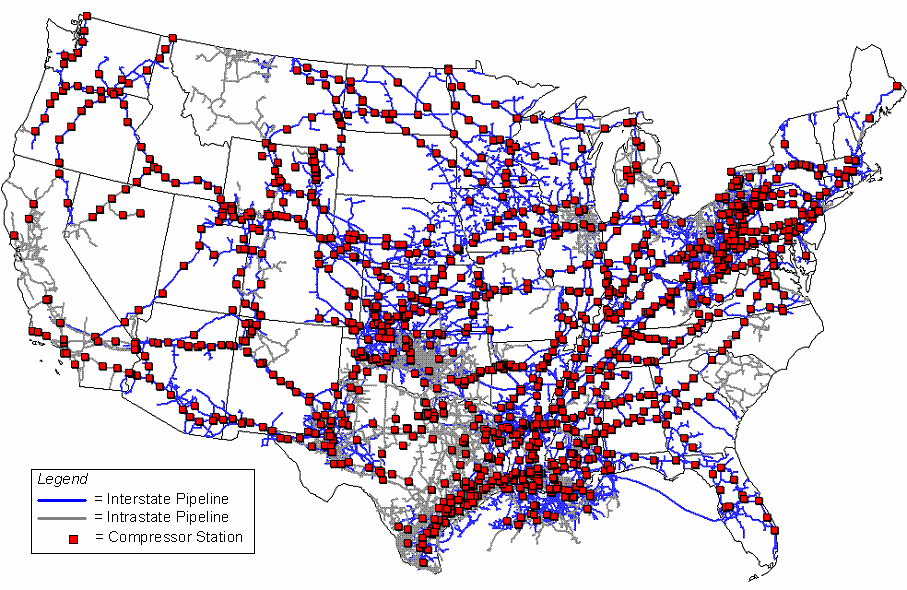
...the gas industry has picked DISH and a few acres just outside its city limits as a perfect place for not one or two but eleven compression stations, to which gas is piped from wells all over northern Tarrant and Denton counties, to be treated, compressed, and sent out into bigger transmission lines. Residents say the veritable industrial corridor thus created emits hydrocarbons that kill trees, sicken and endanger animals and people, and are making their properties worthless.
...
Losing the use of land is only one of the issues posed by pipelines. Gas running through gathering lines is generally filled with chemicals and water that corrode the pipes; it's also generally unodorized until it reaches the compressor - which means people nearby won't know they are in danger if a leak develops. Companies have mechanisms to alert them to weakening pipes, but leaks and explosions in the Barnett Shale have shown those systems aren't foolproof.
...
The compressor stations also regularly release noxious chemical fumes. The acrid smell burns the throat and nose and sears the eyes. "Some days you can hardly breathe anywhere in DISH," Tillman said. "And then the trees started dying, so we wondered what was actually in those fumes."
... "We've lost a lot of trees in DISH. And a number of them were cedar trees, which are almost impossible to kill. Those trees breathe just like we do, so when they start dying, you've got to pay attention," he said. "They're the canary in the coal mine for our air." Thus far, dozens of trees in the little town and right outside it have died.
...
"We knew something was terribly wrong," Tillman said. But their repeated complaints to the state agencies fell on deaf ears. The agencies "basically asked the companies to investigate themselves," said Tillman, "and they came up clean every time."
...
According to an analysis of the [independently contracted] Wolf Eagle air study done by chemist and microbiologist Wilma Subra, the air samples from DISH contained the kind of chemical cocktail that would have been expected near refineries. Subra, who has been studying oil and gas field waste since the 1970s, said the DISH air samples included varying combinations of the carcinogens benzene and trimethylbenzene; napthalene, which is considered a potential human carcinogen; carbon disulfide, which can be absorbed through the skin and affects the central nervous system and many other bodily systems; and xylene compounds, which are neurotoxins. Subra is a member of the board of Earthworks, a nonprofit group that works with communities to address the destructive impacts of mineral development.
...
Even worse, she said, "No one can tell you what happens when you add these compounds together. It might be that in some cases they cancel each other out. Or they might be exponentially worse when you have a mix like that. And with what we know about chemicals, it's probably exponentially worse."
...
[Re: Long term exposure, Wilma Subra said:]
"Two years is sufficient time to cause neurological damage." ...
"You will not be automatically safe from the chronic, long-term health conditions just because you remove yourself from exposure to those chemicals," Subra said. "The damage could have already been done or could still show itself down the line, years later."
...
Tillman said that each of the companies that has a gas compressor at DISH has told him that their emissions are within acceptable levels established by the federal Environmental Protection Agency. "And that might be so," said Tillman. "But what happens when you have 11 of these things sitting next to each other? Even if each one individually is acceptable, add them up, and you wind up with nearly 11 times the acceptable level of toxins being released into our air."
...
DISH officials and residents aren't opposed to all gas drilling or the kinds of industrial activities that come with it. But many of them are furious at how it's been handled in their town and at the state's part in what has happened.
"I am against the way these people have elected to operate - quick and dirty methods, cheap methods," Cisco, the town commissioner said. "It's regrettable that the Railroad Commission and TCEQ have hoodwinked us into thinking they are protecting the citizens of our community when it seems more like they're on the payroll of these companies."
Tillman agreed. "How on earth could the people of this town suffer and complain about the air quality for so long, and I am the first one to do an air quality study?" he said. "This is squarely on the shoulders of TCEQ, and they let this happen to us. I just feel betrayed by the state."

DEMAND ACCOUNTABILITY!

Saturday, September 26, 2009

INDEPENDENT STUDY PROVES GAS INDUSTRY DISHES UP TOXIC AIR IN DISH, TX

DISH, TX has been surrounded and taken over by the gas industry. Formerly a peaceful rural, residential area, it is home to 200 inhabitants, many of whom are horse breeders, whose lives have been negatively impacted by gas wells, condensate tanks, metering, and particularly, large gas compression stations. While the town has ordinances regulating drilling and production of gas wells, as is often the case, the gas industry has located several compression stations just outside town boundaries to avoid regulation. Numerous complaints have been made to the town regarding the constant noise and vibration emanating from the compression stations and the foul odor hanging over the town. Young horses have become gravely ill and there have been several deaths over the past 2 years.

The owners of the compressor site performed a "Natural Gas Leak Survey of the Dish Texas Area", using a mobile leak detection unit to monitor for methane, hydrocarbons and carbon dioxide. Their report, which stresses the extreme sensitivity of their equipment, showed negligible results. Concentrations were all at levels lower than regulatory limits.

DISH Mayor Calvin Tillman has worked ceaselessly to protect his town, it's people, their quality of life and environment in the face of environmental disregard and degradation by the gas industry. Finally, the Town of DISH spent a great deal of time and money to have an independent air study performed around the large natural gas compression facility in their community. Contrary to the industry's survey, the results of the independent study confirmed the presence, in high concentrations, of carcinogenic and neurotoxin compounds in ambient air near and/or on residential properties. The report, a valuable resource as many similar sites are undoubtedly spewing the same harmful chemicals, says Tillman, further indicated that many of the compounds in the air exceeded the Short-term and Long-term Effects Screening Levels (ESLs) according to Texas Commission on Environmental Quality (TCEQ) regulations.

For an extensive analysis of the report by Wilma Subra, MacArthur Award winning chemist, CLICK HERE to read the important findings on Bluedaze.

DEMAND ACCOUNTABILITY!

Saturday, September 19, 2009

Real People Talk About THE FACE OF REALITY on the Marcellus Shale


THE VOICE OF EXPERIENCE:

"I found out there was a spill on Wednesday night at a meeting with
Cabot- someone asked them about a spill and they acted, at first, like they did not know about one, and then they said yes there had been two that day but it was just harmless gel -nothing serious- they said nothing they use is harmful. The chemicals used are just a thimble full- 8,500 gallons is a pretty large thimble!!!
I questioned their water specialist what was this gel- "was it let's say safe enough to shave my legs with?" and he said "Why yes!" The owners of the land where the spills took place were not notified. They asked "I own that land, shouldn't you have told me?" I spoke (actually I yelled - I was so upset) to DEP this morning and Mark Carmen said "call the Governor- we can't do anything." I said if you had let these guys know from day one- they had to do things very carefully here in PA if they wanted to get permits, or the fines would be steep- things would be better than they are!
DEP is afraid to stand up to the gas company AND the governor. DEP allows the gas company to drill just about anywhere they want! I asked DEP awhile ago if it was a good idea to drill there in the wetlands and he said he was worried too- well who is in charge
here? THE GAS COMPANY FROM ANOTHER STATE!!!"


"Last evening a group of a dozen or so residents of Dimock met with
Cabot Oil and Gas. Our request was simple: water. The stories were
told and it was heartwrenching to say the least. I cannot believe the
courage these folks had last night. I am proud to be their neighbor.
Ironically the gas company brought their investors in the day before
to show off their "prize" Dimock. We are a prize- they stole our land
for $25 an acre, they deduct from the minimum royalties...
I imagine the investors smile and nod at the "manicured" well
sites they were shown- while the residents buy and haul water to their homes. I'm sure they did not point out the homes with the water tanks behind them disconnected from their water wells! I'm sure they didn't show them the latest round of spills or leaks -hey maybe the investors wouldn't care about that- it doesn't stop the money from flowing. It certainly doesn't stop the permitting or drilling! Fortunes made of other's misfortunes -tough luck- we gotcha and that is the way it is. They would not, could not offer us water. They blamed DEP. Only if DEP said they had to would they provide us with water, however they do provide water for some. Yet they say the gas company is here for the duration and they want to be good neighbors? Good neighbors to whom? Good neighbors bring you water - not take it away! ..."

FOOD FOR THOUGHT:
"I know this from first hand experience with my family, some of our neighbors and second and third hand rumors from this town and the next town over:
Every land owner that is fighting an individual battle with a gas company is fighting a lonely, private battle. People settle all the time. Confidentiality agreements are signed all the time. Every transgression by big gas seems to result in another hopeless situation for another powerless landowner. It happens all the time and never gets into the news. Royalties are nothing compared to legal fees. The companies fight like hell, because every victory is a victory for industry, every court case sets a precedent. Activists must recognize this and realize the work that needs to be done right now on the front lines of gas drilling. Landowners need organization and REAL tangible resources that go beyond "how to sign a 'good lease'" or "how to convince hicks that gas drilling sucks". We need real honest-to-goodness public interest lawyers not snake-oil-sales-men-make-a-big-buck-gas-boom lawyers. We need legal funds for the important cases. For example, here in New York no precedent has been set on whether one company's well in one layer holds another company's lease in another layer in production, or whether a no storage clause in a unit landowner's lease could prevent a neighbor's injection well. Or whether a town can strip corporate personhood and demand accountability. We need a comprehensive legal strategy. Right now all that is standing between New York State and the gas companies having what ever they want is a few individuals-regular Joes and Jills with the gumption to put everything on the line. And I can tell you no one has the money to last very long.
One thing that has become very clear to me since drilling came to my town 5 years ago. Drilling vs. no drilling is a looser battle. So is singling out the victims, or blaming landowners. This is petty only serves to divide the people and strengthen the gas industry. At our last town board meeting, our Supervisor said "I am not for or against gas drilling. But I am for protecting our water." We need to get over ourselves and get together on the real issue. How many more people, places, streams are going to be sacrificed before we get it?"

Thanks to the people who allowed their thoughts and feelings to be shared here today.
As the gas industry moves into our area with greater and greater volume and intensity, we are being forced to think about things we never had to think about before, and they are demanding considerations to say the least. What is required of us is that we know score, and that we speak up... in the name of clean water, land, air and democracy... our vital resources!

DEMAND ACCOUNTABILITY!

Sunday, September 13, 2009

Police chief: Gas drilling causing increase in crime locally

(They warned us this was going to happen...)

PUBLISHED SEPT. 9, 2009

THE DAILY REVIEW, Towanda, PA

BY JAMES LOEWENSTEIN

TOWANDA - Gas drilling activity is resulting in an increase in crime in the borough, the borough police chief said on Monday.

The issue came up at Monday's Towanda Borough Council meeting, when borough council member Bob McLinko asked Police Chief Mitch Osman whether the "extracurricular activity in the borough, along with population increase, has resulted in problems."

By extracurricular activity, McLinko was apparently referring to drinking at the bars in Towanda.

Osman replied that police calls have gone up as workers in the gas drilling industry have moved into the county, "especially the severity of the calls."

In the past, you could probably predict which nights would be quiet in town, the police chief said.

"We can't do that any more," he said. "It's definitely busy."

Council members said they would be in favor of using federal grant money to hire an additional police officer.

Osman said with a laugh that he could use two additional police officers.

The borough had recently applied for a federal grant to hire an additional full-time police officer, but was not awarded the grant. The grant was to have been funded with federal economic stimulus money.

The borough will be automatically considered when the next round of grants for police officers is awarded by the federal agency, Osman said.

DEMAND ACCOUNTABILITY!

Wednesday, August 26, 2009

The Big Takeover

Wednesday, 26 August 2009 • PETER GORMAN
Fort Worth Weekly

It's been a tough spring and summer for the gas drilling industry's public image.


This gas-drilling site doesn’t look so bad to the naked eye. Courtesy TCEQ

But when seen through infrared camera, the same site is a toxic mess. Courtesy TCEQ

In Caddo Parish in Louisiana's northwest corner, 17 head of cattle died in late April after drinking "frac" water that entered their pasture. During the last several months, earthquakes in Johnson County and at D/FW International Airport caused gas companies to shut down injection wells thought to be responsible. And then a couple of week ago, a film showing invisible poisonous hydrocarbons escaping into the air at gas well sites in North Texas appeared on YouTube:


Closest to home, 14 new wells are planned for a Fort Worth park within 600 feet of a proposed elementary school and community center. Oh, and a gas industry lobbying group has been given the right to put a class in a Fort Worth public high school, with full control of the curriculum.

"Sounds like the apocalypse when you just rattle them off like that," said Don Young, founder of Fort Worth CanDo and a consistent voice against urban gas drilling. The seemingly endless horror stories have activists like Young shaking their heads in disbelief. "Just when you think you've seen it all, something else happens to shock you again," he said.

In the earliest of the incidents, on April 28, a small amount of hazardous material the industry calls simply "waste water" or "salt water" escaped onto a northwest Louisiana pasture while a Chesapeake Energy well was being fracced -- that is, when high-pressure water was being forced within the underground shale formation to release the gas trapped within it. Within an hour, 10 cows that drank some of that water were dead. In the next three hours, another seven died. The Shreveport Times reported in an August 6 update that it had received a letter from Chesapeake official Steve Turk in which he wrote that their investigation of the incident showed "a portion of mixed 'frac' fluids, composed of over 99 percent freshwater, leaked from vessels and/or piping." Chesapeake did not admit the other 1 percent of the fraccing fluids killed the cows but did admit having compensated the farmer for them.

"What I want to know," said Sharon Wilson, a longtime anti-drilling activist who maintains a running blog on problems associated with shale activity, "is how the gas companies can call fraccing fluid 'salt water' [sic: 'fresh water'] when 1 percent of that fluid is enough to kill 17 cows, most of them within an hour?"

Dead cows tend to shake people's faith in the safety of drilling -- but not as much, for some people, as the dozen or more small earthquakes that have been registered in North Texas since October 2008, including one that caused $100,000 worth of damage to a Boy Scouts' building. Although drillers at first denied any connection between their activities and the tremors, in mid-August Chesapeake closed two injection wells it uses for disposing of frac fluid at D/FW airport and in Cleburne after some studies suggested those wells could be causing the problem.

An August 13 report in The Wall Street Journal noted that researchers from Southern Methodist University concluded that there was "a "possible correlation" between the quakes and a salt water disposal well operated by Chesapeake on the southern end of the airport, which sits atop a fault line. Chesapeake spokeswoman Julie Wilson did not return calls to Fort Worth Weekly for this story but told the Journal that the move was a "precautionary, proactive step. The events in that area were very minor, and most have not even been felt or were barely felt."

However, for the tens of thousands of North Texans who now live near gas wells and their attendant gathering stations, compressors, and pipelines were those captured in a short YouTube video put together by Young and Wilson from footage taken by the Texas Commission on Environmental Quality. The state agency film was made as part of an ongoing TCEQ program to identify hydrocarbons escaping into the air from gas wells and other industrial sites around the state. Young learned of the filming program and requested and obtained copies.

The footage that he received was shot at well sites in Johnson and Parker counties from a helicopter equipped with a specialized infrared video camera, called a HAWK, that can film emissions invisible to the eye. The HAWK camera, according to TCEQ spokesperson Lisa Wheeler, photographs "hydrocarbon emissions" but cannot specify which poisonous hydrocarbons are escaping or determine the quantity.

The film shows what looks like great plumes of smoke -- the otherwise invisible hydrocarbons -- escaping from wells being drilled and also from storage tanks, water separators, and pipelines. TCEQ has not released information that would identify the specific well sites and companies involved.

"What's so galling is that the gas companies can put vapor recovery systems on the wells and outfit their pipelines to avoid these fugitive emissions," Sharon Wilson said.

According to a report produced by Southern Methodist University for the Environmental Defense Fund in Austin, "Vapor recovery units on condensate tanks would pay for themselves in a matter of months by generating additional revenue to producers from the gas and condensate that would be captured instead of released to the atmosphere."

The report further concluded that poisonous emissions could be significantly reduced with minor retrofitting to every other stage of drilling and transporting natural gas.

But during the hashing-out of the most recent Fort Worth gas-drilling ordinance, Mayor Mike Moncrief took environmental issues out of the hands of the task force designing the ordinance. City staff later left the green completion of wells, with vapor recovery systems and closed sludge pits full of toxic waste, up to the discretion of the gas companies, rather than requiring any such measures in the ordinance.

"Most gas companies simply won't do it unless you force them," Sharon Wilson said. "But you've got to wonder what these companies are thinking. If you can break even on what you spend by selling what you recover, why wouldn't they? Think of the public relations nightmare they could avoid."

Calls on the issue to several major Barnett Shale producers were not returned.

Chesapeake has another public relations disaster about to happen. Its Murkat site drilling plan calls for up to 14 wells to be drilled directly adjacent to neighboring Rosemont Park on the Fort's South Side. "And that plan now collides with a Fort Worth school district plan to build a combination elementary school/community center right across the street," said Gary Hogan, a member of both of the city's drilling ordinance task forces.

The two sets of plans, Hogan said, put the school building at just about 600 feet from the first well bore, as opposed to the normal distance of 600 feet from the edges of the two properties. That property line is well within 600 feet.

"If the [school district] goes through with the plan it's going to be a perfect storm for our kids: a multiple-well site spewing poisonous hydrocarbons from less than the normal protected distance to an elementary school," he said. "To me, not having [hydrocarbon] recovery systems mandatory on urban wells is criminal. One of these days we're going to have kids needing to go to emergency rooms from this."

Calls to the Fort Worth Independent School District on the issue were not returned.

Most recently, there was the early August announcement that Southwest High School will be the new home of the Southwest Academy for Petroleum Engineering and Technology. It will essentially be a private school within a public school, initially funded by a grant from Quicksilver Resources, a Fort Worth-based gas-drilling company.

The program was developed by the Independent Petroleum Association of America, a Washington D.C.-based lobbying group that will control the curriculum of the academy. School Superintendent Melody Johnson, on the district's web page, hails it as offering "students first-hand testimonies from those who work in these career areas." Johnson also notes that, "When they graduate, these students will be fully prepared for ... direct entry into these fields of work."

But to Hogan, Wilson, Young, and others, it sounds like an outlandish incursion by private and vested interests into what is supposed to be an even-handed learning experience. "The lobbying group controls what is being taught," Wilson said. "That's not teaching. That's propaganda."

As with the issue of the school near Rosemont Park, the FWISD did not return calls concerning the placement of public school curricula in the hands of a lobbying group.

Activists are also upset with a new Chesapeake corporate display in Fort Worth's main library. "My gut feeling is that it is wrong to mix corporate and public interests in a place like a library which is supposed to be a sanctuary for people," said Young. "They try to say it's educational, but it's really just corporate advertising.

"When you look at the whole picture," Young continued, "it's as if the gas industry got together to say, 'We're going to own this city.' And to some extent, they do. They've taken over city hall, no question about that. And they've taken over the parks department, which has given them every waiver and variance they've asked for. They've gotten into the libraries, and now the industry is running its own program with its own curriculum in one of our public schools.

For the complete story, CLICK HERE.

DEMAND ACCOUNTABILITY!

There's lots to pay attention to in this article, lots for folks on the Marcellus shale to consider and work to try to make happen differently...

Monday, August 3, 2009

Pennsylvania: examples of oil and gas drilling gone wrong, but an opportunity to get it right

Pennsylvania. My dad was born and raised there. He also retired there, to a magnificent landscape just south of Lake Nockamixon among the rolling green hills, old stone houses, and bucolic countryside of the serene Delaware River Valley.

North of the lake is the Township of Nockamixon. Earlier this year the Township endorsed federal legislation to repeal the hydraulic fracturing exemption in the Safe Drinking Water Act. The Township cited many reasons, including the importance of water to the community as well as its downstream neighbors and the fundamental precept that it is more effective to protect water by preventing contamination than by cleaning it up after the fact. The Township of Nockamixon also passed rules for natural gas drilling that, among other things, require that all drilling and production be at least 600 feet from residences or buildings used for public assembly and require natural gas producers to submit water quality tests for local approval. Too much to ask? The Township was sued by industry over these rules.

Why does Nockamixon feel the need to take action to protect its water and its citizens?

Pennsylvania has over 70,000 oil and gas wells and, unfortunately, has too many examples of the environmental harms caused by oil and gas production operations. I've listed some incidents below:

In Bradford Township, seven water wells on one street--Hedgehog Lane--were contaminated earlier this year. The state has prohibited additional drilling in the area at this time but is allowing fracturing to go forward. In a letter to their town supervisors, over 30 residents of Hedgehog Lane asked for: new water supplies because over ten homes have contaminated water; air pollution controls due to "caustic" and unhealthy air that keeps residents inside their homes; noise controls to protect them from the constant compressor noise that keeps residents from sleeping at night; enforcement of safety regulations against hazardous roadway conditions, road damage, speeding trucks, tanks without placards and pits without barriers; and property tax reductions to in some small way help compensate for dramatic decreases in property values. The letter signers are not opposed to drilling, not even in their own neighborhood. They wrote: "We do not want to be difficult or take advantage of anybody; we only want what is fair. Please restore our neighborhood to what it was before this drilling occurred. Hedgehog is a big hill and allows enough room for drilling and people's homes." Their requests have not yet been honored.

In the summer of 2008, contamination of a drinking water well used by two families in Gibbs Hill occurred after hydraulic fracturing of a nearby natural gas well. One resident, a nurse, smelled strong fumes and experienced burning in her lungs and sinuses after showering. Her fiancé drank water and felt immediate burning in his mouth. The Pennsylvania Department of Environmental Protection (PADEP) found that pressure in the gas well had exceeded the pressure in the surrounding fresh groundwater system and that there had been unpermitted discharge of hydraulic fracturing fluids, but has not yet issued any final order or enforcement action.

In Dimock Township, a residential drinking water well exploded without warning near a new gas well in January, 2008. At least three other water wells have been contaminated. This case is still being investigated. Dimock has also been the site of two large diesel fuel spills in recent years, as well as torn pit liners and other leaks. In McNett Township , a leaking gas well has contaminated family water supplies as well as two tributaries to Lycoming Creek. In Kushequa, gas drilling is blamed for several explosions in the community water well in September 2007. In Hickory, Ronald Gulla reports that his family farm has been ruined and his fish pond polluted. He has not gotten any help from government agencies. Last year, inadequately treated drilling wastewater contributed to a water quality emergency in the Monongahela River, prompting PADEP to issue a bottled water advisory for 325,000 water customers.

A recent article also discusses accidents in Bridgeville, Vandergrift and, most tragically, Corsica, where three people were killed in a house explosion caused by methane migration from a nearby natural gas well.

On a positive note, the Pennsylvania DEP recently issued a cease and desist order to U.S. Energy Development Corporation, prohibiting new drilling but letting it continue to operate existing wells--after 302 violations over two years.

Pennsylvania-a beautiful state. It can update its oil and gas production rules and strengthen its enforcement activities to catch up with industry expansion and technological advancements. Pennsylvania has a long history of encouraging companies to innovate and adopt new technologies through its Ben Franklin Partnership, which has served as a model for other states. Pennsylvania can now be a model for other states dealing with oil and gas operations by showing the rest of the country how to protect communities, health, and our environment while also stimulating a cleaner and greener oil and gas production industry.

DEMAND ACCOUNTABILITY!

Monday, July 27, 2009

King Coal... RF Kennedy, Jr. Weighs in on Coal vs. Natural Gas

ROBERT F. KENNEDY, JR.

THE HUFFINGTON POST, JULY 27, 2009: LINK HERE.

Over the past decade, nearly one hundred coal burning power plants have died in the proposal stage trumped by the legitimate objections of local communities fearful of a dirty deadly fuel that is neither cheap nor clean. Ozone and particulates from coal plants kill tens of thousands of Americans each year and cause widespread illnesses and disease. Acid rain emissions have destroyed the forests over the length of the Appalachian and sterilized one in five Adirondack lakes. Neurotoxic mercury raining from these plants has contaminated fish in every state--including every waterway in nineteen states--and poisons over a million American women and children annually. Coal industry strip mines have already destroyed 500 mountains in Appalachia, buried 2,000 miles of rivers and streams and will soon have flattened an area the size of Delaware. Finally, coal, which supplies 46% of our electric power, is the most important source of America's greenhouse gases.

Beating our deadly and expensive coal addiction will be lucrative. America's cornucopia of renewable energy resources and the recent maturation of solar, geothermal and wind technologies will allow us to meet most of our future energy needs with clean, cheap, abundant renewables. Bright Source, a solar thermal provider, has just signed contracts to provide California with 2.6 gigawatts of power annually from desert mirror farms. Construction costs are about the same per gigawatt as a coal plant and half the cost of a nuke plant. Once built, the energy is free forever. In contrast, once you build a coal plant, your biggest costs--fuel extraction and transportation and the harm from emissions--are just the beginning.

In the short term, a revolution in natural gas production over the past two years, has left America awash in natural gas and has made it possible to eliminate most of our dependence on deadly, destructive coal practically overnight--and without the expense of building new power plants.

How? Well it's pretty easy. Around 900 of America's coal plants--78% of the total--are small (generating less than half a gigawatt), antiquated, and horrendously inefficient. Their average age is 45 years, with many limping past 75. These ancient plants burn 20% more coal per megawatt hour than modern large coal units and are 60-75% less fuel efficient than high-efficiency gas plants. These small units account for less than 42% of the actual capacity for coal fired power but almost one half the total emission of the entire energy sector! The costs of operation, maintenance, capital improvements and repair costs of these antiquated worm-eaten facilities, if properly assessed, would make them far more expensive to run than natural gas plants. However, energy sector pricing structures make it possible for many plant operators to pass those costs to the public and make choices based on fuel costs, which in the case of coal, appears deceptively cheap because of massive subsidies.

Mothballing or throttling back these plants would mean huge cost savings to the public and eliminate the need for more than 350 million tons of coal, including all 30 million tons harvested through mountain top removal. Their closure would reduce U.S. mercury emissions by 20-25%, dramatically cut deadly particulate matter and the pollutants that cause acid rain, and slash America's CO2 from power plants by 20%--an amount greater than the entire reduction mandated in the first years of the pending Climate Change Legislation--at a fraction of the cost.

These decrepit generators can be eliminated very quickly--in many instances literally overnight by substituting power from America's existing and underutilized natural gas generation, which is abundant, cleaner and more affordable and accessible today than dirty coal.

Since 2007, the discovery of vast supplies of deep shale gas in the United States, along with advanced extraction methods, have created stable supply and predictably low prices for most of the next century. Of the 1,000 gigawatts of generating capacity currently required to meet national energy demand, 336 are coal fired, many of which are utilized far more heavily than for cleaner gas generation units. Surprisingly, America actually has more gas generation capacity--450 gigawatts--than coal. But most of the costs for coal-fired units are ignored in deciding when to operate these units. Public regulators traditionally require utilities to dispatch coal first. For that reason, high efficiency gas generators, which can replace a large percentage of U.S. coal, are used only 36% of the time. By simply changing the dispatch rule nationally, we could quickly reduce power generated by existing coal-fired plants and achieve massive emissions reductions. The new rule would change the order in which gas and coal fired plants are utilized by requiring that whenever coal and gas plants are competing head-to-head, the gas generation must be dispatched first.

To quickly gain further economic and environmental advantages, the larger, newer coal plants that remain in operation should be required to co-fire with natural gas. Many of these plants are already connected to gas pipelines and can easily be adapted to burn gas as 15 to 20% of their fuel. Experience shows using gas to partially fuel these plants dramatically reduces forced outages and maintenance costs and can be the most cost effective way to reduce CO2 emissions. This change can immediately achieve an additional 10 to 20% reduction in coal use and immediately reduce dangerous coal emissions.

Natural gas comes with its own set of environmental caveats. It is a carbon-based fuel and [its] extraction from shale, the most significant new source, if not managed carefully, can cause serious water, land use, and wildlife impacts, especially in the hands of irresponsible producers and lax regulators. But those impacts are dwarfed by the disastrous holocaust of coal and can be mitigated by careful regulation.

The giant advantage of a quick conversion from coal to gas is the quickest route for jumpstarting our economy and saving our planet.
__________________________________________________________________
SPLASHDOWN EDITORIAL:

It sounds reasonable, doesn't it?
All we need are responsible producers and vigilant regulators!

Congress can't even agree that this is necessary! Money isn't there for environmental protection agencies to hire the number of inspectors necessary to monitor this lawless industry. And YES! coal mining and burning is dangerously toxic, but when Kennedy talks about enough affordable natural gas to last us into the next century, he's supporting perpetuation of a carbon-based energy industry that has demonstrated it is unwilling to divert a nickel of its profits to safeguard our absolutely VITAL resources: WATER, AIR and LAND. Their best practices are simply NOT GOOD ENOUGH. Especially not a century's worth!!!
Closing coal fired plants would reduce carbon dioxide emissions from power plants by 20%... BUT, what measure of CO2 and even more environmentally harmful methane is released into the atmosphere during extraction of natural gas, including toxic air polluting emissions from transportating the millions of gallons of water to and from well pads, treatment or burial of "produced water", operating drilling rigs, compressors and other associated gas production equipment and activities, over and above emissions from well flares and finally, power plant emissions from enegy generation from natural gas? How does all that stack up against that 20%?
How too does Kennedy justify the permanent depletion and contamination of drinking water supplies across the country, occuring as a result of mining for gas? Surely he can't think that indicating the need for responsibility and vigilance is going to suddenly manifest a new attitude on all fronts, by all players in this play?
What guarantees do we have that a gluttonous industry won't milk the quick fix dry, leaving us with an irrevocable permanent loss in exchange for temporary energy?

There are important unanswered, and without drilling reform legislation in place, perhaps unanswerable questions. They loom like loopholes in his argument as we continue to learn how criminally untrustworthy corporate America is willing to be in pursuit of the almighty dollar. We've seen too how even regulations aren't foolproof, and how when one entity acts outside the law it encourages others to follow suit.
Meanwhile, the gas industry has already been irresponsible for deadly releases of toxins into the atmosphere, deadly releases of toxins into our waters, for killing and/or sickening livestock, wildlife and humans, for the seepage of toxic wastewater into our lands, contaminating land and water, the evaporation into the atmosphere of carcinogens from open sludgepits... in short, there isn't anything healthy or friendly about the production of natural gas and turning a blind eye to the devastating problems of the lesser of two evils does not make the lesser evil any better.
Today, Governor Ed Rendell of Pennsylvania announced the availability of a new tax credit to help Pennsylvanians in their quest to create renewable sources of clean, alternative energy. Types of eligible projects include solar, wind, geothermal, biologically derived methane gas, fuel cells, biomass and also (unfortunately, and not sure how it's renewable) coal methane. Still, support for 6 out of 7 clean energy sources is encouraging. Let's hope Pennsylvanians take advantage of this inducement!

Like Living with the Atomic Bomb

During the 1950's part of growing up was living with the constant threat of the atomic bomb exploding over my home or my school when I'd be in it, separated from my family, unprotected by them... and knowing they'd be separately annihillated, just like me. This was a kind of silent fear I've learned as an adult that every other person from my time slot endured as a child too. A stressor without personal remedy, and a government with other goals at the helm. Quality of life at the level of individual well-being seems to be low on the list of national priorities. We don't even argue with our legislators about the logical priorities of our health and well-being, or that of the singular irreplaceable environment that feeds and nurtures us, and how that should govern our leadership roles both here at home and abroad.
Global warming, fed by an energy crisis, fed by an unsustainable demand for MORE, by ever more people around the globe, is creating a new, pervasive stress for all of us, including our children who, just as my young friends and i intuitively and helplessly understood the dangers of the atomic bomb, today are understanding and have much to fear about the future they are helplessly inheriting from profligate leaders with antisocial agendas.

DEMAND ACCOUNTABILITY!

Thursday, July 16, 2009

ONE TOWN'S ROLE MODEL POSITION FOR THE HEALTH, SAFETY AND WELFARE OF ITS CITIZENS VIS A VIS HYDRAULIC FRACTURING FOR GAS IN THE MARCELLUS SHALE


CHERRY VALLEY TOWN MEETING MINUTES

Posted Wednesday, July 15, 2009 by the Town Clerk

Resolution of the Cherry Valley Town Board
Resolution # 2008- 8 December 11, 2008

A RESOLUTION OF THE TOWN OF CHERRY VALLEY ENTITLED “COMMENTS TO NYSDEC ON THE on the Draft Scope for Draft Supplemental Generic Environmental Impact Statement on the Oil, Gas and Solution Mining Regulatory Program for Well Permit Issuance for Horizontal Drilling and High-Volume Hydraulic Fracturing focusing on the Development of the Marcellus Shale and Other Low-Permeability Gas Reservoirs.”

WHEREAS, the Town of Cherry Valley recognizes the need to develop domestic sources of energy and their potential for economic development in upstate New York; and

WHEREAS, the Town of Cherry Valley is located in the Marcellus shale field and other gas bearing formations; and

WHEREAS, the Town of Cherry Valley is located at the shallow, northern edge of the Marcellus Shale Field where it outcrops along U.S. Rte 20 in northern Otsego County; and

WHEREAS, there are numerous natural gas leases signed between private land owners and gas exploration companies within the Town on file with the Otsego County Clerk; and

WHEREAS, aspects of hydraulic fracturing include the potential impacts of (1) water withdrawals, (2) transportation of water to the site via town roads, (3) the use of additives in the water to enhance the hydraulic fracturing process, (4) space and facilities required at the well site to ensure proper handling of water and additives, and (5) removal of spent fracturing fluid from the well site and its ultimate disposition.

WHEREAS, due to the technological advances of horizontal drilling and hydraulic fracturing, the Marcellus shale and others gas bearing formations in the Town of Cherry Valley, these gas bearing formations have become economically feasible to exploit; and

WHEREAS, the Town of Cherry Valley has identified the pollution of groundwater as a major concern in its comprehensive plan, adopted by the Cherry Valley Town Board in 2007; and

WHEREAS, the karst topography, limestone bedrock and shallow depth to the Marcellus shale which underlie the Village and the Town of Cherry Valley make our water bearing formations especially vulnerable to pollution; and

WHEREAS, groundwater is the sole source of all public and private water use in the Town and Village of Cherry Valley; and

WHEREAS, the Department of Environmental Conservation is solely responsible for regulating the exploration, development and production of oil and gas resources in New York; and mineral rights owners and exploration companies are interested in developing a potentially significant gas resource in the Town of Cherry Valley through the use of horizontal drilling and hydraulic fracturing; and

WHEREAS, the New York State Department of Environmental Conservation is accepting written comments from ALL interested parties on the Draft Scope for Draft Supplemental Generic Environmental Impact Statement on the Oil, Gas and Solution Mining Regulatory Program for Well Permit Issuance for Horizontal Drilling and High-Volume Hydraulic Fracturing focusing on the Development of the Marcellus Shale and Other Low-Permeability Gas Reservoirs; and

WHEREAS, the Town of Cherry Valley is a local unit of government that has afforded the citizens an opportunity to comment and provide input in the Draft Scope and the actions therein; and

WHEREAS, the oil and natural gas industries are exempt from Federal Clean Water Act, Federal Clean Air Act, Safe Drinking Water Act, and are exempt from local planning review under the New York State Environmental Conservation Law (ECL Section 23-0303); and

WHEREAS, the New York State Environmental Conservation Law (ECL Section 23-0303) preempts towns from regulating land use by the Oil and Natural gas industries except over roads or the rights of local governments under the real property tax law; and

WHEREAS, drilling and hydraulic fracturing involves the use of heavy equipment, millions of gallons of water, all delivered to the well site by heavy trucks, the potential for the degrading of Town roads is possible; and

WHEREAS, the Town of Cherry Valley has reviewed the Draft Scope and affirms that the Draft Scope and the Supplement to the Generic Environmental Impact Statement must include measures to afford adequate protection for the Town’s citizens, water resources, public health, environment and roads.

NOW, BE IT RESOLVED THAT THE TOWN BOARD OF CHERRY VALLEY APPROVES THAT THE NEW YORK STATE DEPARTMENT OF ENVIRONMENTAL CONSERVATION (NYSDEC) TAKE ACTION TO ADDRESS IMPACTS TO THE HEALTH, SAFETY AND WELFARE OF THE CITIZENS OF THE TOWN REGARDING the Oil, Gas and Solution Mining Regulatory Program for Well Permit Issuance for Horizontal Drilling and High-Volume Hydraulic Fracturing BY INCLUDING THE FOLLOWING IN THE DRAFT SCOPE AND SGEIS:

(1) Notify the Town of Cherry Valley upon receipt of an application to drill within the Town and notify the Town of issued permits and permit conditions enacted by the NYSDEC for each well, and

(2) Require representatives (company) of the oil and natural gas industry operating in the Town of Cherry Valley to provide the Town a comprehensive list of all substances and their concentrations (chemical and inert) used in drilling, hydraulic fracturing and recovery processes a minimum of six months prior to the start of drilling or hydraulic fracturing so an adequate water quality baseline for our water supplies can be established prior to drilling/hydraulic fracturing; and

(3) Prohibit the use of all hydraulic fracturing fluid constituents that are known to pose a significant risk to human health, and

(4) Require all oil and natural gas exploration in the Town of Cherry Valley use closed loop systems to avoid open pits and potential of contamination of surface and ground water by hydraulic fracturing fluid due to the sensitive nature of the karst topography and shallow depth to the water bearing formations within the Town, to safeguard our drinking water, public health and the environment; and

(5) Notify the Supervisor of the Town of Cherry Valley of violations to permit conditions that occur at any drilling/hydraulic fracturing site within the Town within 24 hours of the violation; and

(6) Require representatives (company) of the oil and natural gas industry operating in the Town of Cherry Valley to fund completely, water tests for residues of drilling/hydraulic fracturing fluids before and after drilling/hydraulic fracturing for any public or private potable water source (well or surface) within 10,000 feet of the water source to be repeated annually at the expense of the representatives of the oil and natural gas industry for 3 years post drilling/hydraulic fracturing; and

(7) Require representatives (company) of the oil and natural gas industry operating in the Town of Cherry Valley to fund completely, radon tests for any home within 10,000 feet of the proposed well to be repeated annually at the expense of the representatives of the oil and natural gas industry for 3 years post drilling/hydraulic fracturing; and

(8) Make the results of the aforementioned tests available to the Cherry Valley Town Board and every owner of the water source or home within that area, and

(9) Require each representative (company) of the oil and natural gas industry operating in the Town of Cherry Valley to post an Environmental Quality Bond to the Town of Cherry Valley while operating in the Town, the amount of this bond to be determined in consultation with NYSDEC, and

(10) Require representatives (company) of the oil and natural gas industry operating in the Town of Cherry Valley to provide the Town a comprehensive list of all substances used in hydraulic fracturing and their concentrations (chemical and inert) moved off site, including a final destination for these substances to insure proper disposal, and

(11) File a transportation plan with the Town Supervisor and Highway Supervisor to insure Town roads and bridges will accommodate this industrial use, and

(12) Require each representative (company) of the oil and natural gas industry operating in the Town of Cherry Valley to post a Performance Bond to the Town of Cherry Valley for potential damages to Town roads, the amount of this bond to be determined in consultation with NYSDOT and Otsego County DPW, and

BE IT FURTHER RESOLVED that this industry should result in NO additional tax burden whatsoever on the citizens of the Town of Cherry Valley; and

BE IT FURTHER RESOLVED that the certified copy of this resolution be filed with the New York State Department of State, Office of the Assembly, Office of the NYS Senate, and the Governor’s Office to convey that necessary action is needed to update New York Environmental Conservation Law (ECL) Section 23-0303 to allow for more local influence in protecting the health and welfare of residents.

DEMAND ACCOUNTABILITY!

Monday, June 29, 2009

Is the Juice Worth the Squeeze?

The Latest Report from Calvin Tillman, Mayor of DISH, TX

When taking over as mayor of DISH, the first question that was asked by the local media outlets was to respond to the fact that our property values as a whole had decreased considerably from the past year. This is where small towns and cities get the bulk of their funding, through taxes on these property values. Therefore, if the taxable value goes down, naturally the revenue for the town does as well. Now I must say that I am opposed to unnecessary taxation, and therefore have done everything I can to make the taxes here the lowest in the area, and succeeded. However, the town has doubled in size over the last couple of years, yet the taxable value continued to drop. This baffled me how essentially the total value of the town drops every year, while were experiencing massive growth.

Not only did it baffle me, but it concerned me. As most small towns do, we use the county tax assessor’s office to perform the tax collection service for us, so they were my first call. When they explained the mineral values were the cause of this drop, and that was sixty percent of our tax base, I was again stunned. As you know we are located in the middle of the Barnett Shale, and have had a great deal of exploration in this area. So what would cause the values to continue to drop? This was also during the timeframe when natural gas prices were climbing to all time record highs.

As I investigated the source of the decline in my town it all started to become apparent. The property values not tied to minerals have continued to drop. I believe this is mostly due to the massive natural gas compressors, pipelines and metering stations. They have all but made the surface property here worthless; however, that does not account for the minerals which is over half of our taxable values. I then found that on average, each well drilled loses fifty percent of its production after the first year. That is a huge drop in production in only one year. So that tells me that the only way to maintain the same mineral value is to drill fifty percent more wells every year. So if you have ten wells this year, you would need to drill five more next year just to maintain the same production.

Many of the local cities have went on a sort of spending spree with the new found wealth from the natural gas minerals, and are now finding themselves in a financial crunch. The facts that I taught myself through this simple question from an intui tive reporter has made a world of difference on how I approached this problem here in DISH. We are frugal at best here, making the most of every dollar we get. We have cut the town debt in half, built a massive park, a library, repaved roads and performed substantial upgrades to town facilities and done this while lowering taxes and not dipping into the emergency fund we have in only two years.

To the real point, is what do minerals play into all of this? As previously mentioned we have over half of our tax dollars that come from the minerals, more specifically the revenue we received in 2007 was made up of 56% mineral values, in 2008 that number jumped to 64%. We have not gotten the completed numbers for 2009, but they will likely be similar. The dollar figures for this are 14,500,000 in 2007 and 22,277,000 in 2008 in property values from mineral.
On the surface the benefit from this industry seems huge. We are a small town and they double our value. But I also compare this to the drug “heroin”, due to seeing the other towns which have gotten addicted to the drug and when the drug goes away, (when they price of natural gas goes down 75% as it has), they find themselves in a financial crisis. Also, most people do not take into account how much it costs to have this activity going on. I can only explain what goes on in DISH, TX, but will attempt to explain the drug's side effects.
First and foremost this exploration destroys roads, which are very expensive to maintain and replace. None of the existing roads were designed to withstand the constant pounding from an 80,000 pound waste-water truck. Nor were they designed to handle the larger equipment that is used to drill and refracture the wells. To build roads to handle this traffic can cost millions of dollars.
If the municipality owns the roads, they can force the companies to sign a road use agreement, which forces them to pitch in and help the roads. Most of the cities in the area have agreements like this in place. If they do not, then they are foolish, and are likely costing their taxpayers a great deal of money by not forcing the companies to pay. However, the drilling companies are going to take whatever measures they can to keep from paying damages to the roads. The City of Argyle found out the hard way when they were sued by XTO over road work.
Here in DISH many of the roads are not owned by the town. This is both good and bad; it is good because we don’t have to pay for the major upkeep of these roads. However, if we don’t own the road we don’t have much control either. For example, we have implemented a weight restriction on all of the roads that we do own, but we can not enforce this on roads that we do not own. Unfortunately, the county does not have the capability to force these companies to have road agreements and pay for what they destroy. Therefore, the replacement and repairs come from the general taxation, or bond elections, not directly from the gas companies. So as you might guess it is a juggling match for the counties to keep the roads drivable for the average vehicle.
One example of that is Eakin Cemetery Road, which goes through part of DISH, but is owned by the county. A pipeline was being installed in this area, and the equipment used in this process is massive. Please note that the pipelines must be included in the cost of this exploration, even though they contribute little to the towns or property owners, and take a lot in return. I will discuss how bad they hurt the towns later.
When this line went in the companies used Eakin Cemetery Road to access the route. They completely destroyed this road and virtually made in impassible for the average vehicle. You could literally see the grooves where the truck tires that hauled massive equipment went. The pavement was cracked and torn from this equipment and the pipeline companies did nothing to prevent or repair this. And though the county does work hard to keep the roads in reasonable shape, when something like this happens in takes a while to plan the repair; therefore, the citizens here were forced to drive on the impassible road for quite a while until repairs were made.
There is another impact that can be recognized quickly, and that is the affect that the exploration has directly on surface values. I am sure that there are some who believe the propaganda and are fine with having a well or pipeline in their front yard. However, regardless of what you may have heard, they are the exception not rule, especially if you have a small population of mineral owners in your community. The average person will not purchase the property right next to a well site or compressor, providing they are made aware of it. Unfortunately, most of the mineral owners in this area have kept the minerals and moved on to someplace else. However, when they have tried to sell their property with wells and pipelines on them, it has not been successful.
Although you may see a boost in your tax rolls for the short term, you will pay in the long run with the drop in property values. For a small growing community like DISH it especially provides an obstacle for quality growth. There have been four large tracts of property for sale in DISH for several years with no real interest in purchasing the property. If you do manage to get some interest in the property, it will likely be something like a pipeyard or something else that continues to devalue the surrounding property. So getting quality growth in an area that has a large amount of exploration proves to be a large hurdle if not impossible.
The above paragraph dealt with the exploration of the mineral, now we must consider the pipelines, and appurtenances to these pipelines, such as compressors or metering stations. These facilities have dealt us a very harsh blow without giving much in return. This is highlighted by a previous illustration of the pipeyard. The gentleman who unfortunately lives next door to this compressor site sold off a piece of property to a developer who built 18 homes that average around $200,000 each. However, after the compressors were there, he has not been able to give his property away. He was only able to lease some of it to a company that stores pipe. That is the best he can do now, and that in itself is very low quality growth and makes the area even less desirable.
Another illustration that has been used by me before is the gentleman who has had 63 acres for sale now for several years. He purchased the property as an investment, and now has three pipelines and an above ground valve. He can not give this property away. As he reaches retirement age his retirement has been stolen from him. This is no different than Enron or any other scandal, only it has been made legal thievery. There are two other pieces of property that have been for sale for several years, one of which is a large parcel of about 70 acres and the other is about 10 acres.
The above examples are heart wrenching when you look at how much it has cost the property owners, and only one of the above mentioned owners has any substantial mineral interest. Therefore, they others are merely victims of circumstance. However, as this gets to the point of whether this all is really worth it, I believe that if all of these property were sold and developed it would add somewhere around $20,000,000 in property values, which is more than the average in mineral values over the last few years. I also believe this is a very conservative estimation, it could be more.
So would you rather have homes than minerals? Homes in theory will increase in value over the long term while minerals will drop. Although, this has not been case the last couple of years, in the long term this has held true. Also, natural gas is a commodity, and its prices are much more volatile than housing. For example in the last couple of years the lowest price of natural gas is about 25% of the highest; therefore, you have seen a 75% drop in prices in a little over a year.
In DISH we have focused on overcoming the boom and trying to get quality development. We have worked with a number of developers to annex their property into the city. All three of the major annexations we have had since I became mayor, have been solely to protect them from the development of the minerals and total destruction of the surface values that accompany it. This is not saying that we do not allow drilling; we just force the companies to do it responsibly. We have a pad site that is right in the middle of one of these subdivisions and it really does not look that bad. It is lined with an eight foot concrete fence and most of the stuff inside including the tanks is not visible beyond the fence. However, the companies will only do this when they are forced too, they will not volunteer it.
So how about all those mineral owners who have gotten filthy rich? Here in DISH there have been some folks who have made a great deal of money on the minerals. However, most of them had lived here their whole life, and had property handed down over the generations, otherwise they only have a small portion of the mineral rights. Therefore, there are only a few that are still alive that have a major portion of the mineral rights, and as previously stated most of them have moved away to someplace that they do not have to deal with the mess that is left behind.
This area was the beginning of the Barnett Shale, if I am not mistaken the first gas producing well in the Barnett Shale, was within 20 miles of DISH. Therefore, the minerals were purchased several years ago, and the leases were quite low in comparison to the massive leases signed last summer. The lease here is somewhere around 16% royalties with anywhere from $1,000 to $1,500 per acre, not the 25% and $25,000 per acre that have been publicized.
So what does the 16% royalty get you? From what I understand, for someone who owns four acres and has a quarter of the mineral rights, they average less than a $100 a month. Therefore, if you have one acre with 100% of the minerals you would get something similar. Therefore, unless you have a massive amount of land with 100% of the minerals, you are not going to get much money. If you are part of the lease, you must also consider the truck traffic, odor, noise, and you just might be fortunate enough to have a high pressure gas pipeline run through your front yard. All of these things accompany the hundred bucks a month. I do not have any mineral rights, if anyone has another illustration please add it to this posting.
So to the point of, is the juice worth the squeeze? From my perspective as a small town mayor and a property owner, I say no! Not in the manner in which it is being done in Texas. I think that with minor regulation it could both provide the natural resources that we need as well as not totally destroying the surface values and destroying the growth of these areas. For example, there is no process in Texas for the laying or routing of pipelines. The pipeline companies can literally put them anywhere they want without concern for surface owners and other natural resources. Municipalities do have some limited control over the placement of the wells, but not the pipelines.
The items that were discussed were only the things that are easily recognized. I am still learning the affects on air and water quality and to explore the possible health of affects of this exploration. Although I have recently learned that the companies with the compressor site have learned a loophole that allows them to virtually go without regulation in regards to the air emissions they produce. I will share more on this subject as I figure out the specifics. I have the documents; I just have not digested everything yet.
This also does not include the tens of thousands of dollars in legal fees it takes to offer the citizens some minor protection from these companies. Nor does it take into account the hundreds of hours of my time spent researching and campaigning for more regulation for no pay. So you must ask yourself; is the juice is worth the squeeze? I can support any statement that was made in this posting; therefore, if you have more specific questions, please let me know and I will clarify it for you. To those of you who have visited DISH, I doubt you have any questions in regards to the impact the Barnett Shale has had on us.


Calvin Tillman
Mayor, DISH, TX
(940) 453-3640

"Those who say it can not be done, should get out of the way of those that are doing it"

DEMAND ACCOUNTABILITY!
RURAL IMPACT VIDEOS, 6 parts

Natural gas development in Colorado, the impacts on communities, environment and public health. A primer for public servants and residents of counties that care for their lifestyles.

Drilling for Gas in Bradford County, PA ... Listen!

Cattle Drinking Drilling Waste!

EPA... FDA... Hello? How many different ways are we going to have to eat this? ... Thank you TXSharon for all you do! ... Stay tuned in at http://txsharon.blogspot.com

Landfarms

A film by Txsharon. Thank you Sharon for all you do. Click HERE to read the complete article on Bluedaze: Landfarms: Spreading Toxic Drilling Waste on Farmland

SkyTruth: Upper Green River Valley - A View From Above