
Showing posts with label POLLUTION. Show all posts

Saturday, July 31, 2010

As water worries mount, researcher says Marcellus Shale poses risk to air


Protecting watersheds in the Marcellus Shale region and forcing driller disclosure of fracking chemicals are the foremost demands of those concerned about potential environmental harm from natural gas activity.

The focused attention leaves out potentially greater threats, said Conrad "Dan" Volz, Ph.D., director and principal investigator of University of Pittsburgh's Center for Healthy Environments and Communities. The region's air could face a so far undetected threat, he said.

While a spill at a natural gas drilling site that contaminates water is catastrophic, air pollution can be a more insidious problem - one he said he feels is being overlooked.

While environmental groups and citizens scour lists of chemicals added to hydraulic fracturing fluid used to break up the shale formation, the greater threat may come from toxins that come to the surface as flowback, said Mr. Volz. He said state air-monitoring stations tend to be located in urban areas, away from rural areas where much of the drilling would be taking place.

He said the flowback is a slurry that can contain naturally-occurring benzene, strontium and arsenic. The flowback is often stored in uncovered fracking ponds where volatile organic compounds evaporate into the air. Condenser stations, wells and pipelines also discharge VOCs.

VOCs, both manmade and naturally occurring, are emitted into the air by certain liquids and solids. Some can adversely affect health in cases of chronic exposure, according to the Environmental Protection Agency.

VOCs emitted by a single well pad may not be that significant, and Dr. Volz said there's debate over the risk to air quality and health. But as drilling intensifies, however, air quality will become an issue, he said.

Dr. Volz delivered his comments at a rollout of his group's Marcellus Shale website, www.fractracker.org, to a group of stakeholders that included economic development officials, environmental groups and academics in Danville on Thursday.

He hopes Fractracker.org will help inform policymakers on issues such as where to place permanent air-monitoring stations.

Compounding air quality unknowns is the lack of state Department of Environmental Protection air-monitoring stations in many parts of the Marcellus Shale region. The stations tend to be in urban areas with historically high industrial activity. Stations are in Swiftwater, Peckville, Scranton, Wilkes-Barre and Nanticoke. None are in Wayne, Wyoming, Susquehanna or Bradford counties, where drilling activity is more common.

The DEP has a mobile air-quality lab collecting data around natural gas activity. The data has not been released, said DEP spokesman Mark Carmon. But Mr Carmon said it can provide a snapshot of the impact of natural gas activity on air quality.

Chris Tucker, spokesman for Energy In Depth, an oil and gas producers' association, said open fracking pits are increasingly being replaced by closed loop systems such as one being used by Anadarko Petroleum Corp., reducing the release of VOCs.

He also said that unlike natural gas in Southwestern Pennsylvania, natural gas coming from the Northeast is so- called "dry gas," nearly pure methane, with fewer condensates and VOCs.

University of Scranton chemistry professor Michael C. Cann said thousands of different chemicals come out of the earth in fracking fluid, but without research or testing, it's hard to assess the impact of the process.

"Certainly there are dangerous, naturally-occurring volatile organic compounds, but without research and testing, there's no way to know the risk," Dr. Cann said.
LINK

DEMAND ACCOUNTABILITY!

Tuesday, June 8, 2010

Re: Major drilling accident in NW PA.: Media banned from site. Threats of shooting, arrest

A Personal Testimony
by Michael Morrill
reported on Daily Kos
Mon Jun 07, 2010

An explosion at a natural gas well in northwest Pennsylvania resulted in a spill of at least a million gallons of oil and chemicals mixed with water. According to the AP report, there was a shower of gas and chemical-laden water shooting 75 feet into the air. The leak continued for at least 16 hours. The accident was so severe that the area was evacuated and the Federal Aviation Administration prohibited flights in the area.

When I heard of the accident on Friday afternoon, I immediately left the meeting I was attending in Washington, DC and headed for the site with my trusty Flip Camera in hand.

So where are the photos and video showing the extent of the pollution?

They don’t exist, because EOG Resources, the owner of the wells, won’t allow anyone on the site, especially with a camera. When I tried to shoot some video, they not only wouldn’t let me on the site, they told me I might be shot for being on their property and then sent thugs to chase me and threaten me.

Link to Michael Morrill's Daily Kos diary

I arrived around 7:30 PM and drove around the area trying to find the site. I asked a number of locals if they knew the site of the explosion. No one knew what I was talking about, so it wasn’t until about 9:00 that I finally stumbled upon the site. It’s about 5 ½ miles from the entrance to S.B. Elliott State Park in Clearfield County.

As I approached the site a man got out of a pickup truck and told me I would have to leave. I told him I just wanted to get some video of the cleanup. He said he couldn’t allow me on the grounds and I didn’t leave right away I would be arrested for trespassing.

In the morning I tried again and got the same answer from another man in a pickup truck.

I could see through the forest that there was work going on in the distance, but my little flip Camera couldn’t get anything but trees. I decided that maybe a hike through the woods was in order, so I drove a few miles to a point on the other side of the spill site. I chose an entrance point that was not marked as private property and hiked toward the site.

Along the way I saw still and flowing water with oily residue. Some of it may be from the spill, but most of it was uphill from the accident site. That means the water in this area is likely contaminated from the numerous gas wells being drilled.

I found a road on a ridge that appeared to head close to the accident site and walked about a half mile on that road when I was stopped by two men in a Gator. They asked me what I was doing out there and I said I was just taking a hike. They told me that I was on property owned by the Punxsutawney Hunt Club and the members didn’t appreciate trespassers. They told me, in a veiled threat, that I should leave now and as long as I was heading out I would probably not get shot.

I’m not one to back down easily, but I wasn’t ready to take a bullet for a grainy video of the spill site. I wished them a good day and turned back to my car, a couple of miles and bridgeless brook away. As I crossed the brook barefoot I noticed another pickup truck parking on the opposite hill, blocking the path. When I approached the truck two men got out. The older man got in front of me and said “Show me some ID.”

I asked him who he was and he grabbed my arm and told me I was on private property. I shook his hand off and continued walking. Without looking back, I told him there was nothing posted that indicated the land I was on was private property. He yelled to me, “We know where your car is. We called the police. You’ll be arrested when you get back to your car.” He then added, “We know you’re taking water samples.”

The truth is, I had filled up some drinking water bottles with samples of water from various sites along my hike. I’m not sure what use they will be, but I thought it was important to at least get something that could be independently tested.

When I got a few hundred yards from my car I could hear the last two men who confronted me. As I approached my car the older man took out an old disposable film camera and took my picture. I tried to get my Flip Camera to take some video of them, but the battery was dead and I only got a few seconds.

They tried to get me to stay and wait for the police to come, but I wasn’t about to test the fairness of the local criminal justice system. I told them to back off or be charged with assault, and susprisingly they complied.

As a parting shot the younger one said,” Don’t come back.” I replied, childishly, “I’ll do what I want.” He said, “If you come back you won’t leave.”

I got in my car and started to leave the way I came in. They passed me and I drove a safe distance behind them. Then I realized that I may be driving into a trap. When they turned a corner toward the spill site, I stopped and turned around. I drove a few miles in the wrong direction, but eventually found a connection to Route 153. And then home.

I have some video that I’ll be posting later today and tomorrow. It’s not very expository, but it’s all I could get. I’ll also be trying to find an independent lab that can identify the chemicals and oily residue in the water samples I took. I’ll post the results of those tests as I get them.

In the meantime, it’s important for the public to know what’s really going on at the spill site.

There has been very little news coverage of this major accident and part of the reason is the lack of access to the site. It’s hard to report when you have no information. It’s harder when the perpetrators are in full control of what little information has been released. “Nothing to see here,” EOG Resources assures us. “It was only a million gallons and we took care of it.”

If that’s the truth, it’s a huge accident that threatens local waterways that flow into the Susquehanna River and Chesapeake Bay. But what if it’s worse than that? We don’t know because there are no independent eyes and ears on the site. Haven’t we learned yet that we should never rely on the word of the people who caused the problem?

I’m calling on Governor Ed Rendell and Department of Environmental Protection Secretary John Hanger to use their offices to grant access to the spill site to the media, environmental organizations and the local population. It’s probably too late to see anything damning, but it will at least give us a picture of where the accident occurred so we can begin to ask the right questions and make sure any investigations are accurate and complete.

DEMAND ACCOUNTABILITY!

Tuesday, May 4, 2010

DEP head wants tougher laws on shale gas drilling

Monday, May 03, 2010

Pennsylvania needs tougher regulations for Marcellus shale gas drilling, aggressive, independent enforcement and a severance tax on the gas extracted, according to state Department of Environmental Protection Secretary John Hanger.

And yesterday would not be soon enough to get all of that done and "done right" to protect the state's water resources, said Mr. Hanger in a forceful keynote speech opening the Marcellus Shale Policy Conference at Duquesne University today.

Citing environmental damage done by Pennsylvania's early history of unregulated coal mining, the oil well disaster and widening slick in the Gulf of Mexico and the 29 dead miners at the Upper Big Branch Mine in West Virginia, Mr. Hanger challenged state legislators, regulators and the natural gas industry not to make those kinds of mistakes again.

"Let me be clear: Self regulation doesn't work. That's not contestable," Mr. Hanger said to the audience of about 250, including a significant number of gas industry representatives. "We've made mistakes before. We have to get this right or the costs will overwhelm the benefits."

Mr. Hanger said Pennsylvania needs stronger regulations to protect its rivers and creeks from well waste water pollution, tougher and more comprehensive well construction standards, rules limiting toxic air pollution from wells and compressor pumping stations and bigger bonds to cover capping of wells when they stop producing.

"The bonding regulations are pitiful -- $2,500 a well or $25,000 for all the wells a company drills in the state," Mr. Hanger said, provoking a couple of chuckles from the audience. "Well the joke will be on us when the first company leaves Pennsylvania. Right now clearly the rational economic decision would be forfeit the bond and walk away."

Read more HERE.

DEMAND ACCOUNTABILITY!

Wednesday, April 28, 2010

DEP Responding to Odor Complaints, Analyzing Air Quality in Washington, Greene Counties

Inspectors Sampling to Gauge Possible Impact of Natural Gas Well Operations

COMMONWEALTH OF PENNSYLVANIA
Dept. of Environmental Protection

Commonwealth News Bureau
Room 308, Main Capitol Building
Harrisburg PA., 17120

FOR IMMEDIATE RELEASE
04/28/2010

CONTACT:
Helen Humphreys, Department of Environmental Protection Southwest Regional Office
412-417-7943

PITTSBURGH -- The Department of Environmental Protection is gathering samples this week to analyze air quality in areas near natural gas operations in Washington and Greene counties.

The department’s efforts, which will be conducted in four phases with each phase lasting one week, are intended to isolate the source of odors that have prompted complaints from residents.

“DEP has received complaints about odors that residents believe are emanating from gas well drilling facilities,” said DEP Southwest Regional Director George Jugovic Jr. “We take these concerns very seriously and are working to identify the specific source of these odors. If there is a violation of the commonwealth’s air quality laws, the department will take the appropriate enforcement action.

“The bottom line is that any operation subject to our permitting requirements faces real and enforceable emissions limits that are designed to protect the public’s health,” he added.

Under the Air Pollution Control Act, any entity operating a source of odors may be fined up to $25,000. In the natural gas industry, compressor stations, which are located along natural gas transmission lines and pressurize gas so that it can be piped across great distances, operate under a general permit that limits pollutants by incorporating best available technologies.

During the first phase of a multi-phase effort, DEP’s Mobile Analytic Unit will collect air samples at a site in Washington County removed from active drilling and compare the results with samples taken near active drilling sites in Greene and Washington counties. DEP will also analyze air samples collected over a 24-hour period using 12 canisters, some of which will be placed on the properties of residents who have complained of odors.

Phases two through four will be conducted within three miles downwind of sites related to gas well drilling in the Marcellus Shale, including active drill sites, compressor stations, drip tanks, well heads, gas well flares and wastewater impoundments.

All sampling will be completed by June.

Samples will be analyzed for volatile organic compounds, ozone, nitrogen oxides, hydrogen sulfide and carbon monoxide.

Canister samples will be analyzed at the DEP laboratory in Harrisburg.

For more information, visit www.depweb.state.pa.us or call 412-442-4000.

DEMAND ACCOUNTABILITY!


Wednesday, April 7, 2010

PA Must Take Action to Protect Water Resources from Drilling Wastewater, Other Sources of TDS Pollution

Proposed Rules will Help Keep Drinking Water, Streams and Rivers Clean

COMMONWEALTH OF PENNSYLVANIA
Dept. of Environmental Protection

Commonwealth News Bureau
Room 308, Main Capitol Building
Harrisburg PA., 17120

FOR IMMEDIATE RELEASE
04/6/2010

CONTACT:
Neil Weaver
(717) 571-3866

HARRISBURG -- High levels of total dissolved solids pollution from natural gas drilling and other sources pose a real threat to Pennsylvania’s streams and rivers, including aquatic life, warned Department of Environmental Protection Secretary John Hanger today.

“The treating and disposing of gas drilling brine and fracturing wastewater is a significant challenge for the natural gas industry because of its exceptionally high TDS concentrations,” said Hanger. “Marcellus drilling is growing rapidly and our rules must be strengthened now to prevent our waterways from being seriously harmed in the future.”

Hanger pointed to recent examples where TDS impaired streams and affected major sources of drinking water.

In 2008 and 2009, TDS levels exceeded drinking water standards along the Monongahela River, which is a major source of drinking water. Drinking water treatment plants do not have the equipment available to remove TDS, so any water polluted with TDS goes into Pennsylvania’s homes and businesses.

Similarly, in early September 2009, excessive TDS levels led to an environmental disaster that wiped out 26 miles of Dunkard Creek in Greene County, as well as many miles of the creek in West Virginia. These high TDS concentrations, coupled with other factors such as temperature and nutrient concentrations, enabled golden algae to bloom and created an inhospitable environment for aquatic life. The algae released toxins to the water column that literally wiped out aquatic life, including at least 16 species of freshwater mussels and 18 species of fish.

Dunkard Creek is an example of what can happen if TDS is not controlled, said Hanger, and the loss of this important public resource was an environmental and economic tragedy.

TDS is a measure of all elements dissolved in water that can include carbonates, chlorides, sulfates, nitrates, sodium, potassium, calcium and magnesium. In addition to natural gas drilling, other sources of TDS include, abandoned mine drainage, agricultural runoff, and discharges from industrial or sewage treatment plants.

For more information, visit www.depweb@state.pa.us.

DEMAND ACCOUNTABILITY!

Tuesday, April 6, 2010

Incidents where hydraulic fracturing is a suspected cause of drinking water contamination

Amy Mall
Senior Policy Analyst, NRDC
Switchboard: Health and the Environment
Boulder, Colorado
April 6, 2010

NRDC supports federal regulation of hydraulic fracturing under the Safe Drinking Water Act. We believe this is a sensible approach that would ensure a minimum federal floor of drinking water protection in the more than 30 states where oil and gas production occurs.

Opponents of such regulation claim that hydraulic fracturing has never caused any drinking water contamination. They say this because incidents of drinking water contamination where hydraulic fracturing is considered as a suspected cause have not been sufficiently investigated, either because scientists and regulators could not properly investigate (did not have the information or technology needed) or because they chose not to, even where signs clearly point to hydraulic fracturing. Some cases where groundwater was contaminated during hydraulic fracturing operations have been attributed to other causes, such as faulty well structure, even if a well failed during the hydraulic fracturing process.

Below is a list of incidents where drinking water has been contaminated and hydraulic fracturing is a suspected cause. I can't emphasize enough that there are many more cases of drinking water contamination around the country related to oil and gas production; those listed below are cases where a homeowner had enough detailed knowledge to know that a nearby well was recently fractured and specifically included that information in reports. In many cases of drinking water contamination where hydraulic fracturing has not been mentioned as the cause, it may be because the homeowner does not know if the nearby gas well was recently fractured. It does not mean that hydraulic fracturing is completely absolved. As you will see, these cases are not limited to just one company or one state. The stories from around the country are unfortunately familiar.

Please send me other incidents of which you are aware, and I will add them to this list.

Arkansas: In 2008, Charlene Parish of Bee Branch reported contamination of drinking water during hydraulic fracturing of a nearby natural gas well owned by Southwestern Energy Company. Her water smelled bad, turned yellow, and filled with silt.

Arkansas: In 2007, the Graetz family in Pangburn reported contamination of drinking water during hydraulic fracturing of a nearby natural gas well owned by Southwestern Energy Company. The water turned muddy and contained particles that were “very light and kind of slick” and resembled pieces of leather.

Colorado: In 2001, two families in Silt reported a water well blow-out and contamination of their drinking water during hydraulic fracturing of four nearby natural gas wells owned by Ballard Petroleum, now Encana Corporation. Their drinking water turned gray, had strong smells, bubbled, and lost pressure. One family reported health symptoms they believe are linked to the groundwater contamination.

Colorado: In 2007, the Bounds family in Huerfano County reported a pump house exploded and contamination of drinking water during hydraulic fracturing of nearby wells owned by Petroglyph Energy.

New Mexico: A 2004 investigation by the U.S. Environmental Protection Agency found two residents who reported that the quality of their water was affected by hydraulic fracturing.

New York: In 2007, the Lytle family in Seneca County reported contamination of drinking water the morning after hydraulic fracturing of a nearby natural gas well owned by Chesapeake Energy Corporation. The water turned gray and was full of sediment.

New York: In 2009, the Eddy family in Allegany County reported contamination of drinking water during hydraulic fracturing of a nearby well owned by U.S. Energy Development Corporation. The water turned "foamy, chocolate-brown."

Ohio: In 2007, there was an explosion of a water well and contamination of at least 22 other drinking water wells in Bainbridge Township after hydraulic fracturing of a nearby natural gas well owned by Ohio Valley Energy Systems. More than two years later, over forty families are still without clean drinking water and are waiting to be connected to a town water system.

Pennsylvania: In 2009, the Zimmerman family of Washington County reported contamination of drinking water after hydraulic fracturing of nearby natural gas wells owned by Atlas Energy. Water testing on their farm found arsenic at 2,600 times acceptable levels, benzene at 44 times above limits, naphthalene at five times the federal standard, and mercury and selenium levels above official limits.

Pennsylvania: In 2008, two families in Gibbs Hill reported contamination of drinking water after hydraulic fracturing of a nearby natural gas well owned by Seneca Resources Corporation. Their water had strong fumes, caused burning in lungs and sinuses after showering, and caused burning in the mouth immediately upon drinking.

Pennsylvania: In 2009, families in Bradford Township reported contamination of drinking water after hydraulic fracturing of nearby natural gas wells owned by Schreiner Oil & Gas. The drinking water of at least seven families has been contaminated.

Pennyslvania: In 2009, the Smitsky family in Hickory reported contamination of their drinking water after hydraulic fracturing of nearby natural gas wells owned by Range Resources. Their water became cloudy and foul-smelling. Testing found acrylonitrile, a chemical that may be used in hydraulic fracturing. The EPA is now investigating this incident.

Texas: In 2007, three families who share an aquifer in Grandview reported contamination of drinking water after hydraulic fracturing of a nearby well owned by Williams. They experienced strong odors in their water, changes in water pressure, skin irritation, and dead livestock. Water testing found toluene and other contaminants.

Virginia: Citizens reported drinking water contamination after hydraulic fracturing. Water was murky and had oily films, black sediments, methane, and diesel odors. Individuals experienced rashes from showering. The Buchanan Citizens Action Group reported over 100 documented complaints of adverse effects of hydraulic fracturing and the Dickenson County Citizens Committee reported ground water quality deteriorated throughout the county as a result of the large number of hydraulic fracturing events.

Wyoming: Families in the small town of Pavillion have been reporting contamination of their drinking water for at least ten years. Hydraulic fracturing has been used in the many wells in the area owned by Encana Corporation. Drinking water has turned black, smelled bad, and tasted bad. Individuals report medical symptoms they believe are related to water contamination. The U.S. Environmental Protection Agency is investigating and has found contamination in 11 water wells, including toxic chemicals that may be from hydraulic fracturing fluids. Further tests are needed to determine the source of contamination.

Link to Amy Mall's Blog and leave comments: HERE.

Thank you Amy!

DEMAND ACCOUNTABILITY!

Thursday, April 1, 2010

Fracking Makes Natural Gas No Cleaner than Coal

SustainableBusiness.com
News
04/01/2010


A new chapter opens on the controversial practice of hydraulic fracturing, with the publication of research showing the natural gas recovered from the process is no cleaner than burning coal or oil.

Cornell ecology professor Robert Howarth argues that the lifecycle greenhouse gas emissions associated with hydraulic fracturing--or fracking, as it is sometimes called--are much greater than those associated with traditional drilling methods for natural gas.

He says by the time emissions are calculated from water-trucking, pipeline-laying, cutting forests and leaking methane deposits the fuel is not worth pursuing from a climate-change perspective. ...

LINK

"Government and industry should not be moving ahead on the basis of what is already misleading and incomplete information," Howarth said, arguing for a moratorium...
Read the full Jon Hurdle article HERE.

DEMAND ACCOUNTABILITY!

Monday, March 22, 2010

UN: Polluted water killing, sickening millions

By RONALD BERA
The Associated Press
Monday, March 22, 2010; 12:30 PM

NAIROBI, Kenya -- More people die from polluted water every year than from all forms of violence, including war, the U.N. said in a report Monday that highlights the need for clean drinking water.

The report, launched Monday to coincide with World Water Day, said an estimated 2 billion tons of waste water - including fertilizer run-off, sewage and industrial waste - is being discharged daily. That waste fuels the spread of disease and damages ecosystems.

"Sick Water" - the report from the U.N. Environment Program - said that 3.7 percent of all deaths are attributed to water-related diseases, translating into millions of deaths. More than half of the world's hospital beds are filled by people suffering from water-related illnesses, it said.

"If we are not able to manage our waste, then that means more people dying from waterborne diseases," said Achim Steiner, the U.N. Undersecretary General and executive director of UNEP.

The report says that it takes 3 liters of water to produce one liter of bottled water, and that bottled water in the U.S. requires the consumption of some 17 million barrels of oil yearly.

Improved wastewater management in Europe has resulted in significant environmental improvements there, the UNEP said, but that dead zones in oceans are still spreading worldwide. Dead zones are oxygen-deprived areas caused by pollution.

"If the world is to thrive, let alone to survive on a planet of 6 billion people heading to over 9 billion by 2050, we need to get collectively smarter and more intelligent about how we manage waste, including wastewaters," Steiner said.

LINK.

DEMAND ACCOUNTABILITY!

Editorial: The risks of fracking

The Philadelphia Inquirer
OPINION
March 22, 2010

The rush to drill for natural gas in Pennsylvania has put state officials in the unsettling position of playing catch-up with environmental regulations.

The state Department of Environmental Protection is hiring new inspectors as fast as it can, and developing new rules for drillers. But more needs to be done in Harrisburg to ensure this aggressive push for domestic fuel doesn't pollute drinking water.

...

Representatives of the Marcellus Shale Coalition, an industry trade group, point out that not a single case of groundwater contamination has been linked to their drilling technique, called hydraulic fracturing or "fracking." It involves pumping up to three million gallons of water (per well), combined with sand and chemicals, more than a mile underground to shatter the rock and release the gas.

But fracking does carry potential risks to the environment. Those concerns are causing government officials elsewhere to proceed cautiously on Marcellus drilling. New York state has imposed a moratorium on Marcellus wells until it completes an environmental-impact assessment.

And the U.S. Environmental Protection Agency last week launched a two-year study to determine whether fracking is a danger to groundwater. An EPA study in 2004 deemed the process safe, but the Obama administration is questioning the thoroughness of the Bush-era review.

In Pennsylvania, it's full speed ahead with Marcellus drilling, including widespread leasing of state forest land. There is no comprehensive set of laws aimed specifically at regulating this new industry, nor a tax on the production of natural gas that exists in most other gas-producing states. Gov. Rendell correctly seeks to impose a severance tax again.

Another useful tool for protecting the environment is a bill proposed by Rep. Camille "Bud" George (D., Clearfield) that would coincide with pending DEP regulations. George's measure would require more inspections of Marcellus wells and expand to 2,500 feet (from 1,000 feet) the "pollution zone" in which groundwater contamination is presumed to be caused by a well operator.

George also would require drillers to disclose the specific chemical concentrations of their fracking fluid. Many drillers withhold that information, arguing it's proprietary. U.S. Interior Secretary Ken Salazar told Congress last week that he, too, is considering requiring drillers to disclose the chemicals used in fracking.

Some industry leaders agree; some don't. Disclosure of the chemicals being pumped into the ground ought to be a minimum standard of environmental protection as regulators try to keep pace with this burgeoning industry.

LINK.

DEMAND ACCOUNTABILITY!

Sunday, February 21, 2010

Dish, Texas mayor shares cautionary tale about natural gas drilling

By Jason Whong •jwhong@gannett.com
stargazette.com
February 20, 2010

ELMIRA HEIGHTS -- Calvin Tillman, mayor of Dish, Texas, says New York is in a unique position when it comes to getting natural gas.

"What I'm proposing is you look at the negative impacts we've had and do it better here," Tillman told a crowd that packed the Heights Theater on Saturday morning for his address.

Tillman says he does not oppose drilling for natural gas. Rather, he supports using gas production and distribution methods that have minimal environmental impact.

"We have air quality issues in Dish," Tillman said before the presentation. "There's a lot of things that can be put in place ... that would eliminate a lot of those problems."

Tillman said the older technology compressor stations in and around Dish, which compress natural gas and remove impurities for transport through pipelines, would pollute less if they were updated.

...

A recent environmental study of Dish shows excessive levels of benzene and other carcinogens and neurotixins in the air, as well as chemicals associated with natural gas production in the water.

Tillman told reporters what he would do with natural gas in Texas if he could do it all over again:

"I would probably do what New York's doing and I would frankly just slow things down quite a bit and think about things and make sure that everything was done in a responsible, respectful and safe manner," Tillman said.

"We did the 'ready, fire, aim.' We didn't take our time and look at the whole process."

Tillman had many suggestions for what New York and Pennsylvania might consider as gas exploration increases.

Tillman said New York and Pennsylvania are the only two of the 32 states that have had gas exploration but do not charge a severance tax -- which measures the gas and taxes it when it is brought above ground.

Tillman said such a tax could generate funds to pay for road maintenance and hire regulators to watch the industry. Gov. David Paterson proposed such a tax this year.

Tillman recommended strong environmental regulations that mandate the latest green technology in all aspects of drilling and transporting natural gas.

He said stricter regulations likely will not chase away the gas companies.

Tillman also recommended taking the power to permit drilling away from the state, favoring local decision-makers instead.

"The further you go up in government, the less attached officials are," Tillman said.

"Your local officials don't need to ask for (permitting authority); they need to demand it."

...

Noel Sylvester, 62, of Cameron Mills, who has a gas lease agreement with Fortuna Energy, said he wanted to hear about Tillman's experiences in person.

Sylvester said he doesn't oppose drilling for natural gas if it can be done cleanly.

"If we think there's going to be an impact in the next generation or two, there's something wrong with the process. It should be cleaner than that and better than that."

Sylvester said he makes about $500 a year from his gas lease.

CLICK HERE for link to complete article.

DEMAND ACCOUNTABILITY!

Wednesday, February 3, 2010

Gas drilling in Appalachia yields a foul byproduct

By MARC LEVY and VICKI SMITH, Associated Press Writers
Tue Feb 2, 2:40 pm ET


HARRISBURG, Pa. – A drilling technique that is beginning to unlock staggering quantities of natural gas underneath Appalachia also yields a troubling byproduct: powerfully briny wastewater that can kill fish and give tap water a foul taste and odor.

With fortunes, water quality and cheap energy hanging in the balance, exploration companies, scientists and entrepreneurs are scrambling for an economical way to recycle the wastewater.

"Everybody and his brother is trying to come up with the 11 herbs and spices," said Nicholas DeMarco, executive director of the West Virginia Oil and Natural Gas Association.

Drilling crews across the country have been flocking since late 2008 to the Marcellus Shale, a rock bed the size of Greece that lies about 6,000 feet beneath New York, Pennsylvania, West Virginia and Ohio. Geologists say it could become the most productive natural gas field in the U.S., capable of supplying the entire country's needs for up to two decades by some estimates.

Before that can happen, the industry is realizing that it must solve the challenge of what to do with its wastewater. As a result, the Marcellus Shale in on its way to being the nation's first gas field where drilling water is widely reused.

The polluted water comes from a drilling technique known as hydraulic fracturing, or "fracking," in which millions of gallons of water, sand and chemicals are blasted into each well to fracture tightly compacted shale and release trapped natural gas.

...

Fracking a horizontal well costs more money and uses more water, but it produces more natural gas from shale than a traditional vertical well.

Once the rock is fractured, some of the water — estimates range from 15 to 40 percent — comes back up the well. When it does, it can be five times saltier than seawater and laden with dissolved solids such as sulfates and chlorides, which conventional sewage and drinking water treatment plants aren't equipped to remove.

At first, many drilling companies hauled away the wastewater in tanker trucks to sewage treatment plants that processed the water and discharged it into rivers — the same rivers from which water utilities then drew drinking water.

But in October 2008, something happened that stunned environmental regulators: The levels of dissolved solids spiked above government standards in southwestern Pennsylvania's Monongahela River, a source of drinking water for more than 700,000 people.

Regulators said the brine posed no serious threat to human health. But the area's tap water carried an unpleasant gritty or earthy taste and smell and left a white film on dishes. And industrial users noticed corrosive deposits on valuable machinery.

One 11-year-old suburban Pittsburgh boy with an allergy to sulfates, Jay Miller, developed hives that itched for two weeks until his mother learned about the Monongahela's pollution and switched him to bottled or filtered water.

No harm to aquatic life was reported, though high levels of salts and other minerals can kill fish and other creatures, regulators say.

Pennsylvania officials immediately ordered five sewage treatment plants on the Monongahela or its tributaries to sharply limit the amount of frack water they accepted to 1 percent of their daily flow.

"It is a very great risk that what happened on the Monongahela could happen in many watersheds," said Ronald Furlan, a wastewater treatment official for the Pennsylvania Department of Environmental Protection. "And so that's why we're trying to pre-empt and get ahead of it to ensure it doesn't happen again."

Regulators in Pennsylvania are trying to push through a new standard for the level of dissolved solids in water released from a treatment plant.

West Virginia authorities, meanwhile, have asked sewage treatment plants not to accept frack water while the state develops an approach to regulating dissolved solids.

And in New York, fracking is largely on hold while companies await a new set of state permitting guidelines.

For now, the Marcellus Shale exploration is in its infancy. Terry Engelder, a geoscientist at Penn State University, estimates the reserve could yield as much as 489 trillion cubic feet of gas. To date, the industry's production from Pennsylvania, where drilling is most active, is approaching 100 billion cubic feet.

Wastewater from drilling has not threatened plans to develop the nation's other gas reserves. Brine is injected into deep underground wells in places such as Louisiana, Texas and Oklahoma, or left in evaporation ponds in arid states such as Colorado and Wyoming.

However, many doubt the hard Appalachian geology is porous enough to absorb all the wastewater, and the climate is too humid for evaporating ponds. That leaves recycling as the most obvious option.

Entrepreneurs are marketing portable systems that distill frack water at the well site.

Also, in southwestern Pennsylvania, Range Resources Corp., one of the gas field's most active operators, pipes wastewater into a central holding pond, dilutes it with fresh water and reuses it for fracking. Range says the practice saves about $200,000 per well, or about 5 percent.

In addition, a $15 million treatment plant that distills frack water is opening in Fairmont, W.Va. The 200,000 gallons it can treat each day can then be trucked back for use at a new drilling site.

For years, regulators let sewage treatment plants take mining and drilling wastewater under the assumption that rivers would safely dilute. But fracking a horizontal well requires huge amounts of water — up to 5 million gallons per well, compared with 50,000 gallons in some conventional wells.

"In this case," said John Keeling of MSES Consultants, which designed the Fairmont plant, "dilution is not the solution to pollution."

LINK

DEMAND ACCOUNTABILITY!

Thursday, January 21, 2010

MARCELLUS SHALE: Submit your concerns to DEP

Erika Staaf
Clean Water Advocate
PennEnvironment

More and more, Pennsylvanians are becoming aware of the many environmental threats posed by drilling for natural gas in the Marcellus Shale -- an underground gas formation covering huge swaths of the state.

In recent months, gas drilling in Pennsylvania has led to toxic pollution in nearby streams and rivers, and local communities' drinking water supplies being contaminated.

We need to make sure that if gas drilling is taking place in Pennsylvania, it's done in ways that protect public health and our environment.

Luckily, the public has an opportunity to have its voice heard on this important issue. Over the next month, the Department of Environmental Protection is asking for comments to see how gas drilling should be addressed in Pennsylvania.

We need DEP to implement strong health-based standards for chemicals associated with drilling activities in Pennsylvania and the wastewater being produced. We also need these standards implemented as quickly as possible.

Concerned citizens can submit comments to RegComments@state.pa.us and can get more information at www.PennEnvironment.org.

WRITE TODAY! A healthy Pennsylvania depends on each of us!

DEMAND ACCOUNTABILITY!

Monday, November 16, 2009

Susquehanna River Basin Commission proposes automated monitors for streams and creeks in Marcellus Shale region

By FORD TURNER
The Patriot-News
November 11, 2009
Each monitoring station would have a data-gathering device and a platform powered by a solar panel. Courtesy Photo

The Susquehanna River Basin Commission wants to be ready in case pollution makes its way into sensitive streams and creeks in the region where natural gas drilling is on the increase.

(Obviously this indicates a likelihood...)

The commission has proposed a network of 30 automated, solar-powered water quality monitoring stations for the northern tier of Pennsylvania and southern New York.

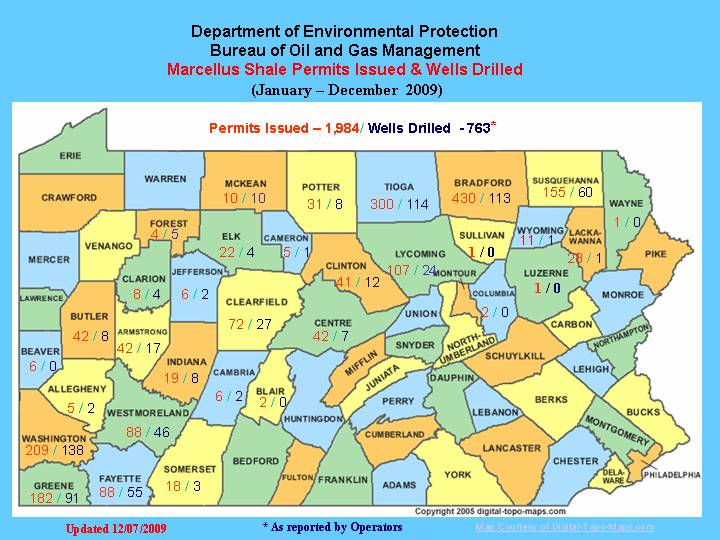
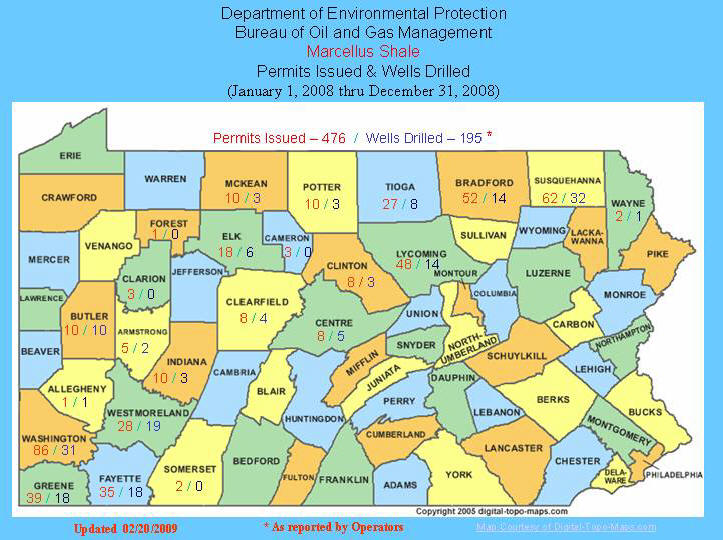
The northern tier counties have been a prime focus in Marcellus Shale natural gas exploration. Through September, 575 of the 1,340 Marcellus Shale drilling permits issued by the state this year were for sites in Susquehanna, Bradford and Tioga counties.

...

The government-sanctioned commission regulates withdrawal and use of water from the river and its tributaries.

"As the demand for water from smaller rivers and streams increases, particularly from the natural gas industry, so does the amount of wastewater that is generated," said commission Executive Director Paul Swartz. "It is important to monitor these smaller, remote waterways to verify whether or not they are being impacted by certain pollutants."

Sounds like the implication here is that waterways would be contaminated by wastewater vs. water withdrawals... something that if it were to occur, would have to be the result of an industry violation of some kind.

...To read the complete report, CLICK HERE.
Editorializing by Splashdown in red.

DEMAND ACCOUNTABILITY!

Sunday, November 15, 2009

TEDX: The Endocrine Disruptor Exchange

Chemicals in Natural Gas Operations

Introduction


As natural gas production rapidly increases across the U.S., its associated pollution has reached the stage where it is contaminating essential life support systems - water, air, and soil - and causing harm to the health of humans, wildlife, domestic animals, and vegetation. This project was designed to explore the health effects of products and chemicals used in drilling, fracturing (frac’ing, or stimulation), recovery and delivery of natural gas. It provides a glimpse at the pattern(s) of possible health hazards posed by the chemicals being used. There are hundreds of products in current use, the components of which are, in many cases, unavailable for public scrutiny and for which we have information only on a small percentage. We therefore make no claim that our list is complete.

Toxic chemicals are used at every stage of development to reach and release the gas. ...............

In addition to the land and water contamination issues, at each stage of production and delivery, tons of toxic volatile compounds, including benzene, toluene, ethylbenzene, xylene, etc., and fugitive natural gas (methane), escape and mix with nitrogen oxides from the exhaust of diesel-driven, mobile and stationary equipment to produce ground-level ozone. Ozone combined with particulate matter less than 2.5 microns produces smog (haze). Gas field produced ozone has created a serious air pollution problem similar to that found in large urban areas, and can spread up to 200 miles beyond the immediate region where gas is being produced. Ozone not only causes irreversible damage to the lungs, it is equally damaging to conifers, aspen, forage, alfalfa, and other crops commonly grown in the West. Adding to this is the dust created by fleets of diesel-driven water trucks working around the clock hauling the constantly accumulating condensate water from well pads to central evaporation pits.

All meaningful environmental oversight and regulation of the natural gas production was removed by the executive branch and Congress in the 2005 Federal Energy Appropriations Bill. Without restraints from the Clean Water Act, Safe Drinking Water Act, Clean Air Act, and CERCLA, the gas industry is steamrolling over vast land segments in the West. Exploitation is so rapid that in less than 6 months in one county, 10 new well pads were built on the banks of the Colorado River, the source of agricultural and drinking water for 25 million people downstream. Spacing has dropped from one well pad per 240 acres to one per 10 acres. From the air it appears as a spreading, cancer-like network of dirt roads over vast acreage, contributing to desertification.

For the complete intro, CLICK HERE.

What you need to know about natural gas production

TEDX has produced a video of Dr. Theo Colborn's 47 minute lecture, complete with photos and data slides to illustrate the fact that natural gas is not the 'clean energy' that industry is touting it to be.
CLICK HERE to view.
CLICK HERE to order a DVD.

DEMAND ACCOUNTABILITY!

Thursday, November 12, 2009

More Dead Life

A while ago... September 1st to be exact, I posted about the birds that died while searching for water, mistakenly lured permanently into a gooey sludgepit in South Texas, on or near the McGill Brothers Lease.
ExxonMobil, having just paid a 600,000$ fine for the death of 85 birds in August, apparently hadn't caught up with its negligence.

Not by a long shot it seems, judging from these recent photos.


Once again ExxonMobil STILL looks negligent!

Stagnant water>dead bodies>disease.
(Grating could so easily prevent this.)

These photos are taken from Mrs. Burns' November 8th post (ExxonMobil -- nature lover), on her great American saga of a blog: A satirical view from the McGill Brothers Lease.

Just a few weeks ago (Oct. 26th), she posted a photo and details of a tractor turned fireball when the driver, a volunteer fire fighter disking fire breaks hit one of XOM's gas lift lines and blew up.
Luckily, he's only 'charred'... but the place reads like a mine field and it's only a matter of time before the next casualty. It certainly doesn't look like there's much remediation going on to prevent it.

How long does this industry imagine it can play the deadly charade too many heedless profiteers, corporate and political alike, are giving a green light?
What will be the ultimate sacrifice that draws their serious, proactive acknowledgement? ...Will we all be dying of thirst? Will it be too late? What's your guess? What are you going to do about it?

DEMAND ACCOUNTABILITY!

Tuesday, November 10, 2009

PA Lawsuit Says Drilling Polluted Water

Jon Hurdle
Mon Nov 9, 2009


AVELLA, Pennsylvania (Reuters) - A Pennsylvania landowner is suing an energy company for polluting his soil and water in an attempt to link a natural gas drilling technique with environmental contamination.

George Zimmermann, the owner of 480 acres in Washington County, southwest Pennsylvania, says Atlas Energy Inc. ruined his land with toxic chemicals used in or released there by hydraulic fracturing.

Water tests at three locations by gas wells on Zimmermann's property -- one is 1,500 feet from his home -- found seven potentially carcinogenic chemicals above "screening levels" set by the U.S. Environmental Protection Agency as warranting further investigation.

Jay Hammond, general counsel for Atlas, said Zimmermann's claims are "completely erroneous" and that the company is in compliance with Pennsylvania's gas-drilling regulations. Hammond said Atlas will "vigorously" defend itself in court and declined further comment.

But Zimmermann says he has evidence that chemicals used by Atlas contaminated his land.

"There are substances that can't be made by nature and that's what's in the ground," he told Reuters during an interview in his 12,000-square-foot house on a remote hilltop.

...

If Zimmermann wins his case, it would be the first in America to prove that hydraulic fracturing causes water contamination. Such a finding could slow the development and use of cleaner-burning natural gas that would reduce American dependence on overseas energy.

PERFECT BASELINE TESTS

Baseline tests on Zimmermann's water a year before drilling began were "perfect," he said. In June, water tests found arsenic at 2,600 times acceptable levels, benzene at 44 times above limits and naphthalene five times the federal standard.

Soil samples detected mercury and selenium above official limits, as well as ethylbenzene, a chemical used in drilling, and trichloroethene, a naturally occurring but toxic chemical that can be brought to the surface by gas drilling.

The chemicals can cause many serious illnesses including damage to the immune, nervous and respiratory systems, according to the Endocrine Disruption Exchange, a researcher of the health effects of chemicals used in drilling.

Zimmermann's suit, filed in September in the Washington County Court of Common Pleas and obtained by Reuters, follows claims by residents in many gas-drilling areas of the United States that fracking pollutes private water wells with toxic chemicals and threatens widespread contamination of aquifers from which many rural households draw drinking water.
Although communities as far apart as Pennsylvania and Wyoming complain that their water has become unusable, they have been unable to prove a link to gas drilling. Energy companies refuse to say what chemicals are used in so-called fracking fluid, saying the mixture is proprietary.

Companies are not required to disclose the composition of the fluid because of an exemption to a federal clean water law granted to the oil and gas industry in 2005.

Many local residents have been deterred from fighting the gas companies by the expense of legal action and water testing. Zimmermann says he has spent about $15,000 on water tests and will spend whatever it takes to prove his case.

Rural residents who live near gas drilling say their water has become discolored, foul-smelling, or even flammable because methane from disturbed gas deposits has migrated into water wells.

DEATHS, MUTATION OF LIVESTOCK

Farmers in southwest Pennsylvania blame cattle deaths and mutations on local fracking. Other complaints attributed to tainted water include children's sickness, skin rashes and neurological disorders.

According to Green Man Blog, "stories are beginning to surface in Western Pennsylvania of dead cattle from water contaminated with frac fluids. In a newly documented case, ten calves died after their mothers drank contaminated water next to a drilling site. The drilling company and PA DEP repeatedly told the farmer his pond water was safe for livestock consumption, and their well water was also safe. ... So what about the ten calves? Four were stillborn, one was born with a cleft lip and five were born without pupils in their eyes. There were never any problems like this before drilling started."
This isn't an isolated case... see shocking photos and read more HERE.
The industry says the chemicals used in fracking are injected through layers of steel and concrete thousands of feet below aquifers, and so pose no threat to drinking water. Spokesman argue there has never been a documented case of water contamination as a result of fracking.

(By now a transparent insult to the victims, this is the standard industry response to claims of water fouled by fracking!)

On Zimmermann's property, the presence of water and soil contaminants that exceed EPA screening levels risks wider pollution of drinking water supply, wrote Cleason Smith, a consultant with Hydrosystems Management, which tested the soil and water, in a letter explaining the test results.

...

Zimmermann's suit says his land has become "virtually valueless" because it is permanently contaminated with toxic chemicals as a result of the 10 wells that Atlas has drilled.

The suit accuses Atlas -- which is able to drill on the land because it acquired the mineral rights from a previous owner -- of negligence. It is seeking an injunction against further drilling, and unspecified financial damages.

With a wife, an eight-year-old son and eight-month-old twins, Zimmermann, 66, worries about air and water quality.

He said he has invested about $11 million in the estate, which includes a winery and an heirloom-tomato business, but he now just wants to walk away because he believes it has been ruined by gas drilling.

He rates his chances of selling the property as "slim to none" in light of the proven water contamination.

"I don't want to live here any more," Zimmermann said. "I'm afraid of the chemicals."

Read more HERE.

Editorializing in red by Splashdown.

DEMAND ACCOUNTABILITY!

Thursday, November 5, 2009

LISTEN TO THIS!!!


DEMAND ACCOUNTABILITY!

Monday, October 19, 2009

How Safe Is Your Drinking Water?

An estimated one in 10 Americans have been exposed to drinking water that contains dangerous chemicals, parasites, bacteria or viruses, or fails to meet federal health standards. Part of the problem is that water-pollution laws are not being enforced.

CLICK HERE to listen to journalist Charles Duhigg talking with Terry Gross on NPR's Fresh Air. The broad ranging discussion includes issues related to hydraulic fracturing.

DEMAND ACCOUNTABILITY!

Tuesday, October 13, 2009

DEAD TREES... DEAD BABY ANIMALS... CARCINOGENS & NEUROTOXINS IN EVERY BREATH!

DISH mayor calls for facility shutdown until emissions controlled

“Frankly, I didn’t think the results would come back as bad as they did,” said Mayor Calvin Tillman. “TCEQ needs to shut these compressors down immediately and until we can get emission controls that protect the residents living right up against this infrastructure.”
The Town of DISH serves as a warning for other communities dealing with the shale gas industry as it drills newly accessible deposits across the country, including Texas, New York, Pennsylvania, Ohio, West Virginia and Arkansas.

"Living with this type of infrastructure and development is difficult to imagine until it’s here. You can feel and hear the compressor engines roaring," says Kathy Chruscielski, a citizen activist with the Texas Oil & Gas Accountability Project. "It's like living next to a 24 hour truck stop. Homeowners suddenly find themselves next door to an industrial zone with very little recourse at the federal and state levels." In Horseheads, New York, Schlumberger – a $75 billion multinational energy company -- is proposing a 65-acre distribution and bulk chemical storage facility that will serve drilling and fracturing operations in the Marcellus Shale deposit.

“Based on Horseheads’ welcome of Schlumberger, I don’t think the Village government really has thought about what’s coming,” says Wes Gillingham of Catskill Mountainkeeper. “Experience like DISH’s and others warn of the too often negative consequences of shale infrastructure.”

For the full report and news release, see Oct. 13 posts, HERE and HERE on the essential blog Bluedaze.

Watch Dallas Fort Worth WFAA news footage HERE. (Notice all the dead trees!)

Carcinogens and neurotoxins found in the air over DISH include: benzene, xylene, carbon disulfide, dimethyl sulfide, dimethyl disulfide, carbonyl sulfide, carbonyl disulfide, methyl ethyl disulfide, ethyl methyl ethyl disulfide, trimethyl benzene, methyl pyridine, dimethyl pyridine...
some at levels 100x Texas state standards!
Industry MUST do better than this!!!

DEMAND ACCOUNTABILITY!

Saturday, September 12, 2009

TOXIC WATERS

The New York Times Reports on the Worsening Pollution of America's Waters and Regulators' Response

Following are excerpts and links from an extensive article by Charles Duhigg, part of a series, on neglected clean water laws and lax regulator response.

• Almost four decades ago, Congress passed the Clean Water Act to force polluters to disclose the toxins they dump into waterways and to give regulators the power to fine or jail offenders. States have passed pollution statutes of their own. But in recent years, violations of the Clean Water Act have risen steadily across the nation, an extensive review of water pollution records by The New York Times found.

• In the last five years alone, chemical factories, manufacturing plants and other workplaces have violated water pollution laws more than half a million times.

• However, the vast majority of those polluters have escaped punishment. State officials have repeatedly ignored obvious illegal dumping, and the Environmental Protection Agency, which can prosecute polluters when states fail to act, has often declined to intervene.

• The Times obtained hundreds of thousands of water pollution records through Freedom of Information Act requests to every state and the E.P.A., and compiled a national database of water pollution violations that is more comprehensive than those maintained by states or the E.P.A.
(For an interactive version, which can show violations in any community, visit
www.nytimes.com/toxicwaters.)
In addition, The Times interviewed more than 250 state and federal regulators, water-system managers, environmental advocates and scientists.

•
That research shows that an estimated one in 10 Americans have been exposed to drinking water that contains dangerous chemicals or fails to meet a federal health benchmark in other ways.

• Because most of today’s water pollution has no scent or taste, many people who consume dangerous chemicals do not realize it, even after they become sick, researchers say.

• The Times’s research also shows that last year, 40 percent of the nation’s community water systems violated the Safe Drinking Water Act at least once, according to an analysis of E.P.A. data. ... More than 23 million people received drinking water from municipal systems that violated a health-based standard.

In some cases, people got sick right away. In other situations, pollutants like chemicals, inorganic toxins and heavy metals can accumulate in the body for years or decades before they cause problems. Some of the most frequently detected contaminants have been linked to cancer, birth defects and neurological disorders.

Records analyzed by The Times indicate that the Clean Water Act has been violated more than 506,000 times since 2004, by more than 23,000 companies and other facilities, according to reports submitted by polluters themselves.

• Finally, the Times’s research shows that fewer than 3 percent of Clean Water Act violations resulted in fines or other significant punishments by state officials. And the E.P.A. has often declined to prosecute polluters or force states to strengthen their enforcement by threatening to withhold federal money or take away powers the agency has delegated to state officials.

• The E.P.A. administrator, Ms. Lisa Jackson, whose appointment was confirmed in January, said in an interview that she intended to strengthen enforcement of the Clean Water Act and pressure states to apply the law. ... "Data available to E.P.A. shows that, in many parts of the country, the level of significant noncompliance with permitting requirements is unacceptably high and the level of enforcement activity is unacceptably low.”

(To find out about every state’s enforcement record and read comments from regulators, visit www.nytimes.com/waterdata.)

[In West Virginia, where health problems seem undeniably linked to contaminated water, industy predictably states that it is not responsible for the difficult to prove source of toxins in drinking water. However, according to Ben Stout, a biology professor at Wheeling Jesuit University who tested the waters, “The chemicals coming out of people’s taps are identical to the chemicals the coal companies are pumping into the ground.”]*

• The memos are marked “DO NOT DISTRIBUTE.”
They were written this year by E.P.A. staff, the culmination of a five-year investigation of states’ enforcement of federal pollution laws. And in bland, bureaucratic terms, they describe a regulatory system — at the E.P.A. and among state agencies — that in many ways simply does not work. For years, according to one memo, federal regulators knew that more than 30 states had major problems documenting which companies were violating pollution laws. Another notes that states’ “personnel lack direction, ability or training” to levy fines large enough to deter polluters.

• [Not surpringly!]* Enforcement lapses were particularly bad under the administration of President George W. Bush, employees say. “For the last eight years, my hands have been tied,” said one E.P.A. official who requested anonymity for fear of retribution. “We were told to take our clean water and clean air cases, put them in a box, and lock it shut. Everyone knew polluters were getting away with murder. But these polluters are some of the biggest campaign contributors in town, so no one really cared if they were dumping poisons into streams.”

• Some say changes will not occur without public outrage.

“When we started regulating water pollution in the 1970s, there was a huge public outcry because you could see raw sewage flowing into the rivers,” said William D. Ruckelshaus, who served as the first head of the Environmental Protection Agency under President Richard M. Nixon, and then again under President Ronald Reagan.

“Today the violations are much more subtle — pesticides and chemicals you can’t see or smell that are even more dangerous,” he added. “And so a lot of the public pressure on regulatory agencies has ebbed away.”

* Splashdown editorializing.

AREA VIOLATIONS

Facility: Towanda Mun Auth WWTP, Towanda, PA

Last Inspected: Sept. 5, 2007

Violations: 11 FINES: $0

Facility: Global Tungsten & Powders Corp., Towanda, PA

Last Inspected: July 24, 2007

Violations: 27 FINES: $0

Facility: Cargill Meat Solutions Corp., Wyalusing, PA

Last Inspected: Oct. 17, 2007

Violations: 13 FINES: $0

DEMAND ACCOUNTABILITY!

RURAL IMPACT VIDEOS, 6 parts

Natural gas development in Colorado, the impacts on communities, environment and public health. A primer for public servants and residents of counties that care for their lifestyles.

Drilling for Gas in Bradford County, PA ... Listen!

Cattle Drinking Drilling Waste!

EPA... FDA... Hello? How many different ways are we going to have to eat this? ... Thank you TXSharon for all you do! ... Stay tuned in at http://txsharon.blogspot.com

Landfarms

A film by Txsharon. Thank you Sharon for all you do. Click HERE to read the complete article on Bluedaze: Landfarms: Spreading Toxic Drilling Waste on Farmland

SkyTruth: Upper Green River Valley - A View From Above