Showing posts with label OIL AND GAS INDUSTRY. Show all posts

Saturday, July 3, 2010

Penn State Admits Gas Study Flaws

Jon Bogle, Responsible Drilling Alliance
NorthcentralPA.com
July 1, 2010


WILLIAMSPORT-- In a response sent by Penn State Dean William Easterling to the Responsible Drilling Alliance (RDA), a non-profit organization based in Williamsport, the University admits that the original version of a natural gas industry study was flawed.

In the Penn State letter, Easterling states that in that initial version, “we found flaws in the way the report was written and presented to the public.” Easterling replies that the first report did not identify the sponsor of the research and he suggests, “…the authors may well have crossed the line between policy analysis and policy advocacy.”

Earlier this month, in a letter initiating correspondence between the two parties, RDA called on the university to disavow publicly papers conducted by Penn State researchers and funded by the Marcellus Shale Committee, a coalition of gas industry representatives.

RDA claims that the papers use the university’s reputation to portray the coalition’s greatly exaggerated claims of economic impact as legitimate research. In a continuation of this correspondence, RDA has released a follow-up letter to Penn State emphasizing the extent to which the industry group has touted the publication as “the Penn State report,” and used its widely contested findings to influence public opinion and political debate in favor of gas drilling in Pennsylvania. Once again, RDA asks the university to repudiate the methods the industry report represents and publicly disavow its findings.

Note: The initial correspondence prompted an Associated Press article, "PSU Drilling Study Questioned Over Industry Tie" Associated Press, Genaro C. Armas, June 14th, 2010. http://abcnews.go.com/Business/wireStory?id=10912385 Since then, the words "Penn State Report" have suddenly disappeared from industry internet sites but the various versions of the reports are still offered carrying the Penn State shield logo on their cover.

  • PSU's original study on Marcellus Shale
  • Letter to President Spanier
  • Dean Easterling's reply
  • RDA's response

To read these lettters, please download the attached PDFs below:

AttachmentSize
PSUStudyMarcellusShale072409.pdf1.9 MB
openletter.pdf30.48 KB
DeanEasterling.pdf49.25 KB
Easterling-RDAletter.pdf1.4 MB

responsibledrillingalliance@comcast.net
www.responsibledrillingalliance.org
LINK

DEMAND ACCOUNTABILITY!

Thursday, May 6, 2010

Oil and gas drilling threatens fish and aquatic habitat onshore

A recent article reported that the Pennsylvania Secretary of Environmental Protection has stated that "water discharges from Marcellus shale drilling operations have already harmed aquatic life in the state...." Because of this, the Pennsylvania Fish and Boat Commission is seeking the help of anglers to identify and survey 45,000 unmanaged Pennsylvania streams in search of native trout. These streams have to be identified in order to be protected from industrial development.

Pennsylvania is not the only place where fish are being harmed or are at risk from oil and gas production. ...

According to Trout Unlimited, the ecological effects of gas and oil development are extensive: "If not done responsibly, this development can contaminate ground and surface water supplies, reduce water quantity and degrade fish habitat."

Back in Pennsylvania, the U.S. Army Corps of Engineers has found that natural gas production activities can impair important trout fisheries. The Corps has stated that these activities pose a "genuine and extreme threat to regional water quality."

Many win-win solutions exist that can protect our wildest lands and streams--our most vital wildlife habitat. Our federal and state agencies should preserve the most vulnerable areas while requiring the highest possible protection where drilling does occur.

LINK to complete post on Amy Mall's blog.

DEMAND ACCOUNTABILITY!

Wednesday, April 14, 2010

The EPA’s Hydraulic Fracturing Study Must Be Designed to Protect America’s Water Sources and Quality


Policy Expert at The Wilderness Society Testifies in Front of EPA Science Advisory Board

(See also Friday, APRIL 9, 2010 post: EPA Study and Big Oil U.)

The Wilderness Society
PRESS RELEASE
April 7, 2010

WASHINGTON – Today, Mary Krueger, a policy expert at The Wilderness Society, testified at the Environmental Protection Agency (EPA)’s Science Advisory Board (SAB) Environmental Engineering Committee on the Hydraulic Fracturing Research Plan Review. The SAB is accepting public comments on the methodology of the EPA’s study on hydraulic fracturing that is scheduled to begin this year.

Krueger’s testimony makes clear that a study on the effects of hydraulic fracturing on drinking water must examine the risk that the invasive process poses to America’s water wells, especially in landforms that are already naturally fractured and porous. Additionally, the study must contain a full lifecycle of the hydraulic fracturing process, including an examination of the water supplies needed to carry out every “frack job.”

The testimony builds on The Wilderness Society’s work to ensure that natural gas drilling is “done right.” One of the most important components of “doing it right” is to make sure that drinking water is protected. Unfortunately, the natural gas industry currently enjoys an exemption from the Safe Drinking Water Act, which can be dangerous to both rural and urban communities. Even more worrisome is that natural gas companies are not required to publicly disclose the chemicals they are injecting underground. As Krueger states, “exempting hydraulic fracturing from the Safe Drinking Water Act creates a regulatory black hole that unnecessarily puts public safety in jeopardy.”

The Wilderness Society’s testimony focuses on three areas that the science committee leading the study must consider:

  • The effects of hydraulic fracturing on karst water systems and landforms that are characterized by sinkholes, caves, seeps, and springs that supply drinking water;
  • The water sources and quantities used for hydraulic fracturing — the process involves the usage of huge amounts of water, often four- seven million gallons or more per well; and
  • Provisions that ensure that both the quantity and quality of drinking water from wells will not be negatively affected.

View Mary Krueger’s testimony.

View the power-point presentation.

“It is imperative that the Obama Administration ensure that natural gas development is done in a way that protects people and lands,” said Krueger. “The EPA should produce a study that is based on sound science and that is not compromised by the worn-out talking points used by the natural gas industry.”

Moving forward, The Wilderness Society urges the EPA to use sound science in decisions regarding hydraulic fracturing.

LINK

DEMAND ACCOUNTABILITY!

Friday, April 9, 2010

EPA Study and Big Oil U.

A conflict of interest?

From a report by the Center for Science in the Public Interest, "As the scientific consensus surrounding climate change has solidified, the oil, gas, coal, and electricity industries have reluctantly recognized the inevitability of political action to reduce greenhouse gas emissions. ... Some actually have begun funding university research aimed at developing technologies and exploring policies that address the global warming crisis.
...
"Since 1991, the major oil companies have committed to investing more than $792 million in at least nine major universities in the United States. Leading institutions like MIT, Stanford, Princeton, and the University of California
at Berkeley have major collaborative research agreements with the energy industry. This study identified five major limitations on academic freedom that are occurring in the nine programs. They include:
• Allowing company representatives on governing boards (6 universities)
• Giving industry sponsors first rights to intellectual property (5 universities)
• Allowing industry sponsors a role in deciding what research projects are funded (6 universities)
• Permitting industry review of research before it is published (5 universities)
• Allowing companies to delay publication of research results (5 universities)
...
"There is an inherent conflict between the interests of universities and the interests of corporations. Former Labor Secretary Robert Reich noted recently, “Corporations obviously are interested in making proprietary, that is . . . having as their personal property, whatever intellectual capital is generated from their sponsorship, but academic freedom – indeed, the life of the mind – depends on the free flow of information.” Although universities and corporations often defend these programs on the basis that they have similar goals and complementary knowledge, the fact is that the interests of universities and corporations can diverge. University research is supposed to work toward the common good. Corporate research is primarily aimed at maximizing profits."
...
In the appendices to the report, Appendix B asks: "Do you allow company representatives on governing boards?" According to Appendix C, the answer is YES for six of the nine universities: Berkeley, Stanford, Rice, UC Davis, Georgia Tech, and Carnegie Mellon.

A number of these impartial? universities are represented on the EPA Science Advisory Board as Members of the Environmental Engineering Committee augmented for hydraulic fracturing review. In fact, David A. Dzombak, Carnegie Mellon University, serves as Chair.

DEMAND ACCOUNTABILITY!

Tuesday, April 6, 2010

Incidents where hydraulic fracturing is a suspected cause of drinking water contamination

Amy Mall
Senior Policy Analyst, NRDC
Switchboard: Health and the Environment
Boulder, Colorado
April 6, 2010

NRDC supports federal regulation of hydraulic fracturing under the Safe Drinking Water Act. We believe this is a sensible approach that would ensure a minimum federal floor of drinking water protection in the more than 30 states where oil and gas production occurs.

Opponents of such regulation claim that hydraulic fracturing has never caused any drinking water contamination. They say this because incidents of drinking water contamination where hydraulic fracturing is considered as a suspected cause have not been sufficiently investigated, either because scientists and regulators could not properly investigate (did not have the information or technology needed) or because they chose not to, even where signs clearly point to hydraulic fracturing. Some cases where groundwater was contaminated during hydraulic fracturing operations have been attributed to other causes, such as faulty well structure, even if a well failed during the hydraulic fracturing process.

Below is a list of incidents where drinking water has been contaminated and hydraulic fracturing is a suspected cause. I can't emphasize enough that there are many more cases of drinking water contamination around the country related to oil and gas production; those listed below are cases where a homeowner had enough detailed knowledge to know that a nearby well was recently fractured and specifically included that information in reports. In many cases of drinking water contamination where hydraulic fracturing has not been mentioned as the cause, it may be because the homeowner does not know if the nearby gas well was recently fractured. It does not mean that hydraulic fracturing is completely absolved. As you will see, these cases are not limited to just one company or one state. The stories from around the country are unfortunately familiar.

Please send me other incidents of which you are aware, and I will add them to this list.

Arkansas: In 2008, Charlene Parish of Bee Branch reported contamination of drinking water during hydraulic fracturing of a nearby natural gas well owned by Southwestern Energy Company. Her water smelled bad, turned yellow, and filled with silt.

Arkansas: In 2007, the Graetz family in Pangburn reported contamination of drinking water during hydraulic fracturing of a nearby natural gas well owned by Southwestern Energy Company. The water turned muddy and contained particles that were “very light and kind of slick” and resembled pieces of leather.

Colorado: In 2001, two families in Silt reported a water well blow-out and contamination of their drinking water during hydraulic fracturing of four nearby natural gas wells owned by Ballard Petroleum, now Encana Corporation. Their drinking water turned gray, had strong smells, bubbled, and lost pressure. One family reported health symptoms they believe are linked to the groundwater contamination.

Colorado: In 2007, the Bounds family in Huerfano County reported a pump house exploded and contamination of drinking water during hydraulic fracturing of nearby wells owned by Petroglyph Energy.

New Mexico: A 2004 investigation by the U.S. Environmental Protection Agency found two residents who reported that the quality of their water was affected by hydraulic fracturing.

New York: In 2007, the Lytle family in Seneca County reported contamination of drinking water the morning after hydraulic fracturing of a nearby natural gas well owned by Chesapeake Energy Corporation. The water turned gray and was full of sediment.

New York: In 2009, the Eddy family in Allegany County reported contamination of drinking water during hydraulic fracturing of a nearby well owned by U.S. Energy Development Corporation. The water turned "foamy, chocolate-brown."

Ohio: In 2007, there was an explosion of a water well and contamination of at least 22 other drinking water wells in Bainbridge Township after hydraulic fracturing of a nearby natural gas well owned by Ohio Valley Energy Systems. More than two years later, over forty families are still without clean drinking water and are waiting to be connected to a town water system.

Pennsylvania: In 2009, the Zimmerman family of Washington County reported contamination of drinking water after hydraulic fracturing of nearby natural gas wells owned by Atlas Energy. Water testing on their farm found arsenic at 2,600 times acceptable levels, benzene at 44 times above limits, naphthalene at five times the federal standard, and mercury and selenium levels above official limits.

Pennsylvania: In 2008, two families in Gibbs Hill reported contamination of drinking water after hydraulic fracturing of a nearby natural gas well owned by Seneca Resources Corporation. Their water had strong fumes, caused burning in lungs and sinuses after showering, and caused burning in the mouth immediately upon drinking.

Pennsylvania: In 2009, families in Bradford Township reported contamination of drinking water after hydraulic fracturing of nearby natural gas wells owned by Schreiner Oil & Gas. The drinking water of at least seven families has been contaminated.

Pennyslvania: In 2009, the Smitsky family in Hickory reported contamination of their drinking water after hydraulic fracturing of nearby natural gas wells owned by Range Resources. Their water became cloudy and foul-smelling. Testing found acrylonitrile, a chemical that may be used in hydraulic fracturing. The EPA is now investigating this incident.

Texas: In 2007, three families who share an aquifer in Grandview reported contamination of drinking water after hydraulic fracturing of a nearby well owned by Williams. They experienced strong odors in their water, changes in water pressure, skin irritation, and dead livestock. Water testing found toluene and other contaminants.

Virginia: Citizens reported drinking water contamination after hydraulic fracturing. Water was murky and had oily films, black sediments, methane, and diesel odors. Individuals experienced rashes from showering. The Buchanan Citizens Action Group reported over 100 documented complaints of adverse effects of hydraulic fracturing and the Dickenson County Citizens Committee reported ground water quality deteriorated throughout the county as a result of the large number of hydraulic fracturing events.

Wyoming: Families in the small town of Pavillion have been reporting contamination of their drinking water for at least ten years. Hydraulic fracturing has been used in the many wells in the area owned by Encana Corporation. Drinking water has turned black, smelled bad, and tasted bad. Individuals report medical symptoms they believe are related to water contamination. The U.S. Environmental Protection Agency is investigating and has found contamination in 11 water wells, including toxic chemicals that may be from hydraulic fracturing fluids. Further tests are needed to determine the source of contamination.

Link to Amy Mall's Blog and leave comments: HERE.

Thank you Amy!

DEMAND ACCOUNTABILITY!

Wednesday, March 31, 2010

What the Frack? Natural Gas from Subterranean Shale Promises U.S. Energy Independence--With Environmental Costs

Natural gas cracked out of shale deposits may mean the U.S. has a stable supply for a century--but at what cost to the environment and human health?

By David Biello
ScientificAmerican.com
March 30, 2010

DISH, Tex.—A satellite broadcasting company bought the rights to rename this town a few years ago in exchange for a decade of free television, but it is another industry that dominates the 200 or so residents: natural gas. Five facilities perched on the north Texas town's outskirts compress the gas newly flowing to the surface from the cracked Barnett Shale more than two kilometers beneath the surface, collectively contributing a brew of toxic chemicals to the air.

It is because of places like DISH (formerly known as Clark) and similar sites from Colorado to Wyoming, that the U.S. Environmental Protection Agency (EPA) has launched a new review of the practice known as hydraulic fracturing, or "fracking". From compressor stations emitting known human carcinogens such as benzene to the poor lining of wells after drilling that has led some water taps to literally spout flames, the full set of activities needed to produce natural gas gives rise to a panoply of potential problems. The EPA study may examine everything from site selection to the ultimate disposal of the fluids used in fracking.

View a slide show of hydraulic fracturing

The picture from DISH is not pretty. A set of seven samples collected throughout the town analyzed for a variety of air pollutants last August found that benzene was present at levels as much as 55 times higher than allowed by the Texas Commission on Environmental Quality (TCEQ). Similarly, xylene and carbon disulfide (neurotoxicants), along with naphthalene (a blood poison) and pyridines (potential carcinogens) all exceeded legal limits, as much as 384 times levels deemed safe. "They're trying to get the pipelines in the ground so fast that they're not doing them properly," says Calvin Tillman, DISH's mayor. "Then you've got nobody looking, so nobody knows if it's going in the ground properly…. You just have an opportunity for disaster here."

DISH sits at the heart of a pipeline network now tuned to exploit a gas drilling boom in the Fort Worth region. The Barnett Shale, a geologic formation more than two kilometers deep and more than 13,000 square kilometers in extent, holds as much as 735 billion cubic meters of natural gas—and the city of Fort Worth alone boasts hundreds of wells, according to Ed Ireland, executive director of the Barnett Shale Energy Education Council, an industry group. "It's urban drilling, so you literally have drilling rigs that are located next door to subdivisions or shopping malls."

Although the first well was drilled in 1982, it took until 2002 for the boom to really get started. Now there are more than 14,000 wells in the Barnett Shale, thanks to a combination of being able to drill horizontally and fracking—pumping water at high pressure deep beneath the ground to literally crack the rock and release natural gas.

"They pump a mixture of water and sand—and half a percent of that is some chemicals, like lubricants," Ireland explains. "They pump that into the formation at a very high pressure. Cracks it just like a windshield. And the cracks go out a couple hundred feet on either side and that forms the pathway for the natural gas to migrate to the well bore and up to the surface."

All that natural gas may prove a boon to a U.S. bid for energy independence. Plus, burning natural gas to produce electricity releases roughly 40 percent less of the greenhouse gas carbon dioxide than burning coal. So the question is: Can extracting that natural gas be done safely?

Water pollution
As Ireland notes: "There's never been a documented case of contaminated water supply." That is technically true, but residents of Dimock, Pa., may disagree. That town sits atop the Marcellus Shale—a giant natural gas–laden rock formation that stretches from Tennessee to New York State—and the kind of extraction now going on in Texas is just getting started there. In Dimock, leaks from badly cased wells contaminated drinking water wells—and one even exploded.

It all comes down to the fact that fracking involves a lot of water. There's the at least 11.5 million liters involved in fracking a well in the first place. There's the brine and other fluids that can come to the surface with the natural gas. And there's the problem of what to do with all that waste fluid at the end of the day.

In Dimock's case, Houston-based Cabot Oil and Gas has spilled fracturing fluid, diesel and other fluids, according to Pennsylvania's Department of Environmental Protection. And elsewhere in the state fracturing fluid contamination has been detected in the Monongahela River, which is a source of drinking water. In more common practice, companies dump used fracking fluid back beneath the surface, usually injecting it into other formations beneath the shale. For example, in the case of the Barnett Shale, disposal wells send that water into the deeper Ellenburger Formation.

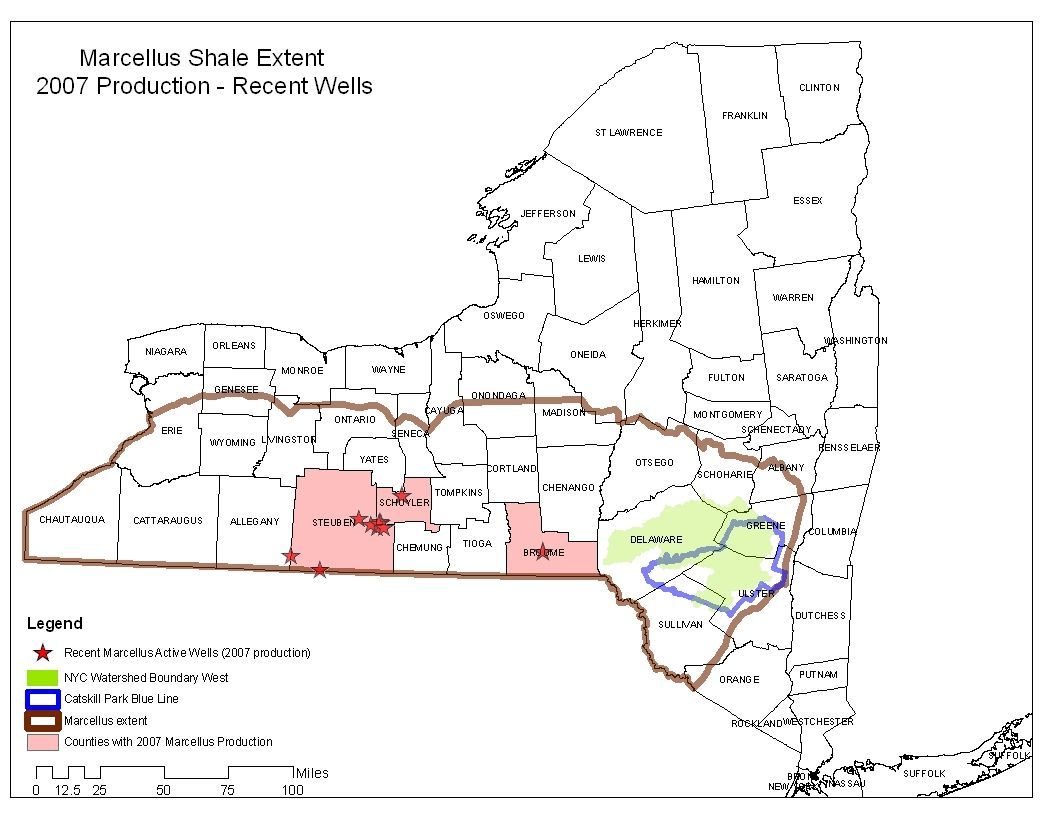
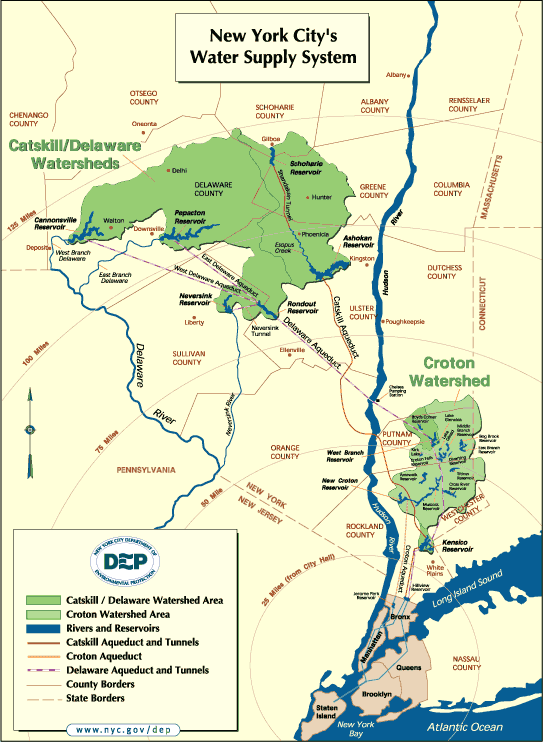
But there's also the problem of what's actually in the fracking fluid. EPA tests in Wyoming have found suspected fracking fluid chemicals in drinking water wells, and a study by the New York State Department of Environmental Conservation identified 260 chemicals used in the process—a review undertaken as the state decides whether to allow such drilling on lands comprising the watershed providing New York City with its drinking water. And Dow Chemical notes that it sells biocides—antimicrobial poisons—to be included in the mix. But companies zealously guard the secret of what exactly makes up their individual "special sauce." It is one of the ways the companies distinguish themselves.
(See Flower Mound Citizens Against Urban Drilling March 30th post: Natural Gas Drilling Companies Searching for Hydraulic Fracturing Alternatives)

Air pollution
In places where required by law, natural gas companies also distinguish themselves by how they filter out air pollutants. "There's [vapor recovery units] that they can put in place to cut out 95 percent of the emissions from a site," Tillman says. "In states where it's been mandated they do it, and they do it willingly—and they do presentations that show how they're going to comply and how their vapor recovery unit is better than the next guy's vapor recovery unit."

That obviously does not happen in DISH, and a big part of such negligence is a lack of appropriate oversight. For example, after it received complaints the TCEQ sent an SUV with a gas detection unit to drive around Dish for a couple of hours. Despite widespread complaints of odor, the commission found "no leaks that would be detectable to the human nose," Tillman says. "So obviously they're trying to deceive us, they're treating us like we're blooming idiots."

As a result, DISH conducted its own air quality test—at a cost of 15 percent of the town's annual budget of $70,000—that revealed the toxic mix of air pollution. Subsequently, the town petitioned and won the right to install one of seven permanent air monitors in the entire state of Texas. "It's not just writing regulations," Tillman notes. "Somebody has to go out and make sure they're following regulations. And when they're not following regulations, the punishments need to be swift and harsh."

That problem is not confined to the TCEQ or the Railroad Commission of Texas, which through a quirk of history regulates the Lone Star State's oil and gas industries. National laws, like the Safe Drinking Water Act, have been specifically amended to exempt hydraulic fracturing from federal regulation. Yet a New York City analysis of fracking has found that whereas a single fractured natural gas well may do no harm, the hundreds required to exploit shale gas "brings an increased level of risk to the water supply." Plus, although fracking occurs deep below freshwater aquifers, natural cracks "serve as conduits that facilitate migration of contaminants, methane or pressurized fluids."

And it's in the air, too. The Texas Health and Human Services Commission is now conducting tests on roughly 30 residents of DISH to see what might be the human health impacts of this air pollution exposure. And the TCEQ has found high air pollution levels in other nearby towns, such as Decatur, and at individual residences.

Climate savior?
Nevertheless, a 2004 study by the EPA found hydraulic fracturing harmless and the oil industry has been using a roughly similar extraction method since the 1940s. If shale gas can be extracted safely, it might go a long way to cutting back on U.S. emissions of greenhouse gases, as acknowledged at the U.N. Copenhagen climate conference this past December by environmentalists such as Christopher Flavin of the Washington, D.C.–based World Resources Institute. "Compared with coal, natural gas allows a 50 to 70 percent reduction in greenhouse gas emissions," he said. "It's a good complement to the wind and solar generators that will be the backbones of a low-carbon electricity system."

Already, the U.S. produces nearly 600 billion cubic meters of natural gas annually, according to the U.S. Department of Energy (DoE), and it estimates proved reserves of natural gas of at least 6.7 trillion cubic meters. The Marcellus Shale alone may have at least 10 trillion cubic meters.

A host of companies have moved in to exploit this resource, and a "few hundred" wildcatters operate in the Barnett Shale alone, according to Ireland. "The wildcatters are the small companies, they have a low overhead, and they can afford to go out and take some risks," he says. "That's been the history of the business and I think that will continue." But major companies have also taken an interest; ExxonMobil hopes to buy natural gas producer XTO Energy pending regulatory approval.

That's because natural gas is becoming more and more the fuel of choice for generating electricity; the DoE expects 21 percent of U.S. electricity to be derived from natural gas by 2035, and by 2034 power plant builder and consulting firm Black & Veatch expects almost half of all U.S. electricity to come from burning natural gas. "I don't see gas shales having an insurmountable environmental problem that is expensive to fix," says Mark Griffith, head of Black & Veatch's power market analysis.

And the gaseous fossil fuel is used for everything from home heating to making plastics and fertilizer. "It's good that we've discovered all this natural gas, because we're going to need it to generate electricity," Ireland says. "Twenty years from now, we're still going to need all the natural gas we can get."

Some, such as Texas oil- and gas-millionaire T. Boone Pickens, have even suggested using this new surfeit of natural gas to help wean the U.S. off foreign oil, turning it into vehicle fuel. Of course, compressed natural gas is already the fuel of choice for many metropolitan area bus fleets.
Ultimately, however, shale gas extraction—and the hydraulic fracturing that goes with it—will have to be done right. "If something comes out that you're poisoning the population, it's going to be a very bad thing," Ireland notes.
The EPA anticipates finishing its latest study of the practice by 2012. "Six months ago, nobody knew that facilities like this would be spewing benzene," Tillman notes. "Someone could come in here and look at us and say, 'You know what? They've sacrificed you. You've been sacrificed for the good of the shale.'"

LINK

Editor's Note: David Biello is the host of a forthcoming series on PBS, tentatively titled "The Future of Electricity". The series will explore the coming transformation of how we use and produce electricity, along with its impact on the environment, national security and the economy. He conducted the interviews for this article in conjunction with his work on that series.

DEMAND ACCOUNTABILITY!

Sunday, March 28, 2010

Appalling News Needs Your Attention and Action!!!

Oil giants propose limiting federal oversight of fracturing
By TOM FOWLER
Copyright 2010 Houston Chronicle
March 24, 2010, 10:12PM
Reprinted by permission. (Thanks Tom)

BP, ConocoPhillips and Shell Oil Co. have provided Senate lawmakers with language to include in a pending climate change bill that essentially would block federal oversight of hydraulic fracturing, a technology that's key to the current natural gas drilling boom.

The companies prepared the document, according to sources familiar with it, at the request of the Senate team that is drafting climate change law, which includes Sens. John Kerry, D-Mass., Lindsey Graham, R-S.C., and Joseph Lieberman, I-Conn.

If incorporated into the climate change law, it would keep the Environmental Protection Agency from imposing regulations on fracturing, which is now regulated at the state level.


Read more HERE,
then write letters!

DEMAND ACCOUNTABILITY!

Monday, January 25, 2010

Forest Fragmentation and Natural Gas Development

PA Environment Digest
Daily Blog
January 24, 2010


Department of Conservation and Natural Resources Acting Secretary John Quigley told the Senate Environmental Resources and Energy Committee recently he was concerned thousands of new natural gas wells and thousands of miles of access roads and related collection pipelines could have a major impact on Pennsylvania's State Forests.
The fragmentation of forest habitats has also been a concern of environmental groups like Pennsylvania Audubon.
Until now it was hard to illustrate how natural gas and oil well development can affect a forest. Recently, however, the website Damascus Citizens circulated aerial photos of gas well sites from all over the country, including in Pennsylvania.
An aerial photo of traditional oil and gas well development in Forest County, Pa in a portion of the Allegheny National Forest just north of the Clear Creek State Forest clearly shows how roads and drilling pads can fragment a forest.
To see it for yourself, enter these coordinates in Google Earth-- 41 degrees, 30 minutes 47.77 seconds North, 79 degrees 11 minutes 16.13 seconds west.
Marcellus Shale well development patterns are different because they use fewer well pads by drilling very deep vertical wells and then drill horizontal wells out in several directions in the natural gas producing strata.
The aerial photo on Google Earth is part of the statewide series made available by the Department of Conservation and Natural Resources' PA Map Program, recently eliminated in this year's state budget.
LINK.
DEMAND ACCOUNTABILITY!

Friday, December 18, 2009

Hydrofracking Regulation Would Kill Exxon’s XTO Acquisition

Posted by Gregg Gethard
heatingoil.com
December 17, 2009

An out clause exists for the Exxon in its merger with XTO Energy if Congress decides to regulate hydraulic fracturing, reported Russell Gold of the Wall Street Journal’s Environmental Capital blog on Wednesday. Exxon will spend $41 billion to purchase XTO, an energy firm known for its expertise in natural gas drilling and production. XTO has invested heavily in the Marcellus Shale, a region in western New York and northern Pennsylvania which is home to large reservoirs of natural gas. However, obtaining this gas is difficult and requires the use of hydraulic fracturing, or hydrofracking, in which thousands of gallons of water are mixed with various fluids to fracture rocks holding natural gas. Critics maintain that hydrofracking causes water pollution, which could force Congress to look at the issue.

If Congress regulates hydrofracking to make it “illegal or commercially impracticable,” in the words of the merger agreement, Exxon can back out of its proposed purchase of XTO.

DEMAND ACCOUNTABILITY!

URGE CONGRESS
TO PASS THE FRAC ACT!


Saturday, September 19, 2009

EUREKA!

Here's how the Independent Oil and Gas Association of New York Figures it Can WHAT??? Placate? Assuage? Appease? ...oh, what's the word for it??? Reassure Us or Mitigate Our Outrage After TWO Toxic Spills in Dimock PA... EUREEEEKA!
This ought to do it!
Come On People!
Talk Back to this Fantasy!!!


(Editorializing in red by Splashdown)

IOGA of NY Press Statement on Spill at Gas-Drilling Site in Dimock, PA

LAKE VIEW, NY (09/18/2009)(readMedia)-- The following press statement was issued by Brad Gill, Executive Director of the Independent Oil and Gas Association of New York (IOGA-NY) on September 18, 2009.

"On behalf of members the Independent Oil and Gas Association of New York, we are deeply concerned with the incident that occurred, in Dimock, Pennsylvania yesterday (September 17, 2009). It is our understanding that the spill resulted from a decoupling of a water line, which contained "slick water". Slick water is comprised of 99.5 percent water and sand and is not considered a toxic substance.

ahem... This is from an Aug. 7th update on the death of 17 cows in a Louisiana pasture:

"No final toxicology report has been made public about what killed 17 cows in south Caddo after they ingested liquid spilled from a nearby Chesapeake Energy Corp. drilling site April 28.

...

During a routine fracturing operation by Schlumberger, some fluids composed of 99 percent freshwater leaked onto the well pad then onto the pasture after a rain, Chesapeake Energy, which owns the well site, says in a letter sent in June to DEQ. About 4 p.m. April 28, site workers noticed the dead cattle."

We've already seen how lethal 99% water can be...

EUREKA!

Care for a glass of that water Mr. Gill?

The Pennsylvania DEP has been on hand and is satisfied with the remediation being completed.

The incident in Dimock is indeed regrettable and unfortunate. It is important to note that this circumstance should not be viewed as representative of members' work and experience day-to-day. Such incidents as the spill in Dimock are quiet rare, ...we interrupt this sentence!

(rare: adj. 1. coming or occurring far apart in time; unusual; uncommon)

EUREKA!, Cabot Oil accused of being responsible for contaminating Dimock wells.

EUREKA! Methane contamination in Colorado water wells linked to drilling.

EUREKA! House explodes in Ohio.

EUREKA! Cows die in Louisiana pasture near Chesapeake spill.

EUREKA! ...drilling has already poisoned wells in western Pennsylvania, Colorado, Alabama, Arkansas, New Mexico, Kansas, Montana, Virginia, Washington, West Virginia and Wyoming.

EUREKA! Water leak from Washington County gas well kills fish.

EUREKA! Not long ago the first earthquake near gas drilling sites in Texas was thought, by some, to be an anomaly. Now, 17 earthquakes later, in the space of only a few months, we cannot claim pure coincidence, nor can we ignore the dangers these earthquakes present to gas pipelines and so, to safety.

EUREKA! Contaminated water in Bradford, PA ... Water problems from drilling more frequent than PA officials said.

EUREKA! Natural gas well leak in Lycoming Co. contaminates tributaries, spring and water wells in private homes.

EUREKA! Another natural gas well leak near Roaring Branch, PA and a string of more than 50 similar cases related to gas drilling in the state.

EUREKA! Pavillion, Wyoming: EPA Confirms Drinking Water Contamination by Toxics Used in Hydraulic Fracturing.

EUREKA! Birds die after exposure to hydrocarbons in open natural gas well pits and wastewater storage facilities at ExxonMobil sites in five states.

EUREKA! 2-BE and other chemical contaminants, used in drilling, linked to series of illnesses. Pollluted water near gas-drilling sites endangering the health of people who live close to drilling rigs.

EUREKA! ...and that's just a six month Splashdown sampling...
(See more on TXsharon's Bluedaze!)

and natural gas exploration has been conducted safely and in an environmentally sound manner for decades in New York.

(Has New York had horizontal hydrofractured wells for decades? Heh. What's stopping the industry from drilling another one tomorrow?)

Our companies have worked very, very hard to work in conscientious concern for the environment – due in large measure to very rigorous oversight by NYSDEC - and we will continue to do so. We live and work in New York too.

We stand steadfast in our conviction that natural gas exploration can be facilitated in a safe and environmentally friendly manner. In days to come, IOGA of NY is looking forward to the Department of Environmental Conservation's issuance of a generic environmental impact statement that will guide Marcellus development. And as we have done in the past, our companies will comply with all regulations and permit requirements."

Well, this just flies in the face of reality. We'll take a closer look at that next.

***

IOGA of NY is a trade association founded in 1980 to protect, foster and advance the common interests of oil and gas producers, professionals and related industries in the State of New York. For additional information on natural gas exploration, as well as an up-to-date listing of the association's public meeting schedule, please visit IOGA of NY's informational blog: https://www.marcellusfacts.com.

DEMAND ACCOUNTABILITY!

Wednesday, August 5, 2009

Fatalities in the Energy Fields: 2000-2006

From the April 02, 2007 issue of High Country News by Ray Ring

At least 89 people died on the job in the Interior West’s oil and gas industry from 2000 to 2006, in a variety of accidents, including 90-foot falls, massive explosions, poison gas inhalations and crushings by safety harnesses. Some states choose to have the federal government handle worker safety regulation, and some create state agencies to handle it; all the agencies tend to go by the nickname OSHA, after the federal Occupational Safety and Health Administration.

Some fines in the cases listed below are not directly related to fatalities; sometimes investigators notice unrelated safety violations when they visit workplaces where workers have died.

This list is almost certainly incomplete, due to loopholes in requirements for reporting fatalities.

The list below includes the victims' names, age at time of death, date of the accident, company(s) involved, a description of the accident, and fines, if any.

COLORADO

Ricky Erb, 19

11/27/06 Schneider Energy Services

Head injury, blown out of 5-foot hole when a reportedly 40-year-old pipeline Pending ruptured. He and rest of crew were using a cutting tool to open the pipeline, and they didn’t expect it to contain pressurized gas.

Jacob Farmer, 19

11/16/06 Leed Energy Services Inc.

Struck by falling pulley on a well-servicing rig. The victim’s father works in oil and gas. Pending

Phillip Smith, 44

11/6/06 Easy Street Crane Service

Crushed by truck. Pending

Joshua Arvidson, 24

1/25/06 Calfrac Well Services Ltd.

Engulfed by 40,000 pounds of sand in a storage bin. $27,825

Zac Mitchek, 42

11/25/05 Patterson-UTI Drilling Co.

Electrocuted while doing maintenance on a light plant for a drill rig. $11,900

Larry Hill, 42

11/7/05 Union Drilling Inc.

Fell 55 feet from platform on drill-rig derrick while handling hoisted drill pipes. OSHA said the company did not ensure that the worker was using proper fall-protection gear. $19,990

Randall Taylor, 62

8/14/04 Wolverine Drilling Inc.

Crushed by pulley system that collapsed from top of derrick while rig was trying to lift 270,000 pounds of drill pipe from a hole 8,400-feet deep. OSHA issued violations for unrelated problems. $4,560

Scott Nelson, 26

6/1/04 Union Drilling Inc.

Crushed when the top of a drill rig collapsed. OSHA estimated the rig was built in the 1970s and said a faulty weld failed under the strain of more than 300,000 pounds of drill pipe. $18,225\

Stephen Amen, 44

5/13/03 D&D Water Service

Struck when parts broke on a hoisting mast on service truck. $10,795

Raul Barron, 44

4/1/03 Kerr McGee Rocky Mt Corp.

Explosion at oil-and-gas waste storage plant while a crew welded a tank. Three others were hospitalized.

$14,000

M.J. Welding Inc.

$3,900

Bravo Services Total Inc. $1,500

Marty Vigil, 32

11/18/02 Caza Drilling Inc.

Fell 100 feet from platform on derrick while drill rig was tripping pipe into the hole. OSHA said he did not have his fall-protection gear rigged properly. OSHA imposed fines for unrelated violations. $4,313

Michael Blanchfield, 41

10/2/02 Hayes Petroleum

Crushed by cable that spooled onto a winch on a drill rig while crew tried to use the winch to jar loose an obstruction deep in the hole. $3,936

Rex McCarley, 44

9/17/01 Baker Oil & Tool

Struck in head on a workover rig by a 60-pound valve that came loose and fell 15 feet. He was wearing a hard hat. None

Martin Mireles, 48

7/11/01 Key Energy Services, Inc.

Struck by counterweight on oil well pumping unit.

$2,500

Merit Energy Co. Merit leases the well site where Mireles died and hired Key Energy to do the work. $2,250

Dominick Mustache, 48

6/15/01 Colorado Refining Co.

Fell off ladder in refinery. None

MONTANA

Jose E. Figueroa, 18

9/1/06 Grant Geophysical Corp.

Crushed in rollover of an ATV, while servicing seismic equipment exploring for oil and gas. He was driving and overloaded the cargo rack. He was part of a 45-person crew that spoke mostly Spanish, working for a Texas subsidiary of a Canadian company; the OSHA investigator needed an interpreter. $9,450

Kory Dawson, 35

4/13/06 Green Oil & Field Service Inc.

Struck, pinned to the ground and crushed by crank arm of oil-pumping rig while his crew tried to repair a part on the rig. Victim died at the scene, but the company reported it to OSHA a week later. $6,750

Rodger Gonzales, 52

4/28/05 Cenex Pipeline LLC

Struck by pieces of a valve that exploded, while he was using high-pressure water — more than 1,500 psi — to test a pipeline for leaks. OSHA said the company had inadequate gauges to measure the pressure. $19,750

Steve Stensaker, 27

12/28/01 Sun Well Service Inc.

Struck by counterweight on pumping unit, while taking down a rig’s derrick. OSHA said the company had inadequate safety training. $2,000

NEW MEXICO

Armando Fraive, 57

12/22/06 Eunice Well Service

Struck “in the chin with much force” by a pipe while erecting a drilling rig. Pending

Martin Estrada, 23

10/4/06 Mayo Mars Casing Pulling Inc.

Pinned to the ground by an oil well head that popped off the well unexpectedly; the crew was trying to plug the well. Pending

Todd Martin, 43

1/31/06 Halliburton Energy

Struck by a rock that was kicked up by tires on a big truck while he stood in a group of workers at a well site. The 8-pound rock flew 43 feet and hit his head and face. None

Mack Grass, 57

12/12/05 Gandy Corp.

Engulfed in a flash fire as he tried to clean the coils on a truck that heats fluids for removing wax from wells. None

Jose Ramon Hidalgo Gomez, 29

8/31/05 Triple P Oilfield Services

Struck as he opened a valve on a capped well. The well’s pressure — 300 psi — vented too quickly, spinning the pipe into his head, breaking his hard hat. OHSA found unsafe company practices and inadequate training. $6,250

Hank Castillo, 43

6/25/04 Drake Well Service

Fell 75 feet from the crow’s nest atop a well-service rig. The crew was pulling rods from the well and rods accidentally hit the crow’s nest, destroying it and dislodging him. None

Edgar A. Nieto, 19

2/3/04 Eunice Well Servicing Co.

Struck in head twice by a 75-ft section of rod on well-service rig. The rod came loose from its clamp while being hoisted. Investigators noted the rig was manufactured in 1976, victim had nine months on the job, company generally has a good training program. None

Shannon Mascarenas, 23

10/10/03 Aztec Drilling

Snagged by a rotating winch as he did a routine ”walkdown” of a drill rig. The lighting in the winch area was poor, and the winch had no guard on it. It tore his arm off. $1,200

Douglas Allen Florence, 28

9/15/03 Aztec Well Servicing Co.

Burned on a coalbed-methane drill rig in a surge of gas. Apparently, the diesel engine for an electrical generator ignited the gas and flames shot more than 100 feet. $3,000

Noe Rios, 40

11/18/02 L & M Drilling Inc.

Struck in shoulder and chest by massive mechanical tongs on a drill rig. The operator of the tongs had to deal with a faulty control mechanism. None

Daniel H. Pina, 39

10/28/02 Banta Oilfield Service Inc.

Burned while repairing a heater that separates oil from water and gas. He unscrewed a valve without relieving internal tank pressure, and it ignited. Investigators said the company had a good safety program, but should’ve had more training on this procedure. $3,500

Ted Thompson, 46

1/31/02 Three Rivers Trucking

Struck in face and chest by pressure gauge that shot off its mount as he pumped drums of chemicals into a gas well casing. The 165-horsepower pump system didn’t have a pressure-relief valve. $500

Jose Aguirre, 31

10/2/01 Tim Snelson Pumping Service

Crushed by pumpjack at oil well while replacing a part; the brakes slipped and pumpjack cycled down on him. Investigators said company had inadequate training and no chain securing the pumpjack in case brakes slipped. $2,325

Larry Blakley, 43

8/21/01 McVay Drilling Co.

While he mixed a sack of caustic potassium hydroxide at mud tank, the mix reacted violently, severely burning his body. $1,225

John M. Trout, 68

8/1/01 Champion Inc.

Struck on forehead by hatch lid that blew off tanker trailer as he took on a load of ”high-gravity” crude oil. Apparently, he hadn’t opened vents to release the pressure inside the tank. He’d worked 59 hours in five days. None

Jimmy Hicks, 40

5/30/01 Patterson-UTI Drilling Co.

Struck in head by hose that came loose from a cross-member of drill rig. $1,312

Juan Mendoza, 46

4/3/01 Lucky Services Inc.

Crushed by well service rig that tipped over while he was standing on it. None

Ricardo Hernandez, 20

10/31/00 Triple P Well Service, Inc.

Fell. (Investigating agency provided no details, saying files this old are typically destroyed.) None

Kirk Webb, 23

3/30/00 Pool Energy Services Co.

Burned in an explosion while he off-loaded brine from a truck into a 1,000-barrel tank. None

NORTH DAKOTA

Charles Lindstrom, 57

8/17/06 Energy Systems Ind., Inc.

“Blunt-force trauma” while he worked alone on the repair of a pumping unit. $750

Karl Heller, 31

4/5/06 Cyclone Drilling

Crushed by 3,400-pound tank that his crew was lifting with a 1.5-inch-diameter rope when the rope broke. OSHA noted most of the crew was inexperienced and didn’t know the rope’s load rating; the company didn’t have a procedure for training workers to stay clear of loads. $3,750

Zach Anderson, 20

1/30/06 American Casing & Equipment

Struck by pipe or pipe clamp while standing on a platform 30 feet above rig floor, as pipes got out of control while being spun and screwed together. OSHA noted the victim only had two or three days’ experience in the pipe-handling job. $1,050

Brian Loken, 45

12/13/04 Plains Marketing L.P.

Electrocuted by an underground 7,000-volt power line while his crew tried to repair a pipeline. $3,375

Danny Schroeder, 44

11/29/04 Northwest Roustabouts

Crushed between bucket and frame of skid-steer loader when he engaged the controls while climbing on the loader. OSHA said the crew lacked training and was misusing the loader in a couple of ways. $4,500

Robert Updike, 21

2/9/04 Wolverine Drilling

Struck in head and neck by steel cable; crew was stringing cable to erect a drill rig, a connector broke, and cable snapped back and dropped on him. OSHA said training was inadequate and the connector had been installed improperly. $3,675

Andrew Lambourn, 23

5/1/03 Stride Well Service Inc.

Crushed by a catwalk that fell when a support chain broke. OSHA said the company should’ve inspected the chain and kept workers clear of suspended loads. $7,000

UTAH

David A. Vickers Jr. (age not provided)

6/27/06 MarMc Transportation Inc.

Run over by a forklift while working with a crew moving a drill rig; he was resting in the shade of the forklift, and a truck driver (not the forklift driver) hopped on it and drove forward. The company had just been cited by Wyoming OSHD for inadequate forklift training. $1,800

Shane L. Judd, 41

6/9/06 DHS Drilling Company

Fell 90 feet from top of a rig’s derrick. He hadn’t hooked up his fall-protection device. Investigators noted the crew was pulling long work shifts, drilling in the rain; the ambulance took 45 minutes to reach the remote site. $3,150

Steven Spooner, 44

2/26/05 Union Drilling

Crushed by 1,000-pound steel deck plate that fell off forklift while crew erected a drill rig. Forklift had been left idling and unattended without the brake set. $4,700

Montgomery L. Allee, 40

1/14/05 Patterson-UTI Drilling Co.

Struck in head by cable as crew was erecting drill rig. The cable had gotten snagged, and rig manager told him to try to unsnag it. Investigators noted they were in a hurry, and it was an unsafe order. $7,000

David Gardner, 23

2/4/04 Basic Energy

Struck in the head by descending oil rig elevator; other loud noises on the job prevented him from hearing his co-workers’ shouts of warning. $5,000

Donald E. Cannon, 47

8/26/02 Cannon Well Service Inc.

Blown 112 feet when pipes ruptured at gas well where gas pressure was 1,900 psi, then gas ignited. Investigators blamed faulty pipes but also said he’d parked too close to the well. (Note: family company; his son died in rig accident in 1997.) $1,125

Marcus Adam Liddell, 21

10/10/01 Basin Swabbing & Oil Service

Struck by the 20-pound elevator of a drill rig when it broke loose from top of rig and fell 66 feet onto him. (Note: family company, and his father is a co-owner. He was a college student and it happened two days after his birthday. Some co-workers quit after the accident.) None

Floyd Morganstean, 37

8/23/00 FMC Fluid Control Div.

Struck by piece of a ”frac” head that exploded, while crew was testing whether it would hold 13,000 psi pressure. Investigators noted the crew should’ve had a shield between them and the test. $1,100

WYOMING

Bobby Ray Owens, Jr., 52

11/11/06 Associated Pipeline Contractors

Driving a bulldozer, blading the right-of-way for a new transcontinental gas pipeline, he hit a 36-inch pipeline, went up in a 300-foot fireball that shook the ground and could be seen for miles. Pending

Jerrid Thomas Gardner, 22

10/31/06 Hawkeye Well Service

Entangled in the driveshaft of an oil well pump; his father also works for the company. Pending

Steve Robinson, 35

6/1/06 High Desert Services Inc.

Slipped from a platform and got wedged between two 11-foot-tall water tanks he was heating with a propane-fired service truck, suffered ”thermal injuries” from being ”trapped against a heated metallic surface.” It happened around sunset as he worked alone at a remote gas-well site; his body wasn’t discovered until the next morning. None

Pete Mascarenas, 52

4/27/06 Pioneer Drilling Serv., Ltd.

Struck in head by a forklift blade as he tried to adjust it, and it came loose; his hard hat didn’t help. $5,625

Rodney Leon Caddy, 39

3/31/06 Nabors Drilling USA LP

Struck by 37-inch handle of chain-tong that didn’t release when pipe string suddenly uncoiled as drill-rig crew tried to get the string unstuck from 4,000+ feet underground. They’d put 220,000 pounds of hoisting power on the string and twisted it clockwise and counterclockwise, trying to unstick it. The man running the drilling console wasn’t supposed to be doing that job; he’d just been demoted for mistakes. $8,750

Colton H. Bryant, 25

2/16/06 Patterson-UTI Drilling Co. LLC

Fell from a grated catwalk beneath a drill rig’s main deck, 26 feet into rig cellar. The place where he fell lacked safety railings. $7,031

Doug Shymanski, 47

12/13/05 Cyclone Drilling, Inc.

Struck by steel cable drilling line when fastline sheave (pulley) broke and severed the line, causing line, block, hook and elevators to crash to rig floor. Some in the crew had noticed the pulley looking worn weeks earlier and had reported it to bosses. $16,250

Duncan Dewayne Hughes, 44

10/31/05 Grey Wolf Drilling Co. L.P.

Crushed when his safety lanyard (fall-protection harness attached to his back) got snagged in the rotating kelly/rotary head on a 1,000 horsepower drill rig, and he got pulled tight against it, rotating with it until crew noticed and shut down. He had no previous oilfield experience; it was his 11th day on the job, and first time doing the task. OSHA noted no guard on this rig’s rotary head/catwalk, crew working long hours. $1,112

Dean A. Harris, 48

10/15/05 DHS Drilling

Fell from platform atop drill rig, as crew tripped pipe into hole; rig was tilted, so he had to lean out to grab tops of pipes; he was wearing a safety harness two sizes too big and wrong kind of harness. When he fell, he dropped 15 feet, hung suspended 75 feet above deck. The driller, Troy Mabbit, giving orders on rescue, was his stepson. OSHA found mistakes by many. $8,250

Daniel Franklin ”Danny” Shaules, 37

9/29/05 Chapman Contracting

Crushed by two 2,400-pound, 40-foot pipes while he worked with other men unloading pipes from a truckbed and stacking them on a pipe rack in yard. He had the job for 28 days, but in previous truck-driving jobs he’d handled pipe. $656

Jimmy Joe Huckman Jr., 26

9/5/05 Cudd Pressure Control

Fell 47 feet from a platform — called a ”stabbing basket” — partway up a drill rig’s derrick; he had five years’ experience but didn’t have his fall-protection safety harness hooked up. $2,812

Cain Wells, 31

7/12/05 HDR Engineering Inc.

Crashed while surveying a route for new power line to serve a coalbed methane field; he was driving an ATV in hilly desert, went over a 2-foot dropoff, flipped, suffered head injury. He had 10 weeks on the job; his training consisted of watching a 15-minute video on how to drive ATVs. He had a helmet but was not wearing it that day; it was hot, temps in the 90s. $5,625

Jon Isaac Johnson, 32

6/25/05 AJ Electric, his own company (sole proprietor)

Electrocuted by a 1,450-volt line while working on a coalbed methane well. Wyoming OSHA did not investigate, because it does not cover sole proprietors. No OSHA investigation

Leslie Wallace Sipe, 23

5/25/05 Northeast Wyoming Construction, LLC

Electrocuted as he was stringing new line on a contract for Powder River Energy Corp.; he was an apprentice, not a journeyman, had three years’ experience. He climbed a pole too high, slipped off a crossbar and grabbed a hot wire, 791 amps surging through him. Then he fell to ground. It happened on his 23rd birthday. $3,375

Joseph K. Laster, 26

2/22/05 Tyvo LLC

Snagged by driveshaft of small drill rig running 800-1,000 rpm, both arms severed. A rancher partnered with Tyvo, LLC to get three old water-well drill rigs back into service; this one was built in 1962 and had been out of service for three years, needed a lot of work. OSHA noted the driveshaft had no guard on it, and he’d had little training. $3,375

Phillip Lynn Pepper, 43

12/23/04 True Drilling Co.

Fell 90 feet from drill rig’s crow’s nest, when he leaned too far to grab a hoisted pipe; he wasn’t wearing fall-protection gear. Rig didn’t have a safety lanyard in the crow’s nest. It had broken 13 days earlier. $19,250

Leroy James "Elroy" Fried, 49

8/3/04 Cyclone Drilling, Inc.

Crushed by a beam that collapsed while his crew erected a drill rig. Bolts supporting the beam broke from being overstressed, OSHA said. Fried had 16 days on the job. $1,534

Joshua Duane Riedel, 23

7/24/04 Nabors Drilling USA LP

Crushed by 500-pound pipe-gripping tongs on a drill rig while crew was ”tripping in” — adding pipe to the hole. The driller accidentally engaged the tongs; the control levers and valves were improperly installed. Riedel was a college student working a summer job; he had three weeks on the job. Other crewmembers were also inexperienced. OSHA fined the company — world’s largest drilling company — $625. When Riedel’s parents expressed outrage, OSHA raised the fine to $1,875

James "Jim" Albert Bates, 48 1/5/04

Patterson-UTI Drilling

Struck by a 6-foot pipe on a “mud line” — pumping high-pressure cement into a well casing — that came loose, knocked him from rig deck 35 feet to the ground. He was part of the drill rig crew; a separate Halliburton Energy Services crew was doing the cement job. OSHA noted the Halliburton pump operator had only four weeks’ experience in that job.

$2,437

1/6/04 Halliburton Energy Services $1,114

Bennie Singleton, 19

7/18/03 Bill’s Hydraulic Specialist Service

Heart attack probably due to heat stress while installing pipe at a remote oil well on a cloudless 100-degree day; family company, owned by one of his uncles, and he was working with another uncle at the time he fell suddenly ill. $3,375

Debra Lee "Debbie" Zeleny, 41

4/7/03 Merit Energy Company

Blown 54 feet sideways by pipeline rupture. She and co-worker Marsha Iriberry were at remote site opening a valve, trying to free a stuck “pig” — spherical line-reamer propelled by gas pressure. None

Charles Douglas ”Chuck” Mead, 41

12/19/02 Merit Energy Company

Struck in chest by fragments of oilfield compressor that blew up. He was working alone, adding methanol antifreeze to the compressor. OSHA said either he made a mistake, or the equipment was designed poorly, or both. OSHA violations were not necessarily related to the accident. $6,187

Harvey Montoya, 39

8/7/02 Central Valley Tongs

Crushed, then fell 15 feet from a basket that rode in vertical rails up rig derrick. When basket tipped, he fell out and swung on the lanyard, pendulumed into the derrick. OSHA noted: The driller running the controls was isolated in a soundproof control room, and the intercom had been broken for five weeks, so he didn’t hear the crew yelling at him to stop.

$10,000

Helmerich & Payne International Drilling Co. $4,500

Donny Chapman, 50

1/21/02 Benchmark Research & Technologies Inc.

Froze to death when he fell from top of truck or ladder and hit his head while delivering a truckload of slurry gel in an oilfield service yard; it was 10 degrees, wind blowing 20-30 mph; he was working alone. The footing was slick and there was no system of fall-protection in the unloading area. $2,500

Brad Eugene Loberg, 37

9/15/01 Splicer Cable Service And Supply Inc.

Crushed while he fed steel cable onto a spool on a well-servicing rig; as the cable began to spool and its speed was increased, he turned to face a co-worker, raised his hand and then “disappeared” — his arm got snagged, he got yanked backwards into the spool and wrapped with cable. None

Christopher W. Michael, 51

8/13/01 Anschutz Corp.

Poisoned by H2S gas while working on top of a 20-foot-tall tank at a gas-gathering plant; as he and a co-worker unbolted pipe flanges, the H2S gas leaked out, killing him instantly and knocking the co-worker unconscious. OSHA said Michael and his co-worker atop the tank should’ve been wearing air masks, and they didn’t unbolt the flanges properly. None

Delbert DeWayne Bailey, 43

7/13/01 Halliburton Energy Services

Crushed by two sliding 30-foot pipes; the Halliburton crew was there to pump cement into the well casing, and while dragging their equipment up a ramp on the side of the rig, they dislodged two pipes that were stored on the ramp; the pipes slid down onto the victim. OSHA noted the crew’s actions were common practices in the industry. None

Dick Cloyd Tidwell, 41

6/25/01 True Drilling LLC

Fell 90 feet from the top of a drill rig; he was wearing a safety harness, but, coming back from a 10-minute break, he forgot to attach it to the rig; he leaned out to grab the top end of a pipe being hoisted, slipped off the platform, clung to the horns of the elevator clamp for 90 seconds while co-workers scrambled trying to reach him, then he lost his grip. None

Loren L. Austin, 43

1/30/01 TNT Backhoe & Roustabout Service

Run over by a 1-ton truck; he and another man were coiling plastic pipe at drill rig site, cold winter day. Company policy on such days was to leave the truck idling without setting the emergency brake, so didn’t have to worry about the truck not starting or the brakes freezing. OSHA recommended chocking the truck’s wheels in such situations. $100

Mark Alan Zike, 40

1/20/01 True Drilling LLC

Struck in the head by fragments of a ball valve that exploded under 1,700 psi pressure. The crew was pumping drilling “mud” to seal a well casing and the valve had deformed due to freezing and thawing. OSHA noted the crew was inexperienced, none of them had more than a few months on the job. $625

Terry Metz (age not provided)

10/27/00 E & J Well Service

Struck by pipeline “pig,” when it came unstuck from a pipeline just upstream from where he was peering into the receiver barrel (where it was supposed to land). $5,400

Wexpro Co. $1,750

Wayne William Franks, 35

3/4/00 Cole’s Construction Service Inc.

Crushed by 680-pound pipes at a coalbed-methane well site as he helped unload the pipes from a truck he was driving. He was standing on pipes stacked on his truck, lost his balance and fell under pipes tumbling off a backhoe. OSHA noted the backhoe driver was inexperienced, and it was unsafe for the truck driver to stand on the pipes during the unloading, but it was also a common practice in the oilfields. None

Edwardo Sanchez, Patrick Martinez (ages not provided)

2/14/00 Okemah Construction

Electrocuted as they stacked coalbed methane pipes when 28-foot-long tractor boom hit an overhead power line.

Ronnie Keith Green, 36

12/20/04 Arrow Trucking

Crushed by a 1,230-pound plastic pipe while he unloaded a truckbed of the pipes at a gas pipeline station. None

James Ronald Shaw Jr. (age not provided)

8/2/01 John Bunning Transfer Co. Inc.

Fell nine feet from platform, while loading hot, molten sulfur onto a truck; the sulfur was piped from a natural gas plant. OSHA noted there was no guardrail. $1,600

DEMAND ACCOUNTABILITY!
Monday, July 20, 2009

DON'T MISS: Split Estate

Imagine discovering that you don't own the mineral rights under your land, and that an energy company plans to drill for natural gas two hundred feet from your front door. Imagine having little recourse, other than accepting an unregulated industry in your backyard. Split Estate maps a tragedy in the making, as citizens in the path of a new drilling boom in the Rocky Mountain West struggle against the erosion of their civil liberties, their communities and their health.

Zeroing in on Garfield County, Colorado, and the San Juan Basin, this clarion call for accountability examines the growing environmental and social costs to an area now referred to as a “National Sacrifice Zone."

This is no Love Canal or Three Mile Island. With its breathtaking panoramas, aspen-dotted meadows, and clear mountain streams, this is the Colorado of John Denver anthems — the wide-open spaces that have long stirred our national imagination.

Exempt from federal protections like the Clean Water Act, the oil and gas industry has left this idyllic landscape and its rural communities pockmarked with abandoned homes and polluted waters. One Garfield County resident demonstrates the degree of benzene contamination in a mountain stream by setting it alight with a match. Many others, gravely ill, fight for their health and for the health of their children. All the while, the industry assures us it is a "good neighbor."

Ordinary homeowners and ranchers absorb the cost. Actually, we all pay the price in this devastating clash of interests that extends well beyond the Rockies. Aggressively seeking new leases in as many as 32 states, the industry is even making a bid to drill in the New York City watershed, which provides drinking water to millions.

As public health concerns mount, Split Estate cracks the sugarcoating on an industry touted as a clean alternative to fossil fuels, and poignantly drives home the need for real alternatives.

CLICK HERE to watch the trailer of this important documentary.

CLICK HERE to hear the powerful voices of determination!

DEMAND ACCOUNTABILITY!

Tuesday, July 14, 2009

Democrats Call for Studies as Industry Assails Proposals to Regulate Hydraulic Fracturing

by Abrahm Lustgarten, ProPublica
July 13, 2009

Legislators who've been pushing a bill to regulate a controversial natural gas drilling process are now calling for further scientific study, a change in tack made under intense lobbying pressure and after a personal request from Colorado's Democratic governor.

If the lawmakers wait for the results of a study, the bill is unlikely to move forward any time soon.

Rep. Diana DeGette, D-Colo., and Rep. Maurice Hinchey, D-N.Y., two of the sponsors of the so-called FRAC Act (PDF), a House bill that would establish federal environmental controls over the process of hydraulic fracturing, are now calling for committee hearings and renewed research into the environmental impacts of the drilling method. Last month, Hinchey attached a provision authorizing funding for such a study to a House appropriations bill.

In an interview this week, Hinchey told ProPublica he is not backing off the FRAC Act. He said he is concerned about new reports of water contamination from drilling and thinks a study could bring those incidents to the forefront of the debate.

"What we want to do is make it clear what is going on," Hinchey said. "The appropriations bill is an incremental step. It will continue to focus attention on this."

Asked whether the FRAC Act is losing momentum, Hinchey pointed out that the bill now has 13 sponsors, 10 more than it had in June. But he acknowledged that the energy industry's opposition to the bill has swayed some members of Congress. "It's not moving forward with the rapidity that I would like to see it move forward," he said.

That may be in part because of the difficulties of bringing diverse perspectives together on energy and economic issues, including within the Democratic Party.

In a speech Thursday before the Colorado Oil and Gas Association, a prominent industry trade group, Colorado Gov. Bill Ritter, a Democrat, assured the group of his support for the natural gas businesses and said he had asked DeGette not to pursue the legislation.

"I encouraged Congresswoman DeGette to consider authorizing a comprehensive study of this issue instead of going directly to a new and potentially intrusive regulatory program," the governor said. "She agreed at that time to go instead to something that would be more in the way of a study instead of an amendment that would prescribe a certain way of every state having to put in place these rules. I thank the congresswoman for having done that."

DeGette, who has been trying to pass fracturing legislation since 2005, confirmed through a spokesman that she and the governor had spoken last month, but said that she had not agreed to abandon the legislation.

"She understands his concerns," said her spokesman, Kristofer Eisenla, "but all options remain on the table. She is moving forward with a potential hearing, and with a study which she would welcome the industry to be a part of."

In an earlier interview, Eisenla said that the information campaign undertaken by the bill's opponents had surprised legislators and slowed their progress.

"The oil and gas guys came out of the barn storming," he said. "I think that opposition has been throwing out scare tactics and mischaracterizations of what she is trying to do."

At least five reports (PDF) have been issued since January arguing that the proposed legislation -- which would give the Environmental Protection Agency authority to investigate fracturing accidents and to dictate how the process is done -- would hamper exploration (PDF), raise fuel prices and cost Americans jobs and energy.

The industry maintains that state regulations already protect drinking water from hydraulic fracturing, a process that forces vast amounts of water laced with chemicals underground to break up rock and release gas. In Thursday's speech, Ritter touted Colorado's new rules as an example of strong state regulation, and later that day an industry group sent out a news release underscoring his statement. What neither mentioned at the time: the Colorado Oil and Gas Association is suing Colorado to block those rules.

The reports supporting the industry's arguments were examined in a recent article by ProPublica [13], which found that the economic assessments were exaggerated and based in part on 10-year-old data (PDF). Three of the reports were paid for by the Department of Energy but produced by consulting firms that also work for the oil and gas industry. One of the DOE reports (PDF) was written by the same person who produced a study for the Independent Petroleum Association of America -- and bore a nearly identical cover.

The oil and gas industry has spent millions of dollars lobbying against fracturing regulation over the last two years. In May, it launched a Web site that disputes criticism of industry and argues against regulation.

As a result, Eisenla said, the true content of the FRAC Act and its implications for the oil and gas industry have become muddled in a thicket of rhetoric and misleading data.

The [FRAC Act] bill proposes to remove an exemption that was written into the Safe Drinking Water Act (SDWA) in 2005 that says hydraulic fracturing is not subject to regulation. It would also require drilling companies to disclose the names of the chemicals they pump underground, information that is currently a protected trade secret. If the act is passed, hydraulic fracturing would be governed by the portion of the SDWA that controls what is injected into underground wells and how it is done.

According to the EPA, the oil and gas industry is the only industry exempted from oversight under one of the nation's landmark laws to protect drinking water.

Representatives of the energy industry say the 2005 legislation wasn't an exemption as much as a clarification of the law. They maintain that the Safe Drinking Water Act didn't explicitly apply to hydraulic fracturing until 2001, when the 11th Circuit Court of Appeals forced the EPA to oversee the process in Alabama. At the time the EPA wasn't using the SDWA rules to monitor hydraulic fracturing, then an emerging technology.

Whether the EPA applied the SDWA to fracturing or not, prior to 2005 it had the authority to do so, according to the agency's former assistant administrator for water, Benjamin Grumbles. Now it does not.

Industry analysts, including at the American Petroleum Institute, maintain that hydraulic fracturing shouldn't be subject to Safe Drinking Water Act regulations that address injection disposal, because the fluids aren't disposed of underground [18]. But the analysts also acknowledge that 30 to 70 percent (PDF) of fracturing fluids can be left underground after the process is completed, and that hydraulic fracturing with chemicals is far more prevalent today than when the Safe Drinking Water Act was written or when courts were examining the issue in Alabama.

The language of the SDWA explicitly gives states authority to enforce the law as long as they meet basic federal criteria. So if federal authority is restored, state regulations would be superseded only if the EPA deemed them insufficient.

The proposed bill would not ban hydraulic fracturing. Nor does the bill, or the Safe Drinking Water Act, require the expensive processes that one industry report said it does.

"Because there has never been any federal regulation of hydraulic fracturing, we have to make some assumptions based on what could be done," said Lee Fuller, vice president for government relations at the Independent Petroleum Association of America. "It's an educated guess based on what the history of regulation has been and the kinds of requirements they would plausibly think that the EPA might require."

Several industry representatives have told ProPublica that what is really driving their opposition to the FRAC Act is their worst fear: that if EPA authority is restored, a suite of lawsuits from environmental organizations will follow, forcing the agency to issue tougher regulations -- possibly even creating a new class of laws for fracturing -- and grinding business to a halt while the issues play out in court.

HOUSE SPONSORS: Rep. Michael A. Arcuri, D-NY, Rep. Lois Capps, D-CA, Rep. Diana DeGette, D-CO, Rep. Maurice Hinchey, D-NY, Rep. Rush D. Holt, D-NJ, Rep. Dennis Kucinich, D-OH, Rep. Carolyn B. Maloney, D-NY, Rep. Eric J.J. Massa, D-NY, Rep. John M. McHugh, R-NY, Rep. Patrick J. Murphy, D-PA, Rep. Jared Polis, D-CO, Rep. Bobby L. Rush, D-IL, Rep. Lynn C. Woolsey, R-NY

To view the article at ProPublica, CLICK HERE.

Write to your Senators and Representatives today!
Urge them to pass the FRAC Act!

See sidebar left for contact info.

DEMAND ACCOUNTABILITY!
RURAL IMPACT VIDEOS, 6 parts

Natural gas development in Colorado, the impacts on communities, environment and public health. A primer for public servants and residents of counties that care for their lifestyles.

Drilling for Gas in Bradford County, PA ... Listen!

Cattle Drinking Drilling Waste!

EPA... FDA... Hello? How many different ways are we going to have to eat this? ... Thank you TXSharon for all you do! ... Stay tuned in at http://txsharon.blogspot.com

Landfarms

A film by Txsharon. Thank you Sharon for all you do. Click HERE to read the complete article on Bluedaze: Landfarms: Spreading Toxic Drilling Waste on Farmland

SkyTruth: Upper Green River Valley - A View From Above