Showing posts with label EXPLOSIONS. Show all posts

Friday, July 23, 2010

Tragic Gas Well Explosion TODAY Kills Two People

Kate Sinding's Blog
SWITCHBOARD
Natural Resources Defense Coucil
July 23, 2010


Tragically, two people were killed on Friday when a gas well exploded in Indiana Township, Pennsylvania. Black smoke belched from the well for hours, and firefighters are still at the scene trying to salvage the area. The well is situated in a rural, wooded area-albeit only 15 miles northeast of Pittsburgh-keeping the human toll of this tragic accident thankfully low.

But this explosion is not an anomaly. Rather, it is the third explosion of the summer in the Marcellus Shale, and only one incident in a long list of accidents, spills, leaks, and unexplained health complaints. On June 3, a gas well in Clearfield County, Pennsylvania, erupted into a 75-foot geyser of gas, wastewater, and sludge. It could not be controlled until after the well had spewed 35,000 gallons of waste, over the course of 16 hours. The company didn't install an appropriate pressure-control system-a basic safety requirement. Four days later, a Marcellus gas well in West Virginia, just southwest of Pittsburgh, exploded and severely burned seven people.

The gas industry is expanding voraciously in Pennsylvania, drilling more and more wells every day. Well pads, condensate tanks, waste pits, pipelines, and access roads are often placed only a few hundred feet from residential homes. A single well pad can contain 16 wells, spaced as little as 10 feet apart - shale gas drilling has industrialized countless acres of rural landscape and is already starting to encroach upon neighborhoods and schools. Reports of air pollution, water contamination, fish kills, livestock deaths, and health problems are piling up in Wyoming, Ohio, Colorado, West Virginia, Arkansas, Texas, and right (here) in Pennsylvania.

... The BP Gulf disaster serves as a potent reminder of the risks associated with unchecked, unregulated fossil fuel extraction. When drillers screw up, tragedies ensue.

CLICK HERE to read more.

DEMAND ACCOUNTABILITY!

Sunday, June 20, 2010

Fracking a danger to communities

Three incidents in one week
Published Jun 19, 2010 8:01 AM

Will the rapid, unregulated expansion of hydraulic fracturing to extract natural gas give way to the next major disaster in the oil and gas industry? Three separate accidents in just one week signify that this could happen.

On June 3 a blowout of a Marcellus gas well in Clearfield County, Pa., sent a gusher of natural gas and chemical-laced drilling fluid 75 feet into the air. The gusher leaked wastewater for 16 hours, spilling an estimated 1.5 million gallons of toxic fluid. Campers were evacuated when the fluid seeped into a small stream in Moshannon State Forest. The well was owned by EOG Resources Inc. — formerly Enron Oil and Gas Co.

Precious hours were lost because a blowout control team had to be flown in from Texas. A virtual media ban on coverage followed the incident; a reporter who attempted to take pictures of the toxic flow was told he’d be shot.

On June 7 seven workers were burned in an explosion caused when drillers hit a pocket of methane in an inactive deep mine near Moundsville, W.Va. The resulting fire flared 50 feet high for four days.

The drilling operations were under subcontract to Union Drilling, headquartered in Fort Worth, Texas. In the past five years, Union Drilling has had more than two dozen violations of Occupational Safety and Health Administration rules and been fined a total of $226,000 at sites in five states.

A gas line explosion on June 7 in North Texas killed one person and injured seven more. The resulting blaze could be seen from 30 miles away.

These are just the latest incidents stemming from the questionable process of using a chemical mix to drive natural gas from shale levels deep below the surface. The mix used in hydraulic fracturing, or fracking, contains more than 85 toxic chemicals, including known carcinogens. Yet state and local government officials across the U.S. seem more interested in the money to be made from gas well leases than in implementing regulations to safeguard residents.

Pennsylvania state officials allowed EOG Resources to restart drilling June 11. Clearwater County Commissioner Mark B. McCracken said the county still wanted a share of the gas boom’s benefits. Commissioners acknowledged that more blowouts were to be expected.

The Texas Railroad Commission, which regulates industry in that state, has reported 102 blowouts of oil and gas wells since 2006, resulting in 10 fires, 12 injuries and two deaths. (Philadelphia Inquirer, June 13) Yet in Fort Worth, wells continue to be built in urban areas, often close to residential areas and even schools.

Upon investigating the natural gas industry, filmmaker Josh Fox encountered Pennsylvania landowners struggling for income in small, rural communities, who gave in to industry pressure and lived to regret their decisions. His investigation led to the documentary “Gasland,” which will air June 21 on HBO.

In western Colorado, Fox found a formerly rural area that had rapidly industrialized, with more than 5,000 wells drilled. Medical researchers from the University of Colorado conducted studies on the air and water and found acute problems as a result of toxic emissions from gas development.

In a March 27 interview, Fox described the pressure the natural gas industry has put on politicians to trade “a short term energy fix and money for the future of our water in America.” (NOW on PBS) More than 200,000 wells are proposed in Pennsylvania and New York state, with 50,000 in the New York City watershed alone, with no additional restrictions placed on drillers.

Fox noted: “I could take a car battery and throw it into a watershed and go to federal prison, but these guys can take the same chemicals and inject them by the thousands of gallons and they’re exempt.”


Articles copyright 1995-2010 Workers World. Verbatim copying and distribution of this entire article is permitted in any medium without royalty provided this notice is preserved.

DEMAND ACCOUNTABILITY!

Tuesday, June 8, 2010

Re: Major drilling accident in NW PA.: Media banned from site. Threats of shooting, arrest

A Personal Testimony
by Michael Morrill
reported on Daily Kos
Mon Jun 07, 2010

An explosion at a natural gas well in northwest Pennsylvania resulted in a spill of at least a million gallons of oil and chemicals mixed with water. According to the AP report, there was a shower of gas and chemical-laden water shooting 75 feet into the air. The leak continued for at least 16 hours. The accident was so severe that the area was evacuated and the Federal Aviation Administration prohibited flights in the area.

When I heard of the accident on Friday afternoon, I immediately left the meeting I was attending in Washington, DC and headed for the site with my trusty Flip Camera in hand.

So where are the photos and video showing the extent of the pollution?

They don’t exist, because EOG Resources, the owner of the wells, won’t allow anyone on the site, especially with a camera. When I tried to shoot some video, they not only wouldn’t let me on the site, they told me I might be shot for being on their property and then sent thugs to chase me and threaten me.

Link to Michael Morrill's Daily Kos diary

I arrived around 7:30 PM and drove around the area trying to find the site. I asked a number of locals if they knew the site of the explosion. No one knew what I was talking about, so it wasn’t until about 9:00 that I finally stumbled upon the site. It’s about 5 ½ miles from the entrance to S.B. Elliott State Park in Clearfield County.

As I approached the site a man got out of a pickup truck and told me I would have to leave. I told him I just wanted to get some video of the cleanup. He said he couldn’t allow me on the grounds and I didn’t leave right away I would be arrested for trespassing.

In the morning I tried again and got the same answer from another man in a pickup truck.

I could see through the forest that there was work going on in the distance, but my little flip Camera couldn’t get anything but trees. I decided that maybe a hike through the woods was in order, so I drove a few miles to a point on the other side of the spill site. I chose an entrance point that was not marked as private property and hiked toward the site.

Along the way I saw still and flowing water with oily residue. Some of it may be from the spill, but most of it was uphill from the accident site. That means the water in this area is likely contaminated from the numerous gas wells being drilled.

I found a road on a ridge that appeared to head close to the accident site and walked about a half mile on that road when I was stopped by two men in a Gator. They asked me what I was doing out there and I said I was just taking a hike. They told me that I was on property owned by the Punxsutawney Hunt Club and the members didn’t appreciate trespassers. They told me, in a veiled threat, that I should leave now and as long as I was heading out I would probably not get shot.

I’m not one to back down easily, but I wasn’t ready to take a bullet for a grainy video of the spill site. I wished them a good day and turned back to my car, a couple of miles and bridgeless brook away. As I crossed the brook barefoot I noticed another pickup truck parking on the opposite hill, blocking the path. When I approached the truck two men got out. The older man got in front of me and said “Show me some ID.”

I asked him who he was and he grabbed my arm and told me I was on private property. I shook his hand off and continued walking. Without looking back, I told him there was nothing posted that indicated the land I was on was private property. He yelled to me, “We know where your car is. We called the police. You’ll be arrested when you get back to your car.” He then added, “We know you’re taking water samples.”

The truth is, I had filled up some drinking water bottles with samples of water from various sites along my hike. I’m not sure what use they will be, but I thought it was important to at least get something that could be independently tested.

When I got a few hundred yards from my car I could hear the last two men who confronted me. As I approached my car the older man took out an old disposable film camera and took my picture. I tried to get my Flip Camera to take some video of them, but the battery was dead and I only got a few seconds.

They tried to get me to stay and wait for the police to come, but I wasn’t about to test the fairness of the local criminal justice system. I told them to back off or be charged with assault, and susprisingly they complied.

As a parting shot the younger one said,” Don’t come back.” I replied, childishly, “I’ll do what I want.” He said, “If you come back you won’t leave.”

I got in my car and started to leave the way I came in. They passed me and I drove a safe distance behind them. Then I realized that I may be driving into a trap. When they turned a corner toward the spill site, I stopped and turned around. I drove a few miles in the wrong direction, but eventually found a connection to Route 153. And then home.

I have some video that I’ll be posting later today and tomorrow. It’s not very expository, but it’s all I could get. I’ll also be trying to find an independent lab that can identify the chemicals and oily residue in the water samples I took. I’ll post the results of those tests as I get them.

In the meantime, it’s important for the public to know what’s really going on at the spill site.

There has been very little news coverage of this major accident and part of the reason is the lack of access to the site. It’s hard to report when you have no information. It’s harder when the perpetrators are in full control of what little information has been released. “Nothing to see here,” EOG Resources assures us. “It was only a million gallons and we took care of it.”

If that’s the truth, it’s a huge accident that threatens local waterways that flow into the Susquehanna River and Chesapeake Bay. But what if it’s worse than that? We don’t know because there are no independent eyes and ears on the site. Haven’t we learned yet that we should never rely on the word of the people who caused the problem?

I’m calling on Governor Ed Rendell and Department of Environmental Protection Secretary John Hanger to use their offices to grant access to the spill site to the media, environmental organizations and the local population. It’s probably too late to see anything damning, but it will at least give us a picture of where the accident occurred so we can begin to ask the right questions and make sure any investigations are accurate and complete.

DEMAND ACCOUNTABILITY!

More Bad News from a Haphazard Industry

Worker killed when natural gas pipeline explodes in fireball
WFAA TV/Dallas/Fort Worth
WFAA.com
June 7, 2010


LINK
DEMAND ACCOUNTABILITY!

W.Va. Gas Well Explosion Injures Seven Workers

By KRIS MAHER
WSJ.com
June 7, 2010


Seven workers drilling for natural gas in the Marcellus Shale formation were injured in an explosion Monday in a northwest corner of West Virginia.

A crew had drilled about 1,000 feet from the surface and hit a pocket of methane gas in an abandoned coal mine. A spokeswoman for Dallas-based Chief Oil & Gas, which has an interest in the well, said a methane ignition was the most likely cause of the explosion, which occurred about 1:30 a.m. Monday. By Monday afternoon, emergency teams were still working to contain a 40-foot high flare. The drill site is in a rural area in Marshall County, W.Va., and company officials said no residents or structures were in danger. ...

Ms. Gittins said she had reports that all seven workers had been taken to area hospitals and none had life-threatening injuries. ...

CLICK HERE to read further.

DEMAND ACCOUNTABILITY!

Thursday, April 1, 2010

Residents reported gas odors before explosion

Thursday, April 01, 2010
For the complete story, CLICK HERE.

DEMAND ACCOUNTABILITY!

Thursday, January 28, 2010

12:45 p.m. Update:

Chesapeake denies its well exploded
RON HOSIE
the dailyreview.com
Published: January 28, 2010
The incident involving a Chesapeake Energy natural gas well this morning in Tuscarora Township [in Bradford Co., PA] was not an explosion, a company spokesman said early this afternoon.

Brian Grove, Chesapeake's director of corporate development in Towanda, in a prepared statement, described what happened as "a brief but forceful uplift of tubing." He specifically denied that the phenomenon was an explosion.

Three employees of a contract company were transported to a hospital, he said, but none had critical injuiries.

"There was no release of any materials that could be harmful to the environment and the situation presents no danger to the public. This is all the information that is available at this time," Grove said in the statement.

According to transmissions over Wyoming County 911 communications at the time of the incident, an explosion took place at the Mowry well site of Chesapeake Energy on Clapper Hill in Tuscarora Township.

One person was thrown in the air 30 feet, and suffered back pain and injuries to his wrist and another individual sustained back pain, according to preliminary reports.

Emergency crews were called out, according to the scanner transmission, but there was no visible fire. Laceyville Fire Chief Scott Fisher refused to comment at mid-morning, saying he wouild need to finish his report first.

Jim Vajda, Bradford County's Emergency Management Agency director was reported on the scene and unavailable for immediate comment.
LINK

DEMAND ACCOUNTABILITY!

Thursday, November 12, 2009

More Dead Life

A while ago... September 1st to be exact, I posted about the birds that died while searching for water, mistakenly lured permanently into a gooey sludgepit in South Texas, on or near the McGill Brothers Lease.
ExxonMobil, having just paid a 600,000$ fine for the death of 85 birds in August, apparently hadn't caught up with its negligence.

Not by a long shot it seems, judging from these recent photos.


Once again ExxonMobil STILL looks negligent!

Stagnant water>dead bodies>disease.
(Grating could so easily prevent this.)

These photos are taken from Mrs. Burns' November 8th post (ExxonMobil -- nature lover), on her great American saga of a blog: A satirical view from the McGill Brothers Lease.

Just a few weeks ago (Oct. 26th), she posted a photo and details of a tractor turned fireball when the driver, a volunteer fire fighter disking fire breaks hit one of XOM's gas lift lines and blew up.
Luckily, he's only 'charred'... but the place reads like a mine field and it's only a matter of time before the next casualty. It certainly doesn't look like there's much remediation going on to prevent it.

How long does this industry imagine it can play the deadly charade too many heedless profiteers, corporate and political alike, are giving a green light?
What will be the ultimate sacrifice that draws their serious, proactive acknowledgement? ...Will we all be dying of thirst? Will it be too late? What's your guess? What are you going to do about it?

DEMAND ACCOUNTABILITY!

Wednesday, October 14, 2009

Highlights from "Sacrificed to Shale"

The energy crisis facing our nation has many facets. One that has been downplayed by the oil and gas industry, regulatory governmental overseers, and hopeful leaseholders, for obvious rea$ons, is the enormous cost in terms of individual, public and environmental safety, health and well-being. However, things are beginning to change. The toxic damage being done can no longer be minimized or brushed aside. Awareness is growing and concern is mounting.

The cover story in the Oct. 14 Fort Worth Weekly is an in depth look at the health, safety and quality of life problems facing DISH,TX on almost every level. The heart of the problem seems to be bad regulation on the part of the government and its agencies. (It should be, by now, a foregone conclusion that industry does not self regulate with the greater good in mind.)
The concerns of the people of DISH demand accountability! People everywhere deserve protection from this kind of rampant disregard for Life Itself.
Following are excerpts from "Sacrificed to Shale", the excellent, comprehensive five page exposé, written by Peter Gorman:

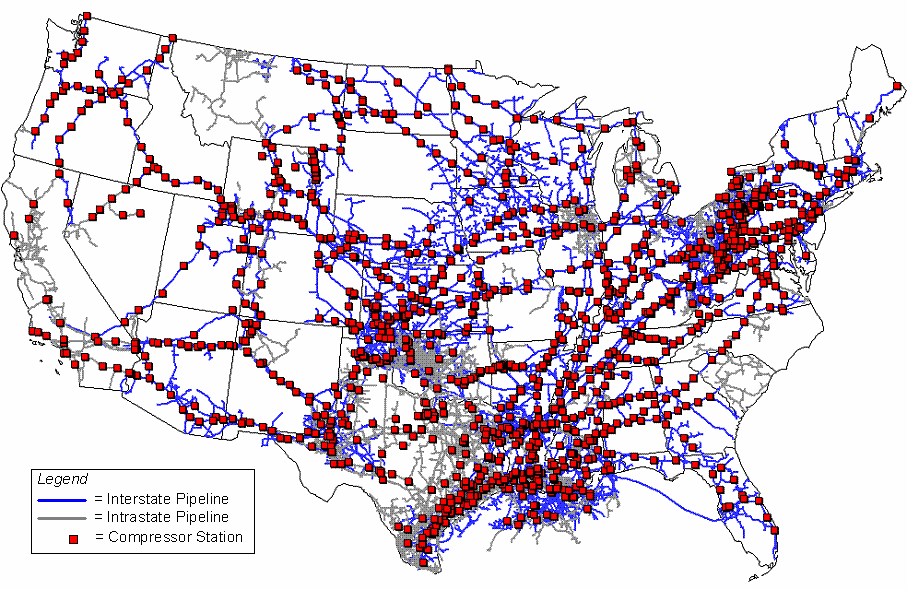
...the gas industry has picked DISH and a few acres just outside its city limits as a perfect place for not one or two but eleven compression stations, to which gas is piped from wells all over northern Tarrant and Denton counties, to be treated, compressed, and sent out into bigger transmission lines. Residents say the veritable industrial corridor thus created emits hydrocarbons that kill trees, sicken and endanger animals and people, and are making their properties worthless.
...
Losing the use of land is only one of the issues posed by pipelines. Gas running through gathering lines is generally filled with chemicals and water that corrode the pipes; it's also generally unodorized until it reaches the compressor - which means people nearby won't know they are in danger if a leak develops. Companies have mechanisms to alert them to weakening pipes, but leaks and explosions in the Barnett Shale have shown those systems aren't foolproof.
...
The compressor stations also regularly release noxious chemical fumes. The acrid smell burns the throat and nose and sears the eyes. "Some days you can hardly breathe anywhere in DISH," Tillman said. "And then the trees started dying, so we wondered what was actually in those fumes."
... "We've lost a lot of trees in DISH. And a number of them were cedar trees, which are almost impossible to kill. Those trees breathe just like we do, so when they start dying, you've got to pay attention," he said. "They're the canary in the coal mine for our air." Thus far, dozens of trees in the little town and right outside it have died.
...
"We knew something was terribly wrong," Tillman said. But their repeated complaints to the state agencies fell on deaf ears. The agencies "basically asked the companies to investigate themselves," said Tillman, "and they came up clean every time."
...
According to an analysis of the [independently contracted] Wolf Eagle air study done by chemist and microbiologist Wilma Subra, the air samples from DISH contained the kind of chemical cocktail that would have been expected near refineries. Subra, who has been studying oil and gas field waste since the 1970s, said the DISH air samples included varying combinations of the carcinogens benzene and trimethylbenzene; napthalene, which is considered a potential human carcinogen; carbon disulfide, which can be absorbed through the skin and affects the central nervous system and many other bodily systems; and xylene compounds, which are neurotoxins. Subra is a member of the board of Earthworks, a nonprofit group that works with communities to address the destructive impacts of mineral development.
...
Even worse, she said, "No one can tell you what happens when you add these compounds together. It might be that in some cases they cancel each other out. Or they might be exponentially worse when you have a mix like that. And with what we know about chemicals, it's probably exponentially worse."
...
[Re: Long term exposure, Wilma Subra said:]
"Two years is sufficient time to cause neurological damage." ...
"You will not be automatically safe from the chronic, long-term health conditions just because you remove yourself from exposure to those chemicals," Subra said. "The damage could have already been done or could still show itself down the line, years later."
...
Tillman said that each of the companies that has a gas compressor at DISH has told him that their emissions are within acceptable levels established by the federal Environmental Protection Agency. "And that might be so," said Tillman. "But what happens when you have 11 of these things sitting next to each other? Even if each one individually is acceptable, add them up, and you wind up with nearly 11 times the acceptable level of toxins being released into our air."
...
DISH officials and residents aren't opposed to all gas drilling or the kinds of industrial activities that come with it. But many of them are furious at how it's been handled in their town and at the state's part in what has happened.
"I am against the way these people have elected to operate - quick and dirty methods, cheap methods," Cisco, the town commissioner said. "It's regrettable that the Railroad Commission and TCEQ have hoodwinked us into thinking they are protecting the citizens of our community when it seems more like they're on the payroll of these companies."
Tillman agreed. "How on earth could the people of this town suffer and complain about the air quality for so long, and I am the first one to do an air quality study?" he said. "This is squarely on the shoulders of TCEQ, and they let this happen to us. I just feel betrayed by the state."

DEMAND ACCOUNTABILITY!

Saturday, September 19, 2009

EUREKA!

Here's how the Independent Oil and Gas Association of New York Figures it Can WHAT??? Placate? Assuage? Appease? ...oh, what's the word for it??? Reassure Us or Mitigate Our Outrage After TWO Toxic Spills in Dimock PA... EUREEEEKA!
This ought to do it!
Come On People!
Talk Back to this Fantasy!!!


(Editorializing in red by Splashdown)

IOGA of NY Press Statement on Spill at Gas-Drilling Site in Dimock, PA

LAKE VIEW, NY (09/18/2009)(readMedia)-- The following press statement was issued by Brad Gill, Executive Director of the Independent Oil and Gas Association of New York (IOGA-NY) on September 18, 2009.

"On behalf of members the Independent Oil and Gas Association of New York, we are deeply concerned with the incident that occurred, in Dimock, Pennsylvania yesterday (September 17, 2009). It is our understanding that the spill resulted from a decoupling of a water line, which contained "slick water". Slick water is comprised of 99.5 percent water and sand and is not considered a toxic substance.

ahem... This is from an Aug. 7th update on the death of 17 cows in a Louisiana pasture:

"No final toxicology report has been made public about what killed 17 cows in south Caddo after they ingested liquid spilled from a nearby Chesapeake Energy Corp. drilling site April 28.

...

During a routine fracturing operation by Schlumberger, some fluids composed of 99 percent freshwater leaked onto the well pad then onto the pasture after a rain, Chesapeake Energy, which owns the well site, says in a letter sent in June to DEQ. About 4 p.m. April 28, site workers noticed the dead cattle."

We've already seen how lethal 99% water can be...

EUREKA!

Care for a glass of that water Mr. Gill?

The Pennsylvania DEP has been on hand and is satisfied with the remediation being completed.

The incident in Dimock is indeed regrettable and unfortunate. It is important to note that this circumstance should not be viewed as representative of members' work and experience day-to-day. Such incidents as the spill in Dimock are quiet rare, ...we interrupt this sentence!

(rare: adj. 1. coming or occurring far apart in time; unusual; uncommon)

EUREKA!, Cabot Oil accused of being responsible for contaminating Dimock wells.

EUREKA! Methane contamination in Colorado water wells linked to drilling.

EUREKA! House explodes in Ohio.

EUREKA! Cows die in Louisiana pasture near Chesapeake spill.

EUREKA! ...drilling has already poisoned wells in western Pennsylvania, Colorado, Alabama, Arkansas, New Mexico, Kansas, Montana, Virginia, Washington, West Virginia and Wyoming.

EUREKA! Water leak from Washington County gas well kills fish.

EUREKA! Not long ago the first earthquake near gas drilling sites in Texas was thought, by some, to be an anomaly. Now, 17 earthquakes later, in the space of only a few months, we cannot claim pure coincidence, nor can we ignore the dangers these earthquakes present to gas pipelines and so, to safety.

EUREKA! Contaminated water in Bradford, PA ... Water problems from drilling more frequent than PA officials said.

EUREKA! Natural gas well leak in Lycoming Co. contaminates tributaries, spring and water wells in private homes.

EUREKA! Another natural gas well leak near Roaring Branch, PA and a string of more than 50 similar cases related to gas drilling in the state.

EUREKA! Pavillion, Wyoming: EPA Confirms Drinking Water Contamination by Toxics Used in Hydraulic Fracturing.

EUREKA! Birds die after exposure to hydrocarbons in open natural gas well pits and wastewater storage facilities at ExxonMobil sites in five states.

EUREKA! 2-BE and other chemical contaminants, used in drilling, linked to series of illnesses. Pollluted water near gas-drilling sites endangering the health of people who live close to drilling rigs.

EUREKA! ...and that's just a six month Splashdown sampling...
(See more on TXsharon's Bluedaze!)

and natural gas exploration has been conducted safely and in an environmentally sound manner for decades in New York.

(Has New York had horizontal hydrofractured wells for decades? Heh. What's stopping the industry from drilling another one tomorrow?)

Our companies have worked very, very hard to work in conscientious concern for the environment – due in large measure to very rigorous oversight by NYSDEC - and we will continue to do so. We live and work in New York too.

We stand steadfast in our conviction that natural gas exploration can be facilitated in a safe and environmentally friendly manner. In days to come, IOGA of NY is looking forward to the Department of Environmental Conservation's issuance of a generic environmental impact statement that will guide Marcellus development. And as we have done in the past, our companies will comply with all regulations and permit requirements."

Well, this just flies in the face of reality. We'll take a closer look at that next.

***

IOGA of NY is a trade association founded in 1980 to protect, foster and advance the common interests of oil and gas producers, professionals and related industries in the State of New York. For additional information on natural gas exploration, as well as an up-to-date listing of the association's public meeting schedule, please visit IOGA of NY's informational blog: https://www.marcellusfacts.com.

DEMAND ACCOUNTABILITY!
Thursday, September 3, 2009

Spate of gas drilling leaks raises Marcellus concerns

Rebecca Renner
Environ. Sci. Technol., Article ASAP
DOI: 10.1021/es9025563
Publication Date (Web): September 2, 2009
Copyright © 2009 American Chemical Society

As Pennsylvania and other eastern states prepare for a rush of new drilling associated with the Marcellus Shale , gas leaks are prompting questions about whether these states are prepared. On New Year’s Day, 2009, in the tiny northeast Pennsylvania town of Dimock, a drinking-water well blew up because of a methane leak associated with natural-gas drilling nearby. In the spring, high levels of methane—a result of a poorly cased gas well—were found in water supplies in the town of Bradford; in late July, one home near Roaring Brook was evacuated, and alternative sources of drinking water were provided when high gas pressure at another well caused a leak.

----------------------------------------------------------------------------------------------------

Read about DEP's investigation of the Lycoming County gas well leak reported here on July 29th.

----------------------------------------------------------------------------------------------------

Natural-gas leaks are relatively common in Pennsylvania, which employs a full-time geologist to investigate such incidents. In recent years, some of these leaks have had devastating consequences, including home explosions and fatalities, according to an investigation by ProPublica, Inc., an independent nonprofit newsroom. Leaks are mainly a legacy of the state’s fossil fuel drilling and mining history; however, leaks from operating wells have caused explosions and even fatalities.

Tracing the leaks is difficult, because sources include gas wells, natural-gas storage fields, pipelines, coal mines, and landfills—all of which can be either active or abandoned. Bacterial degradation of organic matter also produces methane. Stable-isotope analysis is an essential tool for identifying the source, according to Pennsylvania Department of Environmental Protection (PA DEP) geologist Fred Baldassare, who investigates stray gas leaks.

...

Tracing the leak can also be highly contentious, as in the case of the hydraulic fracturing wells drilled into the Marcellus formation at Dimock. In February 2009, PA DEP cited the drilling company Cabot Oil & Gas Corp. for violations of the state’s Clean Streams Law with respect to the Dimock explosion. Cabot contends that methane in drinking-water wells is a historical problem locally and that drilling may not be the cause, according to spokesperson Kenneth Komoroski. But stable-isotope analysis indicates that the gas in drinking-water wells is geological. The additional presence of heavier hydrocarbons, ethane, propane, and butane supports this. Drift gas, which commonly occurs in low concentrations near the surface, is not the culprit, says Baldassare. “The isotopes and the heavier hydrocarbons nail it,” he adds.

...

The recent leaks are related to flaws in cement, well casing, or overpressurization of the casing. PA DEP is in the process of tightening policies that apply to these issues, according to spokesperson Teresa Candori.

A source who has 30 years of experience in the public and private sectors tells ES&T that the regulations need some changes, but “the problem is not enough inspectors. Wells get inspected only once, and many inspectors don’t have enough experience,” the source says. A recent study of state regulations across the country found that most states have standards specifying the use of concrete to protect aquifers, but many, including Pennsylvania, do not require testing to show that the concrete is strong enough for the task. Congressional proposals call for changes in such regulations.

Given the promise and peril of the coming drilling boom, few knowledgeable people are willing to talk on the record. But, says one experienced geologist, “Deep horizontal drilling and hyrdaulic fracturing don’t have a track record in the northeast. Pennsylvania and New York aren’t Texas. Our geology is more complex, our rocks have been through more deformation. Companies and regulators need to tread carefully.”

This article has been excerpted from the ACS Journal of Environmental Science & Technology. To read the complete report, CLICK HERE.

DEMAND ACCOUNTABILITY!

RURAL IMPACT VIDEOS, 6 parts

Natural gas development in Colorado, the impacts on communities, environment and public health. A primer for public servants and residents of counties that care for their lifestyles.

Drilling for Gas in Bradford County, PA ... Listen!

Cattle Drinking Drilling Waste!

EPA... FDA... Hello? How many different ways are we going to have to eat this? ... Thank you TXSharon for all you do! ... Stay tuned in at http://txsharon.blogspot.com

Landfarms

A film by Txsharon. Thank you Sharon for all you do. Click HERE to read the complete article on Bluedaze: Landfarms: Spreading Toxic Drilling Waste on Farmland

SkyTruth: Upper Green River Valley - A View From Above