Showing posts with label SUSQUEHANNA RIVER BASIN COMMISSION. Show all posts

Sunday, August 1, 2010

Department of Environmental Protection Unlawfully Permitting Water Withdrawals For Marcellus Shale Gas Drilling in Western Pennsylvania

Allegheny Defense Project
FOR IMMEDIATE RELEASE
July 26, 2010
Contact: Cathy Pedler – (814) 454-7523
Bill Belitskus – (814) 778-5173
Ryan Talbott – (503) 887-7845

Only riparian owners can make use of water in streams and rivers

Natural gas companies have descended on Pennsylvania’s forests and farmlands to drill into the Marcellus Shale. Each Marcellus Shale gas well requires millions of gallons of water for the drilling process. That water is taken from Pennsylvania’s streams and rivers under the alleged authority of the Pennsylvania Department of Environmental Protection (DEP). The DEP, however, does not have the authority to permit water withdrawals in Pennsylvania.

In central and eastern Pennsylvania, water withdrawalsare managed by the Susquehanna River Basin Commission and Delaware River Basin Commission. Congress created the two commissions as federal interstate compacts with the authority to permit water withdrawals within their respective basins. The rest of Pennsylvania, most of which is in the Ohio River basin, is governed by riparian rights common law, which allows only the owner of property along a watercourse to withdraw water for use on their land. There is no state law regulating water withdrawals other than for municipal drinking water supplies.

In a letter sent to DEP Secretary John Hanger, the Allegheny Defense Project (ADP) outlined the current state of Pennsylvania law regarding water withdrawals and charged the DEP with operating an unauthorized water withdrawal program that allows natural gas companies to take water that they have no legal right to fortheir Marcellus Shale gas drilling operations. (LINK to source.)

“The fact is, the DEP has absolutely no authority to permit water withdrawals in Pennsylvania,” said Cathy Pedler, ADP’s forest watch coordinator. “Outside of the Delaware and Susquehanna River watersheds, water withdrawals are governed by riparian rights common law, which means only those who live adjacent to the water can make reasonable use of the water on their land. A gas company cannot take water that flows through property it does not own.”

Nevertheless, documents obtained by ADP reveal that the DEP is unlawfully authorizing water withdrawals from western Pennsylvania streams and rivers. On March 31, 2010 the DEP approved a Water Management Plan for Hanley & Bird, Inc. The Water Management Plan allows Hanley & Bird to withdraw 1.44 million gallons of water a day from the Redbank Creek in Jefferson County for five years.

Under the Water Resources Planning Act of 2002, the DEP is required to develop Water Management Plans for the entire state. That law, however, does not provide any authority to the DEP to authorize water withdrawals.

“The Water Resources Planning Act is just that, a planning act,” said Bill Belitskus, ADP’s board president. “That law provided no substantive authority to the DEP to regulate or permit water withdrawals from Pennsylvania’s surface waters. Each time the DEP approves a water management plan and tells a natural gas company that it can withdraw surface water for their drilling procedures, it is acting without authority and encouraging illegal conduct.”

Visit ADP’s website to see the documents we obtained from recent file reviews at the DEP’s Northwest Regional Office: http://alleghenydefenseproject.wikispaces.com/Marcellus+Shale

LINK

WRITE LETTERS! SPEAK OUT!
DEMAND ACCOUNTABILITY!

Monday, November 16, 2009

Susquehanna River Basin Commission proposes automated monitors for streams and creeks in Marcellus Shale region

By FORD TURNER
The Patriot-News
November 11, 2009
Each monitoring station would have a data-gathering device and a platform powered by a solar panel. Courtesy Photo

The Susquehanna River Basin Commission wants to be ready in case pollution makes its way into sensitive streams and creeks in the region where natural gas drilling is on the increase.

(Obviously this indicates a likelihood...)

The commission has proposed a network of 30 automated, solar-powered water quality monitoring stations for the northern tier of Pennsylvania and southern New York.

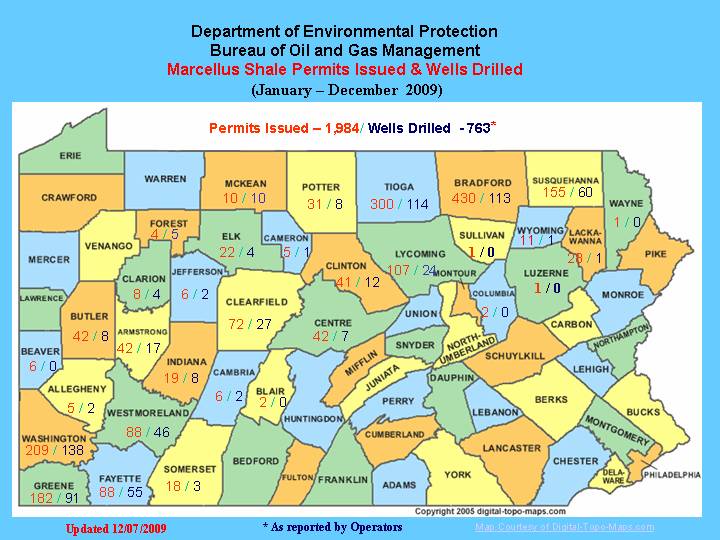
The northern tier counties have been a prime focus in Marcellus Shale natural gas exploration. Through September, 575 of the 1,340 Marcellus Shale drilling permits issued by the state this year were for sites in Susquehanna, Bradford and Tioga counties.

...

The government-sanctioned commission regulates withdrawal and use of water from the river and its tributaries.

"As the demand for water from smaller rivers and streams increases, particularly from the natural gas industry, so does the amount of wastewater that is generated," said commission Executive Director Paul Swartz. "It is important to monitor these smaller, remote waterways to verify whether or not they are being impacted by certain pollutants."

Sounds like the implication here is that waterways would be contaminated by wastewater vs. water withdrawals... something that if it were to occur, would have to be the result of an industry violation of some kind.

...To read the complete report, CLICK HERE.
Editorializing by Splashdown in red.

DEMAND ACCOUNTABILITY!

Wednesday, September 30, 2009

Is Hydrofracking for Natural Gas Worth the Risk?

A controversial drilling technique uses and pollutes lots of water.

By Jonathan Walters | October 2009
GOVERNING

Russia and the Middle East have, by far, the largest proved reserves of natural gas on the planet. But the Marcellus Shale Play, a mile-deep, rock-bound reservoir stretching through New York, Pennsylvania and West Virginia, is the closest approximation this country has. Experts have described it as “the most drilled but least explored” natural-gas basin in America. They say it could yield 400 trillion gallons of natural gas—20 times the current national annual output.

...

However, to get at the Marcellus gas, drilling companies have to employ a controversial boring technique that involves mixing water with a cocktail of sand and toxic chemicals and then injecting that at high pressure into shale more than a mile underground in order to fracture the rock and release the gas.

This process, known as hydraulic fracturing or “hydrofracking,” has been utilized before in several states. But environmentalists claim that it causes everything from earthquakes to above-ground explosions, that it can irredeemably pollute groundwater, and that it drains streams of the water that in many places is a resource as precious as the gas it’s helping to recover.

While the industry disputes that hydrofracking is the cause of such mayhem, nobody disputes that setting up wells is an intensive industrial procedure, and that the drilling process itself uses and pollutes huge amounts of water. A single well requires between 1 million and 5 million gallons of water. About 40 percent of what’s injected into the wells is pumped back out, and it comes out dirty and salty and needs to be treated before it is discharged back into public waterways. Pennsylvania already has reported incidences of unacceptably salty water from hydrofrack wells being discharged into rivers.

That is why the Marcellus Shale wars have been fully engaged, as the irresistible search for energy resources and riches collides with arguments over environmental disaster. The battle pits neighbor against neighbor, full-time residents against weekend homeowners, elected officials against elected officials and states against localities (some Upstate New York localities have enacted moratoria on drilling, something the natural-gas industry claims they don’t actually have the authority to do). Although the fracas over Marcellus Shale is regional, it serves as a cautionary tale for any place that encounters an unexpected energy boom.

As the conflict over hydrofracking rages, one question above all has surfaced: Who is responsible for ensuring environmental protection and public-health safety in the face of an avalanche of drilling-permit applications?

The answer to that question is complicated by two realities: Water does not respect jurisdictional boundaries, and the regulatory framework for hydrofracking is both fragmented and overlapping. Under such circumstances, the U.S. Environmental Protection Agency could provide clarity. However, in the 2005 Energy Policy Act, Congress exempted hydraulic fracturing from federal oversight.

So are states equal to the job? Some are scrambling just to catch up. The New York Department of Environmental Conservation (NYDEC), the agency that reviews and approves drilling permits statewide, has been caught at least a little flatfooted on Marcellus and hydrofracking. Governor David Paterson signed an industry-supported law last year related to the spacing of wellheads. Rather than evaluating the environmental impacts on a well-by-well basis, as is normally required under state law, NYDEC is studying the collective impacts of hydrofracking though what’s called a “generic environmental impact statement.”

The Pennsylvania Department of Environmental Protection (PADEP) seems more prepared, at least when it comes to regulating individual drill sites. PADEP already has received 450 applications for drilling permits, and is in the process of hiring nearly 40 new regulators, paid for in part by a significant increase in permit fees on hydrofrack wells.

But the New York and Pennsylvania regulators are not the only players with skin in the game. Powerful watershed compacts, including the Delaware River Basin Commission and the Susquehanna River Basin Commission, have their own permitting processes. Those kick in whenever anyone wants to draw significant amounts of water out of their watersheds or dump significant amounts back in.

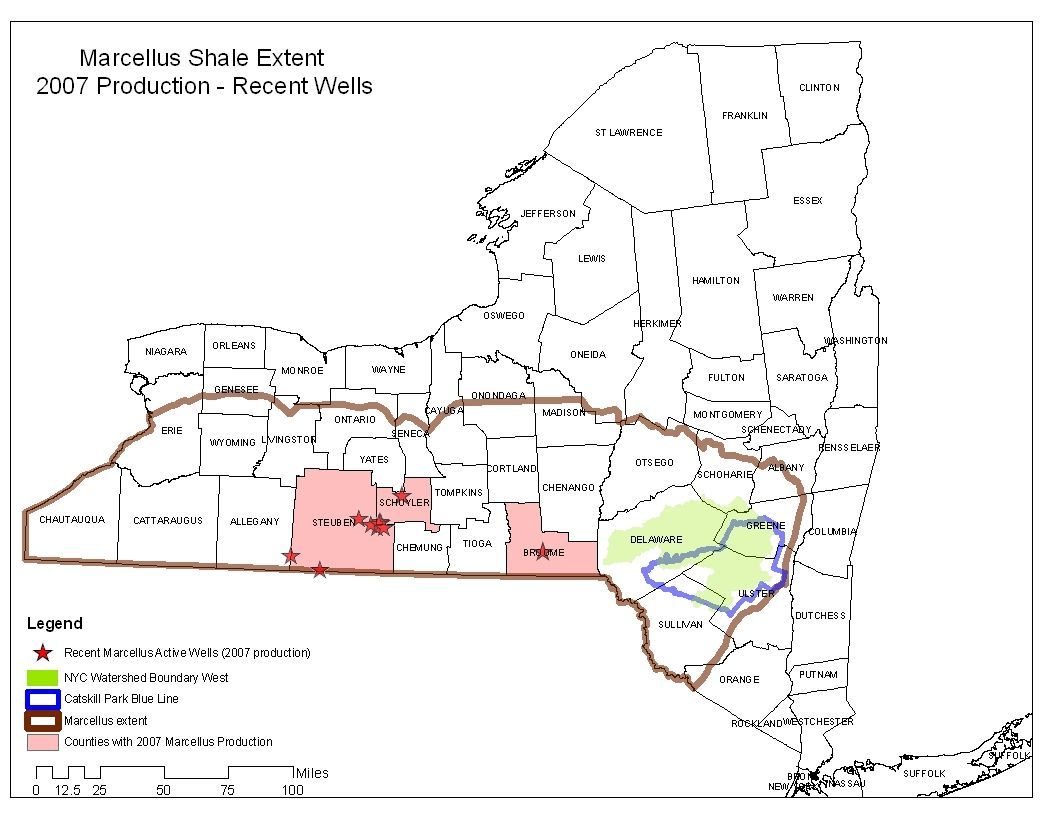
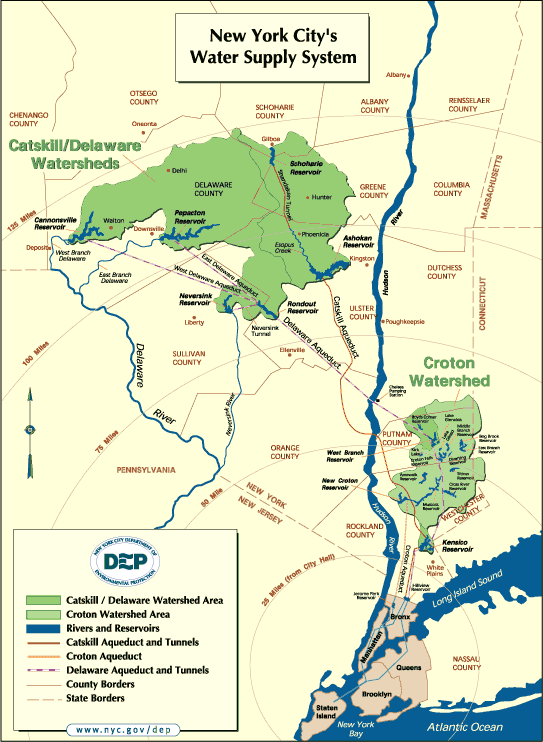
Even New York City is claiming a role, because a huge portion of its internationally renowned source of sweet drinking water originates in the Catskill Mountain watershed, which sits hard by—and in some cases directly over—the Marcellus Shale Play.

“The reality is that the city has no power in this matter,” says Manhattan Borough President Scott Stringer. “But that doesn’t mean that a borough president or residents can’t be mobilized and create a buzz.” As part of his effort to create that buzz, Stringer’s office has produced a report that lists examples from all over the country of disasters—from earthquakes to exploding houses—blamed on hydrofracking.

New York City Councilman James Gennaro, a trained geologist who heads up the council’s environmental committee, believes that the surface impacts of drilling alone represent a prima facie case for an outright ban on drilling in any environmentally sensitive area. “Even if you didn’t inject one drop of ‘fracking fluid’ into the ground, just setting up the wellhead, with the drilling pad and all the trucking involved, are activities that will lead to the degradation of the city’s water supply,” says Gennaro. NYDEC, for its part, says that it won’t permit drilling in any watershed unless that watershed can be “fully protected.”

Scott Roberts, who heads up mining regulation in Pennsylvania, does not discount the challenge that his division faces. In particular, he says, cleaning up the polluted water “is the 800-pound gorilla here. Just pumping it back out and impounding it is not dealing with it.”

There has been some discussion in the industry of pumping the brine back underground, a solution that Carol Collier, executive director of the Delaware River Basin Commission, describes as “a little squirrelly.” Pennsylvania’s Roberts is similarly skeptical of a back-to-the-ground solution and thinks that ultimately industry itself is going to have to take the lead in building facilities to clean up the discharge water.

While Pennsylvania regulators and the river-basin commissions debate these issues, New York continues to work on its draft generic environmental impact statement. However, those both inside and outside of New York State government worry about NYDEC’s capacity to regulate drilling in the Marcellus Shale Play. The NYDEC division that oversees mining and drilling is one of the agency’s smallest sections. A request for 30 new staff members was stripped out of this year’s budget in the face of New York’s abysmal fiscal situation.

NYDEC refutes the characterization that it’s not up to the task of regulating hydrofrack wells. In an e-mail response to questions, an agency spokesperson noted that one out of 10 wells currently operating in New York were hydrofracked, and that so far there have been no adverse environmental impacts associated with any of them. As for the manpower shortage, NYDEC notes, “There have not been and will be no shortcuts in permitting—every well application will get all due scrutiny and oversight. The only impact of more staff would be that more permits could be processed in a given time period.”

It’s not a statement that inspires confidence among hydrofracking’s opponents, who would prefer that new staff be devoted to regulation rather than to pushing permits through the system. But given the fiscal realities, it will probably have to do. Even NYDEC’s critics agree that the Marcellus Shale Play is going to be extensively tapped one way or the other. The trick is going to be finding a way, despite budget shortfalls, to do it without compromising the environment or public health.

“When you look at it, we’re trying to walk a line,” says the Delaware River Basin’s Collier. “Clearly, there’s an economic benefit to the gas, and there’s value from the standpoint of national energy policy. But it is only going to be beneficial if it is done wisely and minimizes the impact to all natural resources.”

CLICK HERE for the complete artcle.

DEMAND ACCOUNTABILITY!
Tuesday, September 15, 2009

Blossburg council votes to change zoning for ‘fracking’ water plant

What's wrong with this picture?

By CHERYL R. CLARKE
SUNGAZETTE.COM
SEPT. 15, 2009
(EDITORIAL COMMENTS By SPLASHDOWN! in red)

BLOSSBURG - Borough council voted 4-1 with one abstention to change the zoning classification on a 10-acre parcel of land on the site adjacent to and behind the Kwik Fill gas station from commercial to heavy industrial so a fracking water treatment facility can possibly be constructed there.

According to Taylor, the plant would remove "suspended solids" from the water used by the natural gas industry to "fracture" the Marcellus Shale natural gas "fairway" currently being developed in Tioga County.

The plant would then sell the water back to the gas companies for re-use.

...

Before taking the vote, council heard from several people at the meeting Monday night, many of whom voiced their opposition to the change, fearful of noise and disruption from increased truck traffic.

There also were unanswered questions about the chemicals used by the natural gas industry in its drilling operations for the natural gas trapped in the Marcellus Shale play.

(Now how come that is??? Is it because they're unanswerable, cause the industry is refusing to provide this information... and for instance, protecting it, even when 'the chemicals' raise serious health and safety issues, such as when they apparently killed 17 peacefully grazing cows in a Louisiana field? Read the latest about it HERE.)

Borough resident Jeri Deming asked council how much research it had done in the month since it tabled a decision on the change at its August meeting.

"The problem isn't with the water plant, it's with the drilling," she pointed out.

[Council president] Ogden told her and others that if they were concerned about the chemicals used in the drilling process they need to address the Department of Environmental Protection.

"Beyond making the zoning change we have no control over anything," he said.

Isn't this a bit like saying "Beyond making all traffic lights permanently green lights, we have no contol over anything (i.e., any accidents) that might happen." ???

As for the noise and dirt from increased truck traffic coming off Route 15, Ogden said that it would come whether a plant was constructed in the borough or not.

Here's comes a classic argument that ignores all other possibilities:

"If they don't build here they will build somewhere else, possibly Morris Run or Arnot, and they will have to use the same exit," Ogden said. "They are drilling all over the place. It's progress and it is inevitable," he said.

Richard "Rusty" Taylor, of Linden, vice president of Hydro-Recovery LP, a newly formed subsidiary of RNS Services, Blossburg, is working with the Williamson Land Co. to get the $6 million facility constructed. He said the zoning change was merely "the first step" of many approvals that would be needed before ground is ever broken for the plant.

One such permit needed is a "consumptive use" water permit from the Susquehanna River Basin Commission to use water from Johnson Creek, Taylor said.

The water is already being used by Ward Foundry for cooling before it is then discharged back into the creek, "slightly warmer than when it was taken out," Taylor said.

"Our intention is to intercept that water and use it for this purpose," he said, but no water from the operation will ever be discharged back into the creek, he added.

"This will be a zero-liquid discharge. We are not going to discharge into the stream. We treat it, dilute what remains and sell it back," he said.

Fact is, these millions and millions of gallons of water are too toxic to discharge anywhere. They're 'gone gallons'! GONE.

If the SRBC decides the creek cannot sustain that kind of usage, then the permit will not be issued, he said, and "may be an issue that prevents this facility from operating."

Taylor said the affirmative decision will allow the "process to continue."

Taylor recommended residents visit the Web site www.pamarcellus.com for more information about the drilling process and the chemicals used.

To read this article in its entirety, CLICK HERE.

www.pamarcellus.com is an industry website that presents a rosy picture of the industry and its activities. From the introductory propaganda:

"You'll find information on the Marcellus Shale formation, how we extract the natural gas and protect the environment, why we value the communities where we do business, and the opportunities that the Commonwealth and its residents can realize in the coming years and decades through natural gas exploration and production.

You'll also learn about the important issues being addressed by our Marcellus Shale Committee and the positive impacts natural gas drilling is already having on families, businesses and communities in many parts of Pennsylvania."

Heh. Almost any of the posts on this blog will give a clear idea of how the industry values the communities they invade, and the positive impacts families and communities are experiencing.

DEMAND ACCOUNTABILITY!

Thursday, August 6, 2009

Hydro-fracturing criticized at regional gas meeting

Public concerned about quality of water

By Jason Whong, Staff Writer

Elmira Star Gazette, August 6, 2009

Proposed changes to rules governing the withdrawal of water to extract gas from the Marcellus Shale drew criticism from people living in the Susquehanna River watershed Wednesday night.

The residents voiced opposition to the practice of hydro-fracturing at a meeting at the Holiday Inn - Riverview in Elmira.

But officials from the Susquehanna River Basin Commission (SRBC) said the changes would not alter the rules on removing water for hydro-fracturing.

The changes proposed by the SRBC would amend the "approval by rule" process to allow gas drillers to use already approved water sources.

Michael Brownell, chief of the commission's Water Resource Management Division, said the changes would streamline the approval process.

The commission allows those who cannot attend a meeting to send in comments.

Many of those received before the meeting focused on hydro-fracturing, or fracking for short.

Hydro-fracturing is a process in which crews drilling for natural gas use water and other materials. When the combination is blasted into the ground under high pressure, it fractures bedrock and boosts the flow of gas.

Brownell said the proposed rule changes would not apply to the disposal of water used in the process.

"The commission does not regulate water quality as it relates to the disposal of frack fluid," he said.

"We rely on member jurisdictions to regulate that activity, and we require a certification ... that the water was disposed of in accordance with state and federal rules."

Kenneth P. Lynch, head of Region 7 of the New York State Department of Environmental Conservation (DEC), and an alternate commissioner representing the state on the commission, said the rule change would not affect the environmental review required of gas drilling projects in the state.

He said DEC plans to release a draft environmental impact statement on fracking in September.

Most of those attending the meeting spoke against fracking, though one area resident and an industry representative said they favor the changes.

Michael Narcavage, speaking for Chesapeake Appalachia LLC and the Marcellus Shale Committee, said the rule changes would "allow for increased flexibility to use approved sources and share water among operators."

"We are talking about this commission allowing Chesapeake to, willy-nilly, with other energy corporations, to trade water from one source to another, to bring it into pristine areas," said Roy Lackner of Binghamton, who manages tree farms in Broome County and Wayne County, Pa.

"This is an unacceptable risk to our water supplies."

John Harney of Milan said the change in regulations would make it too easy for gas companies to use the water for fracking.

"You should be changing the rules to make it more difficult instead of making it easier," Harney said.

"They have enough ease now. You need to protect the people."

DEMAND ACCOUNTABILITY!
Thursday, July 23, 2009

The Giant Sucking Sound...

Large draws from area waterways by natural gas drillers were greenlighted by the Susquehanna River Basin Commission at the June 18 quarterly meeting held in Binghamton, N.Y.
The SRBC approved Alta Operating Co. LLC to take 393,000 gallons per day from Turner Lake, in Liberty Twp.

Chesapeake Appalachia LLC received approval to take up to 499,000 gallons per day from the Wyalusing Creek, in Rush Twp. for the Venderfeltz well pad.

A water withdrawal from the Tunkhannock Creek, Gibson Twp., of up to 380,000 gallons per day was also approved by SRBC for Southwestern Energy Company for the Price well pad.

Stone Energy Corporation received two approvals to take 750,000 gallons per day each from the Wyalusing Creek in Rush Twp. for use at the Hogan and Stang well pads.

Although two Wyoming County municipalities (Meshoppen and Tunkhannock) have been selling water to natural gas companies, no Susquehanna County municipalities have been approved by SRBC to do so.

Pennsylvania American Water Company, a public water supplier, has agreed to provide and has been approved by SRBC to provide 75,000 gallons per day to Cabot Oil and Gas Corporation the Montrose area filter plant.

According to Susan Turcmanovich, Pennsylvania American Water communications and corporate responsibility specialist, PAWC cannot sell water directly from the reservoir. Cabot is a metered customer of PAWC.

Susan Obleski, SRBC Director of Communications, said the SRBC is currently in the process of revising its regulations to improve administration efficiency and also recognize the mobile nature of the natural gas industry.

Although natural gas companies have previously identified specific well pads with the request for water draws, the proposed revisions will allow the gas companies to use water at other well pads as long as they stay within the approved water draw limits, according to Obleski.

The public comment period for the proposed SRBC revisions is open until Aug. 15. More information is available at the SRBC website, http://www.srbc.net.

DEMAND ACCOUNTABILITY!

Tuesday, May 26, 2009

Pennsylvanians, ACT NOW!

JUNE 1st DEADLINE...
Copy, Print, Sign, Stamp and Send!

Reprinted here is an appeal from Williamsport resident, Jon Bogle, and a letter of petition to our DEP. Please do your part...

DEMAND ACCOUNTABILITY!


Dear All,


Below is a letter to DEP opposing the granting of a permit to operate a waste water discharge plant at Water Tower Square. In total, there are ten plants in the works which will dump four million gallons of the gas drilling industry’s waste water, containing millions of pounds of dissolved salts, into the West Branch Basin every day.

The thirty day period DEP has set to comment on this permit ends on June 1st. A strong response is needed.

This is the first issue where the gas industry will try to transfer our quality of life to their bottom line. We need to send a clear message that we won’t stand for it. The Gas industry will do what is necessary to get to the gas. If we demand the state of the art treatment of our landscape and environment we will get it. If we don’t--they will treat rural Pennsylvania as a third world country. Our quality of life is not their concern.

You can simply print out this letter, add your name and address and send it in. Or, you can modify it in any way you want, add to it, or write your own. It is your letter and each person, not just each address, is entitled to send one.

Many of us believe that DEP is under political pressure to grease the way for the gas industry. A strong public response will help to counteract that pressure and loosen the bonds of DEP’s better angels.

If you have persons on your e-mail list who may be willing to help, please send this on to them.

Jon

Jon Bogle
201 E 3rd St.
Williamsport PA
17701
570-772-0151
boglejon@comcast.net

---------------------------------------------------------------------------

TO: Pennsylvania Department of Environmental Protection
Water Management Program, Permit Section
208 West Third Street, Suite 101
Williamsport, PA 17701-6448

RE: Opposing the granting of a NPDES permit to operate, PA0233650,
Industrial Waste, TerrAqua Resource
Management, LLC, 1000 Commerce Park Drive, P. O. Box 487,
Williamsport, PA 17703-0487.
Also opposing NPDES permits for the nine other similar facilities in
the West Branch Basin which DEP
has knowledge of that are preparing to submit NPDES permit
applications or have already done so.

FROM: YOUR NAME/ADDRESS HERE

The TerrAqua proposed facility at Water Tower Square is clearly a transfer of the Susquehanna Riverʼs water quality to the financial bottom lines of the gas industry and to the facilityʼs owners. It will put hundreds of thousands of pounds of dissolved salts into the river at Williamsport-- every day.
It will not remove most of the dangerous chemicals in the water from gas well fracturing operations.
As is the case with the other nine plants being proposed for the West Branch basin, it will be little more than a dilute and dump operation. Pennsylvaniaʼs rivers and environment deserve the same state of the art treatment for this waste water that the gas industry has available and uses in other places. Our rivers havenʼt yet recovered from the damage inflicted by the coal industry over a hundred years ago. We need DEP to protect them from being used as a chemical dump.
Pennsylvaniaʼs DEPʼs new policy statement, Permitting Strategy for High Total Dissolved Solids (TDS) Wastewater Discharges April 11, 2009 clearly describes the damage of continuing to dump dissolved solids (salts) into our rivers. The new strategy, which goes into effect on January 1, 2011, will not permit new large volume dischargers of dissolved salts. It also clearly states that any facilities seeking a licence until then must show they will possess the technology to remove salts from the discharge. A capability TerrAquaʼs application doesnʼt have. The April 11th Strategy policy is cited below:
(a) DEP will not issue permits for new sources of High-TDS industrial waste unless the applicant proposes to install adequate treatment for TDS on or before January of 2011.
TerrAqua, which is still at the conceptual, approval seeking stage, will begin discharging large quantities of dissolved solids into the Susquehanna river almost exactly when DEPʼs new policy goes into effect. It is difficult to understand why TerrAqua would go forward with this application unless they are expecting to be granted an exception to the new regulations when they go into force.
It is also clear that TerrAquaʼs facility isnʼt a critical component of the new gas exploration industry because at a 400,000 gallon maximum capacity it doesnʼt begin to address the volumes of anticipated waste water from this industry. Indeed, even if all ten of the new high-salt dischargers on the Susquehanna were approved, they would only account for 20% of the needed capacity.
Estimates from the industry indicate that demand for brine water treatment in Pennsylvania will reach approximately nine Million Gallons per Day (MGD) in 2009, 16 MGD in 2010, and 19 MGD in 2011.
Estimates from the Susquehanna River Basin Commission are 20 MGD for that same timeframe.
The April 11th report makes clear that the Susquehanna, like other rivers in Pennsylvania, is already challenged from discharges and acid mine drainage.
Many of the areas where the drilling for natural gas is proposed have a history of mining activity and are affected by Abandoned Mine Drainage (AMD). Brine and fracturing wastewater have high concentrations of dissolved solids, and considering the already elevated levels of dissolved solids in the AMD-affected surface waters, the need to stringently control these dissolved solids likely will prevent other pollutants from exceeding water quality standards on a cumulative basis.
...watershed analyses conducted by DEP of the West Branch of the Susquehanna River watershed has documented that it is also severely limited in the capacity to assimilate new loads of TDS and sulfates.
Local biologists have estimated that several million fresh water clams live in each mile of the Susquehanna River. These serve to filter the nutrients out of the water which are
so harmful to the Chesapeake Bay.
Without this natural filtering our local cost of reaching acceptable nutrient levels for the Chesapeake Bay will be higher. Again below, from the April 11th policy:
The major concern associated with high TDS concentrations relates to direct effects of increased salinity on the health of aquatic organisms.
It is clear that TerrAquaʼs NPDES permit application, and the other nine possible facilities, are in direct opposition to the strategic intentions of DEP for maintaining water quality in Pennsylvaniaʼs rivers and streams.
There is no ethical or logical reason why this permit should be granted.

RURAL IMPACT VIDEOS, 6 parts

Natural gas development in Colorado, the impacts on communities, environment and public health. A primer for public servants and residents of counties that care for their lifestyles.

Drilling for Gas in Bradford County, PA ... Listen!

Cattle Drinking Drilling Waste!

EPA... FDA... Hello? How many different ways are we going to have to eat this? ... Thank you TXSharon for all you do! ... Stay tuned in at http://txsharon.blogspot.com

Landfarms

A film by Txsharon. Thank you Sharon for all you do. Click HERE to read the complete article on Bluedaze: Landfarms: Spreading Toxic Drilling Waste on Farmland

SkyTruth: Upper Green River Valley - A View From Above