Showing posts with label BRADFORD COUNTY. Show all posts

Monday, August 2, 2010

DEP Fines Talisman Energy USA for Bradford County Drilling Wastewater Spill, Polluting Nearby Water Resource

COMMONWEALTH OF PENNSYLVANIA
Dept. of Environmental Protection

Commonwealth News Bureau
Room 308, Main Capitol Building
Harrisburg PA., 17120

FOR IMMEDIATE RELEASE
08/2/2010

CONTACT:
Daniel T. Spadoni, Department of Environmental Protection Northcentral Regional Office
570-327-3659

WILLIAMSPORT -- The Department of Environmental Protection has fined Talisman Energy USA Inc., of Horseheads, N.Y., $15,506 for a spill of used natural gas drilling fluids last November at its Klein gas well pad in Armenia Township, Bradford County that polluted a small, unnamed waterway.

The spill involved hydraulic fracturing flowback fluid, which is the substance that returns to the surface after a company injects the pressurized fluid underground to fracture, or “frack,” a geologic formation and extract natural gas.

“DEP’s investigation in late November 2009 determined that Talisman spilled between 4,200 to 6,300 gallons of fracking flowback fluids when a pump failed and sand collected in a valve,” said DEP North-Central Oil and Gas Program Manager Jennifer Means.

The fluids flowed off the well pad and toward a wetland, and a small amount ultimately discharged to an unnamed tributary to Webier Creek, which drains into the upper reaches of the Tioga River, a cold water fishery.

Talisman successfully completed DEP’s Act 2 process for spill cleanup activities.

The fine will be deposited into the fund that supports DEP’s oil and gas permitting and enforcement programs.

DEMAND ACCOUNTABILITY!

Wednesday, July 28, 2010

RED ALERT! Bad Water in Paradise!

Cain Chamberlin
Rocket-Courier
July 29, 2010

Mike Phillips holds the contaminated water that he discovered in his well on July 12 in his left hand, and in his right hand a sample of bottled water. Phillips is concerned that the disturbance in his well is due to gas drilling operations that have taken place near his home.
Photo by Cain Chamberlin


Bad Water in Paradise? Terry Twp. Residents Await Answers

Click here for video of gas igniting from bathroom sink faucet at Phillip's neighbor, Scott Spencer's home.

When Michael and Jonna Phillips woke up on Monday, July 12, they expected it to be like any other day…until they turned on their water.

They noticed that it was an odd, murky, brownish color. For obvious personal safety and health reasons, they decided against tasting it to figure out why.

Since the Phillips’s home, located along Paradise Road in Terry Township, was built in 2002, they have never had any trouble with their water. Their well is approximately 140 deep. They had their water tested in April of this year, and the results came back clear of any contamination, so the sudden change seemed extremely peculiar to them.

The Phillipses were aware that their next-door neighbors, Jared and Heather McMicken, had the same disturbance in their water, although the discoloration of their water started in early June when no one else had the problem, making them think it was just bad luck. The McMicken well is at approximately the same depth as that of the Phillips’s. Soon after the McMickens started having water trouble, Scott Spencer, another nearby resident, made a major discovery in his water as well; he could light it on fire.

“Spit and Sputter”
“All the faucets started
to spit and sputter, so we were curious as to what was going on,” said Spencer.

A Chesapeake drilling site no further than a quarter-mile away from the three homes struck the curiosity of Phillips. Even though all three residents have signed on to lease their land to gas companies, none of their properties has been subject to any operations so far. It made Phillips wonder if the nearby drilling was the culprit.

Phillips finally reached Greg Garrison, an Environmental Health & Safety (EHS) Field Specialist for Chesapeake Energy, after several attempts. Garrison brought a couple of cases of water to their home and looked at the problem for himself. Phillips said that after Garrison saw the disturbance with his own eyes, he told them that they should keep all their receipts dealing with any water purchases or testing and repairs to the well; if the DEP could prove that Chesapeake was at fault, they would be reimbursed.

“He told us that he or someone from Chesapeake would be back on a daily basis,” said Phillips. They have not seen nor heard from anyone at Chesapeake in over a week, while the McMicken family has only seen a Chesapeake representative twice since reporting their water problems.

A representative of the DEP ran a test in the water systems on both the Phillips and McMicken properties on July 15 and again on July 21. According to the DEP, the full results will not be available for about 40 days, but they immediately found rising levels of methane in the water. The reports show the Phillips’s water had minima
l amounts of methane in the first test, but rose to three percent six days later. The McMickens’ level rose from three percent to four percent in the same time period.

DEP Offers Advice
DEP advised them, as well as Scott Spencer and his family, not to drink the water. Heather McMicken, who was diagnosed with Lyme disease, had been drinking close to 25 glasses of tap water per day since the spring until her family’s water problems began. Her children were drinking several glasses every day as well, which concerns her deeply.

“Our kids’ health is number one priority,” she said.

Phillips contacted Thomas Dunn, a local water well specialist, who almost immediately after removing the well cap on July 18 told them that there was gas in the water. Once again, they were advised not to drink the water and told that there was a definite disturbance. According to Mrs. Phillips, who is due to have their second child in October, Garrison told her that she could bathe in the water, although the family doctor advised her not to.

She now has to take her twice-daily showers at a friends’ house about two miles away. Mrs. Spencer, who is also pregnant with their second child, has been bathing in the water because she has no other option. The DEP told the Spencers that the water did contain some effervescence but appeared to be fine, although they shouldn’t drink it, just as a precaution. According to Spencer, the DEP claimed that they would be stopping by on a weekly basis to run water tests but have yet to come back.

“Chesapeake told us that it could be from something five or six years ago that we didn’t realize was happening,” said Spencer, “Basically that the problem was just natural causes.”

Alternate Sources

The Phillipses have purchased a water cooler system, while the Spencers and McMickens are buying bottled water on a regular basis. The children in each family are getting very impatient wondering when they will be able to drink their own water or swim in their plastic kiddie pools again during the current summer heat.

“We don’t know if it will end soon or not, we don’t know what to expect,” Spencer said.

Last week, Phillips wrote several letters in order to address the situation of his family and neighbors. He contacted Chesapeake’s Director of Corporate Development Brian Grove, Sen. Gene Yaw, State Rep. Tina Pickett and Congressman Chris Carney, as well as an environmental lawyer from Washington, DC. Phillips says that he is determined to find answers and to make sure that his drinking water is restored to its original condition.

“No one is immune to this and this is ruining our beautiful place to live,” said Phillips, “All we wanted was a nice, peaceful community. These are young families in new homes, and we just want this problem taken care of.”

(Editor’s Note: Brian Grove, Chesapeake Energy’s Director of Corporate Development, responds to concerns expressed in this article in a statement released on Wednesday, July 28. That statement is published in this issue of the Rocket-Courier.)

Click here for video of gas igniting from bathroom sink faucet at Phillip's neighbor, Scott Spencer's home.

LINK
to article.
(BULLSHIT image for Splashdown post courtesy of Google.)

DEMAND ACCOUNTABILITY!

Friday, June 25, 2010

Methane concerns felt in Terry Twp.

Wednesday, June 16, 2010

A Look at Bradford County, PA

(click to enlarge these images)

Just outside Towanda

Why these water tanks at a Spring Lake residence?

Why the video monitoring?

Word locally is that DEP has ordered the Otten Wells shut down and cleaned up. Note the black plastic covered soil. The road is closed down on either side of this site for no apparent reason, and as shown in the signage photo above, the site warns of video surveillance!
Why haven't we heard about this???

THE OTTEN WELL SITE A YEAR AGO on SPLASHDOWN:
Thursday, July 16, 2009

SLUDGE PITS: Noxious, Toxic, Evaporating into the Atmosphere, Seeping into the Earth

From 5/18/09: Sludge pit at Otten Well Site, Asylum Twp. Bradford Co., PA
Note toxic water seeping into soil where liner has fallen into the pit.

7/8/09: Same Pit: Otten Well Site, Asylum Twp. Bradford Co., PA
Current Condition
Note partially exposed remnants of pit liner...

DEMAND ACCOUNTABILITY!

Thursday, June 3, 2010

SIGNS OF THE TIMES IN BRADFORD COUNTY

What's wrong with these pictures...
(click for larger view)

"A Better Pennsylvania"!?!
(Restoring something you destroy isn't exactly our idea of improvement.)

Heh...
Couldn't we all find the perfect spot for a sign of our own just like that these days!

YIKES!!!
How many trucks peel in and out of that well pad driveway every day while little kids
stand around waiting for the school bus, or walk to or from home along the side of the road?

DEMAND ACCOUNTABILITY!

Wednesday, May 26, 2010

Beyond Burlington

In Bradford County, more and more residents appear to be dealing with "water mysteries".

On May 5th Splashdown! reported properties in the Plank Road vicinity of Towanda, PA. with new above ground water tanks sitting in their yards... replacing what must be wells whose water has become contaminated. Reports of this situation did not appear in local papers.

Here now are additional recently installed replacement water tanks, and evidence of a newly drilled well... this time in the area around Spring Lake, where drilling is also going on, with roads torn up and closed.

LOCATION OF J.T. PLACE RESIDENCE, SITE OF CONTAMINATED WELL ON SPRING LAKE ROAD

J.T. PLACE RESIDENCE, WITH 2 NEW "WATER BUFFALOS"

NEW ELECTRIC SERVICE FOR WATER BUFFALOS
(Note on post reads: To Chesapeake, Do not take
any water from the well. J.T. Place)

The people of Bradford County NEED to know when and where wells and aquifers are being contaminated. If the water at this residence, across from Spring Lake is contaminated, what about Spring Lake??? This is a matter of public health and safety. And yet... the facts are not being reported to the public.

EVIDENT NEW WELL AT THIS SPRING LAKE AREA RESIDENCE...

WHY are we not reading about these important newsworthy items in our local paper? And why, when asked, are residents unwilling to talk about the situation?

Finally... why is the Bradford County Council on the Arts (BCRAC) unwilling to show the award-winning documentary "GASLAND" to the people of Bradford County? Invited repeatedly, the film was termed "unbalanced" and filled with "scare tactics" by Brooks Eldredge-Martin, the art council's executive director, who ruled the film therefore unsuitable, depriving the people of Bradford County of the ability to make up their own minds about the film!
Aside from the fact that this raises a lot of issues, fortunately "GASLAND" will be shown in Montrose, Elmira and Ithaca (see the Announcements sidebar) and has recently been screened in Williamsport, where approximately 1000 people turned out to see it. In each case, filmmaker, Josh Fox is there to answer questions from the audience...

DEMAND ACCOUNTABILITY!

Sunday, May 9, 2010

Keep on Truckin'

The Sunday (Not So) Funnies, Bradford Co. PA
Marshview Road, Sept. '09

North Street, aka Marshview Rd. Today

Trucks Travelling Once Paved Marshview Road

Marshview Road, Weight Limit


10 Tons? Um... I don't think so...

According to the following picture, from this week's Wyalusing Rocket, coming or going on Marshview Road, this truck likely contains 20 tons of fracking sand... 10 tons over the limit.

"It takes only about 10 minutes to transfer 20 tons of sand from a railcar to an awaiting tractor trailer at the new transload terminal in Wyalusing..."

What about these?

?

?

Trucks at well pad...

These pictures were taken in the space of approximately one half hour... How often are our laws disregarded by the gas industry as it maximizes profit?

DEMAND ACCOUNTABILITY!

Thursday, May 6, 2010

Pa. leases land under Susquehanna River to gas driller

By Andrew Maykuth
STAFF WRITER
The Philadelphia Inquirer
May 6, 2010

Pennsylvania has devised a new way to make money from the Marcellus Shale natural gas boom: leasing the mineral rights beneath the Susquehanna River.

The state Department of Conservation and Natural Resources signed a $6.15 million agreement Monday with Chesapeake Energy Corp., giving the company the right to drill the shale under a seven-mile stretch of the Susquehanna in Bradford County.

Under the lease, which applies to 1,500 acres of river between Towanda and the Wyoming County line, Chesapeake Energy is permitted to access the shale with wells drilled on either side of the river. No well bores will penetrate the river itself.

Horizontal-drilling technology makes drilling for gas beneath the waterway feasible. With wells that reach laterally for thousands of feet, operators can capture gas under a large area from a remote surface location.

The state Department of Environmental Protection says that under-river gas exploration poses no more risk than any of the 1,400 other wells drilled into the Marcellus formation, which is a mile below the surface. Shale wells are hydraulically fractured, a controversial technique in which the rock is shattered with injections of high-pressure fluid to release the fossil fuel.

... The $6.15 million raised by the Susquehanna River lease will help keep open 24 state parks that had been threatened with closure because of the budget crisis, said Christina Novak, DCNR spokeswoman.

The state will receive an initial bonus payment of $4,000 an acre, comparable to the amount it received from its recent auctions of state forest. The lease provides for royalty payments of 20 percent of the gas produced - better than previous state forest leases.

Chesapeake Energy approached DCNR last year about drilling under the Susquehanna after it locked up leases on both sides of the river. By law, the state owns the mineral rights beneath navigable waterways.

The agreement may open the door for more leasing of river lands. DCNR estimates the state owns the mineral rights beneath at least 25,000 riverine acres in the Marcellus, which lies under two-thirds of the state.

Natural gas leasing is rapidly becoming a major moneymaker for the state.

About 692,000 acres of state forests are leased, most of them undeveloped. Those leases generated so much opposition that House Democrats this week passed legislation calling for a halt to additional forest leases.

The state Game Commission has 890,000 acres in the Marcellus Shale, though how much of the land is leased is unclear, according to a study published in January by the Legislative Budget and Finance Committee.

The state Department of Transportation also manages thousands of acres, though PennDot does not own the mineral rights on most of its land, spokesman Rich Kirkpatrick said.

PennDot's inability to control mineral extraction under its roads was underscored when miners excavated coal beneath two interstate highways in Southwestern Pennsylvania. The road surface crumbled when the mines subsided.

DCNR's Susquehanna River lease may conjure memories of the 1959 Knox Mine disaster, when the Susquehanna broke through a coal mine that was dug just below the river bottom. A dozen miners died in the flood.

Geologists say subsidence is not an issue with gas exploration. The well bores are only a few inches in diameter.

Matt Sheppard, a Chesapeake spokesman, said that his company had extensive experience drilling in densely populated Fort Worth, Texas, and that wells beneath the Susquehanna posed no unusual challenges.

"We have a demonstrated track record of successfully producing natural gas from beneath lakes, rivers, streams, homes, skyscrapers, and even below the runway and terminal of an international airport," he said.

LINK

DEMAND ACCOUNTABILITY!

Wednesday, May 5, 2010

Water woes aired in Burlington: a Daily Review Report...

BY ERIC HRIN (STAFF WRITER)
thedailyreview.com
May 5, 2010

BURLINGTON - Some residents in Burlington Borough are dealing with a water mystery.

The matter came to the surface at the borough council meeting Tuesday.

According to council member Jerri Renzo, at least five residents on the Berwick Turnpike have been dealing with the problem for a year.

"We're finding like a grit in the bottom of our tub, which we never had before," she said. "We've always had iron, but we learned to live with that. But we've had problems with our water softener, so we had someone come and check it, and they said it was the water ... it wasn't that we needed a new one or anything like that."

She said her water was tested, and it showed high levels of magnesium and strontium. Now, she said they're buying bottled water to drink, noting it's an inconvenience and can be costly.

She said they just don't know what's causing it. "We don't know," she said. "We want to find out."

According to Renzo, the state Department of Environmental Protection (DEP) advised the residents not to drink it or brush their teeth or cook with it, so they're not ingesting it.

"We've never had good water in this town, no one has, but over the past year, it's gotten worse," she said.

Judy Parmenter said a test showed high levels of manganese, iron, sodium, and chloride in her water.

During the meeting, she showed a cup with a dark-colored residue in it from her water.

She thought about 10 people were affected in the borough.

But the residents may have an answer soon.

According to Parmenter, someone from state Sen. Gene Yaw's office informed her that John Hanger, DEP secretary, is reviewing the situation and maybe already delegating it to the proper people.

"We should be hearing from them in a week, we hope," she said.

"It's gets to be very smelly," she said of the water. "The smell is terrible, it goes through the whole house. It sometimes makes you nauseated. When you take a shower, sometimes it burns, sometimes it itches."

Hmmm... sounds familiar!

"Some people got a rash, not all of us."

Parmenter said the whole experience has been inconvenient with having to get bottled water to use.

"I'm hoping they're (DEP) going to tell me that they're going to send in officials to help us find the cause, to help us find a way to clear it up and stop it from going to other residents."

LINK

and now... some things the Daily Review hasn't been reporting!

According to a report dated April 30, 2010, titled New York State Senator Antoine Thompson Makes a Second Fact Finding Trip to Towanda and Dimock, PA, on Thursday, April 29 Senator Thompson, Chair of the NY Senate Environmental Conservation Committee, went on a second fact finding trip to gas drilling sites in northern PA, heading a group of state senators, NYC DEP officials and an assembly person.

"As on the first trip, the morning was devoted to a Chesapeake-guided tour of one of their model well sites near Towanda PA. Mayor Calvin Tillman of DISH, Texas had been invited to join the group. At the 11th hour, the Senator's office received a call from Chesapeake, reportedly at the behest of influential NY O&G lawyer Tom West http://www.westfirmlaw.com/ that Mayor Tillman would not be welcome.

Michael Lebron, a principal of New Yorkers for Sustainable Energy Solutions State Wide (NYSESS) and a board member of Damascus Citizens for Sustainability (DCS), stepped in and took Mayor Tillman on a different tour: to locations where water well contamination has occurred in association with gas drilling activity by Chesapeake in Bradford County. In each instance, a pattern of contamination was described as follows: tap water would first turn black, then it would acquire a foul odor, and then methane levels increased to the point where the water could be lit. In one instance, the contamination occurred after a gas well was drilled one mile away. In another, it was reported that a one acre pond turned black, then became bubbly, and that electrical had to be cut off from a woodworking shop and a utility transformer moved across the street because methane levels risked an explosion."

CONTAMINATION: PLANK ROAD and VICINITY, TOWANDA, BRADFORD CO. PA

REPLACEMENT WATER TANK, LUCE PROPERTY, MAHONEY RD., TOWANDA

PLANK ROAD HOME WITH 2 "WATER BUFFALOS" AND 10' WELL VENT PIPE

The people of Towanda, and other communities in Bradford County NEED to know when and where wells and aquifers are being contaminated. This is a matter of public health and safety. And yet... the facts are not being reported to the public.
These are not the only instances of contamination in Bradford County. Why aren't they being reported?
Subsurface contamination can and does migrate. It can and has affected water wells at unpredictable distances from the gas drilling site. People, domestic animals and wildlife have become sickened or died of contamination resulting from gas drilling. This is a serious matter. It is hard to conceive that the daily newspaper is not striving to be vigilant and intent on keeping the people in the communities it serves informed and aware of potential dangers...

DEMAND ACCOUNTABILITY!

Saturday, March 27, 2010

Bradford County becomes focal point for natural gas education

By Steve Reilly
Staff Writer, MORNING TIMES
Published: Friday, March 26, 2010

TOWANDA — As other counties in Pennsylvania and New York try to prepare themselves for the natural gas boom, Bradford County’s position as one of the most drilled counties in the Marcellus Shale is attracting regional, national and even international attention its way.

At Thursday’s Bradford County Commissioners meeting, Steuben County, N.Y., resident John Benson spoke during the period devoted to remarks from visitors, and asked for the advice of the commissioners on helping his county prepare for the natural gas industry.

The commissioners explained to Benson that Bradford County will be hosting a day-long meeting of officials from the natural gas advisory boards of counties across New York and Pennsylvania next week in order to educate local leaders and share ideas.

“We’re hosting a meeting here in Bradford County for members of other county [task] forces in Pennsylvania and New York to try to share ideas and work with each other on developing our task forces and advisory committees and sharing ideas on what has progressed on each county and how each county has dealt with some of the growth that natural gas is bringing to the area,” explained Commissioner Mark Smith.Smith said that about 80 officials from multiple counties — including Tioga County, N.Y., Sullivan County and Lycoming County will attend.

“It’s going to be the first meeting of the kind in the state,” Smith said.

Smith said the idea came from Bradford County’s own Natural Gas Advisory Committee, which decided that Bradford County should host a forum for other county natural gas advisory committees to join together and discuss the natural gas industry.

According to Smith, the meeting will include presentations from three different county task forces, and round tables that will include three professors from Penn State.

“A lot of people from all over are coming, and I think it’s a great thing for Bradford County to be able to put this together,” Smith said.

Smith added that last week he met with international bank about natural gas play.


“I thought it was pretty interesting that a bank that’s based in Europe is interested in what’s going on in Bradford County,” he said. “The natural gas development in Bradford County has really put us on the map nationally, and even worldwide.”

The 26 natural gas wells drilled in Bradford County in February were more than were drilled in any other county, according to data from the Pennsylvania Department of Enviornmental Protection.

LINK.

DEMAND ACCOUNTABILITY!

Sunday, March 21, 2010

Don't Bring Your Guns to Towanda

Texas man charged after shooting in Towanda
BY JAMES LOEWENSTEIN (Staff Writer)
thedailyreview.com
March 21, 2010

A Fort Worth, Texas man faces felony charges after he discharged a handgun that struck a woman in the forearm during an incident Saturday in Towanda, police said.

Samuel J. Kirchner III, 27, of 6705 Greenlee St., Fort Worth, Texas, has been charged with the third-degree felony of firearms not to be carried without a license, the third-degree felony of flight to avoid apprehension, and the second-degree misdemeanor of recklessly endangering another person, Towanda police said.

The charges stem from an incident that occurred in the area of Capt. Jack's bar on Main Street in Towanda at 12:42 a.m. on Saturday, police said.

READ MORE...

DEMAND ACCOUNTABILITY!

Friday, March 12, 2010

Heavy Trucks Mangle Roads

Area motorists traveling some secondary roads are being hit by a one-two punch as "normal freeze-thaw cycles" and "heavy-truck traffic" are causing deteriorating road conditions, PennDOT said Thursday.
...
Bradford County Commissioner John Sullivan said trucks in the gas drilling industry are causing significant road damage in Bradford County.

"I think the gas companies are trying to act in good faith," Sullivan said. "They said they were going to take care of the roads, but they just underestimated badly" the extent of the damage their trucks would cause in Bradford County, he said.
...
"I think it's only a matter of time before someone gets hurt or even worse," due to the road damage caused by heavy truck traffic in Bradford County, Burlington Twp. Supervisor, Ed Grant said. "This is serious. I can't overemphasize this."

Read more and see pictures HERE.

DEMAND ACCOUNTABILITY!

Fatality occurs at gas drilling rig in Towanda, PA

TOWANDA TWP. - A worker at an area gas drilling rig was reported killed on the job on Thursday evening.

Greg Allen Henry, 31, of Athens, Tenn., fell from a height of about 20 feet off a natural gas drilling rig owned by Nomac Drilling Inc., according to state police.

"The victim was apparently attempting to dislodge a handrail while the drilling unit was being moved to another drilling hole site on the drilling pad when the handrail gave way and in doing so, he slipped and fell approximately 20 feet. The victim suffered a severe head injury," police stated in a press release.

According to information provided by Brian Grove, director of corporate development for the Chesapeake Energy Corporation, Nomac Drilling, a subsidiary of Chesapeake, reported the fatality of an employee working on a Nomac rig in Towanda Township. Preliminary information indicated the fatality occurred because of a fall, according to the information provided by Grove.

The rig is located near Old Plank Road and Fairview Lane [in Towanda, Bradford Co., PA].

CLICK HERE to read the complete report.

DEMAND ACCOUNTABILITY!

Thursday, March 11, 2010

ANOTHER ATYPICAL SPILL

Fuel spill reported in Armenia Township
BY ERIC HRIN (STAFF WRITER)
thedailyreview.com
Published: March 10, 2010

ARMENIA TWP. - Talisman Energy spokesman Mark Scheuerman said a spill of between 50 and 200 gallons of diesel fuel that occurred at a Talisman gas well pad location in Armenia Township this week wasn't a "typical incident for us."

The spill, which he said Tuesday has been contained, occurred mid-day Monday at the Putnam well along Fallbrook Road... The source of the spill, he said, is believed to be a drilling rig component, but he couldn't be more specific. He added that fuel is no longer leaking from the source. How it occurred is still being determined, he said, adding the state Department of Environmental Protection (DEP) is investigating.

...

He said the amount of fuel spilled is "certainly out of the ordinary."

"It's not an incident that can't be dealt with, but it's an incident that needs to be handled accordingly," Scheuerman said. "I don't want to label it as a major incident, but it's not a typical incident for us. (Duh, w0t???) This is something that deserves immediate attention and continuous monitoring."

The snow melt, he said, over the last few days makes the containment more challenging.

He said that, with the snow melting, this leaves a surface that is inconsistent with patches of water and snow as well as dry locations. This doesn't make for ideal clean-up conditions, he said. (WOT!???)

The DEP was contacted, and was at the scene Monday afternoon and Tuesday.

He said the fuel did get in a ditch and into a nearby farm field. "Our efforts are to make sure we monitor that run-off and that it has as little impact as possible," he said.

He said it was estimated that the fuel was spilled over 50 to 100 yards.

For the full report, CLICK HERE.

Editorial comments by Splashdown in red.

DEMAND ACCOUNTABILITY!

Friday, January 29, 2010

BLATANT VIOLATIONS + THAW = ROAD DAMAGE

Natural gas truck stopped on Bradford County road weighing 41.6 tons over weight limit
By Jason Whong •jwhong@gannett.com
pressconnects.com
January 28, 2010, 10:45 pm


The driver of a natural gas industry service truck that was more than 41.6 tons over the weight limit on a Bradford County road received more than $25,000 in traffic citations Tuesday, according to state police in Towanda.

Police said Kevin Parsons, 44, of New Albany, Pa., was the driver of the truck found parked on Covered Bridge Road in Burlington Township. The road has a posted weight limit of 10 tons.

"We've had so many problems lately with blatant (weight limit) violations," said Cpl. Roger Stipcak.
"We've tried ... to educate them about this stuff, but now we're going to start taking them forthwith to the magistrate," Stipcak said.

Police said the truck is owned by Hodges Trucking Co. of Oklahoma City, Okla., which Chesapeake Energy lists as a subsidiary on its Web site.

"It's only going to get worse with all these gas companies coming in," Stipcak said.

Police said they investigated the truck, which they said was parked illegally, at about 12:30 p.m. Tuesday and learned the truck's oversize load was being transported with an invalid permit.

Police then weighed the truck and saw it exceeded the road's 10-ton weight restriction by 83,208 pounds, or 41.6 tons, without a permit.

Police said they also learned of "numerous other permit violations" in the investigation. They did not provide a detailed list of the violations or the exact amount of the fines.

Parsons was arraigned before Magisterial District Judge Timothy Clark, who impounded the truck and its load. Parsons pleaded guilty to the violations, police said.

Heavy trucks can damage roads that weren't built for heavy loads, Stipcak said.

"Take a look at some of the roads that these trucks are running on. They're clumping and breaking up," Stipcak said.

"With this last thaw we had, the roads are really starting to fall apart."
LINK

DEMAND ACCOUNTABILITY!

Sunday, January 24, 2010

Action needed to mitigate local housing shortage

Opinion/Letters
thedailyreview.com
January 24, 2010

There is an affordable rental housing crisis in Bradford County.

Quality rental stock never was abundant here and about, but the situation has worsened with the influx of natural gas workers here to tap the bountiful resource of the Marcellus Shale, perhaps the world's largest natural gas play.

Due to that influx, the rents for housing in the Bradford County area have doubled, tripled or gone up even higher, according to testimony Thursday at a state Senate Urban Affairs & Housing Committee hearing in the Towanda area. That means apartments that a couple of years ago were renting for $400 could now be costing $1,200 or more.

Local families, by and large, cannot afford such steep rents. Worse, reports now are common about landlords who are evicting local tenants, some of them with long tenures, so that gas company workers who are willing to pay the boosted rents can move in.

It is a development that has outraged many area residents, renters and non-renters alike, although some others have praise for the workings of the laws of supply and demand.

But, when any system endangers the well-being of a community-at-large, as may be the case in the Towanda area, for example, the need for controls becomes imperative. Self discipline, of course, would be best, but clearly that is not happening universally at this time.

There is no statewide rent control legislation in Pennsylvania although some cities have it. But, better than struggling to create such an additional bureaucracy would be for the free enterprise system to make way for entrepreneurs to enter the marketplace to build additional affordable housing.

The gas industry is here for the long haul, decades according to industry experts. Surely, the circumstances are ripe for builders, bankers and others to take advantage of the possibilities.

Plans could include providing tax breaks and incentives to businesses to build more housing. State Senate Committee member Gene Yaw, whose district includes Bradford County, said the state should help increase the amount of rental properties available.

"If we could redirect what we're already spending and what we're doing into the areas that it really needs to go then we've made some tremendous steps forward," Yaw said.

We agree and encourage him, Rep. Tina Pickett, whose district also includes Bradford County, another member of the committee, and the legislature as a whole, to move ahead on this vital issue. Time is of the essence.

DEMAND ACCOUNTABILITY!

Tuesday, January 19, 2010

Sociologist taps in to drilling debate

By Steve Reilly
Staff Writer
Morning Times
Tuesday, January 19, 2010

TOWANDA — Questions over the possible environmental impacts of hydraulic fracturing — whereby a 3.5 million gallon mixture of water, sand and chemicals is pumped into the ground to release natural gas locked thousands of feet beneath the surface of the Earth — are fueling a firestorm of debate that only escalates as drilling activity increases in Bradford County and the Marcellus Shale.

While scientific controversy swirls about, Abby Kinchy, a professor at Renssalear Polytechnic Institute and native of Milan, Pa., has recently embarked on an ambitious research project to study the divisive issue through a much different lens: sociology.

Kinchy attended Athens Area High School and received her Ph.D in Sociology from the University of Wisconsin-Madison in 2007. Her specialty within the field is the study of public debates rooted in scientific uncertainty, a pursuit that has taken her to Mexico and Canada to study the debate over genetically modified foods and across the United States to study perceptions of nuclear power.

Now, her focus has shifted homeward, where the energy industry is erecting dozens of new rigs each week in an area that hasn’t traditionally been host to oil and gas activities.


The fact that questions over the science behind hydraulic fracturing have raised such heated tempers, she said, is not atypical of other conflicts she has studied.

“I think that that’s not unusual in environmental conflicts,” Kinchy noted. “We see this in a whole range of different environmental issues where people are on lots of different sides, and everybody is trying to figure out what the science is, and what science can tell you.”

Kinchy explained that she believes that since it is not science alone that is causing the debate, science alone isn’t capable of resolving the differences within communities stemming from questions about hydraulic fracturing.

“(In) many controversies about environmental issues, the answers aren’t going to come from science,” she said. “Even if we have all the answers about water pollution, I don’t think that the controversy about gas drilling will go away.”
...

Kinchy explained that her work will involve three phases. First, she will conduct interviews with various stakeholders, including representatives of oil and gas companies, industry workers and subcontractors, landowners, landowner groups, local and regional environmental advocacy groups, geologists, water experts, oil and gas engineers, and health researchers. The interviews, she said, will help her get a sense of the scope of the questions that surround the debate.


Then, she said, she will begin conducting focus groups with a wider range of community members to get a sense of where each person stands on the issue.

Finally, she will conduct a survey of area populations to test some of the hypotheses that she came up with about the reasons for the wide range of perceptions.
...

“I want to be able to explain public perceptions on the impacts of Marcellus Shale drilling on water resources,” Kinchy explained. “I think that by understanding the underlying causes about the disagreement about the water impacts of gas drilling, decision-makers will be better equipped to reach more effective compromises on this issue.”

Rather than personally or academically taking sides in the debate over hydrofracking’s impact on water quality, Kinchy said, she hopes, through her work “to be a translator between people who have very different ways of thinking and talking about the risks and benefits of shale gas drilling.”

For complete article, CLICK HERE.

DEMAND ACCOUNTABILITY!

DEP Finds Bradford Co. Company Negligent

FOR IMMEDIATE RELEASE
01/19/2010
COMMONWEALTH OF PENNSYLVANIA
Dept. of Environmental Protection

Commonwealth News Bureau
Room 308, Main Capitol Building
Harrisburg PA., 17120


CONTACT:
Daniel T. Spadoni,
Department of Environmental Protection Northcentral Regional Office
570-327-3659

DEP Fines M.R. Dirt Inc. $6,000 for Residual Waste Sludge Spill
Seven Tons Spilled in Clinton County Last Fall

WILLIAMSPORT -- The Department of Environmental Protection has fined M.R. Dirt Inc. of Towanda, Bradford County, $6,000 for a residual waste sludge spill last September at the Avis exit of U.S. Route 220 in Pine Creek Township, Clinton County.

"M.R. Dirt was clearly negligent because a company employee drove away even though he observed that the seven tons of gas well drilling wastewater sludge had spilled from his vehicle,” said DEP Northcentral Regional Director Robert Yowell.

A nearby PennDOT work crew witnessed the incident, contacted the county emergency management agency that, in turn, notified DEP.

After investigating the spill, DEP requested M.R. Dirt to hire a cleanup contractor and the company complied.

The fine was paid to the Solid Waste Abatement Fund that is used to pay for cleanups across the state

For more information, visit www.depweb.state.pa.us, or call 570-327-3659.

DEMAND ACCOUNTABILITY!


Sunday, January 3, 2010

The rush is on

Bradford County leads state in Marcellus Shale drilling permits in 2009
by Steve Reilly, Staff Writer
Morning Times
Saturday, January 2, 2010

The natural gas rig looming over a hundred feet over the Eileen property in Smithfield Township is one of 92 drilled in Bradford County in 2009 — over six times the number drilled in 2008.

Like many Bradford County rigs, the massive structure has become somewhat of a roadside attraction for curious passers-by.

But if current trends continue, it could be only a matter of time before such rigs jutting out from the rural landscape become less a novelty and more a part of the county’s everyday scenery.

If Pennsylvania was the primary target for gas exploration in the Marcellus Shale in 2009, Bradford County was its bulls-eye.

At the end of 2008, there were a total of 63 permits to drill wells into the Marcellus Shale in Bradford County, 17 of which had actually been drilled.

In 2009, according to statistics released on Nov. 30, there were a total of 383 Marcellus Shale drilling permits granted in Bradford County — more than any in other county in Pennsylvania.

With over 300 permitted wells yet to be drilled in the county, and with the torrid pace at which permits are granted showing no signs of stopping, all indications point to 2010 as a year in which the natural gas industry could forever transform the landscape of Bradford County.

The rush to drill in 2009

Until 2008, few had heard of the Marcellus Shale, a rock formation buried 5,000 feet deep stretching across 95,000 acres of a four-state region from New York to West Virginia. But two events in the last decade combined to unleash the hidden potential of the shale bed and make “the Marcellus” a household name.

In 2005, natural gas companies began exploiting the Barnett Shale in the Fort Worth, Texas area using a combination of hydraulic fracturing, or “hydrofracking,” and newly-pioneered horizontal drilling techniques to extract natural gas from the shale. The tremendously profitable gas extraction operations in Texas led to a hunt for similar formations across the country, and eventually to the establishment of relatively smaller natural gas economies in Arkansas’ Fayetteville Shale and Louisiana’s Haynesville Shale.


Then, in January 2008, Penn State geosciences professor Terry Engelder and SUNY-Fredonia geology professor Gary Lash released a study that estimated the size of the Marcellus Shale at 168 trillion to 516 trillion cubic feet — 80 to 250 times the previous U.S. Geological Survey estimate. In terms of geographic area, the Marcellus Shale is estimated to be 19 times larger than the Barnett Shale.

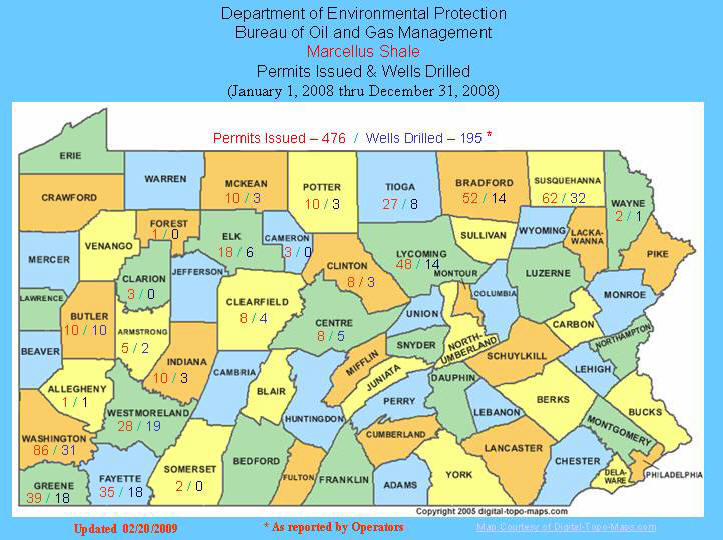
Both of these factors — the development of new drilling technology and new geological insights into the size of the Marcellus Shale — combined to set the stage for an exploratory phase that saw a cadre of multinational gas companies to flock to the area in 2008. That year, the Pennsylvania Department of Environmental Protection (DEP) granted permits to various gas companies to drill in the Marcellus Shale at 476 sites across the state, the majority in later half of 2008.

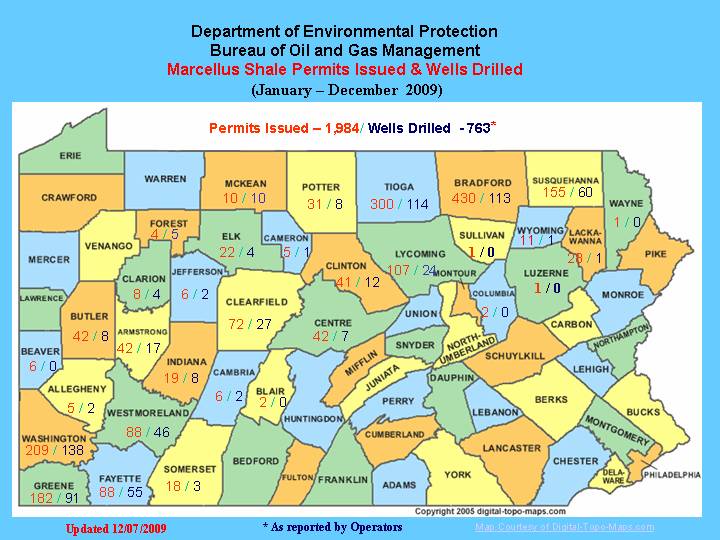
But in 2009, activity took off in earnest. DEP granted 1,742 Marcellus Shale drilling permits state-wide as of Nov. 30, with promises of even more in the pipeline for 2010.

DEP press secretary Teresa Candori stated that although there will continue to be many permits in 2010, she doesn’t necessarily expect the number of permits the agency grants to triple again next year.

...

Candori stated that DEP recently hired 37 new staff members specifically to handle the growing Marcellus Shale workload at the agency. Their salaries, she said, will be drawn directly from a recent hike in permitting fees.

Economic impact

...

“It’s pretty amazing, statewide,” said Mark Scheuerman, chief general counsel and media relations manager for Fortuna Energy. “I think the numbers that the Marcellus Shale Coalition, through their economic development analysis they did through Penn State, account for about 26,000 new jobs in Pennsylvania since about a year ago, all attributed to Marcellus development, (and) we think that will continue.”

“(In) areas like the Barnett Shale in Texas, in the Fort Worth area, in about three to five years there were almost 100,000 new full-time jobs associated with Barnett Shale exploration and the production. That’s a formation that is about 5,000 square miles. The Marcellus — and, of course, it covers a four-state area — is about 95,000 square miles. And Pennsylvania has the biggest chunk of it. So if you can extrapolate from those numbers, it gives you kind of breathtaking forecast of what the economic impact will be from a jobs standpoint,” Scheuerman added.

...

Brian Driscoll, countywide economic development manager of the Central Bradford Progress Authority stated that the economic impact has been noticeable, but difficult to quantify “just because it’s so tough to track that with so many different companies involved, and there are subcontractors involved, and all different dynamics.”

“It’s no secret to anybody there’s a lot of activity more going on,” he said. “There are some employment impacts. A lot of the employment seems to be going to folks from outside of the area. But that has created a tremendous demand for hotel space as well as residential rental units, like apartment-type dwellings. So there’s been a real increase in demand for housing, both temporary and longer-term.”

“You (also) see a lot of activity at restaurants and service-related activity,” Driscoll added. “So I think the spectrum’s pretty wide-ranging.”

But, according to Driscoll, the idea of gas industry profits falling into county resident’s hands hasn’t quite come to fruition yet.

“What we don’t see at this point is a lot of revenue coming directly into residents’ hands through royalty payments or anything like that, because the process isn’t quite far enough along. A lot of folks have gotten lease payments, but aren’t in the royalty cycle yet,” he explained.

Driscoll also pointed to the secondary aspects economy that are indirectly benefiting from the increase in population and the growing numbers of transient workers.

“I know that there are existing businesses in the Valley and elsewhere in the county that you might not think would be totally related (that are benefiting). I know hardware stores have been selling components to these folks. We know of a company that sells cleaning supplies that has been inundated with requests for their materials, just based on additional people in residential units. Flower shops (are benefiting because) guys from Texas are sending flowers back home to their wives. Stuff like that that you just wouldn’t think of has become impacted as well,” Driscoll said.

However, the expected increase in population will probably cause some speed bumps that must be dealt with along the way, according to Bradford County Commissioner Mark Smith.

“The increase in the population and the increase in human services is going to have an impact. Our correctional facility and services such as children and youth, and drug and alcohol services, and the school systems — the issues and problems that arise naturally from having more people in the county will have to be dealt with as the changes develop," Smith stated.

Another issue prominent in the minds of local officials is the prospect of a state-mandated severance tax on oil and gas revenue in Pennsylvania that would send portions of the gas companies back to the state’s general fund.

Many local officials, such as Bradford County Commissioner Doug McLinko and state Rep. Tina Pickett, have been vocal in their opposition to the proposed severance tax on the grounds that it would take tax revenue away from municipalities where most of the drilling is occurring and send it back to the state government.

Pickett stated that a better way to raise revenue from Marcellus Shale activity would be to lease selected portions of state property to gas companies.

Splashdown: Maybe she'll explain that...

Proponents of the tax argue that 14 of the other top 15 gas-producing states in the country have such a tax.

Natural gas and the Valley: ‘A very busy year’

As the natural gas industry takes its foothold across the county, it seems to have skipped over the Valley in terms of permits granted and rigs constructed. But the central location and developed nature of the Valley have made it a prime target of gas companies during the past year in their search for a place to locating their infrastructure.

Tunkhannock-based Somerset Regional Water Solutions’ proposed water treatment facility on Mile Line Road, voted down by the Athens Township Board of Supervisors in November due to it’s failure to correct a number of deficiencies in the original plans, was one example of a failed venture this year. Documents attached to the proposal for the treatment plant indicated that incoming wastewater would potentially be radioactive, and that excess water would be dumped into the Chemung River.

Two successes for the gas industry, however, were achieved in the Tannery Curve area of Athens Township. There, a 50-truck parking lot and a water withdrawal site were approved and are now currently being developed to feed Chesapeake Energy’s drilling operations throughout the county, taking advantage of the site’s proximity to Route 220.

Two other projects — a 60-person temporary housing quarters, or “man camp” on Round Top Road, and an East Athens water withdrawal facility — were nixed by gas companies themselves in the middle of the approval process. Reports indicate that another site for the “man camp” is being sought by Nomac, Chesapeake Energy’s drilling subsidiary.

...

Looking ahead: ‘It depends on the rocks’

Although forecasts indicate that 2010 will be a pivotal year, and many in the area are counting on the quick growth of the fledgling industry, the pace at which the industry develops is dependent on one thing that is out of anyone’s control: nature itself.

...

“From our perspective, about a year ago we had zero production in the Marcellus. Now we’re at about 30 wells and we’re producing just at about 70 million (cubic feet) out of our Marcellus wells in Northern Pennsylvania. It’s been quite a satisfying accomplishment and we’re looking to expand on that in 2010,” [Fortuna's] Scheuerman said.

“But there’s always a lot of factors that go into exactly where you conduct operations — whether it’s exploration or development — and then production is always a question of mother nature,” he added.

“It depends on the rocks, as they say.”

For complete article, CLICK HERE.

DEMAND ACCOUNTABILITY!

RURAL IMPACT VIDEOS, 6 parts

Natural gas development in Colorado, the impacts on communities, environment and public health. A primer for public servants and residents of counties that care for their lifestyles.

Drilling for Gas in Bradford County, PA ... Listen!

Cattle Drinking Drilling Waste!

EPA... FDA... Hello? How many different ways are we going to have to eat this? ... Thank you TXSharon for all you do! ... Stay tuned in at http://txsharon.blogspot.com

Landfarms

A film by Txsharon. Thank you Sharon for all you do. Click HERE to read the complete article on Bluedaze: Landfarms: Spreading Toxic Drilling Waste on Farmland

SkyTruth: Upper Green River Valley - A View From Above