
Showing posts with label DOUG MCLINKO. Show all posts

Sunday, January 3, 2010

The rush is on

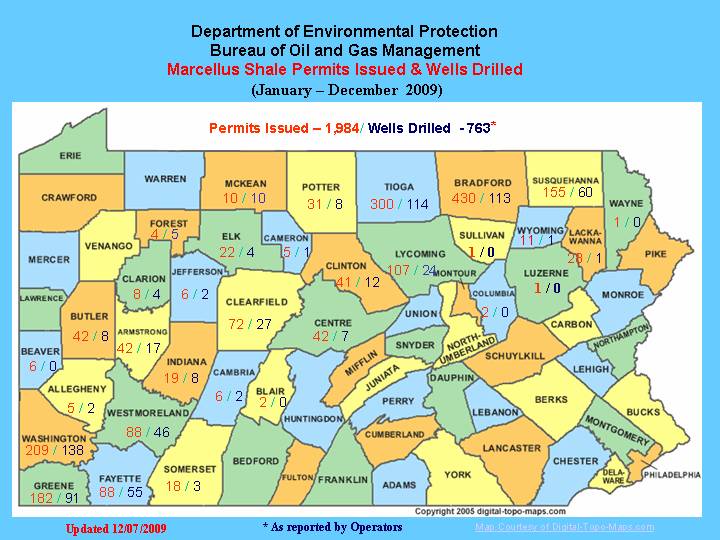
Bradford County leads state in Marcellus Shale drilling permits in 2009
by Steve Reilly, Staff Writer
Morning Times
Saturday, January 2, 2010

The natural gas rig looming over a hundred feet over the Eileen property in Smithfield Township is one of 92 drilled in Bradford County in 2009 — over six times the number drilled in 2008.

Like many Bradford County rigs, the massive structure has become somewhat of a roadside attraction for curious passers-by.

But if current trends continue, it could be only a matter of time before such rigs jutting out from the rural landscape become less a novelty and more a part of the county’s everyday scenery.

If Pennsylvania was the primary target for gas exploration in the Marcellus Shale in 2009, Bradford County was its bulls-eye.

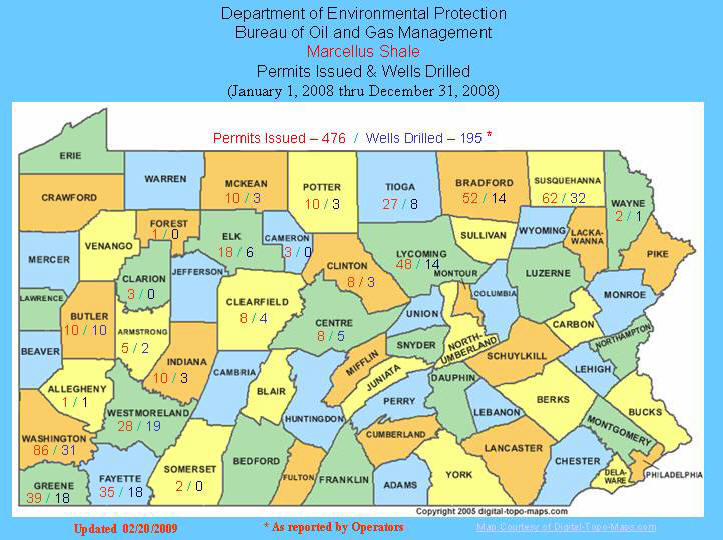
At the end of 2008, there were a total of 63 permits to drill wells into the Marcellus Shale in Bradford County, 17 of which had actually been drilled.

In 2009, according to statistics released on Nov. 30, there were a total of 383 Marcellus Shale drilling permits granted in Bradford County — more than any in other county in Pennsylvania.

With over 300 permitted wells yet to be drilled in the county, and with the torrid pace at which permits are granted showing no signs of stopping, all indications point to 2010 as a year in which the natural gas industry could forever transform the landscape of Bradford County.

The rush to drill in 2009

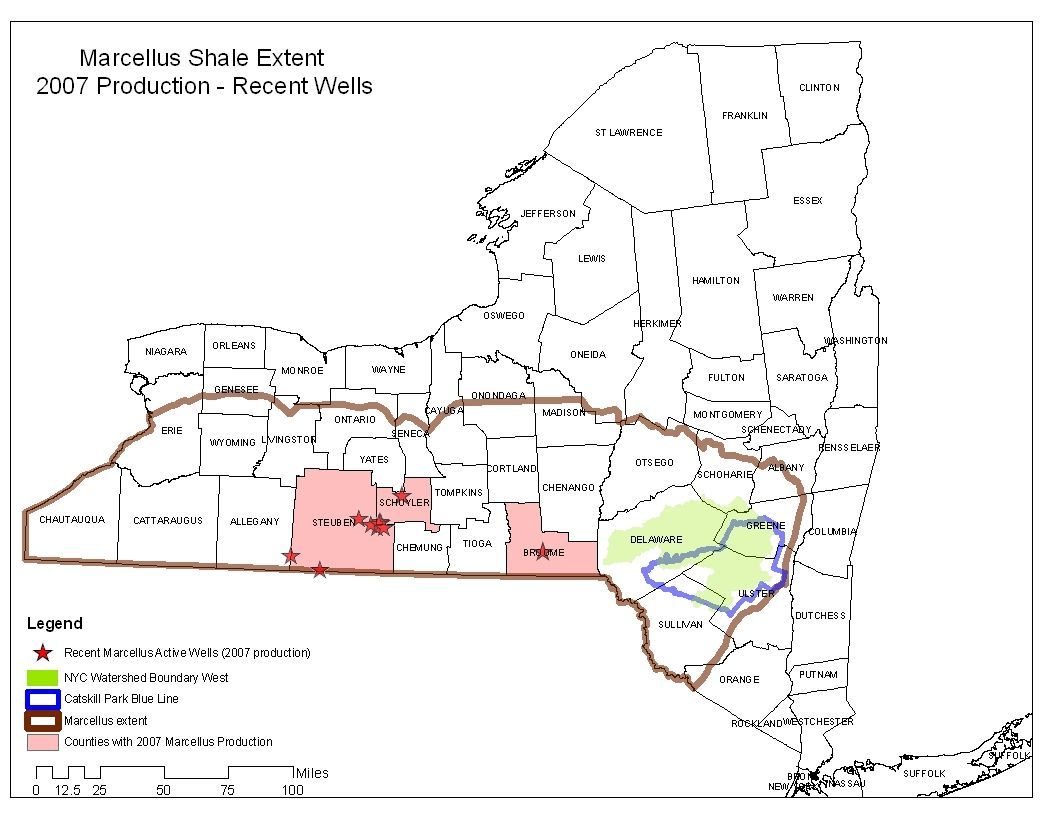
Until 2008, few had heard of the Marcellus Shale, a rock formation buried 5,000 feet deep stretching across 95,000 acres of a four-state region from New York to West Virginia. But two events in the last decade combined to unleash the hidden potential of the shale bed and make “the Marcellus” a household name.

In 2005, natural gas companies began exploiting the Barnett Shale in the Fort Worth, Texas area using a combination of hydraulic fracturing, or “hydrofracking,” and newly-pioneered horizontal drilling techniques to extract natural gas from the shale. The tremendously profitable gas extraction operations in Texas led to a hunt for similar formations across the country, and eventually to the establishment of relatively smaller natural gas economies in Arkansas’ Fayetteville Shale and Louisiana’s Haynesville Shale.


Then, in January 2008, Penn State geosciences professor Terry Engelder and SUNY-Fredonia geology professor Gary Lash released a study that estimated the size of the Marcellus Shale at 168 trillion to 516 trillion cubic feet — 80 to 250 times the previous U.S. Geological Survey estimate. In terms of geographic area, the Marcellus Shale is estimated to be 19 times larger than the Barnett Shale.

Both of these factors — the development of new drilling technology and new geological insights into the size of the Marcellus Shale — combined to set the stage for an exploratory phase that saw a cadre of multinational gas companies to flock to the area in 2008. That year, the Pennsylvania Department of Environmental Protection (DEP) granted permits to various gas companies to drill in the Marcellus Shale at 476 sites across the state, the majority in later half of 2008.

But in 2009, activity took off in earnest. DEP granted 1,742 Marcellus Shale drilling permits state-wide as of Nov. 30, with promises of even more in the pipeline for 2010.

DEP press secretary Teresa Candori stated that although there will continue to be many permits in 2010, she doesn’t necessarily expect the number of permits the agency grants to triple again next year.

...

Candori stated that DEP recently hired 37 new staff members specifically to handle the growing Marcellus Shale workload at the agency. Their salaries, she said, will be drawn directly from a recent hike in permitting fees.

Economic impact

...

“It’s pretty amazing, statewide,” said Mark Scheuerman, chief general counsel and media relations manager for Fortuna Energy. “I think the numbers that the Marcellus Shale Coalition, through their economic development analysis they did through Penn State, account for about 26,000 new jobs in Pennsylvania since about a year ago, all attributed to Marcellus development, (and) we think that will continue.”

“(In) areas like the Barnett Shale in Texas, in the Fort Worth area, in about three to five years there were almost 100,000 new full-time jobs associated with Barnett Shale exploration and the production. That’s a formation that is about 5,000 square miles. The Marcellus — and, of course, it covers a four-state area — is about 95,000 square miles. And Pennsylvania has the biggest chunk of it. So if you can extrapolate from those numbers, it gives you kind of breathtaking forecast of what the economic impact will be from a jobs standpoint,” Scheuerman added.

...

Brian Driscoll, countywide economic development manager of the Central Bradford Progress Authority stated that the economic impact has been noticeable, but difficult to quantify “just because it’s so tough to track that with so many different companies involved, and there are subcontractors involved, and all different dynamics.”

“It’s no secret to anybody there’s a lot of activity more going on,” he said. “There are some employment impacts. A lot of the employment seems to be going to folks from outside of the area. But that has created a tremendous demand for hotel space as well as residential rental units, like apartment-type dwellings. So there’s been a real increase in demand for housing, both temporary and longer-term.”

“You (also) see a lot of activity at restaurants and service-related activity,” Driscoll added. “So I think the spectrum’s pretty wide-ranging.”

But, according to Driscoll, the idea of gas industry profits falling into county resident’s hands hasn’t quite come to fruition yet.

“What we don’t see at this point is a lot of revenue coming directly into residents’ hands through royalty payments or anything like that, because the process isn’t quite far enough along. A lot of folks have gotten lease payments, but aren’t in the royalty cycle yet,” he explained.

Driscoll also pointed to the secondary aspects economy that are indirectly benefiting from the increase in population and the growing numbers of transient workers.

“I know that there are existing businesses in the Valley and elsewhere in the county that you might not think would be totally related (that are benefiting). I know hardware stores have been selling components to these folks. We know of a company that sells cleaning supplies that has been inundated with requests for their materials, just based on additional people in residential units. Flower shops (are benefiting because) guys from Texas are sending flowers back home to their wives. Stuff like that that you just wouldn’t think of has become impacted as well,” Driscoll said.

However, the expected increase in population will probably cause some speed bumps that must be dealt with along the way, according to Bradford County Commissioner Mark Smith.

“The increase in the population and the increase in human services is going to have an impact. Our correctional facility and services such as children and youth, and drug and alcohol services, and the school systems — the issues and problems that arise naturally from having more people in the county will have to be dealt with as the changes develop," Smith stated.

Another issue prominent in the minds of local officials is the prospect of a state-mandated severance tax on oil and gas revenue in Pennsylvania that would send portions of the gas companies back to the state’s general fund.

Many local officials, such as Bradford County Commissioner Doug McLinko and state Rep. Tina Pickett, have been vocal in their opposition to the proposed severance tax on the grounds that it would take tax revenue away from municipalities where most of the drilling is occurring and send it back to the state government.

Pickett stated that a better way to raise revenue from Marcellus Shale activity would be to lease selected portions of state property to gas companies.

Splashdown: Maybe she'll explain that...

Proponents of the tax argue that 14 of the other top 15 gas-producing states in the country have such a tax.

Natural gas and the Valley: ‘A very busy year’

As the natural gas industry takes its foothold across the county, it seems to have skipped over the Valley in terms of permits granted and rigs constructed. But the central location and developed nature of the Valley have made it a prime target of gas companies during the past year in their search for a place to locating their infrastructure.

Tunkhannock-based Somerset Regional Water Solutions’ proposed water treatment facility on Mile Line Road, voted down by the Athens Township Board of Supervisors in November due to it’s failure to correct a number of deficiencies in the original plans, was one example of a failed venture this year. Documents attached to the proposal for the treatment plant indicated that incoming wastewater would potentially be radioactive, and that excess water would be dumped into the Chemung River.

Two successes for the gas industry, however, were achieved in the Tannery Curve area of Athens Township. There, a 50-truck parking lot and a water withdrawal site were approved and are now currently being developed to feed Chesapeake Energy’s drilling operations throughout the county, taking advantage of the site’s proximity to Route 220.

Two other projects — a 60-person temporary housing quarters, or “man camp” on Round Top Road, and an East Athens water withdrawal facility — were nixed by gas companies themselves in the middle of the approval process. Reports indicate that another site for the “man camp” is being sought by Nomac, Chesapeake Energy’s drilling subsidiary.

...

Looking ahead: ‘It depends on the rocks’

Although forecasts indicate that 2010 will be a pivotal year, and many in the area are counting on the quick growth of the fledgling industry, the pace at which the industry develops is dependent on one thing that is out of anyone’s control: nature itself.

...

“From our perspective, about a year ago we had zero production in the Marcellus. Now we’re at about 30 wells and we’re producing just at about 70 million (cubic feet) out of our Marcellus wells in Northern Pennsylvania. It’s been quite a satisfying accomplishment and we’re looking to expand on that in 2010,” [Fortuna's] Scheuerman said.

“But there’s always a lot of factors that go into exactly where you conduct operations — whether it’s exploration or development — and then production is always a question of mother nature,” he added.

“It depends on the rocks, as they say.”

For complete article, CLICK HERE.

DEMAND ACCOUNTABILITY!

Friday, December 11, 2009

Bradford County DA seeks to document impact of gas industry on crime

Sunday, October 25, 2009

Gas production making an impact on Bradford County

An owner of Beck Oilfield Supply traveled from Oklahoma to Pennsylvania this year to find the best place in the midst of the Marcellus Shale natural gas drilling rush to plant one of his stores.

He picked Wysox, and he wasn't alone. Two other stores that specialize in drilling and gas production supplies have opened within two miles of Beck Supply along Route 6 in the last year.

The supply shops are more than specialty hardware stores; they are tailored to the uninterrupted pace and idiosyncratic needs of gas drilling. Beck Supply's staff - four men from Oklahoma and four locals - are on call at all hours of every day to get equipment to well and pipeline work sites.

"If their guys want food, we go grocery shopping," manager J.R. Jordan said.

Although more than half of Pennsylvania lies above the gas-bearing Marcellus Shale, Bradford County has emerged as a focal point for gas production. Nearly 300 Marcellus Shale drilling permits have been issued in Bradford this year, far more than any other county in the state, and 23 new wells have been drilled.

The work that is marking the hills and farms in Bradford County also is leaving its imprint on the towns and people nestled nearby. In small and rural hamlets that had fallen into the slow routine of decline, the drilling is bringing traffic to streets, customers to restaurants and an urgency to everyday business.

"Things have changed," Bradford County Commissioner Doug McLinko said. "There's storefronts filling back up again, there's vacant lots filling back up again. The independent, family-owned businesses are being saved.

"The impact it's having for real people is pretty incredible."

...

An industry-financed study released by Penn State University in August projects that Marcellus Shale drilling will create a total economic output of $3.8 billion in the state this year and $13.5 billion in 2020 - an estimate critics say is inflated and not in line with economic multipliers seen in other gas-producing states.

In Bradford County, it is rare to find a new millionaire, but common to hear how the region's newest industry is keeping the towns from dying.

...

"It takes a lot for the little towns to survive now," [said Bob Morgan, Calkins Motors salesman.] Residents travel to Elmira, Williamsport and Mansfield for work, he said - towns between 15 and 50 miles away.

But gas drilling is beginning to change things. Calkins saw a boost in business after the initial round of gas leasing, when people used their signing bonuses from the gas companies to buy new cars. Tom Calkins IV, an owner of the 61-year-old dealership, did notary work on the side for Fortuna Energy, the dominant gas company in town. And for about six months, the dealership serviced the fleet of Dodge trucks driven by Precision Pipeline workers that are building Fortuna's gas pipelines.

The most visible sign of the boom is the caravan of water and gravel trucks that travel Troy's roads each day.

...

James Barber, the owner of his eponymous transportation and excavating company, said gas drilling has given him "a pile of work" at a time when the stone business he has been in for 20 years has suffered.

The Clifford-based company hauls water and prepares well sites for Chesapeake Energy in Bradford and Susquehanna counties.

"Without them, I'd have 10 to 12 men sitting at home without a job," he said during a cell phone call from a well pad.

The gas industry has also spurred local entrepreneurs to begin new businesses.

A few blocks from the car dealership, in Troy's town square, Emily Eaton opened Country Clean Laundry Service in April. The expansive store doubles as an after-school hangout for neighborhood kids and there is a cage of free kittens at the front. In the back, Eaton washes, dries and irons work shirts and jeans she picks up from job trailers at drilling sites as far away as Wyalusing.

She got the idea for the business from her husband, who was always looking for laundry services in the towns where he traveled for construction work. She started in her home with one washer and one dryer, then opened the store with six machines and now plans to add three more.

"Even the guys that have campers, they've got washers and dryers that are teeny tiny and they can't handle the jeans and the big heavy Carhart shirts that they wear," she said.

The biggest challenge, after the financial hurdle of making a new business profitable, is getting out the stains. "I get all kinds," she said as she pressed the sleeves of a checked Oxford on an ironing board. "The drilling mud from under the coveralls, the concrete."

Outside the former Ames department store on Main Street south of Towanda there are dozens of white pick-up trucks in the parking lot and a well-used boot brush bolted by the front door.

Chesapeake Energy opened a field office in the abandoned store in November 2008. The Oklahoma-based gas exploration company is in the midst of expanding its rented space in the plaza for the third time in a year.

...

Chesapeake's footprint in Bradford County is substantial: it has permits to drill in a third of the county's 51 municipalities. A subsidiary, Nomac Drilling LLC, is renovating a former nursing home in Athens Twp. into a dormitory-style residence for 180 workers. In the last two years, the company has paid more than $700 million to landowners in leases and royalties. And it has made over $70 million in payments to Pennsylvania contractors this year.

The surge of money brought by the gas industry is prompting even long-established businesses to adapt.

The Comfort Inn in Wysox, its sister hotel, the Riverstone Inn, its restaurant, and 13 rental houses and apartments are all busy with gas clients, while the local staff is learning to deal with the odd hours and frequent comings-and-goings of the drilling rigs and their workers. Drilling crews generally work 12-hour shifts for two weeks followed by two weeks off.

"There's peaks and valleys," Comfort Inn operations manager Gregg Murrelle said. "There's times they bail out of here, because they're in and out. They might keep their room, they might not."

In the middle of March, the inns catered a white tablecloth dinner complete with bow tie-clad waiters at a remote well site, an event Murrelle admitted was surreal.

He said gas operations workers have kept his business steady despite a dip in corporate clientele during the recession. The gas workers' extended stays helped convince him to go forward with expansion plans - 20 to 25 rooms and a small lounge - even as the corporate travelers that inspired the renovation booked fewer and fewer rooms.

"Especially with the doldrums of the economic times, we've been fortunate," he said. "This whole area has benefited from the influx of natural gas."

There are clearly no vacancies at the Towanda Motel, north of the center of town. It says so on a sign along the road and again on a sheet of paper taped to the office door.

Since April, Chesapeake has booked all 47 rooms for their workers and the company's reservation will continue until at least the end of March.

Workers in camouflage and cargo jeans sit outside the rooms on their off hours, down from the open door of a security guard who has set up a 24-hour post in the room closest to the office, courtesy of Chesapeake. The parking lot has a disproportionate number of pick-up trucks, including an orange one with a Texas license plate and a custom decal that reads, "Every rig needs a roughneck."

Manager Jaimi Patel said the workers are generally good tenants - although some leave the rooms dirtier than others - and having a booked motel means not having to wait at the front desk through the slow winter months for reservations.

Of the four years since her family started running the place, this has been the busiest, she said.

"In this county, everyone is doing well right now."

During the lunch rush at Harkness Family Restaurant, three miles down Main Street from the motel, regulars at the lunch counter and workers bussed in from the rigs were making waitress Christy Bartholomew run.

"It's been booming," she said.

The restaurant serves three meals a day to workers who ride vans in from the well pads as part of an arrangement with the gas companies. Fliers on the bulletin board just inside the door target the new regulars: one, for a house cleaning service, is labeled "Attn: gas lease people"; another advertises a rental home for a small family "or two workers."

Bartholomew said it has been a year since she noticed a big difference in the number of customers from the gas companies, but she hopes they don't bring too much change. For one thing, they don't tip as well as the locals, she said. And the hometown regulars are still the restaurant's priority.

"We just want to make sure that while these guys are here doing their thing, our locals are taken care of," she said. "Because in the end, they're the ones that will still be here."

The prevalence of good news from the beginning of the boom in the county has left its naturally pragmatic residents - the dairy farmers that have cut the size of their herds and the restaurants that specialize in home-style cooking - a little pensive about the future. It may have been demoralizing to watch the towns stagnate, but no one knows quite what a Pennsylvania gas metropolis might look like either.

On the morning after Fortuna agreed to a landmark lease deal for $5,500 an acre and 20 percent royalties with the owners of 35,000 acres in Bradford, Susquehanna and Broome County, N.Y., posters on the online forum Pagaslease.com, most of whom had a stake in the deal, wondered how the region will change with full-blown development of what one called the "gasicane."

"If you liked things as they've always been around here, you're not gonna be real happy five years out," one poster identified as guardian wrote. "And forget it ten years out."

The new industry is also, at times, struggling to adapt to Pennsylvania.

On Tuesday, the Department of Environmental Protection fined the 2-year-old Towanda branch of Dunn's Tank Service Inc. for illegally storing drilling wastewater in tanker trailers before it could transport it to a treatment plant.

Todd Dunn, owner of Dunn's Tank Service, told The Daily Review his company did not know the storage of the wastewater required a permit.

"We're from Oklahoma," he said. "It was ignorance on our part on not knowing the law."

McLinko, who is decidedly bullish on drilling, said he expects to see problems "between the haves and the have-nots" in the county and, perhaps more noticeably, increased heavy traffic and what he called "idle-time issues" among the workers.

"Do I think that our jails are going to fill up here? No," he said. "Do I think that our police are going to have a hard time monitoring some of the social things that happen at night, such as at some of the taverns? Yes. I think our guys are going to have their hands full."

But, he added, "I'm not pessimistic on it."

"We don't even know what the problems are going to be yet," he said. "Maybe we won't even have problems."

For the complete article, CLICK HERE.


DEMAND ACCOUNTABILITY!

Friday, July 3, 2009

McLinko thinks county will get crummy deal on tax revenue

BY JAMES LOEWENSTEIN
STAFF WRITER, THE DAILY REVIEW
Published: Friday, July 3, 2009 5:43 AM EDT
TOWANDA — A Bradford County commissioner warned Thursday that as the state rushes to enact a severance tax on gas drilling, Bradford County — which will be the most drilled-upon county next year in the Marcellus Shale in Pennsylvania — will get only “crumbs” from the tax revenue for its townships.

Bradford County will be “the No. 1 drilled-upon county in the state” as far as the amount of drilling that will be taking place in the Marcellus Shale next year, Bradford County Commissioner Doug McLinko said at the Bradford County commissioners’ meeting on Thursday.

Yet if the latest version of the proposed severance tax, which was passed by the House Energy Committee last week, becomes law, the formula for distributing the tax revenue will be “locked in,” and little of the tax revenue will come back to the townships in Bradford County in perpetuity, McLinko said.

“They’ll send back crumbs to our townships and that’s what you’ll get forever,” he said.

The issue of the severance tax was raised at the commissioners’ meeting by Bradford County Republican Committee Chairman Eric Matthews, who asked Commissioner Mark Smith during the public comment period whether he supported the severance tax.

“I think in some manner or fashion we’re going to have to have money going back to the counties — whether that’s from a severance tax, or a property tax paid by gas companies,” Smith said. “I don’t see any other way that the impacts of this (gas drilling) industry are going to be covered.”

He said the gas-drilling industry will have impacts on roads, bridges, the criminal justice system and the county jail, as well as social impacts.

However, like McLinko, Smith said that he believes the version of the tax that was passed by House Energy Committee — which was a 5 percent severance tax — would not distribute enough of the tax revenue to townships and counties.

The committee voted to keep 60 percent of the revenues from the severance tax for the state General Fund, but split the remaining 40 percent this way: 4.5 percent each to municipalities and counties where gas drilling is taking place, 5 percent for local road and bridge work, 15 percent to a state environmental fund, 4 percent to a state hazardous waste cleanup fund, 2 percent each to the state game and fish and boating commissions, and 3 percent to the state-run heating assistance program.

McLinko said he opposes the severance tax because it will impose a financial burden on gas companies that will either force them to cease drilling or reduce the number of wells they drill.

However, if the state is going to enact a severance tax, “the lion’s share should come back here,” he said.

“It’s our resource, not Harrisburg’s,” he said.

“I think in some manner or fashion we’re going to have to have money going back to the counties — whether that’s from a severance tax, or a property tax paid by gas companies,” Smith said. “I don’t see any other way that the impacts of this (gas drilling) industry are going to be covered.”

He said the gas-drilling industry will have impacts on roads, bridges, the criminal justice system and the county jail, as well as social impacts.

However, like McLinko, Smith said that he believes the version of the tax that was passed by House Energy Committee — which was a 5 percent severance tax — would not distribute enough of the tax revenue to townships and counties.

The committee voted to keep 60 percent of the revenues from the severance tax for the state General Fund, but split the remaining 40 percent this way: 4.5 percent each to municipalities and counties where gas drilling is taking place, 5 percent for local road and bridge work, 15 percent to a state environmental fund, 4 percent to a state hazardous waste cleanup fund, 2 percent each to the state game and fish and boating commissions, and 3 percent to the state-run heating assistance program.

McLinko said he opposes the severance tax because it will impose a financial burden on gas companies that will either force them to cease drilling or reduce the number of wells they drill.

However, if the state is going to enact a severance tax, “the lion’s share should come back here,” he said.

“It’s our resource, not Harrisburg’s,” he said.

DEMAND ACCOUNTABILITY!

Friday, June 26, 2009

Who Does Dougie Drillbit Represent?

While industry proponents say a severance tax (i.e., anything that would present a hurdle to the unbridled pursuit of natural ga$) would fetter an industry in its infancy here in Pennsylvania, according to a report in today's Pittsburgh Tribune-Review, 87% of PA residents strongly or somewhat favor using a severance tax to protect our land, water and wildlife.
In fact, 39 states now tax the extraction of natural resources, making Pennsylvania (one of the gas wealthiest states in the nation) in the minority when it comes to charging industry with responsibility for reparations necessitated as a result of their activities, and putting McLinko clearly in the minoritiy too.

Whose interests is Dougie Drillbit representing protecting? Are Bradford Countians so out of step with their fellow Pennsylvanians that they want to shelter the profits of commercial drillers (for the sake of lease holders???) at the expense of all residents who will be forced to dig into their pockets to bear the cost of the reckless pursuit of those profits?

Jan Jarrett, CEO of Penn Future, sees the severance tax as a way of balancing the great opportunity the Marcellus shale play offers with the "tremendous risk to the land, water and wildlife that makes Pennsylvania so special."

A well-structured severance tax on natural gas production will protect Pennsylvania taxpayers from shouldering the public costs that come with increased drilling, according to a Pennsylvania Budget and Policy Center report.

The report, “Responsible Growth: Protecting the Public Interest with a Natural Gas Severance Tax,” examines the potential costs of increased natural gas drilling on taxpayers and the environment, how severance taxes are structured in other states, and what lessons Pennsylvania can learn from them. It can be accessed HERE.

As guest columnist in the Delaware County Times last week, Jan Jarrett made the following observations:
(To read Jarrett's complete statement, click HERE.)

• The tax proposed by Gov. Ed Rendell is identical to the tax paid by the industry in West Virginia. If this tax is onerous, we would expect that Pennsylvania would be the drilling capital of the nation. But it isn’t. Pennsylvania is 15th out of 32 gas-producing states.

• But while this tax will do no harm to the industry, it can do a great deal of good for our state. Natural gas development will bring jobs, investment and money into Pennsylvania’s rural communities, but environmental officials admit that drilling will inevitably result in some damage to our natural resources and communities.

• Careful permitting and oversight can reduce, but not eliminate, the environmental harm. We must have a severance tax that reserves a portion for the environment so taxpayers are not left holding the bag for industry’s damage.

• Without a severance tax that has a portion reserved for local governments, rural areas will have no money to accommodate the influx of workers, their families and additional businesses that drilling will bring.

• Without a severance tax, our state agencies will have no money to protect and enhance the parks, forests, fishing and game areas that are likely to be harmed.

• Without a severance tax, our citizens will lose the natural resources being removed, with no compensation for this permanent loss.

• Without a severance tax, our battered state budget will continue to suffer, with our citizens having to pay larger taxes to cover all the needs of our state.

It's almost a no brainer isn't it?

Heh. What's that say about Doug McLinko?
Call him first thing Monday morning at 570.265.1727 x2700!
Tell him you're not satisfied with the way he's representing you!

DEMAND ACCOUNTABILITY!

Predictably, McLinko says gas severance tax, greenhouse bill will hurt Bradford County

“We have a gas industry that’s going to employ hundreds of thousands of people throughout the state—and yet we’re going to punish them before they even get started with (a severance) tax,” said Doug "Drillbit" McLinko.
_______________

Interestingly, in a Daily Review reader comment yesterday re: Fortuna spending over $200M here on expansion, sickandtired wrote:
" The public would really like to know, how many permanent, fulltime jobs have been created by this gas endeavor and are being held by local employees??? Seems every time that question is asked it is "unknown".
I pass the Armenia Mountain Windmill Project home station on the corner of Dewey and State every morning. There are many truck there everymorning, but I have seen no Pennsylvania license plates there. Tx, Wy,Wi, Ky, NY Ut, and others, but NO PA. Where are all the jobs we were told would result from these companies? "

TXsharon replies: An answer to the question of how many can be, at least, partially answered by watching Barnett Shale: An Aerial View. As you look down on all the drill sites, drill rigs, compressor stations, etc., count the number of cars and trucks parked around those sites. You won't find many or any.
_______________
BY JAMES LOEWENSTEIN
DAILY REVIEW STAFF WRITER
Published: Friday, June 26, 2009 2:29 AM EDT
TOWANDA — The proposed state severance tax on gas drilling and an energy bill that is scheduled to be voted on today in the U.S. House of Representatives will both hurt Bradford County, Bradford County Commissioner Doug McLinko said.

McLinko said he opposes the severance tax on gas drilling, which he says will place such a large financial burden on gas drilling companies that the smaller companies will stop drilling in the area and the large ones will slow down the pace of their drilling.

In Pennsylvania, gas drilling companies already face the highest corporate net income tax in the nation, McLinko said at the Bradford County commissioners’ meeting.

The Pennsylvania House Energy Committee earlier this week approved legislation which would create the severance tax and which would distribute less than 2 percent of the tax revenue to local municipalities, said Eric Matthews, chairman of the Bradford County Republican Committee.

Sixty percent of the revenue from the severance tax would go to the state’s General Fund to bail out the state from its budget problems, McLinko said.

While the other 40 percent is to be spent “locally”, “a lot of that is for social spending programs,” and only a fraction of the “local” spending would be directed to municipalities, he said.

Pennsylvanians won’t see the severance tax money used for things like creating parks or expanding hospitals, McLinko said.


Greenhouse bill

McLinko said the federal energy bill, which includes cap-and-trade provisions and is aimed at limiting greenhouse gas emissions, will “crush” industries in the county, which are heavily dependent on electricity.

The greenhouse gas legislation will drive up the cost of electricity, home heating fuel and other energy costs, he said.

Bradford County is particularly vulnerable to the price of electricity because, due to its large industrial plants, the county “consumes as much electricity as the city of Baltimore, save one steel mill.”

DEMAND ACCOUNTABILITY!

Saturday, June 20, 2009

Doug McLinko, Gas and the Family Farm

A Bradford County PA Resident Speaks Out

Dear Editor,

Normally, when I open up The Daily Review I find the usual dose of local news. However, every so often I am confronted with a passage containing quotes from some of our elected officials. On Wednesday June 10, 2009 I opened up to a small article in the “local and state” section in which Doug McLinko stated, “If you believe in agriculture preservation and preserving the family farm, this gas play has done more than any government program could ever do.” It took me awhile to put my brain back together because a statement that devoid of sense can really blow ones mind. Let’s begin with the obvious logical fallacy in McLinko’s statement, how on earth does he expect the preservation of agriculture and the family farm if land used for farming and other agricultural enterprises is being leased and used for drilling? These operations require heavy equipment that isn’t easy on land, exploratory practices that are definitely not easy on land, and pipelines through land, not to mention the effect on roads and water, more on water later. Why doesn’t he just go ahead and say, “I’m lobbying for the gas companies in order to line my own pockets, and I’m not nor was I ever, interested in working with the current or past commissioners to serve the citizens of Bradford County.” It would be a lot easier for him to say that, because I feel like I may not be the only one who can see right through his intentions. The PA Dept. of Agriculture is a part of the PA state government, Doug, and it provides numerous services to farmers in PA. These are services that actually contribute to the preservation of LAND that farmers use to produce, annual reports and publications, and right-to-know services. Many bureaus also lobby on their behalf in Harrisburg, one bureau being the aptly named Pennsylvania Farm Bureau. PA Conservation Districts as well as programs like the Penn State Agricultural Extension help shape agricultural policy within the commonwealth. Do the gas companies provide that for the 58,000 farming families in Pennsylvania? Or are they too busy lobbying for every tax break possible for themselves? I believe it is quite clear that the gas companies do not lobby for anyone but themselves and no one else, save for the minority of landowners who sit on land rich with natural gas. The gas companies have no interest in the preservation of land either; quite the opposite if you paid any attention while you visited Texas, Doug.
You know you’re really in trouble, Doug, when Tina Pickett actually introduces legislation aimed at the interests of her constituents while you are off vehemently defending gas companies who serve no one but themselves and irresponsibly wreck the pristine environment of Bradford County. That’s right folks, Tina Pickett introduced constructive legislation! It only took her 8 years to find an issue in which she could shape policy in, granted its an issue that covers 75% of the earth. I’m speaking of course about water in reference to an article printed the very same day in the Review. Interestingly enough Tina Pickett is an elected official, in a government whose purpose is to SERVE its constituents. I think Doug McLinko could learn a lesson from such behavior. It is my belief that the majority of farmers in the state, and perhaps the county, would agree that an instrument of government in the form of the PA Dept. of Agriculture, and groups like the PA Farm Bureau, The Conservation Districts throughout PA, and programs like the Penn State Agricultural Extension PA serves their interests in preservation of agriculture far more than both the gas companies and Doug McLinko ever has.

Christopher S. Bradley

DEMAND ACCOUNTABILITY!

RURAL IMPACT VIDEOS, 6 parts

Natural gas development in Colorado, the impacts on communities, environment and public health. A primer for public servants and residents of counties that care for their lifestyles.

Drilling for Gas in Bradford County, PA ... Listen!

Cattle Drinking Drilling Waste!

EPA... FDA... Hello? How many different ways are we going to have to eat this? ... Thank you TXSharon for all you do! ... Stay tuned in at http://txsharon.blogspot.com

Landfarms

A film by Txsharon. Thank you Sharon for all you do. Click HERE to read the complete article on Bluedaze: Landfarms: Spreading Toxic Drilling Waste on Farmland

SkyTruth: Upper Green River Valley - A View From Above