
Showing posts with label MAN CAMPS. Show all posts

Friday, January 29, 2010

Don't Frack with New York! Governor Patterson Poisons the Well to Balance the Budget

Alison Rose Levy
The Huffington Post
January 28, 2010

Former New York State Governor Eliot Spitzer may have had his sexual peccadilloes but he knew how to stand up to corporate interests that threatened the public good. It was a big boost for oil companies, planning to despoil New York State, when the powerhouse Spitzer was replaced by his easily rolled-over successor.

While belt-tightening throughout the state budget, Governor Patterson added $3 million to fast track harmful gas drilling practices--a quick fix economic solution with tragic long-range health, economic, and environmental consequences.

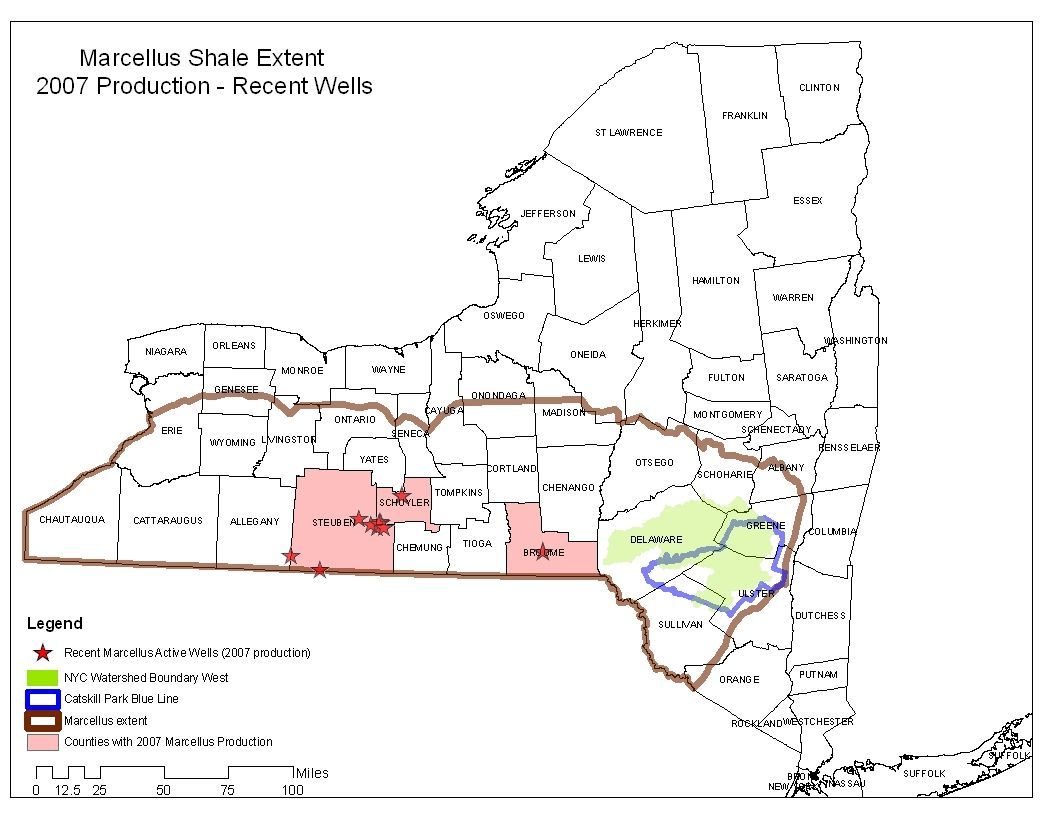
On Monday, a statewide coalition of New York state residents, businesses, and environmental groups rallied in the state capital of Albany to ask legislators to oppose Patterson's plans to contaminate state-wide water supplies (including New York City's) by permitting a damaging form of gas drilling, known as "fracking," or hydraulic fracturing.

Thanks to lobbying by Halliburton and other energy companies, under the Bush-Cheney administration, fracking got exempted from the Clean Water Act even though it releases large quantities of undisclosed carcinogens and toxic chemicals into the earth and water supply.

According to a recent study, conducted by the Environmental Working Group (EWG), just one drilling site deploys harmful chemicals sufficient "to contaminate more than 100 billion gallons of drinking water to unsafe levels ... more than 10 times as much water as the entire state of New York uses in a single day."

The chemicals used in fracking "pose a serious threat to the nation's water supplies, but those risks have been largely ignored," says the report. "Drinking water contamination and property damage have been linked to hydraulic fracturing in four states--Colorado, Ohio, Pennsylvania and Wyoming. In one incident that polluted a Colorado creek, the drilling company is still trying to clean it up--four years later."

Nor does the drilling create local jobs or business. Instead, companies bus in workers from Texas, housing them in "man camps," sites where reportedly alcohol and drug abuse, and sexual predation abound. While no one wants a "man camp" next door, a gas well also ruins the neighborhood. If one owner sells property for drilling, all neighboring land can be conscripted for leasing, with no rights of refusal. Fracking also releases chemicals into the air; an army of trucks must carry over roads and New York State highways up to four million gallons of contaminated water (per well)-- which amps up air pollution and costly highway repairs. There is currently no way to effectively decontaminate the high quantities of waste water produced by fracking.

"We can't let the gleam of potential profits leave us with a legacy of polluted water and industrialized landscapes," said Wes Gillingham, program director of Catskill Mountainkeeper.

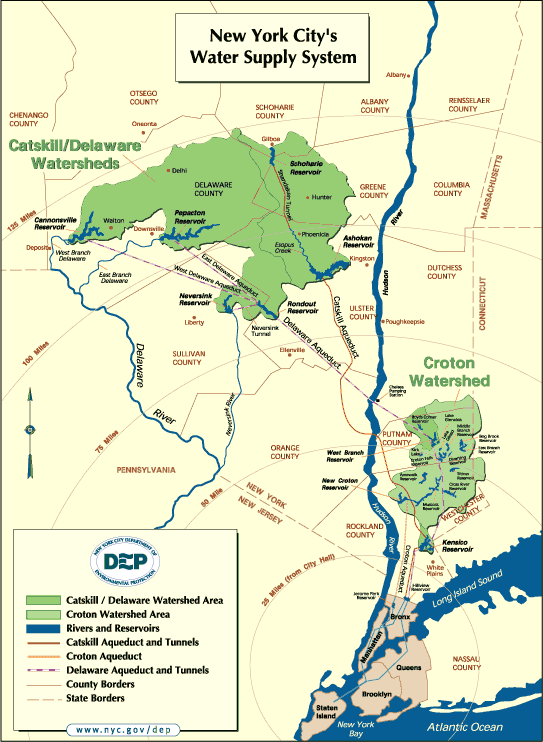
Last month, New York City's Department of Environmental Protection issued a report urging a halt to gas drilling since, "Natural gas drilling and exploration are incompatible with the operation of New York City's unfiltered water supply system and pose unacceptable risks for more than nine million New Yorkers in the City and State." They noted that drilling entails "invasive industrialization and creates a substantial risk of chemical contamination, and infrastructure damage."

This week, Mayor Bloomberg chimed in, "The consequences are so severe that it is not a risk that I think we should run. I do not think that we should allow fractured drilling anywhere near our water supply."

Although land can be fenced in, water can't be. It flows underground, it rises into clouds, it's borne by the winds, and released by the rains, far from its source.

While the Mayor nobly aims to protect the immediate area surrounding the city's upstate water reservoir, so far no studies have investigated how far water-born contaminants from throughout the state could flow downstream to impact NYC, or it's water supply. Fracking originated in arid western regions, and its proponents don't know the extent of pollution possible in a region of interconnected rivers and frequent rains like New York and New England.

In New York State, gas drillers hope to use fracking in the regions of the New York City Watershed, the Delaware River, the Finger Lakes, and upstate watersheds, the source of waters that flow downstate to New York, Pennsylvania, New Jersey, and Delaware.

With fresh water resources becoming scarcer worldwide due to population growth and climate change, it's unconscionable for a short-term Governor to short-sell a precious resource to balance his budget. Perhaps the soon to declare gubernatorial candidate, Andrew Cuomo, will like his popular father, Governor Mario Cuomo, become a successful champion.

To take action, sign up with the Environmental Advocates NY Citizens for Safe Energy http://www.catskillcitizens.org/ The Environmental Working Group proposes a national ban or better regulation. Or join No Fracking Way on Facebook. Or cut to the chase, and ask soon to declare candidate, Andrew Cuomo to make New York State a model for future-oriented policies, rather than a disastrous object lesson in the costs of short-sighted gain.

DEMAND ACCOUNTABILITY!

Sunday, January 3, 2010

The rush is on

Bradford County leads state in Marcellus Shale drilling permits in 2009
by Steve Reilly, Staff Writer
Morning Times
Saturday, January 2, 2010

The natural gas rig looming over a hundred feet over the Eileen property in Smithfield Township is one of 92 drilled in Bradford County in 2009 — over six times the number drilled in 2008.

Like many Bradford County rigs, the massive structure has become somewhat of a roadside attraction for curious passers-by.

But if current trends continue, it could be only a matter of time before such rigs jutting out from the rural landscape become less a novelty and more a part of the county’s everyday scenery.

If Pennsylvania was the primary target for gas exploration in the Marcellus Shale in 2009, Bradford County was its bulls-eye.

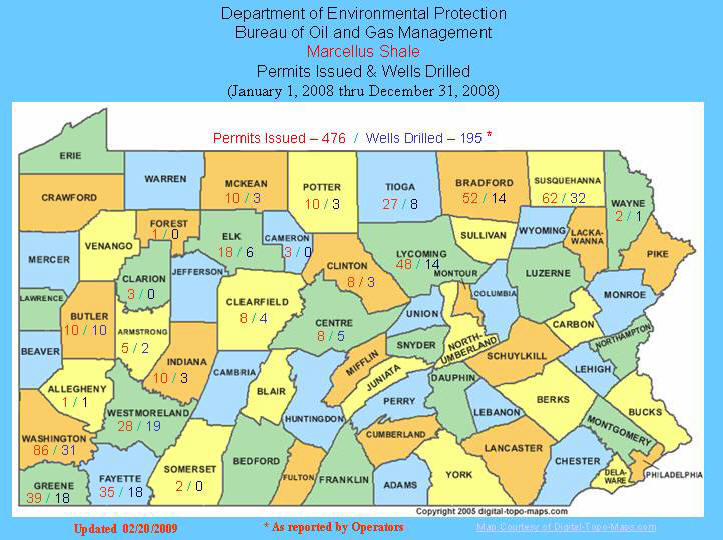
At the end of 2008, there were a total of 63 permits to drill wells into the Marcellus Shale in Bradford County, 17 of which had actually been drilled.

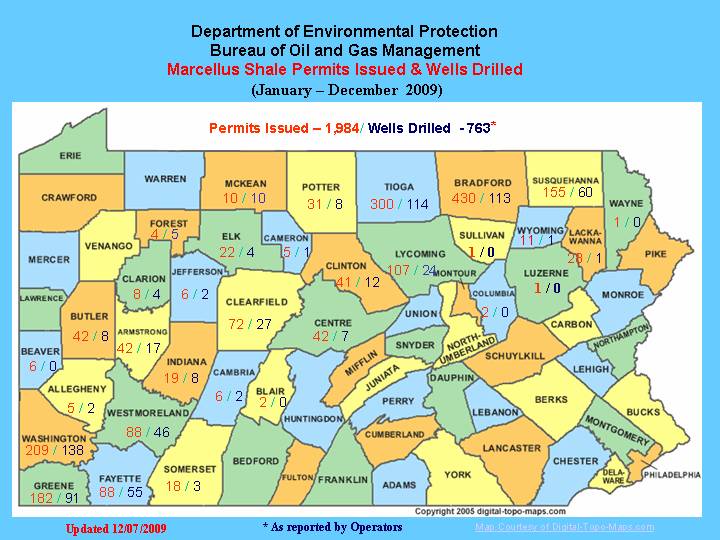
In 2009, according to statistics released on Nov. 30, there were a total of 383 Marcellus Shale drilling permits granted in Bradford County — more than any in other county in Pennsylvania.

With over 300 permitted wells yet to be drilled in the county, and with the torrid pace at which permits are granted showing no signs of stopping, all indications point to 2010 as a year in which the natural gas industry could forever transform the landscape of Bradford County.

The rush to drill in 2009

Until 2008, few had heard of the Marcellus Shale, a rock formation buried 5,000 feet deep stretching across 95,000 acres of a four-state region from New York to West Virginia. But two events in the last decade combined to unleash the hidden potential of the shale bed and make “the Marcellus” a household name.

In 2005, natural gas companies began exploiting the Barnett Shale in the Fort Worth, Texas area using a combination of hydraulic fracturing, or “hydrofracking,” and newly-pioneered horizontal drilling techniques to extract natural gas from the shale. The tremendously profitable gas extraction operations in Texas led to a hunt for similar formations across the country, and eventually to the establishment of relatively smaller natural gas economies in Arkansas’ Fayetteville Shale and Louisiana’s Haynesville Shale.


Then, in January 2008, Penn State geosciences professor Terry Engelder and SUNY-Fredonia geology professor Gary Lash released a study that estimated the size of the Marcellus Shale at 168 trillion to 516 trillion cubic feet — 80 to 250 times the previous U.S. Geological Survey estimate. In terms of geographic area, the Marcellus Shale is estimated to be 19 times larger than the Barnett Shale.

Both of these factors — the development of new drilling technology and new geological insights into the size of the Marcellus Shale — combined to set the stage for an exploratory phase that saw a cadre of multinational gas companies to flock to the area in 2008. That year, the Pennsylvania Department of Environmental Protection (DEP) granted permits to various gas companies to drill in the Marcellus Shale at 476 sites across the state, the majority in later half of 2008.

But in 2009, activity took off in earnest. DEP granted 1,742 Marcellus Shale drilling permits state-wide as of Nov. 30, with promises of even more in the pipeline for 2010.

DEP press secretary Teresa Candori stated that although there will continue to be many permits in 2010, she doesn’t necessarily expect the number of permits the agency grants to triple again next year.

...

Candori stated that DEP recently hired 37 new staff members specifically to handle the growing Marcellus Shale workload at the agency. Their salaries, she said, will be drawn directly from a recent hike in permitting fees.

Economic impact

...

“It’s pretty amazing, statewide,” said Mark Scheuerman, chief general counsel and media relations manager for Fortuna Energy. “I think the numbers that the Marcellus Shale Coalition, through their economic development analysis they did through Penn State, account for about 26,000 new jobs in Pennsylvania since about a year ago, all attributed to Marcellus development, (and) we think that will continue.”

“(In) areas like the Barnett Shale in Texas, in the Fort Worth area, in about three to five years there were almost 100,000 new full-time jobs associated with Barnett Shale exploration and the production. That’s a formation that is about 5,000 square miles. The Marcellus — and, of course, it covers a four-state area — is about 95,000 square miles. And Pennsylvania has the biggest chunk of it. So if you can extrapolate from those numbers, it gives you kind of breathtaking forecast of what the economic impact will be from a jobs standpoint,” Scheuerman added.

...

Brian Driscoll, countywide economic development manager of the Central Bradford Progress Authority stated that the economic impact has been noticeable, but difficult to quantify “just because it’s so tough to track that with so many different companies involved, and there are subcontractors involved, and all different dynamics.”

“It’s no secret to anybody there’s a lot of activity more going on,” he said. “There are some employment impacts. A lot of the employment seems to be going to folks from outside of the area. But that has created a tremendous demand for hotel space as well as residential rental units, like apartment-type dwellings. So there’s been a real increase in demand for housing, both temporary and longer-term.”

“You (also) see a lot of activity at restaurants and service-related activity,” Driscoll added. “So I think the spectrum’s pretty wide-ranging.”

But, according to Driscoll, the idea of gas industry profits falling into county resident’s hands hasn’t quite come to fruition yet.

“What we don’t see at this point is a lot of revenue coming directly into residents’ hands through royalty payments or anything like that, because the process isn’t quite far enough along. A lot of folks have gotten lease payments, but aren’t in the royalty cycle yet,” he explained.

Driscoll also pointed to the secondary aspects economy that are indirectly benefiting from the increase in population and the growing numbers of transient workers.

“I know that there are existing businesses in the Valley and elsewhere in the county that you might not think would be totally related (that are benefiting). I know hardware stores have been selling components to these folks. We know of a company that sells cleaning supplies that has been inundated with requests for their materials, just based on additional people in residential units. Flower shops (are benefiting because) guys from Texas are sending flowers back home to their wives. Stuff like that that you just wouldn’t think of has become impacted as well,” Driscoll said.

However, the expected increase in population will probably cause some speed bumps that must be dealt with along the way, according to Bradford County Commissioner Mark Smith.

“The increase in the population and the increase in human services is going to have an impact. Our correctional facility and services such as children and youth, and drug and alcohol services, and the school systems — the issues and problems that arise naturally from having more people in the county will have to be dealt with as the changes develop," Smith stated.

Another issue prominent in the minds of local officials is the prospect of a state-mandated severance tax on oil and gas revenue in Pennsylvania that would send portions of the gas companies back to the state’s general fund.

Many local officials, such as Bradford County Commissioner Doug McLinko and state Rep. Tina Pickett, have been vocal in their opposition to the proposed severance tax on the grounds that it would take tax revenue away from municipalities where most of the drilling is occurring and send it back to the state government.

Pickett stated that a better way to raise revenue from Marcellus Shale activity would be to lease selected portions of state property to gas companies.

Splashdown: Maybe she'll explain that...

Proponents of the tax argue that 14 of the other top 15 gas-producing states in the country have such a tax.

Natural gas and the Valley: ‘A very busy year’

As the natural gas industry takes its foothold across the county, it seems to have skipped over the Valley in terms of permits granted and rigs constructed. But the central location and developed nature of the Valley have made it a prime target of gas companies during the past year in their search for a place to locating their infrastructure.

Tunkhannock-based Somerset Regional Water Solutions’ proposed water treatment facility on Mile Line Road, voted down by the Athens Township Board of Supervisors in November due to it’s failure to correct a number of deficiencies in the original plans, was one example of a failed venture this year. Documents attached to the proposal for the treatment plant indicated that incoming wastewater would potentially be radioactive, and that excess water would be dumped into the Chemung River.

Two successes for the gas industry, however, were achieved in the Tannery Curve area of Athens Township. There, a 50-truck parking lot and a water withdrawal site were approved and are now currently being developed to feed Chesapeake Energy’s drilling operations throughout the county, taking advantage of the site’s proximity to Route 220.

Two other projects — a 60-person temporary housing quarters, or “man camp” on Round Top Road, and an East Athens water withdrawal facility — were nixed by gas companies themselves in the middle of the approval process. Reports indicate that another site for the “man camp” is being sought by Nomac, Chesapeake Energy’s drilling subsidiary.

...

Looking ahead: ‘It depends on the rocks’

Although forecasts indicate that 2010 will be a pivotal year, and many in the area are counting on the quick growth of the fledgling industry, the pace at which the industry develops is dependent on one thing that is out of anyone’s control: nature itself.

...

“From our perspective, about a year ago we had zero production in the Marcellus. Now we’re at about 30 wells and we’re producing just at about 70 million (cubic feet) out of our Marcellus wells in Northern Pennsylvania. It’s been quite a satisfying accomplishment and we’re looking to expand on that in 2010,” [Fortuna's] Scheuerman said.

“But there’s always a lot of factors that go into exactly where you conduct operations — whether it’s exploration or development — and then production is always a question of mother nature,” he added.

“It depends on the rocks, as they say.”

For complete article, CLICK HERE.

DEMAND ACCOUNTABILITY!

Sunday, October 25, 2009

'Roughnecks' move in amid plans to build 'Man Camp' in Athens, Pa.

A 180-bed Man Camp to house crews working for
Chesapeake Energy and Nomac Drilling, like this one
in Searcy Arkansas, is being proposed for Athens, Pa.


By Tom Wilbertwilber@gannett.com
pressconnects.com
October 24, 2009, 5:40 pm

They have physiques for hard labor, a fondness for steak and a home away from home called a Man Camp.

They are roughnecks, and they are bringing a new dimension to the region's demographic as drilling crews migrate from places like Texas, Oklahoma and Louisiana to pursue the gas-rich Marcellus Shale under the Twin Tiers.

In Athens Township, Pa., Chesapeake Energy and Nomac Drilling are planning a 180-bed gated compound to house their crews when they're not pulling 12-hours shifts, seven days a week, on derricks being erected throughout the countryside.

...

The name roughneck, which crews tend to embrace as a badge of honor, reflects the demanding and sometimes risky work that sustains them, and the cowboy mystique they bring from their hometowns in the South and West.

Nomac, a principal contractor for Chesapeake, is one of many companies relocating manpower and equipment to the Northeast to develop the Marcellus, the largest natural gas reserve in the country...

Unlike other firms, however, Nomac and Chesapeake won't leave crews to house and feed themselves. They are proposing to build a secured modular-home park in Athens, modeled after one in Searcy, Ark.

Commonly referred to as a "Man Camp" by everyone outside the corporate world, it's indigenous to the landscape and drilling culture out there, yet it's a new and foreign presence to the blue-collar worker here.

It has a mess hall, recreation room and laundry. Workers, manning opposing 12-hour shifts, share dorm-style rooms.

Around the perimeter will be a security fence and "facility managers" will track residents, who are required to sign in and sign out. Visitors won't be welcome.

Not surprisingly, it has raised plenty of questions. First and foremost: What's the fence for?

Matt Sheppard, Chesapeake's senior director corporate development, has a simple answer: "These people are working hard. They need a comfortable, secure, consistent place to rest."

The fence, according to Chesapeake officials, keeps out unwanted visitors and minimizes events that could disrupt the crews' sleep. For the record, Chesapeake prefers the name "residential facility" over Man Camp.

"They're trying to get away from that image of the old days," said Jack Walter, an Athens Township Supervisor who was one of several elected officials flown in a private jet to tour the camp in Searcy.

...

"This is tough, dangerous work, and they want them to be ready and alert on the job," Walter said. "They want them to have the right amount of rest and the right amount of food. They don't want them drinking and carousing and things like that."

He added: "I think this is more of a controlled environment so they don't get into that kind of stuff. That point wasn't made to us, but you can come to your own conclusion."

...

Go East young man

Since the beginning of the year, Chesapeake's labor force in Pennsylvania has increased from 200 to 700, Sheppard said. It's expected to have 40 rigs in operation in the next year or two -- more than twice the current number -- with 165 Marcellus wells targeted for 2010.

Many of those jobs are occupied by industry career men following opportunities.

In some cases, they are finding a warm welcome in the Northeast, where local farmers, quarrymen, and construction workers look to join their ranks. Nomac is also recruiting former military personnel with ties to Pennsylvania, Sheppard said.
...

Monday, Chesapeake and Nomac Drilling are holding a job fair in Towanda to recruit local hires.
...

A good bunch

About 40 miles due east of Athens, Cabot Oil & Gas has staked out its own territory over the Marcellus in Dimock Township. Like Chesapeake, Cabot is ramping up drilling operations, importing crews from the South and hiring new people.

Between 150 and 200 workers are developing gas wells in Susquehanna County, about half of what the company plans to eventually employ in the area, said Rick Mullins, foreman of the Susquehanna District Office.

Unlike Chesapeake, Cabot doesn't house its crews in Man Camps. They live out of hotels between Great Bend and Scranton or rent homes. They patronize local delis, restaurants and convenience stores.

For the complete story, CLICK HERE.

DEMAND ACCOUNTABILITY!

RURAL IMPACT VIDEOS, 6 parts

Natural gas development in Colorado, the impacts on communities, environment and public health. A primer for public servants and residents of counties that care for their lifestyles.

Drilling for Gas in Bradford County, PA ... Listen!

Cattle Drinking Drilling Waste!

EPA... FDA... Hello? How many different ways are we going to have to eat this? ... Thank you TXSharon for all you do! ... Stay tuned in at http://txsharon.blogspot.com

Landfarms

A film by Txsharon. Thank you Sharon for all you do. Click HERE to read the complete article on Bluedaze: Landfarms: Spreading Toxic Drilling Waste on Farmland

SkyTruth: Upper Green River Valley - A View From Above