Showing posts with label ECONOMIC DEVELOPMENT. Show all posts

Thursday, May 6, 2010

GAS PAINS

Pennsylvania, reeling from a budget crisis, exploits—at any and all costs—what might be the largest U.S. natural gas deposit. The results could be disastrous.
By Ted Williams
http://www.audubonmagazine.org/incite/incite1005.html

Earth hadn’t seen its first dinosaur when an enormous river system finished dumping its sediments over what is now Pennsylvania, West Virginia, southern New York State, western Maryland, and eastern Ohio. In the 350 million years or so that followed, other sediments piled up on the delta, sometimes to depths of 8,000 feet. As the river’s organic leavings were compressed and heated, hydrocarbons proliferated. Today the 48,000-square-mile Marcellus shale formation contains one of the largest known gas deposits in the United States.

Measured in immediate dollars and without subtracting the real costs of extraction, the windfall is dazzling. A Penn State study that does exactly this predicts that Marcellus gas will inflate Pennsylvania’s economy by at least $8 billion in just 2010. Farmers are now signing away mineral rights—for as much as $5,500 per acre, then getting royalties as high as 20 percent on the gas recovered.

That news would be better if Marcellus gas was recovered in a regulated, responsible fashion and with coordinated resource-agency oversight. After all, natural gas is the least polluting of all fossil fuels. It can even be rendered into cleaner-burning forms of gasoline and diesel fuel. And as a replacement for coal it has the potential to slow global warming because it releases only half as much carbon. But because the technology to extract the gas is younger than the 21st century, no one yet knows how to do it without simultaneously sacrificing the forests, waters, fish, and wildlife that, over time, are worth far more than any finite energy fix. That’s why New York State has placed a moratorium on Marcellus drilling while it struggles to devise effective regulations.

And that’s why some officials in Ohio, Maryland, and West Virginia are scrambling to get protections in place before the onslaught. So far they haven’t had much success. In an effort invoking the image of Oliver Twist requesting seconds on gruel, West Virginia lawmakers twice tried to pass legislation requiring companies merely to alert property owners before they get permits to hack and gouge their land. Both times the gas lobby shouted it down. Such is its stranglehold on the political process.

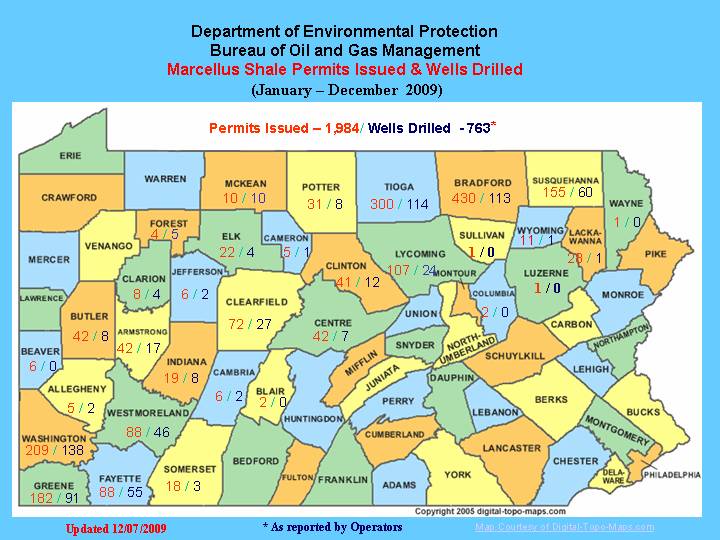
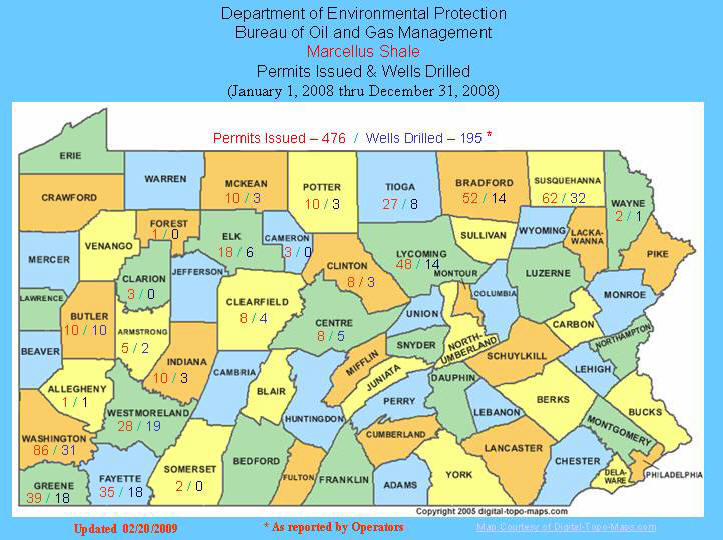
Almost all the development has been in Pennsylvania, which squats on the main chunk of the deposit. One might suppose that Pennsylvania would proceed cautiously, with 4,600 miles of its streams already contaminated by abandoned mines to the point of becoming lifeless acid seeps and having allowed the timber industry to denude the entire state a century ago. But no. The scene here resembles a wagon race of whooping, whip-flailing homesteaders. In 2008 Pennsylvania issued 476 Marcellus shale deposit drilling permits. In 2009 the figure was 1,984, and the industry expects to acquire 5,200 additional permits in 2010.

It’s not just native ecosystems that are being violated, it’s Pennsylvania’s constitution, which states: “The people have a right to clean air, pure water, and to the preservation of the natural, scenic, historic and esthetic values of the environment. Pennsylvania’s public natural resources are the common property of all the people, including generations yet to come. As trustee of these resources, the Commonwealth shall conserve and maintain them for the benefit of all the people.” What most alarms and outrages fish and wildlife advocates is that the state’s equally alarmed and outraged professional resource managers have been sidelined by big-money politics.

Pennsylvania’s wildest woods and most pristine streams are managed by the Department of Conservation and Natural Resources (DCNR). This 2.3-million-acre state forest system is among the largest publicly owned pieces of real estate east of the Mississippi River, and it is almost unique among state holdings in that it has been certified as “sustainable” by the Forest Stewardship Council. But in many places the agency can’t protect that sustainability because it doesn’t control mineral rights. In an attempt to marginally protect these areas, the DCNR had been requiring gas companies to sign surface-use agreements. But last May the companies got a state court to end even this.

If the current orgy is allowed to continue and if it becomes a model for the other Marcellus states, vast swaths of the East’s best forests will be fragmented, groundwater and surface water polluted, and fish and wildlife wiped out on a scale that would dwarf the recent tragedy seen in the gas fields of Wyoming, Colorado, and New Mexico.

For remainder of this excellent article, CLICK HERE.

DEMAND ACCOUNTABILITY!

Saturday, April 3, 2010

New report shows natural gas economic impact will be minimal

Paper counters other assessments on subject
By Tom Wilber
pressconnects.com
April 1, 2010


And now for another educated guess about what the Marcellus Shale will do to the economy: Not much.

That's from Jannette M. Barth, president of J.M. Barth & Associates, Inc., an economic research and consulting firm in Croton-on-Hudson.

In a paper released last week, Barth looked at employment and demographic information in areas where drilling has flourished in New York, Pennsylvania and western states. Unlike a study commissioned by Broome County and another at Penn State sponsored by the gas drilling industry, Barth's assessment suggested economic benefits from drilling will be underwhelming, at best. Using Pennsylvania as an example, she cited employment data that show the oil and gas extraction industry has historically produced less than 3,000 jobs a year, although it's been well established for decades. The number of Walmart employees in the state, by comparison, was 48,777.

In New York, her analysis showed income and employment data ... vastly different from two other studies. One,commissioned by Broome County and released last year, projected a $14 billion impact if 4,000 wells were drilled within the county's borders. Another 2009 Penn State study, sponsored by the industry, forecast nearly 175,000 jobs annually and more than $13 billion in added value. That study ... also warned that taxes and regulations threaten to "stunt" the industry and hurt the overall tax base.

"The studies used to support the claim that drilling will bring economic benefits to New York are either biased, dated, seriously flawed, or simply not applicable to the region that would be affected,"
said Barth, who holds master's and doctoral degrees in economics from the University of Maryland.
...
CLICK HERE for complete article.


DEMAND ACCOUNTABILITY!

Wednesday, February 17, 2010

Gas drillers find welcome mat in New York state

BINGHAMTON, New York
Wed Feb 17, 2010 3:17pm EST

Alex Knapp (L) and his father Albert Knapp of Berkshire, hold placards as they protest in favor of the drilling process of hydraulic fracturing to extract natural gas at the Capitol in Albany, New York January 25, 2010. REUTERS/Hans Pennink

Alex Knapp (L) and his father Albert Knapp of Berkshire, hold placards as they protest in favor of the drilling process of hydraulic fracturing to extract natural gas at the Capitol in Albany, NY Jan. 25, 2010. Credit: Reuters/Hans Pennink

BINGHAMTON, New York (Reuters) - New York landowners whose properties sit on the gas-rich Marcellus Shale are pushing back against calls for greater environmental regulation, saying it has halted the U.S. gas drilling boom at the New York border.

Their concerns have opened a new front in the gas drilling wars, in which environmentalists and neighbors opposed to seeing gas wells in their back yards have put a drag on the exponential growth of onshore U.S. natural gas production.

A group of landowners who stand to earn a windfall from leasing their property to companies like Chesapeake Energy gathered in the town of Binghamton recently to push back against claims that drilling could pose health hazards.

"This is a very depressed area and this is something that will turn this whole community around," said Dan Fitzsimmons, 54, a leader of the Joint Landowners Coalition, which includes 17,500 families.

"If people are educated with the facts and not with environmental scare rhetoric, I think this thing will move along very quickly," he said.

Development of the massive Marcellus Shale in several northeastern states holds the promise of providing the United States with an abundant, relatively clean domestic energy source, but environmental concerns that shale gas drilling could contaminate drinking water have created regulatory risk.

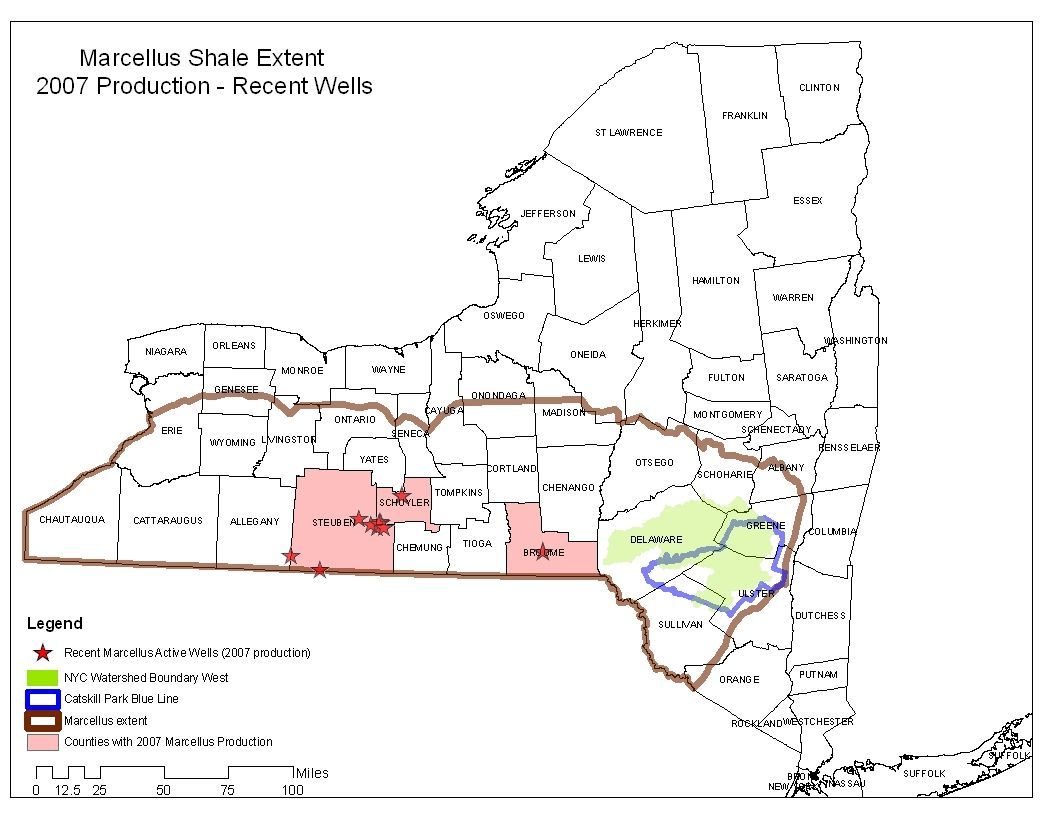
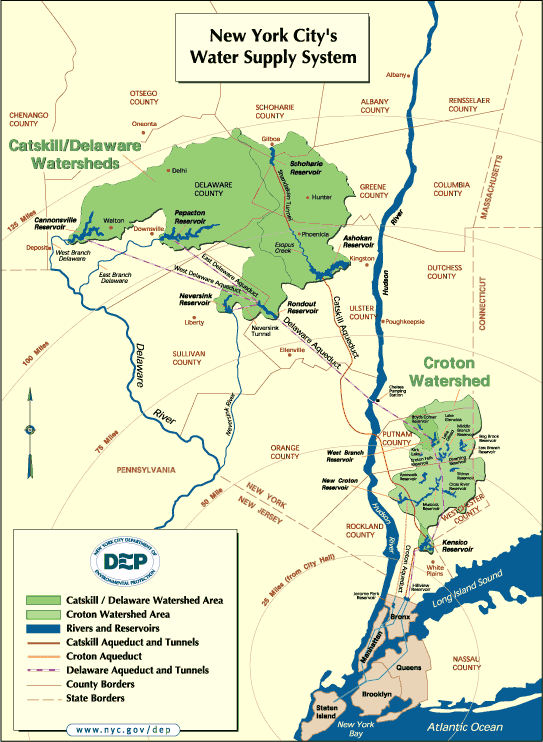
New York City, for example, has urged a ban on drilling in its upstate watershed, an unfiltered system that serves 9 million people and accounts for 6 percent of the Marcellus Shale area in New York state.

Critics point to the rural Pennsylvania town where residents recently sued Cabot Oil & Gas Corp, claiming the company's natural-gas drilling has contaminated their water wells with toxic chemicals and reduced their property values.

New York landowners see a flurry of drilling activity just over the border in Pennsylvania and wonder why it cannot happen in New York, where the state is trying to close an $8.2 billion budget deficit.

Industry sources privately express their exasperation with New York, saying they have all but given up on the state. (!!!)

...

At issue is a process known as hydraulic fracturing, in which 3.5 million gallons (13.25 million liters) per well plus sand and diluted chemicals are pumped into shale formations at high pressures, cracking the rock and freeing the gas.

"New York state, because of its great environmental laws, has a tremendous opportunity to be a national leader in how this process evolves," said James Simpson, a staff attorney at environmental group Riverkeeper.

"There's no question that hydraulic fracturing is here to stay throughout the country and New York state is positioned uniquely to do it right," he said.

NEW YORK TAKES ANOTHER LOOK

In 2008, Governor David Paterson ordered the Department of Environmental Conservation to study the impact of high-volume horizontal hydraulic fracturing, a process that enables drilling in multiple directions from a single drilling pad.

Chesapeake, the second largest producer of U.S. natural gas, has leased the mineral rights for 1 million acres in New York state. The Oklahoma-based energy company says the process is already heavily regulated and there has never been a documented case of ground water contamination because of hydraulic fracturing.

"There has been a lot of non-factual information shared with the public," David Spigelmyer, Chesapeake Energy's vice president for government relations, told Reuters.

The company has fought new federal regulation including the proposed Frac Act, which would give the U.S. Environmental Protection Agency more oversight over natural gas drilling.

"We believe the states are much more ideally positioned to ... regulate this industry," Spigelmyer said.

Environmentalists -- including many that tout natural gas as a cleaner alternative to other oil and coal -- say the industry has been unwilling to meet them half way.

"As long as the natural gas industry continues to insist that these concerns, these environmental, economic, public health, landowner concerns, are not real... the more powerful this movement will grow," said Albert Appleton, who headed the New York City Department of Environmental Protection in the 1990s.

Earlier this month, the Onondaga County legislature -- which includes the city of Syracuse -- voted to ban hydraulic fracturing on county-owned land until impacts are studied.

Attitudes are different in Binghamton, a city of less than 50,000 people, where advocates of drilling point to boarded-up store fronts on Main Street.

"We stand on the edge of something here, when done correctly, that can change our area," said Bryant La Tourette, 47, a landowner who heads the Oxford Land Group. "I don't see right now any other business that can come here and make this much of an economic impact."

(Additional reporting by Jon Hurdle; Editing by Daniel Trotta)

LINK

Editorial comment by Splashdown in red.

DEMAND ACCOUNTABILITY!

Sunday, February 14, 2010

Northeastern Pennsylvania's Resources Exploited Once Again

timesleader.com
Sat., February 13, 2010
Local Commentary

NORTHEASTERN Pennsylvania once contained three-quarters of the Earth’s anthracite coal deposits and, at the turn of the 19th century, provided the United States with the fuel it needed for consumer heating and industrial production.

But the hard coal industry also violated a once beautiful region rich in evergreens and oaks, leaving black refuse piles. It polluted springs and creeks, leaving acidic waste and the stench of sulfur. Underground fires, cave-ins and mine subsidence haunted many local towns for generations.

Today, the region’s natural resources again are being exploited for financial profit. Companies contend that deposits trapped miles below the Earth’s surface hold enough natural gas to supply the entire United States for 15 years. Although these companies insist there is little risk to the environment, there is serious cause for concern.

The Marcellus shale is a low-density, carbon bedrock that lies a mile or more beneath the surface in Pennsylvania, New York, West Virginia and Ohio. The shale contains an enormous volume of potentially recoverable gas, which has great economic significance for the United States at a time when we are seeking alternative fuel sources.

Gas is extracted from the Marcellus shale through a process called “hydraulic fracturing,” or “fracking,” in which up to 4 million gallons of water mixed with sand and chemicals is pumped into the shale at high pressure. The drilling not only breaks apart the shale to release the gas, but also discharges hazardous substances.

Gas companies claim that there is little risk, insisting that fracking is used safely in most oil and gas drilling operations. But last September, the Pennsylvania Department of Environmental Protection (DEP) reported that an estimated 8,000 gallons of fracking fluid spilled into a creek near Dimock, Susquehanna County. The spill was blamed on “faulty pipe work” and resulted in a significant fish kill.

Two months later, on Nov. 20, Reuters News Service reported that several of Dimock’s residents sued Cabot Oil & Gas Corp., claiming its natural gas drilling had contaminated their water wells with toxic chemicals, caused gastrointestinal sickness and reduced their property values. The lawsuit accuses Cabot of negligence and says it has failed to restore residential water supplies disrupted by gas drilling.

Dimock is not an isolated case. Hydraulic fracturing is the suspected source of impaired or polluted drinking water reported by residents who had gas drilling near their homes in southwest Pennsylvania and West Virginia.

Despite the apparent risk, the state DEP continues to issue hundreds of Marcellus drilling permits and the current state budget requires the Department of Conservation and Natural Resources to raise $60 million by leasing up to 10,000 more acres of public forestland to drillers within the year.

Gas companies are offering more than $1,000 per acre to some residents whose property overlays the Marcellus shale in order to continue the drilling. And they are protected legally for any liability.

In 2005, Congress, at the urging of then Vice President Dick Cheney, passed the “Halliburton loophole” to the Safe Drinking Water Act. The measure prevents the U.S. Environmental Protection Agency from regulating the fracking process. Halliburton, which was previously headed by Cheney, reportedly earns $1.5 billion a year from its energy operations, which rely substantially on the hydraulic fracturing business.

Pennsylvania cannot allow financial profits to take precedent over environmental stewardship. Harrisburg can begin immediately by calling for a moratorium on gas drilling in the Marcellus shale until a detailed scientific study is completed on the fracking process.

In the meantime, we should demand that our state representatives establish legislation that creates buffer zones for drilling near water supplies, requires gas companies to disclose the chemicals used in the fracking process and establishes strict guidelines for those companies to clean up the hazards created by their drilling.

LINK

DEMAND ACCOUNTABILITY!

Friday, January 29, 2010

Don't Frack with New York! Governor Patterson Poisons the Well to Balance the Budget

Alison Rose Levy
The Huffington Post
January 28, 2010

Former New York State Governor Eliot Spitzer may have had his sexual peccadilloes but he knew how to stand up to corporate interests that threatened the public good. It was a big boost for oil companies, planning to despoil New York State, when the powerhouse Spitzer was replaced by his easily rolled-over successor.

While belt-tightening throughout the state budget, Governor Patterson added $3 million to fast track harmful gas drilling practices--a quick fix economic solution with tragic long-range health, economic, and environmental consequences.

On Monday, a statewide coalition of New York state residents, businesses, and environmental groups rallied in the state capital of Albany to ask legislators to oppose Patterson's plans to contaminate state-wide water supplies (including New York City's) by permitting a damaging form of gas drilling, known as "fracking," or hydraulic fracturing.

Thanks to lobbying by Halliburton and other energy companies, under the Bush-Cheney administration, fracking got exempted from the Clean Water Act even though it releases large quantities of undisclosed carcinogens and toxic chemicals into the earth and water supply.

According to a recent study, conducted by the Environmental Working Group (EWG), just one drilling site deploys harmful chemicals sufficient "to contaminate more than 100 billion gallons of drinking water to unsafe levels ... more than 10 times as much water as the entire state of New York uses in a single day."

The chemicals used in fracking "pose a serious threat to the nation's water supplies, but those risks have been largely ignored," says the report. "Drinking water contamination and property damage have been linked to hydraulic fracturing in four states--Colorado, Ohio, Pennsylvania and Wyoming. In one incident that polluted a Colorado creek, the drilling company is still trying to clean it up--four years later."

Nor does the drilling create local jobs or business. Instead, companies bus in workers from Texas, housing them in "man camps," sites where reportedly alcohol and drug abuse, and sexual predation abound. While no one wants a "man camp" next door, a gas well also ruins the neighborhood. If one owner sells property for drilling, all neighboring land can be conscripted for leasing, with no rights of refusal. Fracking also releases chemicals into the air; an army of trucks must carry over roads and New York State highways up to four million gallons of contaminated water (per well)-- which amps up air pollution and costly highway repairs. There is currently no way to effectively decontaminate the high quantities of waste water produced by fracking.

"We can't let the gleam of potential profits leave us with a legacy of polluted water and industrialized landscapes," said Wes Gillingham, program director of Catskill Mountainkeeper.

Last month, New York City's Department of Environmental Protection issued a report urging a halt to gas drilling since, "Natural gas drilling and exploration are incompatible with the operation of New York City's unfiltered water supply system and pose unacceptable risks for more than nine million New Yorkers in the City and State." They noted that drilling entails "invasive industrialization and creates a substantial risk of chemical contamination, and infrastructure damage."

This week, Mayor Bloomberg chimed in, "The consequences are so severe that it is not a risk that I think we should run. I do not think that we should allow fractured drilling anywhere near our water supply."

Although land can be fenced in, water can't be. It flows underground, it rises into clouds, it's borne by the winds, and released by the rains, far from its source.

While the Mayor nobly aims to protect the immediate area surrounding the city's upstate water reservoir, so far no studies have investigated how far water-born contaminants from throughout the state could flow downstream to impact NYC, or it's water supply. Fracking originated in arid western regions, and its proponents don't know the extent of pollution possible in a region of interconnected rivers and frequent rains like New York and New England.

In New York State, gas drillers hope to use fracking in the regions of the New York City Watershed, the Delaware River, the Finger Lakes, and upstate watersheds, the source of waters that flow downstate to New York, Pennsylvania, New Jersey, and Delaware.

With fresh water resources becoming scarcer worldwide due to population growth and climate change, it's unconscionable for a short-term Governor to short-sell a precious resource to balance his budget. Perhaps the soon to declare gubernatorial candidate, Andrew Cuomo, will like his popular father, Governor Mario Cuomo, become a successful champion.

To take action, sign up with the Environmental Advocates NY Citizens for Safe Energy http://www.catskillcitizens.org/ The Environmental Working Group proposes a national ban or better regulation. Or join No Fracking Way on Facebook. Or cut to the chase, and ask soon to declare candidate, Andrew Cuomo to make New York State a model for future-oriented policies, rather than a disastrous object lesson in the costs of short-sighted gain.

DEMAND ACCOUNTABILITY!

Sunday, January 3, 2010

The rush is on

Bradford County leads state in Marcellus Shale drilling permits in 2009
by Steve Reilly, Staff Writer
Morning Times
Saturday, January 2, 2010

The natural gas rig looming over a hundred feet over the Eileen property in Smithfield Township is one of 92 drilled in Bradford County in 2009 — over six times the number drilled in 2008.

Like many Bradford County rigs, the massive structure has become somewhat of a roadside attraction for curious passers-by.

But if current trends continue, it could be only a matter of time before such rigs jutting out from the rural landscape become less a novelty and more a part of the county’s everyday scenery.

If Pennsylvania was the primary target for gas exploration in the Marcellus Shale in 2009, Bradford County was its bulls-eye.

At the end of 2008, there were a total of 63 permits to drill wells into the Marcellus Shale in Bradford County, 17 of which had actually been drilled.

In 2009, according to statistics released on Nov. 30, there were a total of 383 Marcellus Shale drilling permits granted in Bradford County — more than any in other county in Pennsylvania.

With over 300 permitted wells yet to be drilled in the county, and with the torrid pace at which permits are granted showing no signs of stopping, all indications point to 2010 as a year in which the natural gas industry could forever transform the landscape of Bradford County.

The rush to drill in 2009

Until 2008, few had heard of the Marcellus Shale, a rock formation buried 5,000 feet deep stretching across 95,000 acres of a four-state region from New York to West Virginia. But two events in the last decade combined to unleash the hidden potential of the shale bed and make “the Marcellus” a household name.

In 2005, natural gas companies began exploiting the Barnett Shale in the Fort Worth, Texas area using a combination of hydraulic fracturing, or “hydrofracking,” and newly-pioneered horizontal drilling techniques to extract natural gas from the shale. The tremendously profitable gas extraction operations in Texas led to a hunt for similar formations across the country, and eventually to the establishment of relatively smaller natural gas economies in Arkansas’ Fayetteville Shale and Louisiana’s Haynesville Shale.


Then, in January 2008, Penn State geosciences professor Terry Engelder and SUNY-Fredonia geology professor Gary Lash released a study that estimated the size of the Marcellus Shale at 168 trillion to 516 trillion cubic feet — 80 to 250 times the previous U.S. Geological Survey estimate. In terms of geographic area, the Marcellus Shale is estimated to be 19 times larger than the Barnett Shale.

Both of these factors — the development of new drilling technology and new geological insights into the size of the Marcellus Shale — combined to set the stage for an exploratory phase that saw a cadre of multinational gas companies to flock to the area in 2008. That year, the Pennsylvania Department of Environmental Protection (DEP) granted permits to various gas companies to drill in the Marcellus Shale at 476 sites across the state, the majority in later half of 2008.

But in 2009, activity took off in earnest. DEP granted 1,742 Marcellus Shale drilling permits state-wide as of Nov. 30, with promises of even more in the pipeline for 2010.

DEP press secretary Teresa Candori stated that although there will continue to be many permits in 2010, she doesn’t necessarily expect the number of permits the agency grants to triple again next year.

...

Candori stated that DEP recently hired 37 new staff members specifically to handle the growing Marcellus Shale workload at the agency. Their salaries, she said, will be drawn directly from a recent hike in permitting fees.

Economic impact

...

“It’s pretty amazing, statewide,” said Mark Scheuerman, chief general counsel and media relations manager for Fortuna Energy. “I think the numbers that the Marcellus Shale Coalition, through their economic development analysis they did through Penn State, account for about 26,000 new jobs in Pennsylvania since about a year ago, all attributed to Marcellus development, (and) we think that will continue.”

“(In) areas like the Barnett Shale in Texas, in the Fort Worth area, in about three to five years there were almost 100,000 new full-time jobs associated with Barnett Shale exploration and the production. That’s a formation that is about 5,000 square miles. The Marcellus — and, of course, it covers a four-state area — is about 95,000 square miles. And Pennsylvania has the biggest chunk of it. So if you can extrapolate from those numbers, it gives you kind of breathtaking forecast of what the economic impact will be from a jobs standpoint,” Scheuerman added.

...

Brian Driscoll, countywide economic development manager of the Central Bradford Progress Authority stated that the economic impact has been noticeable, but difficult to quantify “just because it’s so tough to track that with so many different companies involved, and there are subcontractors involved, and all different dynamics.”

“It’s no secret to anybody there’s a lot of activity more going on,” he said. “There are some employment impacts. A lot of the employment seems to be going to folks from outside of the area. But that has created a tremendous demand for hotel space as well as residential rental units, like apartment-type dwellings. So there’s been a real increase in demand for housing, both temporary and longer-term.”

“You (also) see a lot of activity at restaurants and service-related activity,” Driscoll added. “So I think the spectrum’s pretty wide-ranging.”

But, according to Driscoll, the idea of gas industry profits falling into county resident’s hands hasn’t quite come to fruition yet.

“What we don’t see at this point is a lot of revenue coming directly into residents’ hands through royalty payments or anything like that, because the process isn’t quite far enough along. A lot of folks have gotten lease payments, but aren’t in the royalty cycle yet,” he explained.

Driscoll also pointed to the secondary aspects economy that are indirectly benefiting from the increase in population and the growing numbers of transient workers.

“I know that there are existing businesses in the Valley and elsewhere in the county that you might not think would be totally related (that are benefiting). I know hardware stores have been selling components to these folks. We know of a company that sells cleaning supplies that has been inundated with requests for their materials, just based on additional people in residential units. Flower shops (are benefiting because) guys from Texas are sending flowers back home to their wives. Stuff like that that you just wouldn’t think of has become impacted as well,” Driscoll said.

However, the expected increase in population will probably cause some speed bumps that must be dealt with along the way, according to Bradford County Commissioner Mark Smith.

“The increase in the population and the increase in human services is going to have an impact. Our correctional facility and services such as children and youth, and drug and alcohol services, and the school systems — the issues and problems that arise naturally from having more people in the county will have to be dealt with as the changes develop," Smith stated.

Another issue prominent in the minds of local officials is the prospect of a state-mandated severance tax on oil and gas revenue in Pennsylvania that would send portions of the gas companies back to the state’s general fund.

Many local officials, such as Bradford County Commissioner Doug McLinko and state Rep. Tina Pickett, have been vocal in their opposition to the proposed severance tax on the grounds that it would take tax revenue away from municipalities where most of the drilling is occurring and send it back to the state government.

Pickett stated that a better way to raise revenue from Marcellus Shale activity would be to lease selected portions of state property to gas companies.

Splashdown: Maybe she'll explain that...

Proponents of the tax argue that 14 of the other top 15 gas-producing states in the country have such a tax.

Natural gas and the Valley: ‘A very busy year’

As the natural gas industry takes its foothold across the county, it seems to have skipped over the Valley in terms of permits granted and rigs constructed. But the central location and developed nature of the Valley have made it a prime target of gas companies during the past year in their search for a place to locating their infrastructure.

Tunkhannock-based Somerset Regional Water Solutions’ proposed water treatment facility on Mile Line Road, voted down by the Athens Township Board of Supervisors in November due to it’s failure to correct a number of deficiencies in the original plans, was one example of a failed venture this year. Documents attached to the proposal for the treatment plant indicated that incoming wastewater would potentially be radioactive, and that excess water would be dumped into the Chemung River.

Two successes for the gas industry, however, were achieved in the Tannery Curve area of Athens Township. There, a 50-truck parking lot and a water withdrawal site were approved and are now currently being developed to feed Chesapeake Energy’s drilling operations throughout the county, taking advantage of the site’s proximity to Route 220.

Two other projects — a 60-person temporary housing quarters, or “man camp” on Round Top Road, and an East Athens water withdrawal facility — were nixed by gas companies themselves in the middle of the approval process. Reports indicate that another site for the “man camp” is being sought by Nomac, Chesapeake Energy’s drilling subsidiary.

...

Looking ahead: ‘It depends on the rocks’

Although forecasts indicate that 2010 will be a pivotal year, and many in the area are counting on the quick growth of the fledgling industry, the pace at which the industry develops is dependent on one thing that is out of anyone’s control: nature itself.

...

“From our perspective, about a year ago we had zero production in the Marcellus. Now we’re at about 30 wells and we’re producing just at about 70 million (cubic feet) out of our Marcellus wells in Northern Pennsylvania. It’s been quite a satisfying accomplishment and we’re looking to expand on that in 2010,” [Fortuna's] Scheuerman said.

“But there’s always a lot of factors that go into exactly where you conduct operations — whether it’s exploration or development — and then production is always a question of mother nature,” he added.

“It depends on the rocks, as they say.”

For complete article, CLICK HERE.

DEMAND ACCOUNTABILITY!

Thursday, November 26, 2009

Pennsylvania towns often find themselves powerless against gas company practices

By Rona Kobell
Alliance for the Chesapeake Bay
Bay Journal
December 2009


There's a reason they call these the Endless Mountains.

Undulating hills of yellow and crimson rise gracefully before disappearing into a blanket of gauze-like fog. For miles, no other cars share the two-lane roads that snake through this tranquil pocket of northeast Pennsylvania.

People visit here for the hiking and the bicycling and the skiing and the leaf peeping; they stay for the quiet.

But natural gas drilling is quickly transforming these rural hamlets into industrial zones. Towns and counties that are sitting atop the gas-rich Marcellus Shale know that the gas companies are coming, and they are trying to prepare. But because of industry practices and current regulations, they may be powerless to control their destinies.

Gas companies play their cards close to their vests. They do not announce they may drill 40 wells; they drill one first and see how it produces. Usually, they approach a private landowner, who does not need permission from his or her municipality to lease. That's how Dimock, a rural hamlet in northeast Pennsylvania, went from one well in 2006 to more than 60 by the end of 2009. That's why visitors who meander down its barely one-lane roads will see the classic tableau of red barn, silver silo and lazing cows - but behind it is often a gas well lit up like a space shuttle.

"There's only so much that they can plan, because when these gas companies decide to come in, it happens rather quickly," said Jerry S. Walls, who was director of the Lycoming County Planning Commission for 37 years.

Many Pennsylvania towns have no zoning ordinances, complicating matters. But even those that do will not necessarily be able to enforce them on drillers. Under the Pennsylvania Gas Act of 1984, state regulations trump local ordinances.

The Pennsylvania Department of Environmental Protection regulates gas drilling. It approves most permits and relies on the industry to self-report problems, while conducting spot checks for compliance.

"We've got no oversight at the federal level, none at the local level, and the state is in a shambles," said Jim Weaver, the lone planner in Tioga County, a prime location for drilling. "For all intents and purposes, the state legislature has handed the gas industry the Marcellus play to do with whatever they please."

Weaver called the situation "short-sighted and less than strategic" and said he hoped some planning would occur at the state level.

This year, two court cases in Western Pennsylvania clarified the powers of local authorities over drilling. In Oakmont, the state Supreme Court ruled that gas companies could not drill a well where zoning laws forbade it. But in Salem, the court ruled the local laws had no say over where gas companies put infrastructure, such as pipelines, which come under the DEP's permitting process.

Bradford County Planning Director Ray Stolinas has been following the cases, trying to figure out how to apply them in his county. Recently, the county decided not to review plans to build a compressor station on the advice of their attorney.

"The message of these court cases is that you can regulate, to some extent, where, but you can't regulate how," Stolinas said. "I do feel unprepared. We're learning every day as we go along."

While Stolinas worries about stormwater and big trucks on the county's gravel roads, town officials are enjoying the boon. In Towanda, Bradford's county seat, restaurants are full and new businesses are opening.

"I think it's going to be a good thing for the town," said Towanda Mayor Richard Snell.

Sixty miles south, many gas companies have set up offices in Williamsport, breathing life into once-vacant downtown buildings. The renovated Holiday Inn offers world-class food with prices to match: a room, if one is even available, costs at least $145.

"It's like a convention that really hasn't left yet," said Jason Fink, vice president of economic development for the Williamsport/Lycoming County Chamber of Commerce.

Some residents say money is already changing the character of these towns. Linda Nealon, a Wyoming County preschool teacher, does not plan to lease her land. But, with landowners in her county commanding nearly $6,000 an acre and 20 percent royalties, she says, she's in the minority. And because she's aired concerns in public about drilling, she feels hostility from neighbors.

"I always felt very connected to my community. Now I feel very disconnected," she said. "It breaks my heart."

But residents and municipalities in the Marcellus Shale region don't have to throw up their hands, according to Walls, the professional planner. The gas companies will be in the state for a long time, and there is room to negotiate. He suggests local officials meet early with the companies and point out ecologically important areas and other places inappropriate for drilling. He also says local officials should update their land ordinances, talk to officials where drilling is already in full swing for advice, and get zoning if they don't already have it.

Lynn Senick, a Montrose activist who has organized an online forum to discuss drilling risks, is hoping the government can somehow slow down the process.

"It's such a travesty to take these pristine areas and ruin them," she said, "because once you start, you're never going to get them back."

NOTE: This comment posted elsewhere by Damascus Citizens for Sustainability:

In February of this year the PA Supreme Court has ruled in the two consolidated Pennsylvania state court appeals (Huntley v. Borough council of Oakmont and Range et al. vs. Salem Township) that local laws can’t conflict with the state regulations for oil and gas drilling, and so local regulations that govern the same features – defined in the opinion as “pertain[ing] to technical aspects of well functions and matters ancillary thereto (such as registration, bonding, and well site restoration)” – as the state Oil and Gas Act are preempted. However, importantly, the Court also ruled that local officials CAN use zoning to determine where drilling can happen within a municipality, as local zoning “serves different purposes from those enumerated in the Oil and Gas Act”.

Continue reading "Marcellus Shale: Pipe Dreams in Pennsylvania?"

and see the oil and gas timeline "Drilling for Resources" also in the December Bay Journal.

DEMAND ACCOUNTABILITY!

Sunday, October 25, 2009

Gas production making an impact on Bradford County

An owner of Beck Oilfield Supply traveled from Oklahoma to Pennsylvania this year to find the best place in the midst of the Marcellus Shale natural gas drilling rush to plant one of his stores.

He picked Wysox, and he wasn't alone. Two other stores that specialize in drilling and gas production supplies have opened within two miles of Beck Supply along Route 6 in the last year.

The supply shops are more than specialty hardware stores; they are tailored to the uninterrupted pace and idiosyncratic needs of gas drilling. Beck Supply's staff - four men from Oklahoma and four locals - are on call at all hours of every day to get equipment to well and pipeline work sites.

"If their guys want food, we go grocery shopping," manager J.R. Jordan said.

Although more than half of Pennsylvania lies above the gas-bearing Marcellus Shale, Bradford County has emerged as a focal point for gas production. Nearly 300 Marcellus Shale drilling permits have been issued in Bradford this year, far more than any other county in the state, and 23 new wells have been drilled.

The work that is marking the hills and farms in Bradford County also is leaving its imprint on the towns and people nestled nearby. In small and rural hamlets that had fallen into the slow routine of decline, the drilling is bringing traffic to streets, customers to restaurants and an urgency to everyday business.

"Things have changed," Bradford County Commissioner Doug McLinko said. "There's storefronts filling back up again, there's vacant lots filling back up again. The independent, family-owned businesses are being saved.

"The impact it's having for real people is pretty incredible."

...

An industry-financed study released by Penn State University in August projects that Marcellus Shale drilling will create a total economic output of $3.8 billion in the state this year and $13.5 billion in 2020 - an estimate critics say is inflated and not in line with economic multipliers seen in other gas-producing states.

In Bradford County, it is rare to find a new millionaire, but common to hear how the region's newest industry is keeping the towns from dying.

...

"It takes a lot for the little towns to survive now," [said Bob Morgan, Calkins Motors salesman.] Residents travel to Elmira, Williamsport and Mansfield for work, he said - towns between 15 and 50 miles away.

But gas drilling is beginning to change things. Calkins saw a boost in business after the initial round of gas leasing, when people used their signing bonuses from the gas companies to buy new cars. Tom Calkins IV, an owner of the 61-year-old dealership, did notary work on the side for Fortuna Energy, the dominant gas company in town. And for about six months, the dealership serviced the fleet of Dodge trucks driven by Precision Pipeline workers that are building Fortuna's gas pipelines.

The most visible sign of the boom is the caravan of water and gravel trucks that travel Troy's roads each day.

...

James Barber, the owner of his eponymous transportation and excavating company, said gas drilling has given him "a pile of work" at a time when the stone business he has been in for 20 years has suffered.

The Clifford-based company hauls water and prepares well sites for Chesapeake Energy in Bradford and Susquehanna counties.

"Without them, I'd have 10 to 12 men sitting at home without a job," he said during a cell phone call from a well pad.

The gas industry has also spurred local entrepreneurs to begin new businesses.

A few blocks from the car dealership, in Troy's town square, Emily Eaton opened Country Clean Laundry Service in April. The expansive store doubles as an after-school hangout for neighborhood kids and there is a cage of free kittens at the front. In the back, Eaton washes, dries and irons work shirts and jeans she picks up from job trailers at drilling sites as far away as Wyalusing.

She got the idea for the business from her husband, who was always looking for laundry services in the towns where he traveled for construction work. She started in her home with one washer and one dryer, then opened the store with six machines and now plans to add three more.

"Even the guys that have campers, they've got washers and dryers that are teeny tiny and they can't handle the jeans and the big heavy Carhart shirts that they wear," she said.

The biggest challenge, after the financial hurdle of making a new business profitable, is getting out the stains. "I get all kinds," she said as she pressed the sleeves of a checked Oxford on an ironing board. "The drilling mud from under the coveralls, the concrete."

Outside the former Ames department store on Main Street south of Towanda there are dozens of white pick-up trucks in the parking lot and a well-used boot brush bolted by the front door.

Chesapeake Energy opened a field office in the abandoned store in November 2008. The Oklahoma-based gas exploration company is in the midst of expanding its rented space in the plaza for the third time in a year.

...

Chesapeake's footprint in Bradford County is substantial: it has permits to drill in a third of the county's 51 municipalities. A subsidiary, Nomac Drilling LLC, is renovating a former nursing home in Athens Twp. into a dormitory-style residence for 180 workers. In the last two years, the company has paid more than $700 million to landowners in leases and royalties. And it has made over $70 million in payments to Pennsylvania contractors this year.

The surge of money brought by the gas industry is prompting even long-established businesses to adapt.

The Comfort Inn in Wysox, its sister hotel, the Riverstone Inn, its restaurant, and 13 rental houses and apartments are all busy with gas clients, while the local staff is learning to deal with the odd hours and frequent comings-and-goings of the drilling rigs and their workers. Drilling crews generally work 12-hour shifts for two weeks followed by two weeks off.

"There's peaks and valleys," Comfort Inn operations manager Gregg Murrelle said. "There's times they bail out of here, because they're in and out. They might keep their room, they might not."

In the middle of March, the inns catered a white tablecloth dinner complete with bow tie-clad waiters at a remote well site, an event Murrelle admitted was surreal.

He said gas operations workers have kept his business steady despite a dip in corporate clientele during the recession. The gas workers' extended stays helped convince him to go forward with expansion plans - 20 to 25 rooms and a small lounge - even as the corporate travelers that inspired the renovation booked fewer and fewer rooms.

"Especially with the doldrums of the economic times, we've been fortunate," he said. "This whole area has benefited from the influx of natural gas."

There are clearly no vacancies at the Towanda Motel, north of the center of town. It says so on a sign along the road and again on a sheet of paper taped to the office door.

Since April, Chesapeake has booked all 47 rooms for their workers and the company's reservation will continue until at least the end of March.

Workers in camouflage and cargo jeans sit outside the rooms on their off hours, down from the open door of a security guard who has set up a 24-hour post in the room closest to the office, courtesy of Chesapeake. The parking lot has a disproportionate number of pick-up trucks, including an orange one with a Texas license plate and a custom decal that reads, "Every rig needs a roughneck."

Manager Jaimi Patel said the workers are generally good tenants - although some leave the rooms dirtier than others - and having a booked motel means not having to wait at the front desk through the slow winter months for reservations.

Of the four years since her family started running the place, this has been the busiest, she said.

"In this county, everyone is doing well right now."

During the lunch rush at Harkness Family Restaurant, three miles down Main Street from the motel, regulars at the lunch counter and workers bussed in from the rigs were making waitress Christy Bartholomew run.

"It's been booming," she said.

The restaurant serves three meals a day to workers who ride vans in from the well pads as part of an arrangement with the gas companies. Fliers on the bulletin board just inside the door target the new regulars: one, for a house cleaning service, is labeled "Attn: gas lease people"; another advertises a rental home for a small family "or two workers."

Bartholomew said it has been a year since she noticed a big difference in the number of customers from the gas companies, but she hopes they don't bring too much change. For one thing, they don't tip as well as the locals, she said. And the hometown regulars are still the restaurant's priority.

"We just want to make sure that while these guys are here doing their thing, our locals are taken care of," she said. "Because in the end, they're the ones that will still be here."

The prevalence of good news from the beginning of the boom in the county has left its naturally pragmatic residents - the dairy farmers that have cut the size of their herds and the restaurants that specialize in home-style cooking - a little pensive about the future. It may have been demoralizing to watch the towns stagnate, but no one knows quite what a Pennsylvania gas metropolis might look like either.

On the morning after Fortuna agreed to a landmark lease deal for $5,500 an acre and 20 percent royalties with the owners of 35,000 acres in Bradford, Susquehanna and Broome County, N.Y., posters on the online forum Pagaslease.com, most of whom had a stake in the deal, wondered how the region will change with full-blown development of what one called the "gasicane."

"If you liked things as they've always been around here, you're not gonna be real happy five years out," one poster identified as guardian wrote. "And forget it ten years out."

The new industry is also, at times, struggling to adapt to Pennsylvania.

On Tuesday, the Department of Environmental Protection fined the 2-year-old Towanda branch of Dunn's Tank Service Inc. for illegally storing drilling wastewater in tanker trailers before it could transport it to a treatment plant.

Todd Dunn, owner of Dunn's Tank Service, told The Daily Review his company did not know the storage of the wastewater required a permit.

"We're from Oklahoma," he said. "It was ignorance on our part on not knowing the law."

McLinko, who is decidedly bullish on drilling, said he expects to see problems "between the haves and the have-nots" in the county and, perhaps more noticeably, increased heavy traffic and what he called "idle-time issues" among the workers.

"Do I think that our jails are going to fill up here? No," he said. "Do I think that our police are going to have a hard time monitoring some of the social things that happen at night, such as at some of the taverns? Yes. I think our guys are going to have their hands full."

But, he added, "I'm not pessimistic on it."

"We don't even know what the problems are going to be yet," he said. "Maybe we won't even have problems."

For the complete article, CLICK HERE.


DEMAND ACCOUNTABILITY!
Saturday, October 17, 2009

Marcellus Shale Will Impact Pa.’s Rural Landscape

Charlene M. Shupp Espenshade
Special Sections Editor
Lancaster Farming
October 16, 2009

Editorial comments in red by Splashdown.

STATE COLLEGE, Pa. — For generations, Pennsylvania has been known for its coal, which heated homes and fired steel furnaces for more than a century.

However, in the past few years, a new vernacular has crept into the dialog for landowners in northeastern and western Pennsylvania: “Marcellus shale”. With the advent of technology to harvest natural gas from this mineral deposit, Pennsylvania is once again on the verge of tapping an abundant energy resource.

... Tim Kelsey, a Penn State economist, said based on current estimates, the average yield on a gas well will have a value of about $2.25 million. Given current technology and restrictions, the average landowner will have two wells.

“Marcellus can fundamentally transform Pennsylvania communities,” he said.

...

Kelsey and Tom Murphy, an extension educator, said for these rural communities, the flow of cash will be significant.

...

Murphy said Pennsylvania is a part of the second largest shale play. The Northeast and Mid-Atlantic region is also the largest consumer of natural gas. The proximity of supply to demand has brought forward the interest of gas companies to contract available sites.

“There is a lot in the economics that is moving this process along in Pennsylvania. We are looking at 100 year supply of natural gas,” said Murphy. “It’s a really big deal and we need to be thinking about this. We are talking about decades to do the production work.”

One company looking for potential lease opportunities in Bradford, Susquehanna, Sullivan and Wyoming Counties said that more than 83 percent of the available land is under contract.

Looking at Texas and the changes that Barnett shale brought to that region, the panel sees this impacting agriculture as well. According to Murphy, one researcher said, “millionaires don’t milk cows.”

The prediction they see is a change in the type of agriculture. Looking forward, communities will have to look at how to adapt for both the change in farms and its impact on the agriculture infrastructure.

Considering the toxicity associated with drilling, the almost inevitable potential for air, land and water pollution and contamination and the potential for these deadly toxins to enter the food chain, ignoring mounting evidence is like crossing fingers to deal with a time bomb.

CLICK HERE to read the Bluedaze report about how the poisonous air in DISH, TX has already killed livestock and trees, and how "some of the chemicals travel for miles ending up in our soil and water." Pennsylvania farmers need to be concerned. They need to bring these concerns to regulatory authorites who can protect farmers' investments in the land.

Ross Pifer, director of the Ag Law Center at Dickenson School of Law, said the learning curve for landowners is significant. ... [He] stressed that landowners need to seek legal advice before signing a contract to make sure their interests are protected.

The panel also noted working with landowners to address the multi-generational impact of the leases. With an impact extending more than a century, decisions made today will impact the family for two to three generations.

Since the start of drilling wells, the one limiting factor is water and what to do with the waste water that results from the fracturing of the shale to capture the gas.

Bryan Swistock, a Penn State extension associate, said state laws overseeing drilling were crafted in the 1980s and leave to question if the regulations address the current landscape. The other challenge he noted is Pennsylvania does not regulate its private wells. He said that landowners need to understand which party is responsible for the different aspects of monitoring the water supply, which is divided between the gas company and the landowner.

The panel also touched upon the legal battles being resolved in the court system. Most are tied to the early contracts signed for gas leases, which were signed at the fraction of the value of contracts signed more recently. Piffer said the issue has been heard by the state supreme court.

“It’s important for all of us, (to see the bigger picture) and understand the scale and scope of what is happening,” said Murphy. Several of the major gas companies have sold assets in other areas to position themselves to invest in Pennsylvania.

Massive change is barking at our heels and running out in front of us. Clearly we are NOT prepared. We need to dance faster and smarter. Industry has demonstrated again and again and again that it is single minded, and that it is NOT going to consider anything but making the biggest, fastest profit. Making sure they do that in a way that is mindful of individual, public and environmental health and safety and protecting our quality of life and vital lifeline resources, is OUR job.

We need to speak out, press our elected officials for legislation and regulation. We need to:

DEMAND ACCOUNTABILITY!

Tuesday, September 15, 2009

Blossburg council votes to change zoning for ‘fracking’ water plant

What's wrong with this picture?

By CHERYL R. CLARKE
SUNGAZETTE.COM
SEPT. 15, 2009
(EDITORIAL COMMENTS By SPLASHDOWN! in red)

BLOSSBURG - Borough council voted 4-1 with one abstention to change the zoning classification on a 10-acre parcel of land on the site adjacent to and behind the Kwik Fill gas station from commercial to heavy industrial so a fracking water treatment facility can possibly be constructed there.

According to Taylor, the plant would remove "suspended solids" from the water used by the natural gas industry to "fracture" the Marcellus Shale natural gas "fairway" currently being developed in Tioga County.

The plant would then sell the water back to the gas companies for re-use.

...

Before taking the vote, council heard from several people at the meeting Monday night, many of whom voiced their opposition to the change, fearful of noise and disruption from increased truck traffic.

There also were unanswered questions about the chemicals used by the natural gas industry in its drilling operations for the natural gas trapped in the Marcellus Shale play.

(Now how come that is??? Is it because they're unanswerable, cause the industry is refusing to provide this information... and for instance, protecting it, even when 'the chemicals' raise serious health and safety issues, such as when they apparently killed 17 peacefully grazing cows in a Louisiana field? Read the latest about it HERE.)

Borough resident Jeri Deming asked council how much research it had done in the month since it tabled a decision on the change at its August meeting.

"The problem isn't with the water plant, it's with the drilling," she pointed out.

[Council president] Ogden told her and others that if they were concerned about the chemicals used in the drilling process they need to address the Department of Environmental Protection.

"Beyond making the zoning change we have no control over anything," he said.

Isn't this a bit like saying "Beyond making all traffic lights permanently green lights, we have no contol over anything (i.e., any accidents) that might happen." ???

As for the noise and dirt from increased truck traffic coming off Route 15, Ogden said that it would come whether a plant was constructed in the borough or not.

Here's comes a classic argument that ignores all other possibilities:

"If they don't build here they will build somewhere else, possibly Morris Run or Arnot, and they will have to use the same exit," Ogden said. "They are drilling all over the place. It's progress and it is inevitable," he said.

Richard "Rusty" Taylor, of Linden, vice president of Hydro-Recovery LP, a newly formed subsidiary of RNS Services, Blossburg, is working with the Williamson Land Co. to get the $6 million facility constructed. He said the zoning change was merely "the first step" of many approvals that would be needed before ground is ever broken for the plant.

One such permit needed is a "consumptive use" water permit from the Susquehanna River Basin Commission to use water from Johnson Creek, Taylor said.

The water is already being used by Ward Foundry for cooling before it is then discharged back into the creek, "slightly warmer than when it was taken out," Taylor said.

"Our intention is to intercept that water and use it for this purpose," he said, but no water from the operation will ever be discharged back into the creek, he added.

"This will be a zero-liquid discharge. We are not going to discharge into the stream. We treat it, dilute what remains and sell it back," he said.

Fact is, these millions and millions of gallons of water are too toxic to discharge anywhere. They're 'gone gallons'! GONE.

If the SRBC decides the creek cannot sustain that kind of usage, then the permit will not be issued, he said, and "may be an issue that prevents this facility from operating."

Taylor said the affirmative decision will allow the "process to continue."

Taylor recommended residents visit the Web site www.pamarcellus.com for more information about the drilling process and the chemicals used.

To read this article in its entirety, CLICK HERE.

www.pamarcellus.com is an industry website that presents a rosy picture of the industry and its activities. From the introductory propaganda:

"You'll find information on the Marcellus Shale formation, how we extract the natural gas and protect the environment, why we value the communities where we do business, and the opportunities that the Commonwealth and its residents can realize in the coming years and decades through natural gas exploration and production.

You'll also learn about the important issues being addressed by our Marcellus Shale Committee and the positive impacts natural gas drilling is already having on families, businesses and communities in many parts of Pennsylvania."

Heh. Almost any of the posts on this blog will give a clear idea of how the industry values the communities they invade, and the positive impacts families and communities are experiencing.

DEMAND ACCOUNTABILITY!

Tuesday, August 18, 2009

‘Concrete’ proof of gas development impact...

No strawberries. No taxes.


By DAVID THOMPSON
- dthompson@sungazette.com
August 18, 2009

MONTGOMERY - A proposed cement plant in Clinton Township is concrete proof that developing natural gas resources in the Marcellus Shale region will produce jobs for local residents. ...

The complex will be built and operated by global oil and gas industry support company Halliburton.

The facility will produce concrete specifically for the gas drilling industry and could generate up to 300 jobs, according to company officials. ...

The project, estimated to cost between $10 million and $12 million, will include a concrete plant, warehouse, offices and truck wash and maintenance bays built over two phases, Pabst said.

A sand plant may be built as part of a third phase, but that depends on gas industry demand, he said.

Pabst said 70 to 80 percent of the jobs generated by the facility will be local hires. ...

Perry Harris, the company's northeast district manager, said Halliburton found the site appealing because of its proximity to the Marcellus Shale, the availability of local workers and the fact that they needed a significant amount of land on which to build.

"We feel like it is a good location," he said. ...

The company bought the property for $450,000 from the Industrial Properties Corp., a real estate development authority administered by the Chamber of Commerce, said Williamsport-Lycoming Chamber of Commerce executive vice president Jason Fink.

The parcel, which formerly was a strawberry field, was the last available parcel in the commerce park, Fink said.

Fink said one of the things that appealed to the company was the fact that it is a Keystone Opportunity Zone, a designation that provides relief from state, municipal, county and school taxes through 2011. An application has been submitted to the state to extend the designation beyond 2011, Fink said. ...

"Obviously, they're here for the long term," Matteo said.

For a more detailed account, CLICK HERE.

DEMAND ACCOUNTABILITY!

Warren County Commissioner gathering evidence for oil/gas drilling hearing

By BRIAN FERRY bferry@timesobserver.com
TIMES OBSERVER, August 18, 2009

One side says the economic impacts are devastating.

The other side doesn't see it that way.

The judge in a case filed by representatives of the oil and gas industry against the U.S. Forest Service and environmental groups wants to hear the specifics of those economic impacts.

Warren County Commissioner John Bortz will be one of the witnesses testifying at an evidentiary hearing scheduled for Monday and Tuesday in federal court in Erie.

To prepare for that event, Bortz, with the help of Warren County Chamber of Business and Industry (WCCBI) Director of Workforce Development Heidi Powley, is gathering evidence.

...

Bortz did not disclose the results of the survey that had come in as of Monday, but gave a preliminary outline of the findings.

"There is a degree of confirmation" of negative effects on the economy, he said. "They are pointing to a direct impact from the moratorium on new development."

"This is having a direct effect on us locally," Bortz said.

Powley explained that she has been polling local businesses via email.

"I basically asked them how the ruling... has impacted their business," she said.

Those polled include all chamber members and various other business contacts in Warren, Forest, McKean and Elk counties, Powley said.

She did not disclose the results of the polling but said she has been getting responses.

In July, U.S. District Court Judge Sean McLaughlin scheduled the evidentiary hearing after a hearing to rule on a defense motion to dismiss the lawsuit and a plaintiff motion for a preliminary injunction against a prior settlement.

In that prior settlement, the Forest Service and plaintiffs Allegheny Defense Project (ADP), Forest Service Employees for Environmental Ethics (FSEEE), and the Sierra Club agreed that the appropriate level of National Environmental Policy Act analysis be done before new drilling development is allowed on the Allegheny National Forest.

The Forest Service agreed to allow several hundred new wells, for which applications were already in place, but to otherwise put a hold on new drilling until a forest-wide Environmental Impact Statement can be prepared. That process is expected to take at least a year.

In the current lawsuit, Minard Run Oil, Pennsylvania Oil and Gas Association (POGAM), Allegheny Forest Alliance (AFA) and Warren County are the plaintiffs and the Forest Service, the agency's local and national leaders, ADP, FSEEE, and Sierra Club are named as defendants.

CLICK HERE for article source.

DEMAND ACCOUNTABILITY!

Friday, April 10, 2009

"Pennsylvania has to get this right."

Senate Majority Policy Committee Holds Public Hearing on Marcellus Shale Gas Reserves

According to the Williamsport Online Newspaper, the hearing, led by Committee Chairman John Pippy (R-37) and Senator Gene Yaw (R-23), included discussion with local government officials, industry representatives, environmental organizations and other experts.
“It’s been well established that the natural gas within the Marcellus Shale region provides an extraordinary - even historic — opportunity for energy and economic development,” said Pippy. “The next, critical phase is to develop an approach that takes advantage of this opportunity and addresses the challenges that come with it. Pennsylvania has to get this right.

NOTE: Video of the hearing will be available on the Senate Majority Policy Committee website, www.pasenatepolicy.com or on Senator Yaw’s website, www.senatorgeneyaw.com.

RURAL IMPACT VIDEOS, 6 parts

Natural gas development in Colorado, the impacts on communities, environment and public health. A primer for public servants and residents of counties that care for their lifestyles.

Drilling for Gas in Bradford County, PA ... Listen!

Cattle Drinking Drilling Waste!

EPA... FDA... Hello? How many different ways are we going to have to eat this? ... Thank you TXSharon for all you do! ... Stay tuned in at http://txsharon.blogspot.com

Landfarms

A film by Txsharon. Thank you Sharon for all you do. Click HERE to read the complete article on Bluedaze: Landfarms: Spreading Toxic Drilling Waste on Farmland

SkyTruth: Upper Green River Valley - A View From Above