
Showing posts with label DCNR. Show all posts

Thursday, May 6, 2010

Pa. leases land under Susquehanna River to gas driller

By Andrew Maykuth
STAFF WRITER
The Philadelphia Inquirer
May 6, 2010

Pennsylvania has devised a new way to make money from the Marcellus Shale natural gas boom: leasing the mineral rights beneath the Susquehanna River.

The state Department of Conservation and Natural Resources signed a $6.15 million agreement Monday with Chesapeake Energy Corp., giving the company the right to drill the shale under a seven-mile stretch of the Susquehanna in Bradford County.

Under the lease, which applies to 1,500 acres of river between Towanda and the Wyoming County line, Chesapeake Energy is permitted to access the shale with wells drilled on either side of the river. No well bores will penetrate the river itself.

Horizontal-drilling technology makes drilling for gas beneath the waterway feasible. With wells that reach laterally for thousands of feet, operators can capture gas under a large area from a remote surface location.

The state Department of Environmental Protection says that under-river gas exploration poses no more risk than any of the 1,400 other wells drilled into the Marcellus formation, which is a mile below the surface. Shale wells are hydraulically fractured, a controversial technique in which the rock is shattered with injections of high-pressure fluid to release the fossil fuel.

... The $6.15 million raised by the Susquehanna River lease will help keep open 24 state parks that had been threatened with closure because of the budget crisis, said Christina Novak, DCNR spokeswoman.

The state will receive an initial bonus payment of $4,000 an acre, comparable to the amount it received from its recent auctions of state forest. The lease provides for royalty payments of 20 percent of the gas produced - better than previous state forest leases.

Chesapeake Energy approached DCNR last year about drilling under the Susquehanna after it locked up leases on both sides of the river. By law, the state owns the mineral rights beneath navigable waterways.

The agreement may open the door for more leasing of river lands. DCNR estimates the state owns the mineral rights beneath at least 25,000 riverine acres in the Marcellus, which lies under two-thirds of the state.

Natural gas leasing is rapidly becoming a major moneymaker for the state.

About 692,000 acres of state forests are leased, most of them undeveloped. Those leases generated so much opposition that House Democrats this week passed legislation calling for a halt to additional forest leases.

The state Game Commission has 890,000 acres in the Marcellus Shale, though how much of the land is leased is unclear, according to a study published in January by the Legislative Budget and Finance Committee.

The state Department of Transportation also manages thousands of acres, though PennDot does not own the mineral rights on most of its land, spokesman Rich Kirkpatrick said.

PennDot's inability to control mineral extraction under its roads was underscored when miners excavated coal beneath two interstate highways in Southwestern Pennsylvania. The road surface crumbled when the mines subsided.

DCNR's Susquehanna River lease may conjure memories of the 1959 Knox Mine disaster, when the Susquehanna broke through a coal mine that was dug just below the river bottom. A dozen miners died in the flood.

Geologists say subsidence is not an issue with gas exploration. The well bores are only a few inches in diameter.

Matt Sheppard, a Chesapeake spokesman, said that his company had extensive experience drilling in densely populated Fort Worth, Texas, and that wells beneath the Susquehanna posed no unusual challenges.

"We have a demonstrated track record of successfully producing natural gas from beneath lakes, rivers, streams, homes, skyscrapers, and even below the runway and terminal of an international airport," he said.

LINK

DEMAND ACCOUNTABILITY!

GAS PAINS

Pennsylvania, reeling from a budget crisis, exploits—at any and all costs—what might be the largest U.S. natural gas deposit. The results could be disastrous.
By Ted Williams
http://www.audubonmagazine.org/incite/incite1005.html

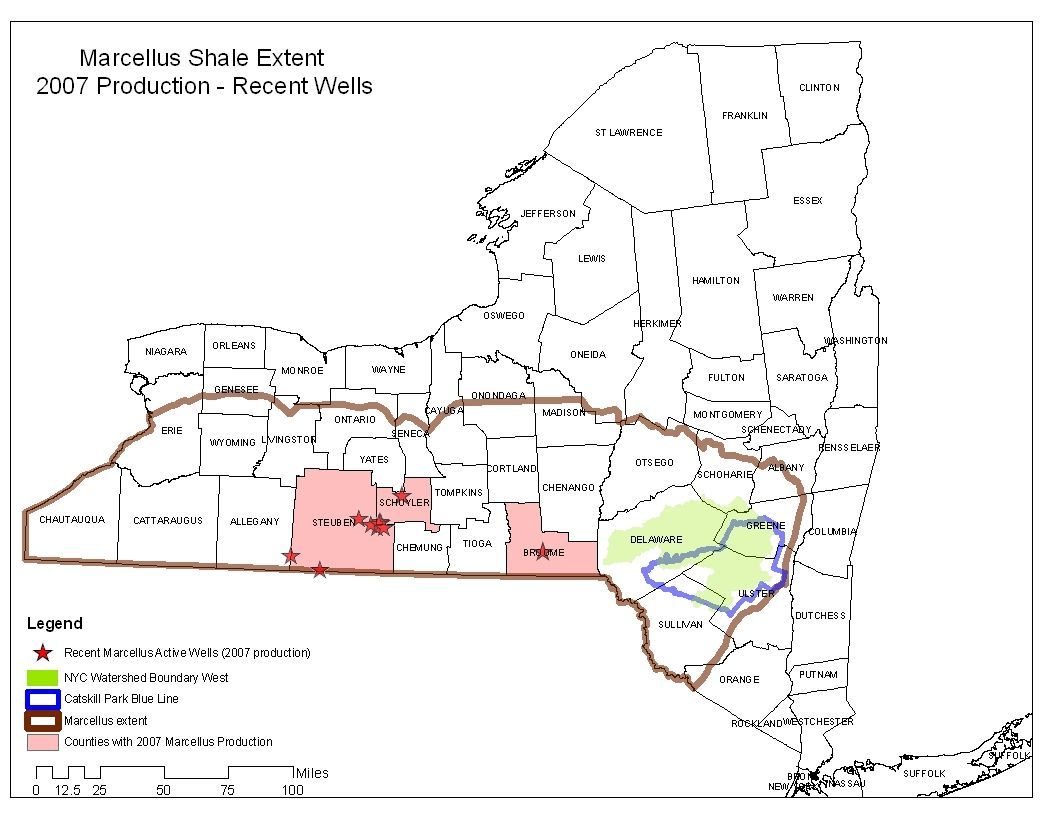
Earth hadn’t seen its first dinosaur when an enormous river system finished dumping its sediments over what is now Pennsylvania, West Virginia, southern New York State, western Maryland, and eastern Ohio. In the 350 million years or so that followed, other sediments piled up on the delta, sometimes to depths of 8,000 feet. As the river’s organic leavings were compressed and heated, hydrocarbons proliferated. Today the 48,000-square-mile Marcellus shale formation contains one of the largest known gas deposits in the United States.

Measured in immediate dollars and without subtracting the real costs of extraction, the windfall is dazzling. A Penn State study that does exactly this predicts that Marcellus gas will inflate Pennsylvania’s economy by at least $8 billion in just 2010. Farmers are now signing away mineral rights—for as much as $5,500 per acre, then getting royalties as high as 20 percent on the gas recovered.

That news would be better if Marcellus gas was recovered in a regulated, responsible fashion and with coordinated resource-agency oversight. After all, natural gas is the least polluting of all fossil fuels. It can even be rendered into cleaner-burning forms of gasoline and diesel fuel. And as a replacement for coal it has the potential to slow global warming because it releases only half as much carbon. But because the technology to extract the gas is younger than the 21st century, no one yet knows how to do it without simultaneously sacrificing the forests, waters, fish, and wildlife that, over time, are worth far more than any finite energy fix. That’s why New York State has placed a moratorium on Marcellus drilling while it struggles to devise effective regulations.

And that’s why some officials in Ohio, Maryland, and West Virginia are scrambling to get protections in place before the onslaught. So far they haven’t had much success. In an effort invoking the image of Oliver Twist requesting seconds on gruel, West Virginia lawmakers twice tried to pass legislation requiring companies merely to alert property owners before they get permits to hack and gouge their land. Both times the gas lobby shouted it down. Such is its stranglehold on the political process.

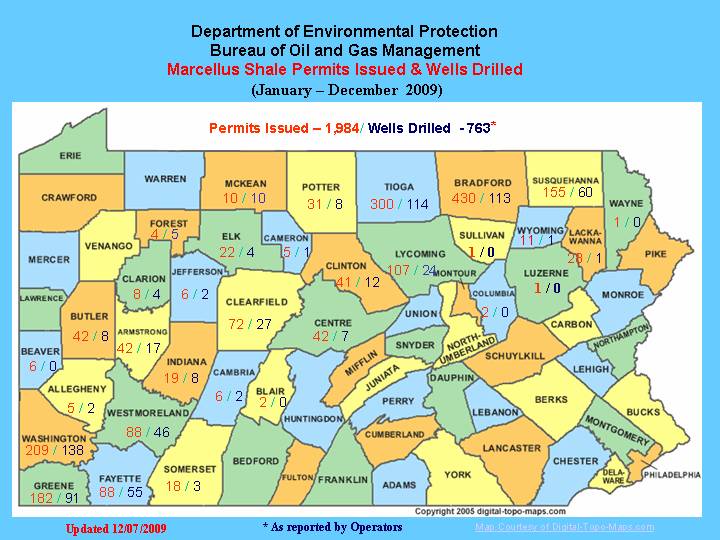
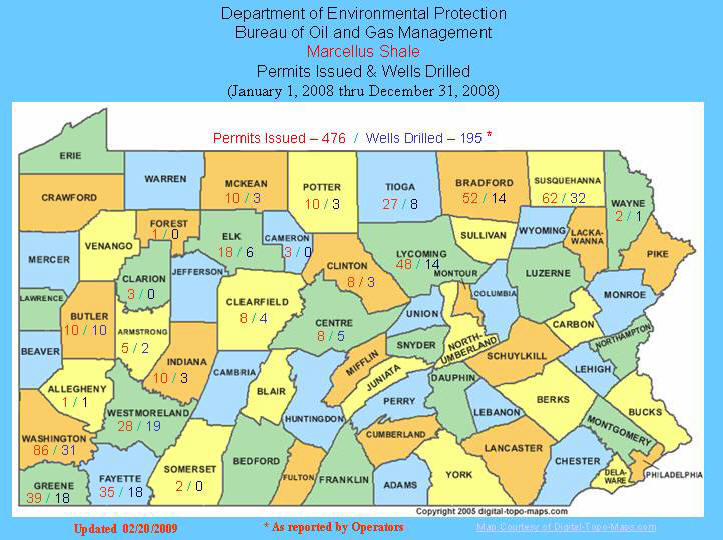
Almost all the development has been in Pennsylvania, which squats on the main chunk of the deposit. One might suppose that Pennsylvania would proceed cautiously, with 4,600 miles of its streams already contaminated by abandoned mines to the point of becoming lifeless acid seeps and having allowed the timber industry to denude the entire state a century ago. But no. The scene here resembles a wagon race of whooping, whip-flailing homesteaders. In 2008 Pennsylvania issued 476 Marcellus shale deposit drilling permits. In 2009 the figure was 1,984, and the industry expects to acquire 5,200 additional permits in 2010.

It’s not just native ecosystems that are being violated, it’s Pennsylvania’s constitution, which states: “The people have a right to clean air, pure water, and to the preservation of the natural, scenic, historic and esthetic values of the environment. Pennsylvania’s public natural resources are the common property of all the people, including generations yet to come. As trustee of these resources, the Commonwealth shall conserve and maintain them for the benefit of all the people.” What most alarms and outrages fish and wildlife advocates is that the state’s equally alarmed and outraged professional resource managers have been sidelined by big-money politics.

Pennsylvania’s wildest woods and most pristine streams are managed by the Department of Conservation and Natural Resources (DCNR). This 2.3-million-acre state forest system is among the largest publicly owned pieces of real estate east of the Mississippi River, and it is almost unique among state holdings in that it has been certified as “sustainable” by the Forest Stewardship Council. But in many places the agency can’t protect that sustainability because it doesn’t control mineral rights. In an attempt to marginally protect these areas, the DCNR had been requiring gas companies to sign surface-use agreements. But last May the companies got a state court to end even this.

If the current orgy is allowed to continue and if it becomes a model for the other Marcellus states, vast swaths of the East’s best forests will be fragmented, groundwater and surface water polluted, and fish and wildlife wiped out on a scale that would dwarf the recent tragedy seen in the gas fields of Wyoming, Colorado, and New Mexico.

For remainder of this excellent article, CLICK HERE.

DEMAND ACCOUNTABILITY!

Friday, March 19, 2010

DEP: Gas industry treatment behind discharge on hillside


By PATRICK DONLIN - pdonlin@sungazette.com
sungazette.comMarch 17, 2010


WATERVILLE - A substance used in the natural gas drilling process is discoloring and distorting the texture of spring water running off a Cummings Township sidehill.

...

The mysterious substance was seen flowing down the slope, under the road and into Pine Creek, said Daniel T. Spadoni, spokesman for DEP's northcentral region office. Officials from another state agency alerted DEP.

"We were notified (Monday) morning by the Department of Conservation and Natural Resources," Spadoni said. "There was a white foamy material discharging from a spring down the hill."

...

Terming it a surfactant, Spadoni said a substance known as Airfoam HD* was causing the water run-off to be unnatural in appearance.

...

Surfactant used to treat Pennsylvania General Energy wells affected the water run-off, which Spadoni said had nothing to do with hydrofracturing.

Workers for the Warren-based energy company are drilling five wells in the area, high above the road, but he said they have yet to reach the point of using highly pressurized water to break the rock underneath the ground.

They were using the whitening substance as a lubricant that lowers the surface tension between air and water, according to Spadoni.

A receptionist answering a Pennsylvania General Energy phone Tuesday afternoon said company officials were not available to comment.

"They're attempting to determine what caused this problem and what actions they can take to stop it," Spadoni said of energy company representatives, with whom DEP members have been communicating.

The only precaution Spadoni recommended to residents is to avoid the suspicious spring water run-off in the area.

"I don't think you would want to drink this discharge," he said.

The substance leaking down the hill isn't listed as dangerous on a Material Safety Data Sheet, according to Spadoni.

UH-OH...

"I don't believe there are concerns about drinking water in Waterville at this time," Spadoni said, adding that area residents can continue regularly using tap water in their homes.

The investigation will continue.

"We don't know for sure what its chemical composition is," Spadoni said.

He said DEP will continue to make sure the gas company assists to dissolve the situation. (!!!)

Spadoni said there may be more than one suspect discharge.

..................................................................................................

DEP lies to residents of Waterville about chemical product hazards

Nastassja Noell

*AIRFOAM HD discharging into spring water from gas production -- Dan Spadoni of the DEP said to the reporter in this news article that the MSDS sheet states that Airfoam HD is not dangerous -- HOWEVER, Air Foam HD has high levels of a chemical called 2-BE (2-Butoxyethanol) which is strongly associated with a rare form of adrenal cancer. The MSDS sheets for Airfoam HD (see below) indicate that this chemical product can cause health problems and is also soluble in water. Water tests for 2-BE are extremely expensive, costing over $100 for a 500ppm test of a water sample (as Wayne and Angel Smith in Clearville, PA found out last winter). There is already one poster child for 2-BE contamination and this rare adrenal cancer in a gas drilling area: Laura Amos. (read more following MSDS)

..................................................................................................

Laura Amos's water became contaminated with 2-BE when "fracturing four wells on our neighbors' property (less than 1000' from [their] house) ... "blew up" [their] water well, creating or opening a hydrogeological connection between [their] water well and the gas well...

...

In August 2004 [Amos] came across a memo written to the US Forest Service and BLM Regional offices in Delta County, describing the health hazard posed by a chemical used in fluids that are injected underground to enhance the release of methane. Dr. Theo Colborn of Paonia, Colorado submitted the memo in response to decisions that were being made in Delta County by the government officials to allow gas exploration and development on the Grand Mesa. Colborn is the President of the Endocrine Disruption Exchange, Inc (TEDX) and for over 10 years directed the World Wildlife Fund's Wildlife and Contaminants Program. She has been honored worldwide for her focus on the effects of synthetic chemicals on human and wildlife health. The focus of Colborn's memo was on a chemical called 2BE, used in fracturing fluids.

The following information was taken from Colborn's report: "2BE is a highly soluble, colorless liquid with a very faint, ether like odor." She wrote that at the concentration to be used in Delta county 2BE might not be detectable through odor or taste. "2-BE has a low volatility, vaporizes slowly when mixed with water and remains well dissolved throughout the water column." "It mobilizes in soil and can easily leach into groundwater." "It could remain entrapped underground for years."

She noted it is readily absorbed by the skin and can easily be inhaled as it off-gasses in the home. Colborn cited the Agency for Toxic Substances and Disease Registry Profile that listed the following effects of 2-BE: kidney damage, kidney failure, toxicity to the spleen, the bones in the spinal column and bone marrow, liver cancer, anemia, female fertility reduction, embryo mortality, and the biggie that got my attention - elevated numbers of combined malignant and non-malignant tumors of the adrenal gland."

CLICK HERE to read Amos' entire galling tale.

DEMAND ACCOUNTABILITY!

Saturday, March 13, 2010

Lawmakers urge against Marcellus Shale permits

...and propose a heartening series of environmentally proactive bills for Pennsylvania

Alex Rose
Main Line Media News
March 12, 2010


State Rep. Greg Vitali, D-166, of Haverford, recently joined legislators and environmentalists asking that Gov. Ed Rendell stop granting permits to drill in state forest land over the Marcellus Shale region, a huge deposit of natural gas lying under much of the state.
“We already have made available 692,000 acres and there could potentially be thousands of wells drilled to extract the gas,” said Vitali in a release. “We cannot lease any further state forest acreage without encroaching on the most sensitive lands, which include old-growth forests, habitat for endangered species and fragile ecosystems.”
Rendell spokesman Gary Tuma previously said a requirement of passing the last state budget was generating enough recurring revenue to help balance the budget for two fiscal years. That included $180 million worth of drilling leases in the 2010-11 budget, he said.

Vitali has entered legislation that would place a five-year moratorium on those leases. The State Forest Natural Gas Lease Moratorium Act would also confer sole discretion for additional leases to the state Department of Conservation and Natural Resources when the moratorium ends, and would require the DCNR to conduct an annual report on the impact gas drilling has on state forests.

State Rep. Bryan Lentz, D-161, of Swarthmore, meanwhile, introduced his own legislation this week that would establish a severance tax on natural gas and put the proceeds toward tax exemptions for green businesses.

Lentz’s bill would authorize the state Department of Community and Economic Development to establish 15 Keystone Green Zones in the state, similar to the Keystone Opportunity Zones that offer businesses a bevy of tax breaks for setting up shop.

In this instance, those breaks would go to businesses that manufacture energy-efficient products or products used in the renewable energy industry.

“I am proposing that we give companies a financial incentive to do business in Pennsylvania, which will produce good-paying jobs and brand the state a hot spot for this growing industry,” said Lentz, a Democratic candidate in the 7th Congressional District. “All the while, we’ll be reducing our impact on the environment and surrounding communities, and improving the quality of life for residents across Pennsylvania.”

Environmental attorney Gail Conner, another Democratic contender in the 7th Congressional District, also called for the closure of the so-called “Halliburton loophole” in the Safe Drinking Water Act that bars the Environmental Protection Agency from regulating hydraulic fracturing being used to mine natural gas in the Marcellus Shale region.

“The Safe Drinking Water Act in its current form allows the oil and gas industry to inject ‘undisclosed’ hazardous materials directly into or adjacent to our nation’s water supplies during the process of fracturing rock through drilling to release gas reserves,” said Conner. “These fracturing fluids pose a potential threat to human health and drinking water supplies.”

Like Vitali, Conner is calling for the restoration of jobs cut at the DEP and DCNR last year, as well as a moratorium on drilling leases.

She has also proposed a slew of permit application requirements, including full disclosure of chemicals used in fracking, and specifying locations for the source of water used and disposal of waste water.

Conner also said the public needs to be informed of a spill or other contamination within 24 hours and some financial remedy should be available for residents whose property is damaged by drilling.

“Protecting our environment and natural resources, and providing a voice for the residents in our communities, should not take a back seat to special interests,” said Conner. “The citizens of the commonwealth have a state constitutional right to clean air and water. I hope that our state leaders will uphold those rights intended to protect the citizens and our communities.”
LINK to source.

Commentary by Splashdown in red.

DEMAND ACCOUNTABILITY!

Monday, February 8, 2010

Breaking: Rendell rumored to be considering unilateral leasing of even more state forest for drilling

Governor Rendell is rumored to be considering directing the Department of Conservation and Natural Resources (DCNR) to lease more land for Marcellus Shale gas drilling, even before the 2010-2011 budget, which he proposes tomorrow, passes.

"The fear is that governor will lease out more land in the spring," said State Representative Greg Vitali (D-Delaware). "The governor does not need legislative approval to lease out more land for drilling. He could do it tomorrow."

Vitali has sponsored a bill that would impose a moratorium on further leasing of state forest for drilling.

Some background:

For the past few weeks, rumor had it that the four main caucuses of the General Assembly had made a closed-door agreement to require DCNR to authorize the lease of even more forest land for Marcellus Shale gas drilling to the tune of $180 million.

As I reported in this week's column, Man Overboard ("Uh-oh" 2/3/2010), the legislature included a similar – and totally unprecedented – clause in last year's budget, requiring DCNR to lease $60 million worth of state forest, effectively usurping DCNR Secretary John Quigley's job of determining himself what and whether to lease:

For years, Gov. Ed Rendell and legislators have rubbed their hands in anticipation of this windfall. And during the 2009 budget wars, they did something completely unprecedented: Lawmakers ordered the Department of Conservation and Natural Resources (DCNR), which oversees state forests, to lease land to gas drillers to the tune of $60 million — which the state would keep.

That decision ignored the advice of former DCNR Secretary (and current Philly Parks and Rec czar) Michael DiBerardinis, who in a March 2009 memo warned that too much leasing would "scar the economic, scenic, ecological and recreational values of the forest," and that "a rush to drill threatens the certification of our state forests as sustainably managed."

They did it anyway.

Governor Spokesman Michael Smith confirmed in a phone call with CP last week that Rendell would indeed seek $180 million from "gas drilling revenues of some sort" - but whether that amount would include a possible proposed tax on drilling or include the leasing of state forest – he declined to specify.

That, he said, would be up to the legislature.

But maybe not. If the rumor's true (the governor's office has not yet responded to a call for comment), the Governor may decide to lease state forest for drilling all by himself – effectively letting legislators who might face opposition on such a vote off the hook.

Currently, one-third of all state forest land has already been leased for drilling. And while thousands of wells are expected on the land already leased, only three are operational.

LINK

DEMAND ACCOUNTABILITY!

Monday, January 25, 2010

Forest Fragmentation and Natural Gas Development

PA Environment Digest
Daily Blog
January 24, 2010


Department of Conservation and Natural Resources Acting Secretary John Quigley told the Senate Environmental Resources and Energy Committee recently he was concerned thousands of new natural gas wells and thousands of miles of access roads and related collection pipelines could have a major impact on Pennsylvania's State Forests.
The fragmentation of forest habitats has also been a concern of environmental groups like Pennsylvania Audubon.
Until now it was hard to illustrate how natural gas and oil well development can affect a forest. Recently, however, the website Damascus Citizens circulated aerial photos of gas well sites from all over the country, including in Pennsylvania.
An aerial photo of traditional oil and gas well development in Forest County, Pa in a portion of the Allegheny National Forest just north of the Clear Creek State Forest clearly shows how roads and drilling pads can fragment a forest.
To see it for yourself, enter these coordinates in Google Earth-- 41 degrees, 30 minutes 47.77 seconds North, 79 degrees 11 minutes 16.13 seconds west.
Marcellus Shale well development patterns are different because they use fewer well pads by drilling very deep vertical wells and then drill horizontal wells out in several directions in the natural gas producing strata.
The aerial photo on Google Earth is part of the statewide series made available by the Department of Conservation and Natural Resources' PA Map Program, recently eliminated in this year's state budget.
LINK.
DEMAND ACCOUNTABILITY!

Thursday, November 19, 2009

State identifies 32,000 acres of forest for gas drilling

HARRISBURG - Nearly 32,000 acres of state forest land in north-central Pennsylvania will be opened up next month to potential natural gas drilling under a plan to generate revenue for state government, the Department of Conservation and Natural Resources announced Monday.

Setting minimum bids at $2,000 an acre, DCNR officials anticipate that if all 32,000 acres are leased to private drilling firms it will generate $60 million in gas lease revenue to help support the state budget enacted last month.

The budget requires DCNR to lease enough forest land this fiscal year so it can transfer $60 million to the General Fund. It provides $50 million in future royalties from gas production to help operate and maintain state parks and forests. The lease terms set minimum royalties at 18 percent.

...

DCNR will open six tracts in Elk, Moshannon, Sproul, Susquehanna and Tioga state forests in Cameron, Clearfield, Clinton, Potter and Tioga counties.

"The tracts represent a little more than 1.5 percent of our total state forest land," said Acting DCNR Secretary John Quigley.

The bids will be opened Jan. 12 and awarded a day later.

DCNR officials have spent the past year conducting an environmental review of the land chosen for drilling. The process starts when drillers identify land they are interested in. DCNR officials say their review focuses on how drilling will affect the health of the forests and ecosystems that support wildlife and other permitted uses of forest land such as public recreation and timber cutting. The department sets conditions on how drillers operate. The head of the statewide environmental group PennFuture expressed concern about how the new drilling will affect hikers and hunters.

PennFuture CEO Jan Jarrett said she is aware of anecdotal stories of hikers in the Tioga State Forest finding trails unexpectedly blocked because of drilling operations. She said the state needs to do a more comprehensive study weighing the impact of drilling on forest activities.

About 660,000 acres of the 2.1 million acres of state forest land is leased for gas production. A lot of that acreage is in the traditional shallow gas fields of Northwest Pennsylvania.

Complete story: CLICK HERE.

DEMAND ACCOUNTABILITY!

Friday, October 9, 2009

Some Good News: State Forests saved - for now

This just in from PennFuture's Session Daze
with thanks from Splashdown!

The Pennsylvania House of Representatives, led by a core group of "green dog" and "hunting dog" House Democrats, and a strong coalition of conservation, hunting and angling organizations, have staved off a raid on Pennsylvania's State Forest system by the gas drilling industry and their legislative allies. A strong public outcry that included conservationists, hunters, anglers and most of the state's major newspapers helped achieve this reprieve.

The outcome is a significant improvement over a series of proposals to open up hundreds of thousands of acres of state forest land to gas drilling. The original budget agreement would also have rescinded the Oil and Gas Lease Fund that since 1955 has been used to purchase land for state parks and invest in park and forest infrastructure among many uses.

The final package still requires DCNR to raise $60 million from drilling in the State Forests this year, but eliminates any further requirements that the agency lease land for drilling. It also preserves the fundamental integrity of the Oil and Gas Lease Fund.

Heroes of the forests... Thank you!
Anyone who uses and values Penn's Woods owes a debt of gratitude to Representative Dave Levdansky (D-Allegheny) who led the effort to repel the raid on the forest against long odds. We can't name all of the House members who provided assistance, but a few we would like to salute include Representatives Greg Vitali (D-Delaware), Steve Santarsiero (D-Bucks), David Kessler (D-Berks), Ed Staback (D-Lackawanna), Mike Hanna (D-Clinton), Robert Freeman (D-Northampton), Camille "Bud George (D-Clearfield), Tim Briggs (D-Montgomery), Tom Houghton (D-Chester), Barbara McIlvaine Smith (D-Chester), John Siptroth (D-Monroe) and Matt Bradford (D-Montgomery).

A sigh of relief, a call to arms
Citizens who care about public lands can breathe a sigh of relief today, but this is only a temporary reprieve. We must enact a severance tax, just like every other major gas producing state, in order to relieve the pressure to turn our forests into a cash register for the state budget.

DEMAND ACCOUNTABILITY!

Thursday, April 2, 2009

NOT SO FAST... THERE GOES THE NEIGHBORHOOD REDUX

TEMPORARY HOLD ON LEASING STATE LAND SOUGHT

Just last week, the GOP House Energy Task Force, co-chaired by Tina "Drill Baby Drill" Pickett (R-Bradford), unveiled a proposal to violate 390,000 new acres of PA state forest land drilling for gas.

In an environmentally considered move, the Conservation and Natural Resources Advisory Committee has requested a temporary hold on leasing additional state forest land for Marcellus Shale natural gas drilling until the environmental impacts of drilling on the first 74,000 acres can be evaluated.

The Memorandum of Concern, addressed to Governor Edward Rendell and Department of Conservation and Natural Resources (DCNR) Secretary Michael DeBerardinis, notes, “We believe that to lease additional substantial acreage of state forest lands at this time would be an abrogation of the public trust of these public lands, and would be a short-sighted approach to the use of the resources managed by this state agency [DCNR].”

The committee also recommended future revenues from leased lands be retained in DCNR’s Oil and Gas Lease Fund to help maintain state parks and forests and to address any environmental issues arising from the drilling.

RURAL IMPACT VIDEOS, 6 parts

Natural gas development in Colorado, the impacts on communities, environment and public health. A primer for public servants and residents of counties that care for their lifestyles.

Drilling for Gas in Bradford County, PA ... Listen!

Cattle Drinking Drilling Waste!

EPA... FDA... Hello? How many different ways are we going to have to eat this? ... Thank you TXSharon for all you do! ... Stay tuned in at http://txsharon.blogspot.com

Landfarms

A film by Txsharon. Thank you Sharon for all you do. Click HERE to read the complete article on Bluedaze: Landfarms: Spreading Toxic Drilling Waste on Farmland

SkyTruth: Upper Green River Valley - A View From Above