Monday, November 16, 2009

Trout Unlimited's NYS Council Opposes Fracking

Concerned about the possibility of fracking fluid contaminating streams and rivers, Trout Unlimited has announced it is opposed to “exploitation” of the Marcellus shale gas deposits until “crucial issues” are resolved.

Calling for an extension of the comment period for the the state's environmental impact statement (SGEIS) into next year, the council feels that after hundreds of thousands of years in the gas' development, additional time taken to insure safety and protect the future in extracting it isn't a lot to ask.

DEMAND ACCOUNTABILITY!

Susquehanna River Basin Commission proposes automated monitors for streams and creeks in Marcellus Shale region

By FORD TURNER
The Patriot-News
November 11, 2009
Each monitoring station would have a data-gathering device and a platform powered by a solar panel. Courtesy Photo

The Susquehanna River Basin Commission wants to be ready in case pollution makes its way into sensitive streams and creeks in the region where natural gas drilling is on the increase.

(Obviously this indicates a likelihood...)

The commission has proposed a network of 30 automated, solar-powered water quality monitoring stations for the northern tier of Pennsylvania and southern New York.

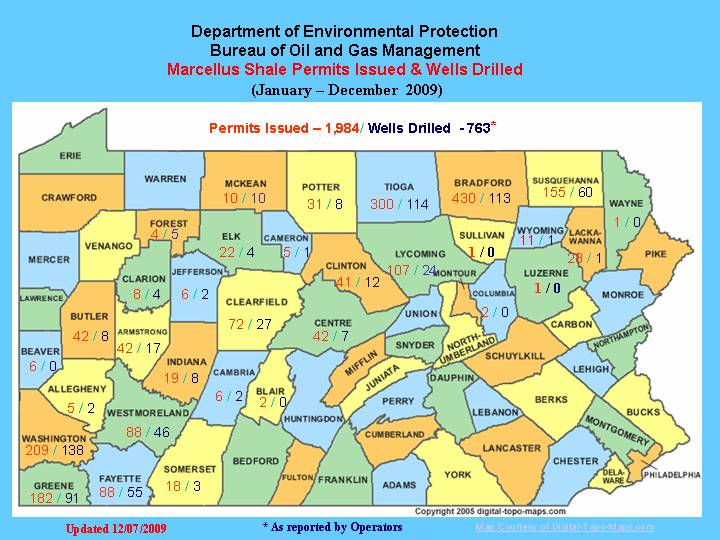
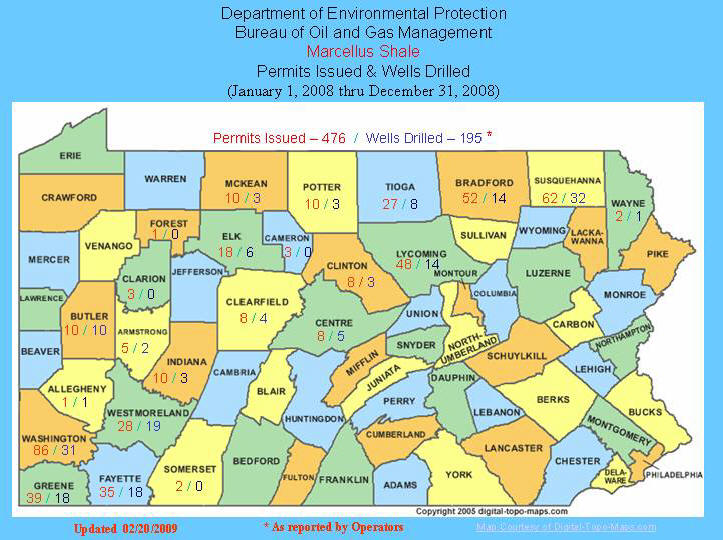
The northern tier counties have been a prime focus in Marcellus Shale natural gas exploration. Through September, 575 of the 1,340 Marcellus Shale drilling permits issued by the state this year were for sites in Susquehanna, Bradford and Tioga counties.

...

The government-sanctioned commission regulates withdrawal and use of water from the river and its tributaries.

"As the demand for water from smaller rivers and streams increases, particularly from the natural gas industry, so does the amount of wastewater that is generated," said commission Executive Director Paul Swartz. "It is important to monitor these smaller, remote waterways to verify whether or not they are being impacted by certain pollutants."

Sounds like the implication here is that waterways would be contaminated by wastewater vs. water withdrawals... something that if it were to occur, would have to be the result of an industry violation of some kind.

...To read the complete report, CLICK HERE.
Editorializing by Splashdown in red.

DEMAND ACCOUNTABILITY!

Sunday, November 15, 2009

A MESSAGE FROM THE MAYOR OF DISH, TX

I have been asked on several occasions, by folks around the country to come and talk about the air study here in DISH. It seems a bit odd to me, but it appears that tiny DISH, TX has been the only municipality to perform a study such as this. I will happily share our story here in DISH with anyone who would like to hear about. I firmly believe that the only way to change the current situation is stand together. I further believe that helping you, where ever you may be, will also help us here in DISH. Therefore, if you are interested in hearing about our story please contact me directly to discuss the possibilities. I will not accept funding for any travel expenses, but also need to know that my presentation would make a difference. Please give me a call or email for details.

Calvin Tillman,
Mayor, DISH TX

940.453.3640

tillman4council@aol.com

DEMAND ACCOUNTABILITY!

TEDX: The Endocrine Disruptor Exchange

Chemicals in Natural Gas Operations

Introduction


As natural gas production rapidly increases across the U.S., its associated pollution has reached the stage where it is contaminating essential life support systems - water, air, and soil - and causing harm to the health of humans, wildlife, domestic animals, and vegetation. This project was designed to explore the health effects of products and chemicals used in drilling, fracturing (frac’ing, or stimulation), recovery and delivery of natural gas. It provides a glimpse at the pattern(s) of possible health hazards posed by the chemicals being used. There are hundreds of products in current use, the components of which are, in many cases, unavailable for public scrutiny and for which we have information only on a small percentage. We therefore make no claim that our list is complete.

Toxic chemicals are used at every stage of development to reach and release the gas. ...............

In addition to the land and water contamination issues, at each stage of production and delivery, tons of toxic volatile compounds, including benzene, toluene, ethylbenzene, xylene, etc., and fugitive natural gas (methane), escape and mix with nitrogen oxides from the exhaust of diesel-driven, mobile and stationary equipment to produce ground-level ozone. Ozone combined with particulate matter less than 2.5 microns produces smog (haze). Gas field produced ozone has created a serious air pollution problem similar to that found in large urban areas, and can spread up to 200 miles beyond the immediate region where gas is being produced. Ozone not only causes irreversible damage to the lungs, it is equally damaging to conifers, aspen, forage, alfalfa, and other crops commonly grown in the West. Adding to this is the dust created by fleets of diesel-driven water trucks working around the clock hauling the constantly accumulating condensate water from well pads to central evaporation pits.

All meaningful environmental oversight and regulation of the natural gas production was removed by the executive branch and Congress in the 2005 Federal Energy Appropriations Bill. Without restraints from the Clean Water Act, Safe Drinking Water Act, Clean Air Act, and CERCLA, the gas industry is steamrolling over vast land segments in the West. Exploitation is so rapid that in less than 6 months in one county, 10 new well pads were built on the banks of the Colorado River, the source of agricultural and drinking water for 25 million people downstream. Spacing has dropped from one well pad per 240 acres to one per 10 acres. From the air it appears as a spreading, cancer-like network of dirt roads over vast acreage, contributing to desertification.

For the complete intro, CLICK HERE.

What you need to know about natural gas production

TEDX has produced a video of Dr. Theo Colborn's 47 minute lecture, complete with photos and data slides to illustrate the fact that natural gas is not the 'clean energy' that industry is touting it to be.
CLICK HERE to view.
CLICK HERE to order a DVD.

DEMAND ACCOUNTABILITY!

Saturday, November 14, 2009

Marcellus shale drilling biggest threat to Pennsylvania Wilds


By Patriot-News Op-Ed
November 14, 2009
by Robert Pennell, secretary of the Pennsylvania Council of Trout Unlimited


They call it the “Pennsylvania Wilds,” more than 6 million acres of relatively unspoiled forests and mountains in 12 northern Pennsylvania counties.

The area has long been known for its remnants of virgin forests, pristine mountain streams, abundant wildlife and magnificent vistas. More than 2 million of those acres are public land, an area equivalent to the acreage occupied by Yellowstone National Park.

Today, however, if you were to visit this part of our commonwealth, you would be greeted by a different environment. You would find a proliferation of new roads being cut into the forests, with semis and tanker trucks hauling tons of heavy equipment and water to remote destinations.

Not since the heyday of heavy timbering has there been such an assault on our northern forests.

This is all about the natural gas being extracted from a widespread geological formation known as Marcellus Shale.

...

Unfortunately, we already have witnessed significant negative environmental impacts resulting from the activities of several drilling companies that either chose not to follow the rules or were simply careless in the execution of their efforts.

In the development of a typical Marcellus gas well, an access road must first be constructed or an existing forest road must be improved to handle the heavy truckloads of equipment and water. Next, about 5 acres of forest must be destroyed to make room for a well pad and water retention pond.

Millions of gallons of water must then be hauled to the site for the fracking operation, which also requires the addition of several potentially toxic chemicals. After the fracking operation is complete, the contaminated water flows back to the surface where it must be treated before discharged into a receiving river or stream.

So why should we be concerned over these activities? Construction of roads and pad sites can cause erosion and sedimentation pollution in some of our highest-quality streams. Excessive water withdrawals from smaller streams can result in the loss of aquatic life. Inadequate liner materials in wastewater retention ponds can result in contaminants leaching into groundwater, and more and better off-site treatment plants are needed to handle the ever-increasing volumes of contaminated frack water.

With this in mind, the state Department of Environmental Protection has seemingly shot itself in the foot when it comes to protecting our natural environment from the inevitable problems of rapidly escalating gas extraction activities.

This year, DEP made the decision to dismiss the county conservation districts as the watchdogs over local construction activities, and then instituted a fast-track permitting rule whereby construction plans would no longer be subjected to scrutiny by DEP, as long as the plans are certified by a registered engineer.

This practice already has proved itself ineffective in a recent case in which the DEP-approved engineer’s plans failed to include some of the most basic measures to control erosion and sedimentation at several well sites.

Then there’s the major issue of our state legislators failing to impose a gas severance tax that could pump much-needed General Fund capital into the state coffers and provide a funding source to help pay for future environmental mishaps.

Gov. Rendell proposed such a tax in June to help balance the state budget, but he later backed down. Although every other major natural gas-producing state imposes a severance tax on gas extraction, it is relevant to note that more than $1 million was spent this year by oil and gas lobbyists to help defeat this tax in Pennsylvania.

When the state budget was finally passed, the agencies that suffered the largest cutbacks are the same agencies we depend on to oversee the health of our natural environment: DEP and DCNR.

Now more than ever, it is imperative that our legislators support and pass a gas severance tax that allocates a substantial percentage to our environmental programs. We must keep the “wild” in Pennsylvania Wilds.

Original posting: HERE.

DEMAND ACCOUNTABILITY!

Thursday, November 12, 2009

More Dead Life

A while ago... September 1st to be exact, I posted about the birds that died while searching for water, mistakenly lured permanently into a gooey sludgepit in South Texas, on or near the McGill Brothers Lease.
ExxonMobil, having just paid a 600,000$ fine for the death of 85 birds in August, apparently hadn't caught up with its negligence.

Not by a long shot it seems, judging from these recent photos.


Once again ExxonMobil STILL looks negligent!

Stagnant water>dead bodies>disease.
(Grating could so easily prevent this.)

These photos are taken from Mrs. Burns' November 8th post (ExxonMobil -- nature lover), on her great American saga of a blog: A satirical view from the McGill Brothers Lease.

Just a few weeks ago (Oct. 26th), she posted a photo and details of a tractor turned fireball when the driver, a volunteer fire fighter disking fire breaks hit one of XOM's gas lift lines and blew up.
Luckily, he's only 'charred'... but the place reads like a mine field and it's only a matter of time before the next casualty. It certainly doesn't look like there's much remediation going on to prevent it.

How long does this industry imagine it can play the deadly charade too many heedless profiteers, corporate and political alike, are giving a green light?
What will be the ultimate sacrifice that draws their serious, proactive acknowledgement? ...Will we all be dying of thirst? Will it be too late? What's your guess? What are you going to do about it?

DEMAND ACCOUNTABILITY!

Watchdog: New York State Regulation of Natural Gas Wells Has Been “Woefully Insufficient for Decades.”


The New York-based Toxics Targeting went through the Department of Environmental Conservation’s own database of hazardous substances spills over the past thirty years. They found 270 cases documenting fires, explosions, wastewater spills, well contamination and ecological damage related to gas drilling. Many of the cases remain unresolved. The findings are contrary to repeated government assurances that existing natural gas well regulations are sufficient to safeguard the environment and public health.
Instantly check for hidden environmental hazards before buying a home or property in New York State. Toxics Targeting's Free Internet Map identifies more than 270,000 abandoned landfills, industrial dumps, leaking tanks and other reported pollution threats.
For more, CLICK HERE and HERE.

DEMAND ACCOUNTABILITY!

RURAL IMPACT VIDEOS, 6 parts

Natural gas development in Colorado, the impacts on communities, environment and public health. A primer for public servants and residents of counties that care for their lifestyles.

Drilling for Gas in Bradford County, PA ... Listen!

Cattle Drinking Drilling Waste!

EPA... FDA... Hello? How many different ways are we going to have to eat this? ... Thank you TXSharon for all you do! ... Stay tuned in at http://txsharon.blogspot.com

Landfarms

A film by Txsharon. Thank you Sharon for all you do. Click HERE to read the complete article on Bluedaze: Landfarms: Spreading Toxic Drilling Waste on Farmland

SkyTruth: Upper Green River Valley - A View From Above