Showing posts with label DELAWARE RIVER BASIN COMMISSION. Show all posts

Sunday, August 1, 2010

Department of Environmental Protection Unlawfully Permitting Water Withdrawals For Marcellus Shale Gas Drilling in Western Pennsylvania

Allegheny Defense Project
FOR IMMEDIATE RELEASE
July 26, 2010
Contact: Cathy Pedler – (814) 454-7523
Bill Belitskus – (814) 778-5173
Ryan Talbott – (503) 887-7845

Only riparian owners can make use of water in streams and rivers

Natural gas companies have descended on Pennsylvania’s forests and farmlands to drill into the Marcellus Shale. Each Marcellus Shale gas well requires millions of gallons of water for the drilling process. That water is taken from Pennsylvania’s streams and rivers under the alleged authority of the Pennsylvania Department of Environmental Protection (DEP). The DEP, however, does not have the authority to permit water withdrawals in Pennsylvania.

In central and eastern Pennsylvania, water withdrawalsare managed by the Susquehanna River Basin Commission and Delaware River Basin Commission. Congress created the two commissions as federal interstate compacts with the authority to permit water withdrawals within their respective basins. The rest of Pennsylvania, most of which is in the Ohio River basin, is governed by riparian rights common law, which allows only the owner of property along a watercourse to withdraw water for use on their land. There is no state law regulating water withdrawals other than for municipal drinking water supplies.

In a letter sent to DEP Secretary John Hanger, the Allegheny Defense Project (ADP) outlined the current state of Pennsylvania law regarding water withdrawals and charged the DEP with operating an unauthorized water withdrawal program that allows natural gas companies to take water that they have no legal right to fortheir Marcellus Shale gas drilling operations. (LINK to source.)

“The fact is, the DEP has absolutely no authority to permit water withdrawals in Pennsylvania,” said Cathy Pedler, ADP’s forest watch coordinator. “Outside of the Delaware and Susquehanna River watersheds, water withdrawals are governed by riparian rights common law, which means only those who live adjacent to the water can make reasonable use of the water on their land. A gas company cannot take water that flows through property it does not own.”

Nevertheless, documents obtained by ADP reveal that the DEP is unlawfully authorizing water withdrawals from western Pennsylvania streams and rivers. On March 31, 2010 the DEP approved a Water Management Plan for Hanley & Bird, Inc. The Water Management Plan allows Hanley & Bird to withdraw 1.44 million gallons of water a day from the Redbank Creek in Jefferson County for five years.

Under the Water Resources Planning Act of 2002, the DEP is required to develop Water Management Plans for the entire state. That law, however, does not provide any authority to the DEP to authorize water withdrawals.

“The Water Resources Planning Act is just that, a planning act,” said Bill Belitskus, ADP’s board president. “That law provided no substantive authority to the DEP to regulate or permit water withdrawals from Pennsylvania’s surface waters. Each time the DEP approves a water management plan and tells a natural gas company that it can withdraw surface water for their drilling procedures, it is acting without authority and encouraging illegal conduct.”

Visit ADP’s website to see the documents we obtained from recent file reviews at the DEP’s Northwest Regional Office: http://alleghenydefenseproject.wikispaces.com/Marcellus+Shale

LINK

WRITE LETTERS! SPEAK OUT!
DEMAND ACCOUNTABILITY!

Tuesday, June 15, 2010

Congressman Sestak Commends the Delaware River Basin Commission for Protecting Pennsylvanians' Water Supply

Commission Extends Important Policy to Include Natural Gas Exploratory Wells
The Hellenic News of America
June 15, 2010


Media, PA —Congressman Joe Sestak (PA-07) applauded the Delaware River Basin Commission (DRBC) for effectively ensuring that parts of the Marcellus Shale within its jurisdiction will only be drilled when we can best ensure the safety of our communities. In a decision publicized Monday, the Commission ruled that companies wishing to drill exploratory wells to tap into Marcellus Shale – done through a specialized method known as fracking – will need approval of the DRBC. The Commission has further determined that it will not issue more permits until proper safety regulations are put in place. DRBC had previously established this policy for production wells, which are drilled when a location is known to contain natural gas.

Earlier this month, a blowout of a natural gas well in Clearfield County resulted in gas and harmful drilling liquids being let loose for 16 hours before they were contained. Since 2004, methane related to the natural gas industry has contaminated water wells in at least seven Pennsylvania counties.

“Recent events, from the tragic oil spill in the Gulf of Mexico to the fraudulent activity that contributed to the collapse on Wall Street, have reminded us all that we cannot depend on industry to police itself when our quality of life, present and future, is at stake,” said Congressman Sestak. “The resources of the Marcellus Shale have given us a tremendous economic opportunity, but we must be certain that the environmental, health, and property safeguards in place are strong enough to protect Pennsylvanians. I commend Executive Director Carol R. Collier for recognizing the pragmatic approach needed on this issue, which is a path to drilling that most benefits Pennsylvanians, not just the oil and gas companies. As an added benefit, we need some time to train workers in our state to qualify for Marcellus Shale jobs.”

To read more, including the DRBC Executive Director Determination, CLICK HERE.

DEMAND ACCOUNTABILITY!

Sunday, May 9, 2010

Some Marcellus Shale drilling put on hold

By Sandy Bauers, Staff Writer
The Philadelphia Inquirer
May 6, 2010

Drilling for natural gas in the Marcellus Shale in Pennsylvania's easternmost counties has been put on hold for months, if not longer.

On Wednesday, the Delaware River Basin Commission voted unanimously to draft new regulations to govern natural gas projects and not to issue any permits until the new rules are in effect.

The decision means that even as activity escalates throughout the state - nearly 900 Marcellus permits have been issued this year - no production drilling can be done in the Delaware watershed.

Adopting new rules could take six months to a year, commission executive director Carol R. Collier said Thursday. ...

"I know there are many that want the gas-well drilling to move along quickly because of the economics and the issue of national security and providing clean fuel," Collier said. "But I really think we have to do it correctly and smartly. There's just too much at stake in the Delaware River basin."

Environmental groups cheered the decision, saying it was the "pause button" they have long sought statewide as the tally of explosions, spills, and pollution incidents mounts. So far this year, the state Department of Environmental Protection has initiated 116 enforcement actions against drillers. ...

John Hanger, secretary of the state Department of Environmental Protection, which also has regulatory authority over natural gas drilling, said the two agencies should work together so no conflicts arise and "to provide strong oversight of this industry."

The commission is an interstate agency, formed by a federal compact, that has legal authority over water quality and quantity in the basin. The governors of the four basin states - Pennsylvania, New Jersey, New York, and Delaware - plus a federal appointee are commissioners, but they often send representatives.

The New Jersey representative at Wednesday's meeting, Fred Sickels of the state DEP water-supply division, said that with all the activity, "the cumulative impacts could be significant if there aren't appropriate safeguards."

Pennsylvania's northeastern counties - where the shale region and the Delaware watershed overlap - have been deemed a high-stakes area.

The pressure to drill there could be even more intense than elsewhere. Geological maps indicate that corner of Pennsylvania is a sweet spot with huge quantities of natural gas.

More than 6,000 leases have been signed in Wayne County alone, said Brian W. Smith, chairman of the Wayne County supervisors.

No drilling other than test wells, which are still allowed, has been done in the watershed.

But environmental concerns are high. The Delaware River from Hancock, N.Y., south to Trenton is so clean that it is under stricter, "special protection waters" regulations. Also, the federal government has designated portions of the river wild and scenic areas worthy of enhanced protection.

And downstream - where the river's quality is the sum of everything that has occurred upstream - are Philadelphia's water intakes.

Proponents say natural gas drilling is adding millions of dollars to local economies and has environmental benefits because the fuel burns cleaner than coal.

Critics say the drilling process is fraught with hazards and the regulatory baseline is inadequate.

In March, Philadelphia City Council unanimously passed a resolution asking the commission not to approve any applications in the Marcellus Shale until a full environmental impact assessment is done. ...

During a public-input period, the commission received more than 2,000 comments.

"We're looking at things that have happened to the west of us and what needs to be put in place to prevent that," Collier said. "We're learning a lot, and we want to do it right."

LINK

HOORAY FOR SENSIBLE PRIORITIES! Hopefully the DRBC's actions will serve as a bellwether for the rest of the state! Clearly the same perspectives were lacking when the DCNR chose to allow drilling under the Susquehanna River... for a "whopping" (just joking) $6.15 million! -Splashdown

DEMAND ACCOUNTABILITY!

Saturday, March 27, 2010

Protecting Our Waters Hails Philadelphia Weighing In Against Fracking In Delaware Basin

PRESS RELEASE
Says DRBC Should Heed City Position - Reject Stone Energy Permits

Philadelphia, PA -
Environmental groups from across the region hailed passage of a Philadelphia City Council Resolution yesterday calling on the Delaware River Basin Commission (DRBC) to reject all permits related to hydraulic fracturing, or fracking, until a full environmental impact assessment is complete. The groups said the DRBC should follow the Council's direction and not allow this environmentally destructive drilling practice to occur in the Delaware River Basin.

"We are extremely happy that City Council took its first strong step towards protecting Philadelphia's watershed from shale gas drilling," said Iris Marie Bloom, Campaign Director of Protecting Our Waters, a grassroots Philadelphia organization that opposes shale gas drilling. "Thanks to this resolution, the Delaware River Basin Commission now knows that Philadelphia's elected officials don't want any arsenic, benzene, radium 226 or hundreds of other Marcellus Shale fracking contaminants anywhere near our drinking water!"

"The Delaware River Watershed provides drinking water to 15 million people who will all be affected if shale gas drilling moves ahead in the River's headwaters, 1.5 million of them here in Philadelphia," noted Maya van Rossum, the Delaware Riverkeeper. "Until comprehensive analysis of the cumulative impacts of this new industrial activity is complete and protective regulations are in place, we will continue to fight to prevent shale gas extraction in our watershed".

So far, no gas drilling has occurred in the Delaware River Basin but many companies are poised to drill if they can obtain permits. Two applications from Stone Energy, one to frack the first well in the Delaware River watershed and one to withdraw up to 700,000 gallons per day from the West Branch Lackawaxen River, for five years, are pending. How DRBC rules on the Stone Energy permits will be considered a bellwether for gas exploration in the region. The DRBC Public Comment Period on the Stone Energy permits ends on April 12, 2010 and a decision could come in May.

"There are some places that simply are too sensitive and too important to allow any drilling at all, and the Delaware River Basin is one of those places." said Deborah Goldberg,
Managing Attorney for Earthjustice, a national environmental organization with offices in New York.

Stone Energy's water withdrawal permit would allow them to withdraw up to one billion, 277 million gallons of fresh, clean water from the West Branch Lackawaxen River over the next five years. If permitted, all of that water would be mixed with a toxic cocktail of fracking chemicals including methanol, formaldehyde, 2-butoxyethanol, and other known carcinogens. Fracking technology is exempt from major provisions of five federal environmental laws. The EPA recently announced a two year environmental review of the technology. New York City commissioned a scientific study which concluded there should be no shale gas drilling within 7 miles of New York City's watershed.

"There is no doubt that tremendous pollution of our water and air would result if these permits are granted" concluded Bloom, adding, "The net impact on climate change appears to be negative. This tiny, healthy tributary to the Lackawaxen River, Pennsylvania's 2010 River of the Year, spawns tremendous biodiversity and keeps the water flowing down to the mainstream Delaware River clean and fresh."

DEMAND ACCOUNTABILTY!

Wednesday, October 21, 2009

Delaware River Impacts From Natural Gas Drilling

Delaware River Basin Commission "Doesn’t Ask" what will happen to hundreds of millions of gallons of toxic wastewater when deciding on million gallon a day water withdrawal permit
By Iris Marie Bloom
Community Contributor
(Phila.) Weekly Press
21 Oct. 09

Upstate, some folks have started putting spikes in the roads to block trucks related to the natural gas industry. Downstate, meetings have stayed polite but tense, so far.

In New York, the Executive Committee of the Sierra Club decided on October 17, looking at the damage across the river in Pennsylvania so far, to ask New York State to ban hydraulic extraction, the water-intensive new natural gas technology, outright. But in Pennsylvania last week, the state legislature decimated its own environmental regulatory agency, the Department of Environmental Protection, with 27% cuts, while protecting the natural gas industry from a severance tax that would have given state coffers 90 million dollars this year, according to its sponsor. As soon as that was accomplished, Rendell’s point man on the issue went to work for the industry.

Nationally, clean water advocates are working to pass the FRAC Act, a bill to restore the Clean Drinking Water Act. The FRAC Act would close a loophole exempting hydraulic extraction – which has contaminated drinking water with toxic substances in at least three states so far, including Pennsylvania – from federal regulation.

What’s that all got to do with Philadelphia? Here, it’s all about drinking water.

The Delaware River Basin Commission (DRBC) indicated at a meeting sponsored by the American Water Resources Association in Center City on October 15th that it will likely approve a massive withdrawal request for a million gallons of water per day from the Upper Delaware River. Off the record, some officials indicated that public outcry and "TV cameras" might make a difference. All of the water will be mixed with toxic chemicals at a ratio of about 7,500 chemicals per million and a half gallons of water, according to the natural gas industry. Both the industry and the DRBC concur that no plan currently exists to treat the resulting heavily polluted wastewater. Hundreds of millions of gallons of wastewater will be brought back to the surface from natural gas drilling operations and stored in pits (some open, some closed), with a certain amount of inevitable spills, until industry officials and regulators figure out what to do with it.

That could take years. There are currently no treatment plants in Pennsylvania capable of adequately treating the heavily polluted wastewater. Building new plants capable of doing so is extremely expensive, and officials estimate it would take about 50 such plants to handle the anticipated discharge. There is no information available about what might happen to the 40% to 70% of the contaminated water left behind, deep in the ground.

Meanwhile, Carol Collier, Executive Director of the DRBC, commented on October 15 that perhaps the wastewater would be "trucked downstream to where TDS (total dissolved solids, the most measurable and obvious component of frac wastewater) is not such an issue." Translated into simple language, that apparently means discharging the water in the Delaware River far south of where it is being trucked (200 trucks a day, leaving every 7 to 8 minutes) to natural gas pads in northern Pennsylvania. South of Trenton, the Delaware River has a greater volume of water to dilute the pollution. North of Trenton, the Delaware is better protected from severe pollution under the environmental designation, "Special Protection Waters."

Fifty percent of Philadelphia’s drinking water comes from the Delaware River; fifty percent comes from the Schuylkill River, which may also be impacted.

What’s in those chemicals? The exact formulas are not disclosed, at least as long as the process remains exempt from the Safe Drinking Water Act. But EPA officials and other scientists have identified 54 to 300 components of "frac fluid" and wastewater resulting from hydraulic fracturing for natural gas in deep shale layers, such as the Marcellus Shale in Pennsylvania.

The components include known carcinogens and powerful fish pesticides, and the wastewater includes radioactive material from underground as well as heavy metals and extreme amounts of salt from ancient oceans.

The DRBC is still accepting public comment about the proposal from Chesapeake Appalachia, LLC to withdraw a million gallons a day in Wayne, PA, and may make their decision about the proposal and other proposals pending in November. The agency is under tremendous pressure to approve the proposal. Appalachia has taken out ads in northern Pennsylvania blaming the DRBC for keeping landowners from getting the royalties they expect after leasing their lands to gas companies. Hostility towards the DRBC from landowners is mounting accordingly.

In related recent news, one to three spills of frac fluid, from 5,000 to 8,000 gallons, occurred last week in Dimock, PA. Last month, 161 species completely died off in Dunkard Creek in Southwestern PA, creating a mystery that investigators have still not solved. Last week the DEP issued drinking water notices again for the Monongahela River due to unacceptable levels of total dissolved solids (TDS), a result of hydraulic fracturing wastewater being discharged into the river. The Monongahela River provides drinking water to 350,000 people in Pennsylvania.

In August, the EPA confirmed the presence of 2-BE (butoxyethanol), which is associated with kidney damage, harm to the adrenal gland, and reproductive problems, in drinking water both in Colorado and in Pavillion, Wyoming, in association with hydraulic extraction for natural gas there. Butoxyethanol is a known constituent of fracing fluid.

Citizens in both states complaining of adrenal cancer, seizures, birth defects and miscarriages have called for a halt to hydraulic fracturing in their regions after 2-BE contamination in their drinking water was confirmed by the EPA.

At the October 15 public meeting, DRBC director Collier was asked whether existing treatment plants in Pennsylvania have the capacity to treat chemicals such as 2-BE. She answered, "I don’t know."

Collier was also asked for clarification: "Are you saying that you plan to approve the withdrawal of a million gallons a day from the Delaware River without any plan to treat the resulting wastewater?"

The answer was yes: "We don’t ask that question [what will happen to the wastewater] when we are approving water withdrawal proposals."

To continue reading this article, CLICK HERE.

DEMAND ACCOUNTABILITY!

Wednesday, September 30, 2009

Is Hydrofracking for Natural Gas Worth the Risk?

A controversial drilling technique uses and pollutes lots of water.

By Jonathan Walters | October 2009
GOVERNING

Russia and the Middle East have, by far, the largest proved reserves of natural gas on the planet. But the Marcellus Shale Play, a mile-deep, rock-bound reservoir stretching through New York, Pennsylvania and West Virginia, is the closest approximation this country has. Experts have described it as “the most drilled but least explored” natural-gas basin in America. They say it could yield 400 trillion gallons of natural gas—20 times the current national annual output.

...

However, to get at the Marcellus gas, drilling companies have to employ a controversial boring technique that involves mixing water with a cocktail of sand and toxic chemicals and then injecting that at high pressure into shale more than a mile underground in order to fracture the rock and release the gas.

This process, known as hydraulic fracturing or “hydrofracking,” has been utilized before in several states. But environmentalists claim that it causes everything from earthquakes to above-ground explosions, that it can irredeemably pollute groundwater, and that it drains streams of the water that in many places is a resource as precious as the gas it’s helping to recover.

While the industry disputes that hydrofracking is the cause of such mayhem, nobody disputes that setting up wells is an intensive industrial procedure, and that the drilling process itself uses and pollutes huge amounts of water. A single well requires between 1 million and 5 million gallons of water. About 40 percent of what’s injected into the wells is pumped back out, and it comes out dirty and salty and needs to be treated before it is discharged back into public waterways. Pennsylvania already has reported incidences of unacceptably salty water from hydrofrack wells being discharged into rivers.

That is why the Marcellus Shale wars have been fully engaged, as the irresistible search for energy resources and riches collides with arguments over environmental disaster. The battle pits neighbor against neighbor, full-time residents against weekend homeowners, elected officials against elected officials and states against localities (some Upstate New York localities have enacted moratoria on drilling, something the natural-gas industry claims they don’t actually have the authority to do). Although the fracas over Marcellus Shale is regional, it serves as a cautionary tale for any place that encounters an unexpected energy boom.

As the conflict over hydrofracking rages, one question above all has surfaced: Who is responsible for ensuring environmental protection and public-health safety in the face of an avalanche of drilling-permit applications?

The answer to that question is complicated by two realities: Water does not respect jurisdictional boundaries, and the regulatory framework for hydrofracking is both fragmented and overlapping. Under such circumstances, the U.S. Environmental Protection Agency could provide clarity. However, in the 2005 Energy Policy Act, Congress exempted hydraulic fracturing from federal oversight.

So are states equal to the job? Some are scrambling just to catch up. The New York Department of Environmental Conservation (NYDEC), the agency that reviews and approves drilling permits statewide, has been caught at least a little flatfooted on Marcellus and hydrofracking. Governor David Paterson signed an industry-supported law last year related to the spacing of wellheads. Rather than evaluating the environmental impacts on a well-by-well basis, as is normally required under state law, NYDEC is studying the collective impacts of hydrofracking though what’s called a “generic environmental impact statement.”

The Pennsylvania Department of Environmental Protection (PADEP) seems more prepared, at least when it comes to regulating individual drill sites. PADEP already has received 450 applications for drilling permits, and is in the process of hiring nearly 40 new regulators, paid for in part by a significant increase in permit fees on hydrofrack wells.

But the New York and Pennsylvania regulators are not the only players with skin in the game. Powerful watershed compacts, including the Delaware River Basin Commission and the Susquehanna River Basin Commission, have their own permitting processes. Those kick in whenever anyone wants to draw significant amounts of water out of their watersheds or dump significant amounts back in.

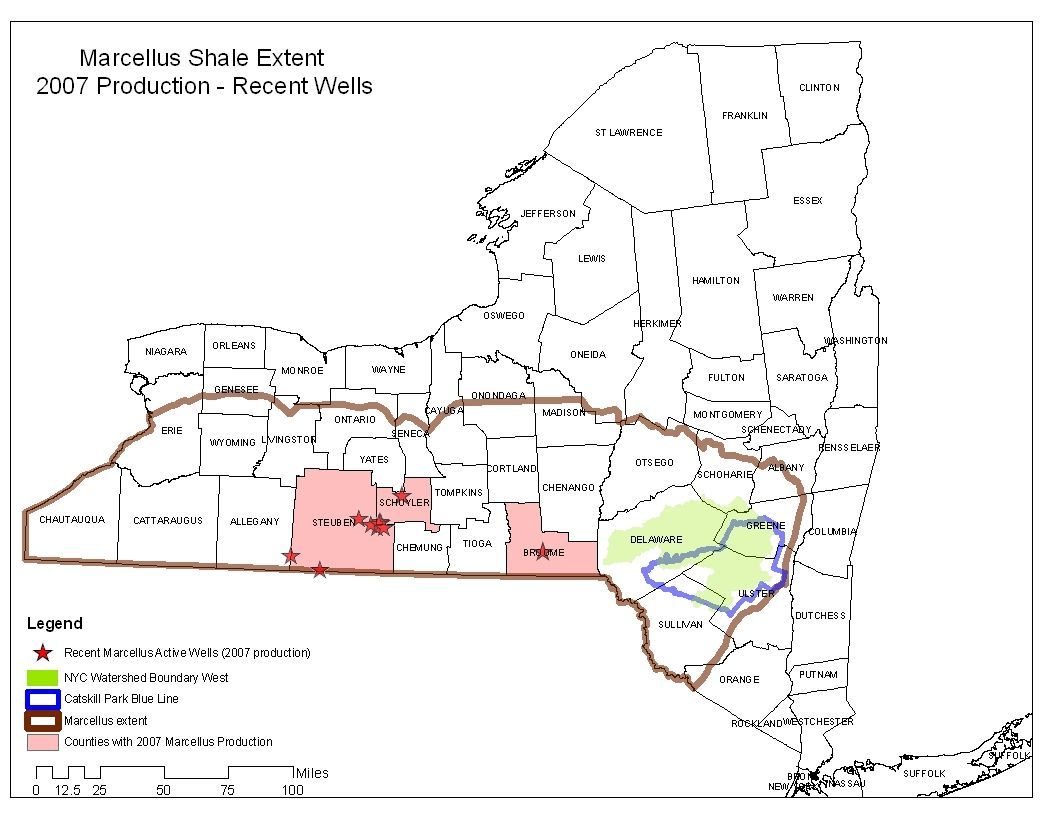
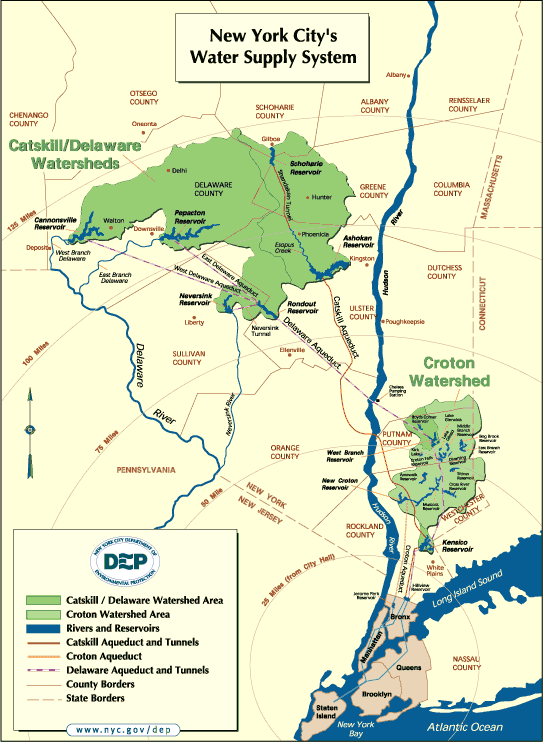
Even New York City is claiming a role, because a huge portion of its internationally renowned source of sweet drinking water originates in the Catskill Mountain watershed, which sits hard by—and in some cases directly over—the Marcellus Shale Play.

“The reality is that the city has no power in this matter,” says Manhattan Borough President Scott Stringer. “But that doesn’t mean that a borough president or residents can’t be mobilized and create a buzz.” As part of his effort to create that buzz, Stringer’s office has produced a report that lists examples from all over the country of disasters—from earthquakes to exploding houses—blamed on hydrofracking.

New York City Councilman James Gennaro, a trained geologist who heads up the council’s environmental committee, believes that the surface impacts of drilling alone represent a prima facie case for an outright ban on drilling in any environmentally sensitive area. “Even if you didn’t inject one drop of ‘fracking fluid’ into the ground, just setting up the wellhead, with the drilling pad and all the trucking involved, are activities that will lead to the degradation of the city’s water supply,” says Gennaro. NYDEC, for its part, says that it won’t permit drilling in any watershed unless that watershed can be “fully protected.”

Scott Roberts, who heads up mining regulation in Pennsylvania, does not discount the challenge that his division faces. In particular, he says, cleaning up the polluted water “is the 800-pound gorilla here. Just pumping it back out and impounding it is not dealing with it.”

There has been some discussion in the industry of pumping the brine back underground, a solution that Carol Collier, executive director of the Delaware River Basin Commission, describes as “a little squirrelly.” Pennsylvania’s Roberts is similarly skeptical of a back-to-the-ground solution and thinks that ultimately industry itself is going to have to take the lead in building facilities to clean up the discharge water.

While Pennsylvania regulators and the river-basin commissions debate these issues, New York continues to work on its draft generic environmental impact statement. However, those both inside and outside of New York State government worry about NYDEC’s capacity to regulate drilling in the Marcellus Shale Play. The NYDEC division that oversees mining and drilling is one of the agency’s smallest sections. A request for 30 new staff members was stripped out of this year’s budget in the face of New York’s abysmal fiscal situation.

NYDEC refutes the characterization that it’s not up to the task of regulating hydrofrack wells. In an e-mail response to questions, an agency spokesperson noted that one out of 10 wells currently operating in New York were hydrofracked, and that so far there have been no adverse environmental impacts associated with any of them. As for the manpower shortage, NYDEC notes, “There have not been and will be no shortcuts in permitting—every well application will get all due scrutiny and oversight. The only impact of more staff would be that more permits could be processed in a given time period.”

It’s not a statement that inspires confidence among hydrofracking’s opponents, who would prefer that new staff be devoted to regulation rather than to pushing permits through the system. But given the fiscal realities, it will probably have to do. Even NYDEC’s critics agree that the Marcellus Shale Play is going to be extensively tapped one way or the other. The trick is going to be finding a way, despite budget shortfalls, to do it without compromising the environment or public health.

“When you look at it, we’re trying to walk a line,” says the Delaware River Basin’s Collier. “Clearly, there’s an economic benefit to the gas, and there’s value from the standpoint of national energy policy. But it is only going to be beneficial if it is done wisely and minimizes the impact to all natural resources.”

CLICK HERE for the complete artcle.

DEMAND ACCOUNTABILITY!
Saturday, May 30, 2009

Gas drilling critics welcome move by U.S. regulator DRBC

By Jon Hurdle

PHILADELPHIA, May 29 (Reuters) - Opponents of natural gas drilling in the U.S. northeast on Friday welcomed new restrictions by an interstate regulator requiring prior approval for any new projects in the Delaware River basin.

Energy companies and their trade association criticized the new regulations and said they would need to study the ruling to determine what impact it would have on plans to exploit gas reserves that form part of the massive Marcellus Shale formation in Pennsylvania and parts of surrounding states.

The Delaware River Basin Commission said on May 19 that energy companies must obtain its approval before beginning extraction.

There is no current gas development in the area covered by the measure, although the commission has received about 100 applications from energy companies, said Clarke Rupert, a spokesman for the organization.

The action -- which precedes a formal rulemaking -- may slow development of the Marcellus Shale which is said to contain enough gas to meet U.S. needs for a decade or more.

The commission, representing Pennsylvania, New York, New Jersey, Delaware and the federal government, said its action reflects concern about the potential for damage to water quality in a 197-mile, non-tidal stretch of the river from Hancock, New York to Trenton, New Jersey.

DRBC Executive Director Carol Collier "determined that as a result of water withdrawals, wastewater disposals and other activities, natural gas extraction projects in shale formations may individually or cumulatively affect the water quality of Special Protection Waters by altering their physical, biological, chemical, or hydrological characteristics," the organization said in a statement.

The measure was hailed by critics of gas drilling who say the new "hydraulic fracturing" technique for gas extraction is contaminating groundwater with a cocktail of chemicals, some of them carcinogenic.

Activists have been particularly concerned about the possibility of pollution in the Delaware River watershed which supplies some 15 million people.

People living near drilling sites in Pennsylvania and other states have suffered from rashes, vomiting, and discolored water, while animals have died and some wells have been polluted with escaping methane, critics say. ...

Tracy Carluccio, deputy director of the Delaware Riverkeeper, a nonprofit environmental group, said the commission's action goes beyond the rules imposed by individual Pennsylvania or New York regulators, who activist accuse of treating energy companies too leniently.

"We think there should be some positive trickle-down on other agencies," Carluccio said.

Click HERE for the complete story.

DEMAND ACCOUNTABILITY!
RURAL IMPACT VIDEOS, 6 parts

Natural gas development in Colorado, the impacts on communities, environment and public health. A primer for public servants and residents of counties that care for their lifestyles.

Drilling for Gas in Bradford County, PA ... Listen!

Cattle Drinking Drilling Waste!

EPA... FDA... Hello? How many different ways are we going to have to eat this? ... Thank you TXSharon for all you do! ... Stay tuned in at http://txsharon.blogspot.com

Landfarms

A film by Txsharon. Thank you Sharon for all you do. Click HERE to read the complete article on Bluedaze: Landfarms: Spreading Toxic Drilling Waste on Farmland

SkyTruth: Upper Green River Valley - A View From Above