Showing posts with label DEC. Show all posts

Wednesday, August 4, 2010

N.Y. Senate Approves Fracking Moratorium

By MIREYA NAVARRO
nytimes.com
August 4, 2010

The New York State Senate voted 48 to 9 Tuesday night in Albany to issue a temporary moratorium on a type of natural gas exploration that combines hydraulic fracturing with horizontal drilling and the injection of millions of gallons of chemically treated water underground. The aim of the measure is to ensure an adequate review of safety and environmental concerns.

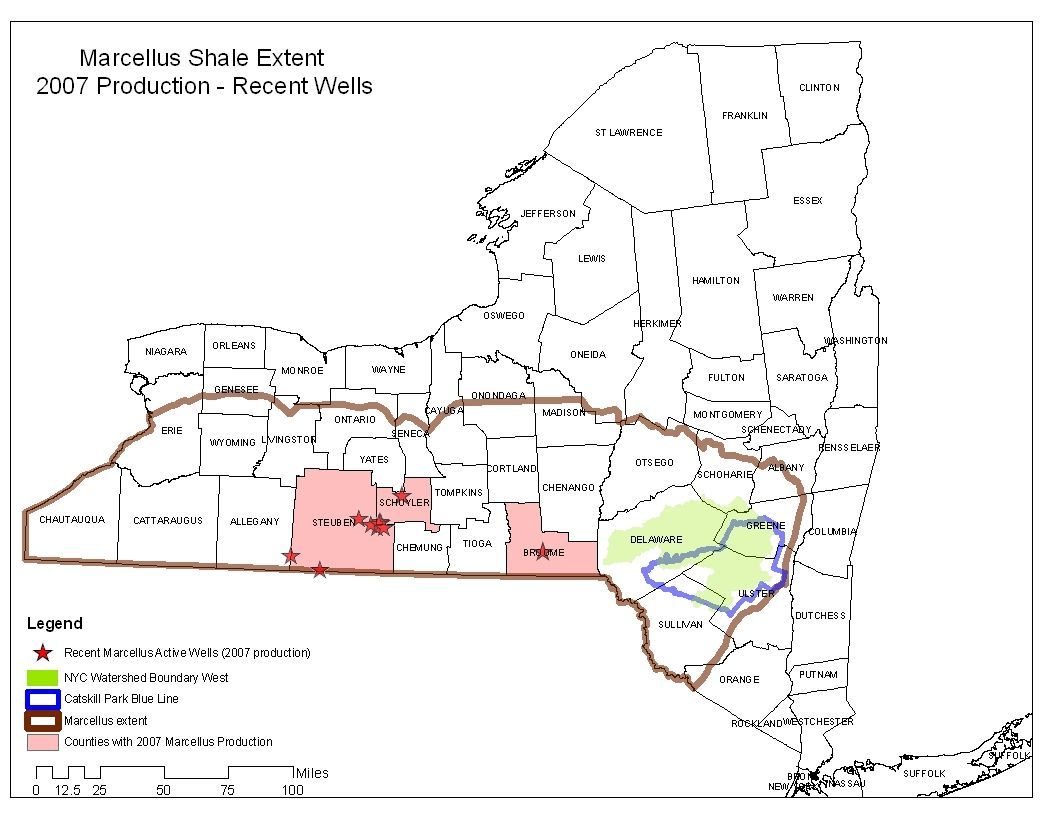
The state Department of Environmental Conservation is currently reviewing the environmental impact of drilling in upstate New York, where natural gas companies are buying up leases and applying for permits to tap the Marcellus Shale, one of the largest natural gas fields in North America.

The moratorium proposed in the bill would prevent new drilling permits from being issued for the Marcellus Shale until May 15, 2011. While the measure cannot become law before the state Assembly passes a similar bill, and that chamber is not expected to take up the issue until September, environmentalists said the vote was significant in that it buys state officials more time to examine safety issues. They noted that a new administration will be taking over after the November elections because Gov. David Paterson is not running for re-election.

“This is the first action in the country to put the brakes on this type of drilling to give New York the time we need to assess the risks if we’re going to move forward responsibly,” said Katherine Nadeau, a program director with Environmental Advocates of New York.

New York City officials, who oppose drilling anywhere near the watersheds that supply drinking water to the city, welcomed the vote. Councilman James F. Gennaro, head of the City Council’s environmental protection committee, called it “a historic victory for all New Yorkers.”

“Speaker Quinn and I urge the Assembly to follow the lead of the Senate and for Governor Paterson to sign this historic first-in-the-nation hydraulic fracturing moratorium bill,” he said, referring to Christine C. Quinn, the City Council speaker.

Officials with the Independent Oil and Gas Association of New York, a trade group, had no immediate comment on the vote. They have argued that delays and more regulation of gas exploration only serve to stifle an energy source that the nation sorely needs.

3:01 p.m. | Updated Brad Gill, the association’s executive director, said Wednesday that the moratorium is delaying the jobs, tax revenue and other benefits the state would attract with more drilling. “We have companies that want to come to New York, but in this regulatory and legislative climate and instability they’re going to Pennsylvania,” he said. “We’re just losing out on this economic opportunity.”

Horizontal hydraulic fracturing, or fracking, is controversial because of the chemicals and vast amounts of water it requires and the risks that opponents say it poses to groundwater. The Senate bill noted both the “risks of accidents” and “potential effects on the communities in which shale gas production is located, including traffic, noise and an influx of transient workers.”

The federal Environmental Protection Agency is currently holding hearings on the effects of hydrofracking as it conducts a national study.

LINK

DEMAND ACCOUNTABILITY!

Wednesday, April 28, 2010

Camillus bans use of hydrofracking to drill for natural gas

By John Stith/The Post-Standard
April 28, 2010, 3:34PM

Camillus, NY -- Camillus officials have banned hydrofracking anywhere in the town.

The town board passed a local law that bans drilling for natural gas using the horizontal hydraulic fracturing technique. The action does not affect vertical drilling, town Supervisor Mary Ann Coogan said.

Hydraulic fracturing —known commonly as fracking — involves injecting a mixture of water, sand and chemicals into the ground, fracturing underground rock and freeing natural gas trapped there. Industry officials say fracking is safe, but opponents say it poses environmental risks.

“It would pose a potential danger to water supplies as well as scarring the land,” Councilman James F. Salanger said of the fracking technique. Salanger chairs the board’s public works subcommittee.

Camillus isn’t alone in questioning the use of hydrofracking.

The state Department of Environmental Conservation is preparing regulations that would allow hydrofracking throughout New York. But just last week, the agency made it more difficult to use fracking in the watersheds that send drinking water to Syracuse or New York City. The DEC will allow fracking in the two watersheds but will require drilling companies to prepare an environmental impact statement for each drilling site, effectively making the cost of drilling prohibitive.

Earlier this year, both Onondaga County and DeWitt both passed moratoriums banning the use of fracking for a year while the technique is studied.

LINK

DEMAND ACCOUNTABILITY!

Assembly members push for uniform watershed protections in Marcellus shale drilling

EmpireStateNews.Net
Wednesday, April 28, 2010

ALBANY – Days after the state DEC announced it would require case-by-case review of any proposal to mine natural gas from Marcellus shale in the New York Watershed, Assembly members Kevin Cahill of Kingston and Barbara Lifton of Ithaca criticized the proposal.

The two lawmakers said there should be one standard, whether the hydraulic fracturing of the shale formation is in a watershed or not.

Cahill spells out their concerns. “There is no reason to be more protective of the drinking water of a child in New York City than there is to be protective of the drinking water for somebody who doesn’t happen to live in the New York City watershed,” he said. “One standard would work. If it’s not safe for the watershed, it ought not be considered safe for the rest of the state.”

Cahill and Lifton are asking the DEC to revisit their plans and come up with one unified plan for environmentally safe natural gas drilling.

LINK

DEMAND ACCOUNTABILITY!

Friday, April 23, 2010

NY ruling sets back gas drilling in watersheds

By Basil Katz
Reuters

NEW YORK, April 23 (Reuters) - New York state imposed new restrictions on shale gas drilling in watersheds for the cities of New York and Syracuse, citing concerns over drinking water safety and prompting victory calls from environmentalists.

The Department of Environmental Conservation (DEC) announced on Friday that applications to drill for shale gas in the two cities' watersheds will be taken on a case-by-case basis instead of falling under the general rules that will apply to the rest of the state.

For these cities it amounts to a "de facto ban" on the drilling process known as hydraulic fracturing, said Alex Matthiessen, president of environmental group Riverkeeper. He called the ruling a "huge win." ...

"Due to the unique issues related to the protection of New York City and Syracuse drinking water supplies, these watersheds will be excluded from the pending generic environmental review process for natural gas drilling," the state agency said.

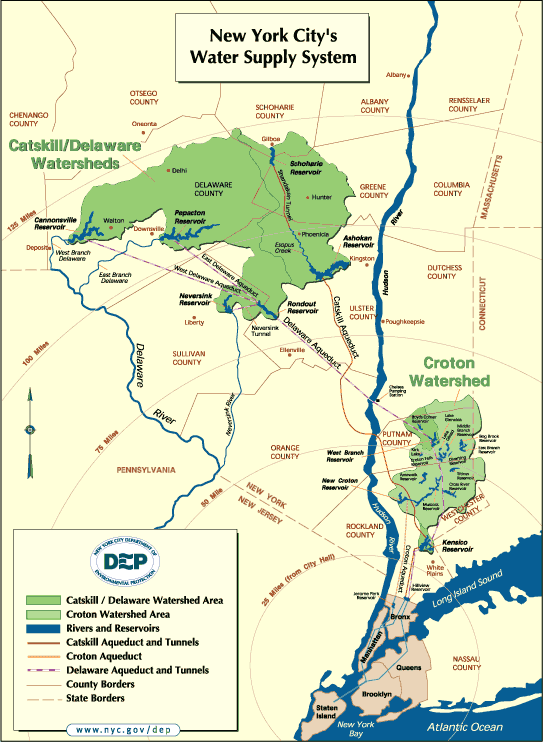
New York City joined environmentalists in December in voicing strong concern the process might harm the city's fresh water supplies, which come unfiltered from a 2,000-square-mile (5,200-square-km) watershed largely located in the Catskills Mountains north of the city.

"Portions of the Marcellus Shale where the city's watershed lies must be treated differently and the Department of Environmental Conservation's decision today recognizes that crucial fact," New York Mayor Michael Bloomberg said. ...

Some say the proposed separate track for the cities is not nearly enough and reiterated calls for a blanket ban.

"A complete ban on watershed drilling was the right thing a year ago, it's the right thing today, and it will remain the right thing for as long as we debate hydraulic fracturing in New York," Manhattan Borough President Scott Stringer said in a statement.

LINK

(Reporting by Basil Katz; editing by Daniel Trotta and Andre Grenon)

DEMAND ACCOUNTABILITY!

Wednesday, February 17, 2010

Update: Chesapeake withdrawing Pulteney wastewater site plans

stargazette.com
February 16, 2010


Chesapeake Energy is withdraw its permit applications to the U.S. Environmental Protection Agency and [New York] state Department of Environmental Conservation for a wastewater disposal facility in the Steuben County town of Pulteney.

Chesapeake's plans to convert an abandoned natural gas well into a disposal site for wastewater from the hydraulic fracturing process stirred up stiff public opposition.

The company indicated last week it would not pursue those plans, but also noted that it wasn't going to withdraw permit applications with the EPA or state Department of Environmental Conservation.

In letters sent to both agencies, Chesapeake indicated it changed its mind not because of public opposition, but because it has better options available.

"This decision is based primarily on the fact that the state will not allow completion of Marcellus shale wells until the Supplemental Generic Environmental Impact Statement is completed," the letters stated. "In addition, since initiating this project, we have advanced our operational capacity to reuse/recycle water produced in other areas of the Marcellus Shale, greatly reducing our current need for additional disposal facilities in New York."

Chesapeake's decision was applauded by state Sen. George H. Winner Jr., who opposed the plan to locate an injection well in Pulteney.

"It's the right decision, and I'm pleased that company officials have been more than willing to listen and give every consideration to the concerns of local leaders and local residents," Winner said in a news release.

LINK

DEMAND ACCOUNTABILITY!

Tuesday, January 5, 2010

Chesapeake says NY could drive away gas drillers

Accuses environmentalists of promoting "fear and panic"

By Edith Honan
(Reporting by Edith Honan; Writing by Daniel Trotta; Editing by Cynthia Osterman)

NEW YORK, Jan 5 (Reuters) - Chesapeake Energy (CHK.N) has called proposed New York state regulations for the shale gas drilling industry unnecessarily onerous and likely to scare energy companies out of state, depriving New York of badly needed revenue.

The sentiment was supported by competitor Fortuna Energy, a subsidiary of Canada's Talisman Energy (TLM.TO), which said it was shifting its focus to Pennsylvania because uncertainties in New York threatened to undermine its investments there.

"The measures proposed ... will be more burdensome than any of those placed on our industry throughout the United States," Chesapeake said in public comments made available to Reuters on Tuesday.

As a result, "some operators may elect to focus their risk capital in other states," the company said, which would mean New York would lose potential tax revenue from gas production at a time when the state is looking to close a $3.2 billion budget deficit.

The Oklahoma-based energy company, which on Monday announced a deal to sell a $2.25 billion stake in its Texas shale gas assets to French oil major Total (TOTF.PA), accused the state Department of Environmental Conservation (DEC) regulators of going overboard with environmental protections.

Fortuna said companies faced uncertainty over whether the state would issue drilling permits and it was looking toward Pennsylvania, where exploration of the Marcellus Shale is booming -- but it is also where some of the greatest environmental concerns have arisen.

"New York is facing the loss of at least hundreds of millions of dollars of direct economic impact stimulus and is forfeiting the opportunity to create thousands of new jobs at a time in our state's history when they have never been needed more," Fortuna lawyer Mark Scheuerman told the DEC.

Development of the massive Marcellus Shale in several northeastern states holds the promise of providing the United States with a valuable domestic energy source. But environmental concerns that shale gas drilling contaminates drinking water have created uncertainty for the industry because of the risk of greater regulation.

The U.S. Environmental Protection Agency is scrutinizing shale gas drilling, and the U.S. Congress is considering a bill that would force companies to disclose the chemicals that are mixed with water and sand in the process known as hydraulic fracturing.

New York Governor David Paterson proposed opening the Marcellus Shale to the technique. It has been taking place in New York but on a small scale and using relatively minor volumes of water compared to the current industry norm.

...

Until now, shale gas drillers in the state have been limited to less modern techniques that yield less energy.

HEALTH CONCERNS

Environmentalists have raised serious health concerns about the chemicals used in hydro-fracturing, including that they might cause cancer.

Neighbors of shale drilling operations in other states have complained their drinking water has become discolored or foul-smelling, their pets and farm animals have died from drinking it, and their children have suffered from diarrhea and vomiting.

Chesapeake accused critics of creating "fear and panic" with misleading or incorrect information and concerns "that have no basis in science or reality."

Chesapeake's views on the industry took on greater weight in light of its deal bringing Total into Chesapeake's Barnett Shale gas fields in north Texas.

That continued a trend in the industry of international oil majors buying shale gas assets. In December, the largest U.S. oil and gas company, Exxon Mobil (XOM.N), agreed to buy shale gas producer XTO Energy Inc (XTO.N) for about $30 billion.

LINK.

DEMAND ACCOUNTABILITY!

Tuesday, December 1, 2009

Marcellus Shale Drilling Recommendations from PA and NY


PA Enviro. Group Offers Gas Drilling Protections

By AP_Exchange
December 1, 2009

PITTSBURGH (AP) A Pennsylvania environmental group is suggesting five recommendations it says will help ensure gas drilled in the Marcellus Shale is done safely.

PennEnvironment recommends improving the public's right to access information about drilling, keeping some areas off limits to drilling and creating mandatory penalties for polluters. The group also recommends increasing state Department of Environmental Protection funding for expanded enforcement and strengthening existing clean water laws.

PennEnvironment released its recommendations Tuesday.

The potentially lucrative Marcellus Shale gas formation lies under about 60 percent of Pennsylvania. Environmentalists say drilling has polluted water and threatens public health.

NY Resident Offers Suggestions at DEC Public Hearing
on draft SGEIS
in Corning, November 18, 2009

Knowing a man whose water well was contaminated after seismic testing was done on his neighbor’s property, hearing a speaker from Pennsylvania who had a fish kill in his pond when the plastic liner of the evaporation pit leaked, and having read about benzene in water wells in Wyoming and ground-level ozone in rural Colorado, I think it is crucial that this draft be greatly strengthened after the EPA does its study of hydraulic fracturing. Here are some suggestions.

There will be thousands of truck trips per well pad. Diesel exhaust downwind can cause health problems from asthma to cancer (see studies attached). Therefore all trucks should be required to have diesel filters. The technology exists, right here in Corning, and New York could become a leader for other states to follow.

The report says private water wells within 1,000 feet of a gas well will be tested before drilling. That’s good but not good enough. Drilling may go 5,000 feet horizontally; so wells within a mile should be tested before drilling, a month after fracking, 6 months later and every year thereafter.

Setbacks of 2,000 feet are required for municipal water resources but only 150 feet for private wells. That’s discrimination. There should be a one-mile set back for drilling near any drinking water supply.

Since concrete can crack, the surface casing must cure long enough to withstand drilling. Therefore an inspector must be on site not only when the concrete is poured but also when the decision to drill is made, lest drillers start too soon to save time and money.
For drilling, “green” non-toxic chemicals should be used, as is done offshore. Very dangerous chemicals like 2-butoxy ethanol (an endocrine disruptor) and hexavalent chromium (a potent carcinogen) must be banned. The latter is notorious from the film “Erin Brockovich.” It now contaminates some 30 water wells near drilling in Midland, Texas, and cancer rates are high. In section 5.11.3 (p. 5-102) of this document chrome 6 is listed as typically found in the flowback from fracking in Pennsylvania and West Virginia. The DEC must prevent this.
CLICK HERE to read about Schlumberger's "Green Slurry", an environmentally safe fracking fluid developed for use in "environmentally sensitive regions". What kind of industrial and/or regulatory arrogance has determined that there is anywhere that is not an environmentally sensitive region??? WRITE LETTERS! DEMAND THE USE OF ENVIRONMENTALLY SAFE SOLUTIONS!!!
Another option is “green completions” instead of venting and flaring which emit volatile organic compounds (VOCs) and nitrous oxides. When combined in the presence of sunlight, these cause ground-level ozone, a mere speck of which burns holes in lung tissue. The Dallas/Fort Worth Airport required green completions in its deal with Chesapeake Energy in 2006. The DEC must require it in 2010.

In the draft document steel tanks are suggested for waste water. They should be required. Drilling permits should not be granted until viable treatment of the wastefluid is in place. With recent news that samples of brine analyzed by the DEC had excessively high levels of radium 226, the DEC must find a way to safely deal with radioactivity.

In conclusion, given shortcomings like the ones mentioned above and given the fact that the cumulative effect of all wells has not been addressed in the report, the DEC must redo the study and make very strong requirements if unconventional drilling is to be allowed. With DEC’s lack of money and manpower, however, the State of New York must levy a severance tax on the gas industry to fund the enforcement. Without both of these in place, an environmental and health disaster is inevitable.

Editorial comments by Splashdown in red.

DEMAND ACCOUNTABILITY!

Friday, October 30, 2009

STATEMENT OF BOROUGH PRESIDENT SCOTT M. STRINGER ON PLEDGE BY CHESAPEAKE ENERGY TO NOT DRILL IN NYC WATERSHED

Contact: Carmen Boon (212) 669-3882
Joan Vollero (212) 669-8143


FOR IMMEDIATE ATTENTION

The announcement today [Oct. 27] by Chesapeake Energy CEO Aubrey McClendon that his company will not drill for natural gas in New York City’s upstate watershed is an important step toward protecting our drinking water, but it’s not enough. Chesapeake’s leases in the watershed will expire after five years, and even before then there is no guarantee that Mr. McClendon will remain the head of the company.

Today I call on Mr. McClendon to translate his public statement to a legally binding commitment by selling his company’s leases in the watershed to New York City for one dollar. That way, the good words we’ve heard today will not be undercut by an unforeseen corporate deal a year or two from now, once this controversy has passed.

Chesapeake’s announcement validates the calls for a ban on drilling in the watershed that have come from concerned citizens, editorial pages, environmental groups, and elected officials like myself. The State environmental agency now finds itself in the uncomfortable position of lagging behind the industry it regulates in protecting New York City’s drinking water. The Department of Environmental Conservation must correct its mistake by immediately announcing a permanent and complete ban on drilling in the watershed.

Stephen Corson
Investigative Policy Analyst
Office of Manhattan Borough President Scott M. Stringer
One Centre Street, 19th Floor
New York, NY 10007
Phone: (212) 669-2392
Fax: (212) 669-3840

DEMAND ACCOUNTABILITY!

Monday, October 26, 2009

A new light on drilling

By ABRAHM LUSTGARTEN, Pro Publica
First published in print: Monday, October 26, 2009
(Albany) timesunion.com

New York may become the first state in the nation to demand that in certain situations companies that drill in New York be required to report the concentrations of the chemicals they use to state regulators.

The rules would reveal information that environmental scientists say is essential to investigating water pollution from drilling.

New York's recently released review of the environmental risks of proposed natural gas production in the Marcellus Shale in the state's Southern Tier also offers the clearest picture yet of the chemicals used in the drilling process called hydraulic fracturing.

The document makes public the names of 260 chemicals, more than eight times as many as Pennsylvania state regulators have compiled. The list, the most complete released by any state or federal agency, could help answer concerns about hydraulic fracturing in Congress and in states where gas drilling has increased in recent years.

The industry has been reluctant to release information about the chemicals it uses because it considers them trade secrets. While New York has made the names of the chemicals public, it seems likely the data about their concentration will be shared only with state officials.

...

Environmental scientists have long sought complete information about the chemicals used in hydraulic fracturing, saying they need it to thoroughly investigate water pollution. Contamination can occur when the chemicals are pumped underground, held in waste pits or trucked to water treatment plants before being discharged back into rivers and drinking water supplies.

...In Pennsylvania, environmental officials told ProPublica that their list of chemical products used for drilling there was complete, but it names just 39 products and 31 unique chemicals. ...

New York obtained the names of the chemicals by surveying drilling companies, their contractors and the manufacturers of the chemicals. The Department of Environmental Conservation identified 152 trademarked products and obtained the complete list of their ingredients; it gathered a partial list of ingredients for an additional 45 products.*

To read more CLICK HERE.

*See the following post for the list of chemicals used in drilling/fracking operations.

Friday, October 23, 2009

New York Drilling Study ‘A Big Step Forward’

by Abrahm Lustgarten, ProPublica
October 22, 2009 11:00 pm EDT

A drilling rig in the town of Barton, in Tioga County, N.Y. (NYS DEC 2008)

New York's recently released review of the environmental risks (PDF) posed by natural gas production in the Marcellus Shale offers the clearest picture yet of the chemicals used in the drilling process called hydraulic fracturing.

The document makes public the names of 260 chemicals, more than eight times as many as Pennsylvania state regulators have compiled. The list is the most complete released by any state or federal agency and could help answer concerns about hydraulic fracturing in Congress and in states where gas drilling has increased in recent years.

The review also takes another dramatic step by proposing that in certain situations companies that drill in New York be required to report the concentrations of the chemicals they use to state regulators, thereby creating a suite of information that environmental scientists say is essential to investigating water pollution from drilling. New York would be the first state to make such a demand.

...

"In a number of areas these regulations are more stringent than in other states," said Kate Sinding, a senior attorney with the Natural Resources Defense Council. "As commendable as that is, and wanting to give the department credit where credit is due, the bar set in most other states is so abysmally low, it still begs the question of whether stronger is strong enough."

Environmental scientists have long sought complete information about the chemicals used in hydraulic fracturing, saying they need it to thoroughly investigate water pollution. Contamination can occur when the chemicals are pumped underground, held in waste pits or trucked to water treatment plants before being discharged back into rivers and drinking water supplies.

Colorado passed regulations last year requiring companies to disclose the names of chemicals, but they apply only to chemicals held in 50-gallons drums or larger. Now the industry is suing Colorado to repeal the group of regulations that includes that clause. In Pennsylvania, environment officials told ProPublica that their list of chemical products used for drilling there was complete, but it names just 39 products and 31 unique chemicals. Congress has been debating a bill to require disclosure, but the industry is fighting the legislation with millions of dollars in lobbying efforts.

New York obtained the names of the chemicals by surveying drilling companies, their contractors and the manufacturers of the chemicals. The Department of Environmental Conservation identified 152 trademarked products and obtained the complete list of their ingredients; it gathered a partial list of ingredients for an additional 45 products.

The review, which was released last month, leaves some environmental concerns unanswered. It offers few specific measures to protect New York City's watershed -- the unfiltered source of drinking water for nearly half the state's population. It says that wastewater will be treated by facilities in New York and Pennsylvania, but does not confirm whether those plants have the capacity to receive Marcellus Shale wastewater or the technology to make that water safe. Critics also complain it does little to describe how several thousand new wells would cumulatively affect air and water quality, leaving the analysis to a per-well basis.

"The DEC's shocking refusal to assess cumulative impacts undermines the validity of the entire study and if implemented will lead to devastating, unanticipated outcomes," said Roger Downs, a conservation associate at the Sierra Club's Atlantic Chapter, which has called for a ban on drilling in New York despite the Sierra Club's general support for gas development in the United States.

The review does, however, deal directly with some of most critical problems that have led to contamination in other drilling states.

It suggests strict limits on the kind of open waste pits that have led to hundreds of cases of water contamination in other states; guarantees additional scientific review before drilling can happen near water supplies; and requires government inspectors to be more regularly involved at several stages of the drilling and fracturing processes. An environmental review, sometimes including public hearings, would be required each time a gas well is proposed within 150 feet of a private water well, stream or pond or within 300 feet of a reservoir. An additional environmental review would also be required before gas wells could be hydraulically fractured within 1,000 feet of water supply infrastructure, or within 2,000 feet of the surface. Private water wells within 1,000 feet of a gas well would be tested before drilling begins, to create a baseline for measuring any future pollution.

The review recommends requiring that chemical-laden wastewater from hydraulic fracturing be enclosed in steel tanks rather than pits at well sites, a practice that has been proven to reduce the risk of spills and prevent evaporation of chemicals into the air. Some waste could still be kept in open pits, but new rules would require that those pits be emptied after seven days, and that state inspectors check the pits and their liners before they can be used again.

The review also suggests strengthening structural requirements to prevent leaks from inside gas well pipes, and establishing an explicit chain of custody record to make sure drilling wastewater is delivered to treatment facilities that are capable of accepting it.

For the complete report, CLICK HERE.

DEMAND ACCOUNTABILITY!

Friday, October 2, 2009

Responses to NY DEC's Long Awaited Environmental Impact Statement Begin to Emerge

"The state’s mitigation proposals are half measures," Manhattan Borough President Scott Stringer said in a news release Wednesday night. "I believe the choice is simple: we either correct this error and ban drilling now, or soon enough the officials entrusted with protecting our environment will be asked to explain why they were asleep at the switch when it mattered most."

Provisions highlighted in the news release would make New York State’s environmental protections more stringent than those in many other drilling areas, but a quick review of the document indicates those provisions may be accompanied by conditions and stipulations, making it unclear exactly where the rules would apply and how they would be implemented.

To read the NY Dept. of Conservation's summary of the 809 page document, posted on Splashdown! on Sept. 30th, CLICK HERE.

New York Gov. David Paterson ordered the Supplemental Generic Environmental Impact Statement in July 2008, one day after a ProPublica investigation raised questions about the state’s preparedness to handle a rush of drilling in the Marcellus Shale. The governor has since made clear that drilling will eventually play a prominent role in the state’s economy.

In 2008, ProPublica also reported that New York was unprepared to treat the wastewater itself – the DEC said drillers would have to ship it to neighboring Pennsylvania. But ProPublica found that Pennsylvania’s specialized treatment plants don’t have the capacity for it either.

To read the ProPublica article, CLICK HERE.

According to the New York State SGEIS: The only regulatory role DEC has over disposal of flowback water at out-of-state municipal or industrial treatment plants is that transport of these fluids, which are considered industrial waste, must be by a licensed Part 364 Transporter. For informational purposes, Table 5.14 lists out-of-state plants that have been proposed for disposition of flowback water recovered in New York.

Table 5-14
Out-of-state treatment plants proposed for disposition of NY flowback water:

Treatment Facility - Location - County

Advanced Waste Services - New Castle, PA Lawrence

Eureka Resources - Williamsport, PA Lycoming

Lehigh County Authority Pretreatment Plant - Fogelsville, PA Lehigh

Liquid Assets Disposal - Wheeling, WV Ohio

Municipal Authority of the City of McKeesport - McKeesport, PA Allegheny

PA Brine Treatment, Inc. - Franklin, PA Venango

Sunbury Generation - Shamokin Dam, PA Snyder

Tri-County Waste Water Management - Waynesburg, PA Greene

Tunnelton Liquids Co. - Saltsburg, PA Indiana

Valley Joint Sewer Authority - Athens, PA Bradford

Waste Treatment Corporation - Washington, PA Washington
DRAFT SGEIS 9/30/2009, Page 5-123

Meanwhile, according to a report in the Ithaca Journal: With only 17 inspectors to enforce the state's newly proposed regulations overseeing the natural gas industry, it will be a while before the gas rush moving up the Appalachian basin takes hold in the Southern Tier.
...
"They do not have the manpower to do this. That's no secret," said Lindsay Wickham, a field adviser for the New York State Farm Bureau, an agency that advocates landowners' interests.
...
It does not address staffing necessary to enforce the regulations, which propose on-site inspection of critical operations, such as cementing well bores to protect aquifers from contamination.

"The report calls for a lot more hands-on inspection, and we are going to have to find ways to fund additional staff," said Assemblywoman Donna Lupardo, D-Endwell.
...
Once regulations are finalized, between 2,000 and 4,000 wells could be produced in Broome County in the coming decades, according to an economic report commissioned by the Broome County Legislature.

The rate at which permits are issued is a function of the staffing available to process them, DEC officials said. The smaller the staff, the slower the process.

It's clear to anyone doing the math -- 2,000 or more potential wells in Broome County alone, 47 applications already pending in the Southern Tier, only 17 inspectors -- conditions are ripe for a substantial backlog ... or for overworked regulators to cut corners.

"DEC has no intention of rubber stamping paperwork or permits just to speed things up, regardless of the number of applications that may come in," said Yancey Roy, a spokesman for the department. "The Department will work with existing staff to do this right."
...
Deborah Goldberg, an attorney for Earth Justice, said she is skeptical DEC staff facing a backlog of permits will sufficiently evaluate and track each one.

"Enforcement is absolutely key," she said. "Without it, the law is not worth the paper it is written on."

Advocates point to Pennsylvania, where Cabot Oil & Gas in Susquehanna County has been keeping regulators busy.
...
New York officials say they learned a lot watching problems unfold to the south, and that is reflected in their proposed regulations.To back them up, both opponents and critics agree, it's going to take more than 17 inspectors.

To read the complete Ithaca Journal article, by Tom Wilber, CLICK HERE.

DEMAND ACCOUNTABILITY!

Wednesday, September 30, 2009

Is Hydrofracking for Natural Gas Worth the Risk?

A controversial drilling technique uses and pollutes lots of water.

By Jonathan Walters | October 2009
GOVERNING

Russia and the Middle East have, by far, the largest proved reserves of natural gas on the planet. But the Marcellus Shale Play, a mile-deep, rock-bound reservoir stretching through New York, Pennsylvania and West Virginia, is the closest approximation this country has. Experts have described it as “the most drilled but least explored” natural-gas basin in America. They say it could yield 400 trillion gallons of natural gas—20 times the current national annual output.

...

However, to get at the Marcellus gas, drilling companies have to employ a controversial boring technique that involves mixing water with a cocktail of sand and toxic chemicals and then injecting that at high pressure into shale more than a mile underground in order to fracture the rock and release the gas.

This process, known as hydraulic fracturing or “hydrofracking,” has been utilized before in several states. But environmentalists claim that it causes everything from earthquakes to above-ground explosions, that it can irredeemably pollute groundwater, and that it drains streams of the water that in many places is a resource as precious as the gas it’s helping to recover.

While the industry disputes that hydrofracking is the cause of such mayhem, nobody disputes that setting up wells is an intensive industrial procedure, and that the drilling process itself uses and pollutes huge amounts of water. A single well requires between 1 million and 5 million gallons of water. About 40 percent of what’s injected into the wells is pumped back out, and it comes out dirty and salty and needs to be treated before it is discharged back into public waterways. Pennsylvania already has reported incidences of unacceptably salty water from hydrofrack wells being discharged into rivers.

That is why the Marcellus Shale wars have been fully engaged, as the irresistible search for energy resources and riches collides with arguments over environmental disaster. The battle pits neighbor against neighbor, full-time residents against weekend homeowners, elected officials against elected officials and states against localities (some Upstate New York localities have enacted moratoria on drilling, something the natural-gas industry claims they don’t actually have the authority to do). Although the fracas over Marcellus Shale is regional, it serves as a cautionary tale for any place that encounters an unexpected energy boom.

As the conflict over hydrofracking rages, one question above all has surfaced: Who is responsible for ensuring environmental protection and public-health safety in the face of an avalanche of drilling-permit applications?

The answer to that question is complicated by two realities: Water does not respect jurisdictional boundaries, and the regulatory framework for hydrofracking is both fragmented and overlapping. Under such circumstances, the U.S. Environmental Protection Agency could provide clarity. However, in the 2005 Energy Policy Act, Congress exempted hydraulic fracturing from federal oversight.

So are states equal to the job? Some are scrambling just to catch up. The New York Department of Environmental Conservation (NYDEC), the agency that reviews and approves drilling permits statewide, has been caught at least a little flatfooted on Marcellus and hydrofracking. Governor David Paterson signed an industry-supported law last year related to the spacing of wellheads. Rather than evaluating the environmental impacts on a well-by-well basis, as is normally required under state law, NYDEC is studying the collective impacts of hydrofracking though what’s called a “generic environmental impact statement.”

The Pennsylvania Department of Environmental Protection (PADEP) seems more prepared, at least when it comes to regulating individual drill sites. PADEP already has received 450 applications for drilling permits, and is in the process of hiring nearly 40 new regulators, paid for in part by a significant increase in permit fees on hydrofrack wells.

But the New York and Pennsylvania regulators are not the only players with skin in the game. Powerful watershed compacts, including the Delaware River Basin Commission and the Susquehanna River Basin Commission, have their own permitting processes. Those kick in whenever anyone wants to draw significant amounts of water out of their watersheds or dump significant amounts back in.

Even New York City is claiming a role, because a huge portion of its internationally renowned source of sweet drinking water originates in the Catskill Mountain watershed, which sits hard by—and in some cases directly over—the Marcellus Shale Play.

“The reality is that the city has no power in this matter,” says Manhattan Borough President Scott Stringer. “But that doesn’t mean that a borough president or residents can’t be mobilized and create a buzz.” As part of his effort to create that buzz, Stringer’s office has produced a report that lists examples from all over the country of disasters—from earthquakes to exploding houses—blamed on hydrofracking.

New York City Councilman James Gennaro, a trained geologist who heads up the council’s environmental committee, believes that the surface impacts of drilling alone represent a prima facie case for an outright ban on drilling in any environmentally sensitive area. “Even if you didn’t inject one drop of ‘fracking fluid’ into the ground, just setting up the wellhead, with the drilling pad and all the trucking involved, are activities that will lead to the degradation of the city’s water supply,” says Gennaro. NYDEC, for its part, says that it won’t permit drilling in any watershed unless that watershed can be “fully protected.”

Scott Roberts, who heads up mining regulation in Pennsylvania, does not discount the challenge that his division faces. In particular, he says, cleaning up the polluted water “is the 800-pound gorilla here. Just pumping it back out and impounding it is not dealing with it.”

There has been some discussion in the industry of pumping the brine back underground, a solution that Carol Collier, executive director of the Delaware River Basin Commission, describes as “a little squirrelly.” Pennsylvania’s Roberts is similarly skeptical of a back-to-the-ground solution and thinks that ultimately industry itself is going to have to take the lead in building facilities to clean up the discharge water.

While Pennsylvania regulators and the river-basin commissions debate these issues, New York continues to work on its draft generic environmental impact statement. However, those both inside and outside of New York State government worry about NYDEC’s capacity to regulate drilling in the Marcellus Shale Play. The NYDEC division that oversees mining and drilling is one of the agency’s smallest sections. A request for 30 new staff members was stripped out of this year’s budget in the face of New York’s abysmal fiscal situation.

NYDEC refutes the characterization that it’s not up to the task of regulating hydrofrack wells. In an e-mail response to questions, an agency spokesperson noted that one out of 10 wells currently operating in New York were hydrofracked, and that so far there have been no adverse environmental impacts associated with any of them. As for the manpower shortage, NYDEC notes, “There have not been and will be no shortcuts in permitting—every well application will get all due scrutiny and oversight. The only impact of more staff would be that more permits could be processed in a given time period.”

It’s not a statement that inspires confidence among hydrofracking’s opponents, who would prefer that new staff be devoted to regulation rather than to pushing permits through the system. But given the fiscal realities, it will probably have to do. Even NYDEC’s critics agree that the Marcellus Shale Play is going to be extensively tapped one way or the other. The trick is going to be finding a way, despite budget shortfalls, to do it without compromising the environment or public health.

“When you look at it, we’re trying to walk a line,” says the Delaware River Basin’s Collier. “Clearly, there’s an economic benefit to the gas, and there’s value from the standpoint of national energy policy. But it is only going to be beneficial if it is done wisely and minimizes the impact to all natural resources.”

CLICK HERE for the complete artcle.

DEMAND ACCOUNTABILITY!
RURAL IMPACT VIDEOS, 6 parts

Natural gas development in Colorado, the impacts on communities, environment and public health. A primer for public servants and residents of counties that care for their lifestyles.

Drilling for Gas in Bradford County, PA ... Listen!

Cattle Drinking Drilling Waste!

EPA... FDA... Hello? How many different ways are we going to have to eat this? ... Thank you TXSharon for all you do! ... Stay tuned in at http://txsharon.blogspot.com

Landfarms

A film by Txsharon. Thank you Sharon for all you do. Click HERE to read the complete article on Bluedaze: Landfarms: Spreading Toxic Drilling Waste on Farmland

SkyTruth: Upper Green River Valley - A View From Above