
Showing posts with label CANCER. Show all posts

Tuesday, January 5, 2010

Chesapeake says NY could drive away gas drillers

Accuses environmentalists of promoting "fear and panic"

By Edith Honan
(Reporting by Edith Honan; Writing by Daniel Trotta; Editing by Cynthia Osterman)

NEW YORK, Jan 5 (Reuters) - Chesapeake Energy (CHK.N) has called proposed New York state regulations for the shale gas drilling industry unnecessarily onerous and likely to scare energy companies out of state, depriving New York of badly needed revenue.

The sentiment was supported by competitor Fortuna Energy, a subsidiary of Canada's Talisman Energy (TLM.TO), which said it was shifting its focus to Pennsylvania because uncertainties in New York threatened to undermine its investments there.

"The measures proposed ... will be more burdensome than any of those placed on our industry throughout the United States," Chesapeake said in public comments made available to Reuters on Tuesday.

As a result, "some operators may elect to focus their risk capital in other states," the company said, which would mean New York would lose potential tax revenue from gas production at a time when the state is looking to close a $3.2 billion budget deficit.

The Oklahoma-based energy company, which on Monday announced a deal to sell a $2.25 billion stake in its Texas shale gas assets to French oil major Total (TOTF.PA), accused the state Department of Environmental Conservation (DEC) regulators of going overboard with environmental protections.

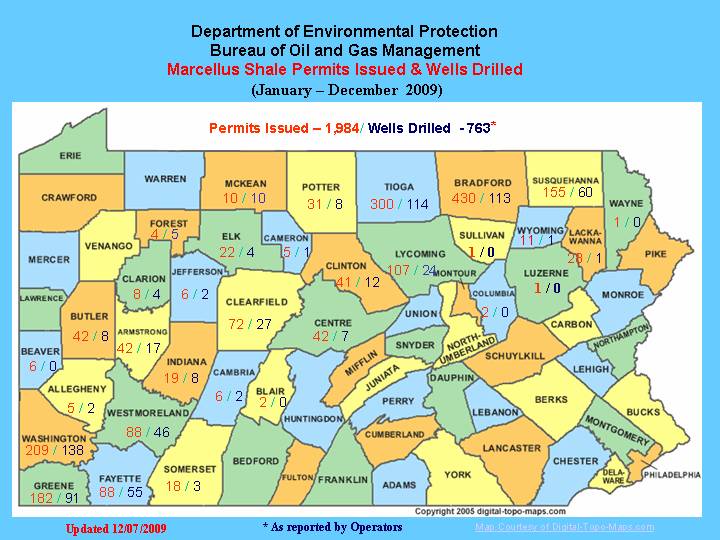
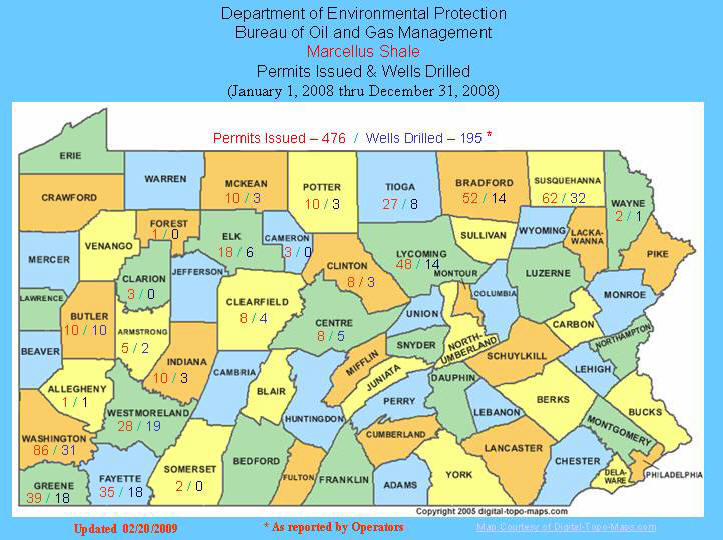
Fortuna said companies faced uncertainty over whether the state would issue drilling permits and it was looking toward Pennsylvania, where exploration of the Marcellus Shale is booming -- but it is also where some of the greatest environmental concerns have arisen.

"New York is facing the loss of at least hundreds of millions of dollars of direct economic impact stimulus and is forfeiting the opportunity to create thousands of new jobs at a time in our state's history when they have never been needed more," Fortuna lawyer Mark Scheuerman told the DEC.

Development of the massive Marcellus Shale in several northeastern states holds the promise of providing the United States with a valuable domestic energy source. But environmental concerns that shale gas drilling contaminates drinking water have created uncertainty for the industry because of the risk of greater regulation.

The U.S. Environmental Protection Agency is scrutinizing shale gas drilling, and the U.S. Congress is considering a bill that would force companies to disclose the chemicals that are mixed with water and sand in the process known as hydraulic fracturing.

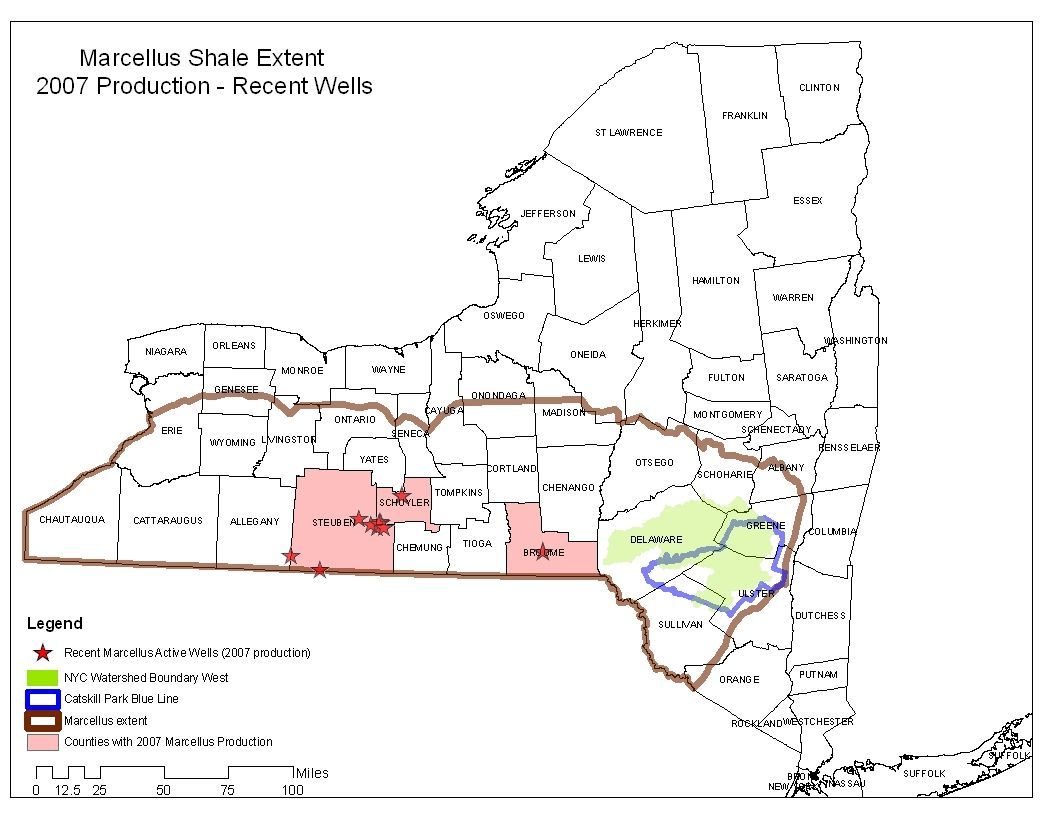
New York Governor David Paterson proposed opening the Marcellus Shale to the technique. It has been taking place in New York but on a small scale and using relatively minor volumes of water compared to the current industry norm.

...

Until now, shale gas drillers in the state have been limited to less modern techniques that yield less energy.

HEALTH CONCERNS

Environmentalists have raised serious health concerns about the chemicals used in hydro-fracturing, including that they might cause cancer.

Neighbors of shale drilling operations in other states have complained their drinking water has become discolored or foul-smelling, their pets and farm animals have died from drinking it, and their children have suffered from diarrhea and vomiting.

Chesapeake accused critics of creating "fear and panic" with misleading or incorrect information and concerns "that have no basis in science or reality."

Chesapeake's views on the industry took on greater weight in light of its deal bringing Total into Chesapeake's Barnett Shale gas fields in north Texas.

That continued a trend in the industry of international oil majors buying shale gas assets. In December, the largest U.S. oil and gas company, Exxon Mobil (XOM.N), agreed to buy shale gas producer XTO Energy Inc (XTO.N) for about $30 billion.

LINK.

DEMAND ACCOUNTABILITY!

Saturday, January 2, 2010

EPA questions New York state plan to drill for shale gas

Thu Dec 31, 2009

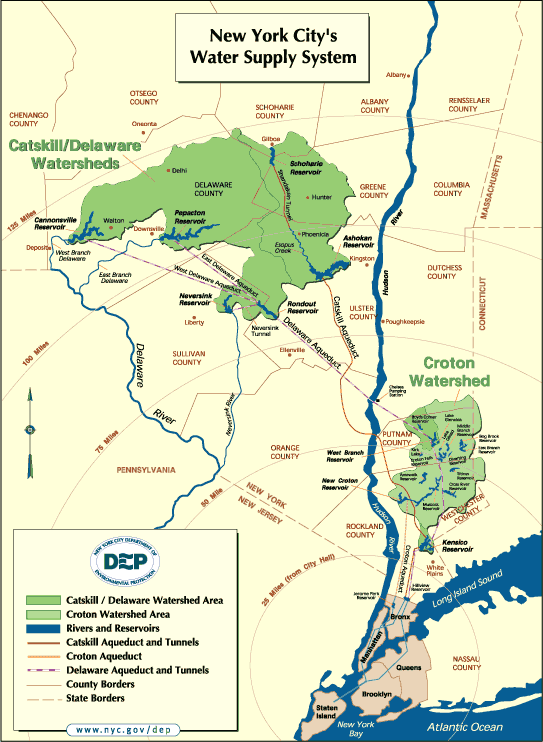
PHILADELPHIA (Reuters) - The U.S. Environmental Protection Agency has "serious reservations" about allowing shale gas drilling in New York City's watershed, warning of a threat to the drinking water for 9 million people.

An EPA report on the divisive issue is the latest potential roadblock for energy companies seeking to exploit the Marcellus Shale formation, which state officials say may contain enough natural gas to satisfy U.S. demand for more than a decade.

"We have concerns regarding potential impacts to human health and the environment that we believe warrant further scientific and regulatory analysis," wrote John Filippelli, chief of the agency's Strategic Planning and Programs Branch.

"EPA has serious reservations about whether gas drilling in the New York City watershed is consistent with the vision of high-quality unfiltered water supply," he wrote in the agency's report, dated Wednesday.

Last week, New York City asked the state to ban shale gas drilling in the city's watershed.

At issue is the controversial process of shale gas extraction known as hydraulic fracturing, or "fracking," in which a combination of chemicals, sand and water are blasted through rock to free trapped gas. Fracking is exempted from regulation under the U.S. Clean Water Act.

The natural gas industry argues that drilling poses no risk to drinking water, saying the chemicals are injected through layers of steel and concrete thousands of feet below aquifers.

But opponents argue that toxic fracking chemicals are contaminating drinking water, citing numerous reports of private wells near gas installations having water that is discolored, foul tasting, or even flammable because of methane that has escaped from drilling operations.

Theo Colborn, a researcher with the Endocrine Disruption Exchange who has drawn links between fracturing chemicals and a range of illnesses including cancer, said the EPA report indicates the agency was taking a new look at fracturing in light of growing public concern and media coverage.

"The natural gas industry can't keep saying it's clean," she said.

TO DRILL OR NOT TO DRILL

"We're pleased to see that the EPA recognizes what the state so far has not, that gas drilling is entirely inappropriate with in the drinking supply for 9 million people," said James Simpson, a staff attorney for Riverkeeper, a New York environmental group.

Eric Goldstein, a senior lawyer for the Natural Resources Defense Council, said the state's proposal "will require a dramatic rethinking and revamping if it is going to pass muster with federal guardians of water quality.

...

For complete article, CLICK HERE.

DEMAND ACCOUNTABILITY!

Wednesday, October 21, 2009

Delaware River Impacts From Natural Gas Drilling

Delaware River Basin Commission "Doesn’t Ask" what will happen to hundreds of millions of gallons of toxic wastewater when deciding on million gallon a day water withdrawal permit
By Iris Marie Bloom
Community Contributor
(Phila.) Weekly Press
21 Oct. 09

Upstate, some folks have started putting spikes in the roads to block trucks related to the natural gas industry. Downstate, meetings have stayed polite but tense, so far.

In New York, the Executive Committee of the Sierra Club decided on October 17, looking at the damage across the river in Pennsylvania so far, to ask New York State to ban hydraulic extraction, the water-intensive new natural gas technology, outright. But in Pennsylvania last week, the state legislature decimated its own environmental regulatory agency, the Department of Environmental Protection, with 27% cuts, while protecting the natural gas industry from a severance tax that would have given state coffers 90 million dollars this year, according to its sponsor. As soon as that was accomplished, Rendell’s point man on the issue went to work for the industry.

Nationally, clean water advocates are working to pass the FRAC Act, a bill to restore the Clean Drinking Water Act. The FRAC Act would close a loophole exempting hydraulic extraction – which has contaminated drinking water with toxic substances in at least three states so far, including Pennsylvania – from federal regulation.

What’s that all got to do with Philadelphia? Here, it’s all about drinking water.

The Delaware River Basin Commission (DRBC) indicated at a meeting sponsored by the American Water Resources Association in Center City on October 15th that it will likely approve a massive withdrawal request for a million gallons of water per day from the Upper Delaware River. Off the record, some officials indicated that public outcry and "TV cameras" might make a difference. All of the water will be mixed with toxic chemicals at a ratio of about 7,500 chemicals per million and a half gallons of water, according to the natural gas industry. Both the industry and the DRBC concur that no plan currently exists to treat the resulting heavily polluted wastewater. Hundreds of millions of gallons of wastewater will be brought back to the surface from natural gas drilling operations and stored in pits (some open, some closed), with a certain amount of inevitable spills, until industry officials and regulators figure out what to do with it.

That could take years. There are currently no treatment plants in Pennsylvania capable of adequately treating the heavily polluted wastewater. Building new plants capable of doing so is extremely expensive, and officials estimate it would take about 50 such plants to handle the anticipated discharge. There is no information available about what might happen to the 40% to 70% of the contaminated water left behind, deep in the ground.

Meanwhile, Carol Collier, Executive Director of the DRBC, commented on October 15 that perhaps the wastewater would be "trucked downstream to where TDS (total dissolved solids, the most measurable and obvious component of frac wastewater) is not such an issue." Translated into simple language, that apparently means discharging the water in the Delaware River far south of where it is being trucked (200 trucks a day, leaving every 7 to 8 minutes) to natural gas pads in northern Pennsylvania. South of Trenton, the Delaware River has a greater volume of water to dilute the pollution. North of Trenton, the Delaware is better protected from severe pollution under the environmental designation, "Special Protection Waters."

Fifty percent of Philadelphia’s drinking water comes from the Delaware River; fifty percent comes from the Schuylkill River, which may also be impacted.

What’s in those chemicals? The exact formulas are not disclosed, at least as long as the process remains exempt from the Safe Drinking Water Act. But EPA officials and other scientists have identified 54 to 300 components of "frac fluid" and wastewater resulting from hydraulic fracturing for natural gas in deep shale layers, such as the Marcellus Shale in Pennsylvania.

The components include known carcinogens and powerful fish pesticides, and the wastewater includes radioactive material from underground as well as heavy metals and extreme amounts of salt from ancient oceans.

The DRBC is still accepting public comment about the proposal from Chesapeake Appalachia, LLC to withdraw a million gallons a day in Wayne, PA, and may make their decision about the proposal and other proposals pending in November. The agency is under tremendous pressure to approve the proposal. Appalachia has taken out ads in northern Pennsylvania blaming the DRBC for keeping landowners from getting the royalties they expect after leasing their lands to gas companies. Hostility towards the DRBC from landowners is mounting accordingly.

In related recent news, one to three spills of frac fluid, from 5,000 to 8,000 gallons, occurred last week in Dimock, PA. Last month, 161 species completely died off in Dunkard Creek in Southwestern PA, creating a mystery that investigators have still not solved. Last week the DEP issued drinking water notices again for the Monongahela River due to unacceptable levels of total dissolved solids (TDS), a result of hydraulic fracturing wastewater being discharged into the river. The Monongahela River provides drinking water to 350,000 people in Pennsylvania.

In August, the EPA confirmed the presence of 2-BE (butoxyethanol), which is associated with kidney damage, harm to the adrenal gland, and reproductive problems, in drinking water both in Colorado and in Pavillion, Wyoming, in association with hydraulic extraction for natural gas there. Butoxyethanol is a known constituent of fracing fluid.

Citizens in both states complaining of adrenal cancer, seizures, birth defects and miscarriages have called for a halt to hydraulic fracturing in their regions after 2-BE contamination in their drinking water was confirmed by the EPA.

At the October 15 public meeting, DRBC director Collier was asked whether existing treatment plants in Pennsylvania have the capacity to treat chemicals such as 2-BE. She answered, "I don’t know."

Collier was also asked for clarification: "Are you saying that you plan to approve the withdrawal of a million gallons a day from the Delaware River without any plan to treat the resulting wastewater?"

The answer was yes: "We don’t ask that question [what will happen to the wastewater] when we are approving water withdrawal proposals."

To continue reading this article, CLICK HERE.

DEMAND ACCOUNTABILITY!

Saturday, September 26, 2009

Gas-extraction chemicals dangerous

Observer-Reporter.com
Candy S. DeBerry, Ph.D.
North Franklin Township


The identity of many of the chemicals and the proportions in which they are used in gas extraction from Marcellus shale are not really known. Of those that have been reported, the Endocrine Disruption Exchange (www.endocrinedisruption.org) states that 73 percent are known to be damaging to human health. Of the damaging chemicals, 95 percent affect the respiratory system - and remember that Washington County and Allegheny County [PA] already are among the 35 counties in the entire United States with the lowest (worst) air quality.

Furthermore, 44 percent of the potentially harmful chemicals are endocrine disruptors that effect development and reproduction. Think bis-phenol A and hard plastic water bottles; think lowered sperm counts in males and increasingly early puberty in boys and girls; think about the mounting evidence for a connection between endocrine disruptors and autism.

Other of these chemicals affect the brain and nervous system, the heart, the liver and the immune system. Approximately 30 percent are known to contribute to the development of cancer. Most of the effects are long-term and the extent of damage to human health won't be apparent for years or even decades after gas drilling has stopped.

Will the gas company clean all of the chemicals out of the water they use? They regularly dump enormous amounts of dissolved salt and other dissolved solids into the Monongahela River as brine water from fracturing operations. That's not counting the leaks and spills such as the one that killed salamanders, crayfish and other aquatic life in Cross Creek Park in May.

Not near the drilling operation? Don't breathe a sigh of relief - 45 percent of the chemicals known to harm humans are volatile. They'll get into the air and blow over everyone's property, well or no well.

And that $40-per-month that is a realistic average estimate for the amount you'll get for the gas they extract from under your property? Better think about saving it for future medical bills.

To read this letter in its originally published site, CLICK HERE.

DEMAND ACCOUNTABILITY!

Friday, September 11, 2009

How Diesel Exhaust Grows Cancer

By Julia Whitty
Wed September 2, 2009
Mother Jones

NOMAC Rig #117, Bradford Co., PA

A link has been found between diesel fumes and cancer and it lies in the ability of diesel exhaust to grow new blood vessels supplying solid tumors.

The new research, forthcoming in Toxicology Letters, found that more new blood vessels sprouted in mice exposed to diesel exhaust than in mice exposed to clean filtered air. The growth occurred in both healthy and diseased animals—meaning that even healthy bodies are susceptible to the damaging effects of diesel.

The problem lies in the size of inhaled diesel particles. Most are less than 0.1 micron in diameter—that's less than one-tenth of a millionth of a meter. Such tiny particles penetrate the blood stream, organs, and tissues to damage practically any part of the body.

Photo courtesy the US Environmental Agency

Exposure levels in the study mimicked the exposures of people living in urban areas and of people commuting in heavy traffic. The levels were lower than, or similar to, those typically experienced by workers using diesel-powered equipment and those working along railroads, in mines, tunnels, vehicle maintenance garages, on bridges, farms, and at loading docks.

For more on this story, CLICK HERE.

DEMAND ACCOUNTABILITY!

RURAL IMPACT VIDEOS, 6 parts

Natural gas development in Colorado, the impacts on communities, environment and public health. A primer for public servants and residents of counties that care for their lifestyles.

Drilling for Gas in Bradford County, PA ... Listen!

Cattle Drinking Drilling Waste!

EPA... FDA... Hello? How many different ways are we going to have to eat this? ... Thank you TXSharon for all you do! ... Stay tuned in at http://txsharon.blogspot.com

Landfarms

A film by Txsharon. Thank you Sharon for all you do. Click HERE to read the complete article on Bluedaze: Landfarms: Spreading Toxic Drilling Waste on Farmland

SkyTruth: Upper Green River Valley - A View From Above