Wednesday, November 4, 2009

ACTION ALERT! 2 quick ways to help make clean water a reality


1. Right Now!

Contact your Members of Congress:

The Chesapeake Clean Water and Ecosystem Restoration Act is new legislation just introduced in both the U.S. Senate and the House of Representatives. This legislation will clean up both the Chesapeake Bay and our own rivers and streams for swimming, fishing, and boating. It will set a legally binding deadline to clean up the Bay and our local waterways by 2025 and puts some legal muscle behind President Obama’s Executive Order on Bay clean up. It will also create regional pollution caps covering all waterways that lead to the Bay.

Unfortunately, these bills were introduced without a single cosponsor from Pennsylvania. We can – and must — do better than that.

We need your help in getting Pennsylvania’s members of Congress to step up and fight for clean water. With Pennsylvania providing more than half of the water that makes up the Chesapeake Bay (much of it polluted), having our members of Congress cosponsor the bill is crucial. The legislation will also mean our own rivers and streams — the Juniata, Conodoguinet, Octoraro, Loyalsock, and Susquehanna — get cleaned up.

Please contact your members of Congress (click this link for an instant letter) and urge them to join in sponsoring this critical Clean Water legislation. Let them know you support clean and healthy water and that you expect them to do the same.

2. Beginning Nov. 9th
In May, President Obama issued an historic Executive Order on Chesapeake Bay clean up, the first and only one about the environment. The President recognized the Chesapeake Bay as a national treasure and called on the federal government to lead a new effort to protect the nation’s largest estuary (where the river meets the sea) and all the waters that drain to it. A Federal Leadership Committee will oversee the drafting of seven reports to outline how our federal agencies can protect and restore our water resources.

Your public input is vital. The draft strategy and revised reports will be released on Monday, November 9, 2009; the public comment period will begin then.

So mark your calendars for November 9 and let the Federal Leadership Committee know what clean water means to you. Your comments will mean a strong plan of action for the Bay.

DEMAND ACCOUNTABILITY!

And do your part...

DEC Extends Public Comment Period for Marcellus Shale Draft SGEIS

News from New York State Department of Environmental Conservation

For more information contact: Yancey Roy, 518-402-8000

ALBANY, NY (11/04/2009)(readMedia)-- The New York State Department of Environmental Conservation today announced it has extended the public comment period on the draft Supplemental Generic Environmental Impact Statement (SGEIS) governing potential natural gas drilling activities in the Marcellus Shale formation from Nov. 30 to Dec. 31.

The SGEIS addresses the range of potential impacts of shale gas development using horizontal drilling and high-volume hydraulic fracturing and outlines safety measures, protection standards and mitigation strategies that operators would have to follow to obtain permits. The full draft SGEIS (www.dec.ny.gov/energy/58440.html) is available on DEC's web site, along with highlights of the document (www.dec.ny.gov/press/58472.html). Printed copies are available for review at DEC regional offices and most sub-offices and libraries that traditionally have served as repositories. A list of repositories (www.dec.ny.gov/energy/58672.html) can be found on DEC's web site.

DEC is offering four ways in which to submit comments. Comments may be provided at one of the scheduled public hearings (www.dec.ny.gov/energy/58705.html). There is an online submission system (www.dec.ny.gov/cfmx/extapps/SGEISComments/) which will allow interested parties to write comments and tag them to specific areas of concern. Attachments can also be included. E-mail comments may be submitted to dmnsgeis@gw.dec.state.ny.us; please include your name, e-mail or return mail address to ensure notice of the Final SGEIS when it is available. Finally, written comments should be sent to: Attn: dSGEIS Comments, Bureau of Oil & Gas Regulation, NYSDEC Division of Mineral Resources, 625 Broadway, Third Floor, Albany, NY 12233-6500.

*** Note: DEC also has moved up the start time of the hearing in New York City on November 10. Doors will open at 5:30 p.m. for individual questions and speaker sign-up. DEC staff will be available at this time to answer individual questions about the format and contents of the draft SGEIS. The public comment session will begin at 6:30 p.m.

DEMAND ACCOUNTABILITY!

Penn. natgas water treatment plant challenged

REUTERS
Tue Nov 3, 2009 5:15pm EST
By Jon Hurdle


PHILADELPHIA - Environmentalists have challenged the proposed construction of a plant that would process waste water from natural gas drilling in Pennsylvania's booming Marcellus Shale field, an activist group said on Tuesday.

Clean Water Action, a nonprofit, said the plant would discharge drilling waste into the Monongahela River in southwest Pennsylvania without testing for most of the toxic chemicals that form part of the fluid.

...

Clean Water Action accused the state's Department of Environmental Protection of illegally entering an agreement with Shallenberger Construction Inc, a water infrastructure contractor, to build the plant at Masontown in southwest Pennsylvania.

The plant would dump 500,000 gallons (1.9 million litres) of gas drilling waste water a day into the Monongahela River, violating federal clean-water standards, the group said.

The DEP has failed to control many of the chemicals that are used in hydraulic fracturing, a technique widely used to extract gas from deep deposits beneath Pennsylvania and parts of surrounding states, it added.

"Carcinogens like arsenic and benzene are required to be limited in our water to protect our health," said Myron Arnowitt, state director for Clean Water Action. "Yet DEP is not even testing for these dangerous toxins, let alone requiring some kind of treatment."

Clean Water Action, represented by the environmental law firm Earthjustice, called the agreement a "backroom deal" which was issued without any formal notice in an official state bulletin.

...

Critics say waste water from Marcellus drilling far exceeds the capacity of the state to process it so that it can be safely discharged into waterways.

Energy companies ... decline to specify the chemicals they use in fracking fluid, saying the mixture is proprietary, but contend they operate many safeguards that prevent any escape of the chemicals into water supplies.

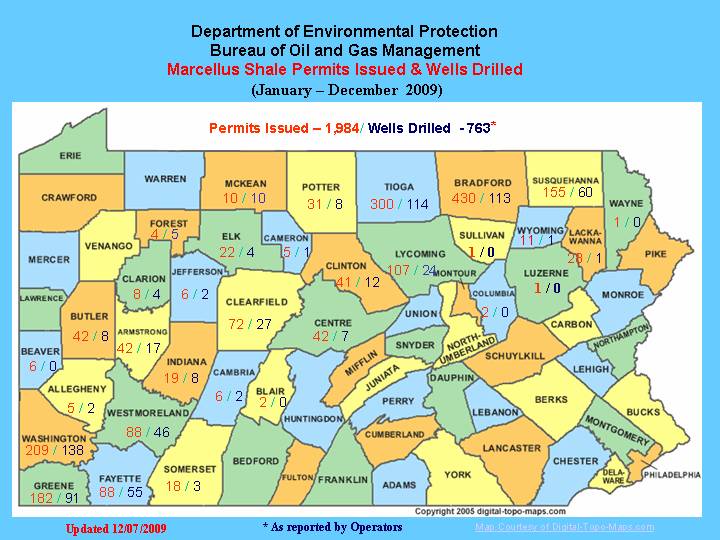
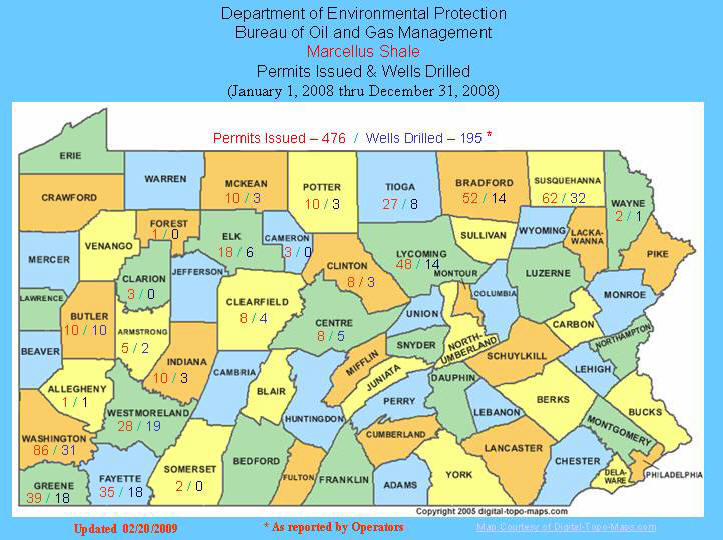
The DEP issued 1,500 permits for drilling in the Marcellus from Jan. 1 to Oct. 23 this year, up from 476 for all of 2008 and 93 for the four years from 2003 to 2007, [DEP spokeswoman, Teresa] Candori said.

For the complete article, CLICK HERE.

(Editing by Daniel Trotta and Marguerita Choy)

DEMAND ACCOUNTABILITY!

The Halliburton Loophole

The New York Times
EDITORIAL
Published: November 2, 2009


Among the many dubious provisions in the 2005 energy bill was one dubbed the Halliburton loophole, which was inserted at the behest of — you guessed it — then-Vice President Dick Cheney, a former chief executive of Halliburton.

It stripped the Environmental Protection Agency of its authority to regulate a drilling process called hydraulic fracturing. Invented by Halliburton in the 1940s, it involves injecting a mixture of water, sand and chemicals, some of them toxic, into underground rock formations to blast them open and release natural gas.

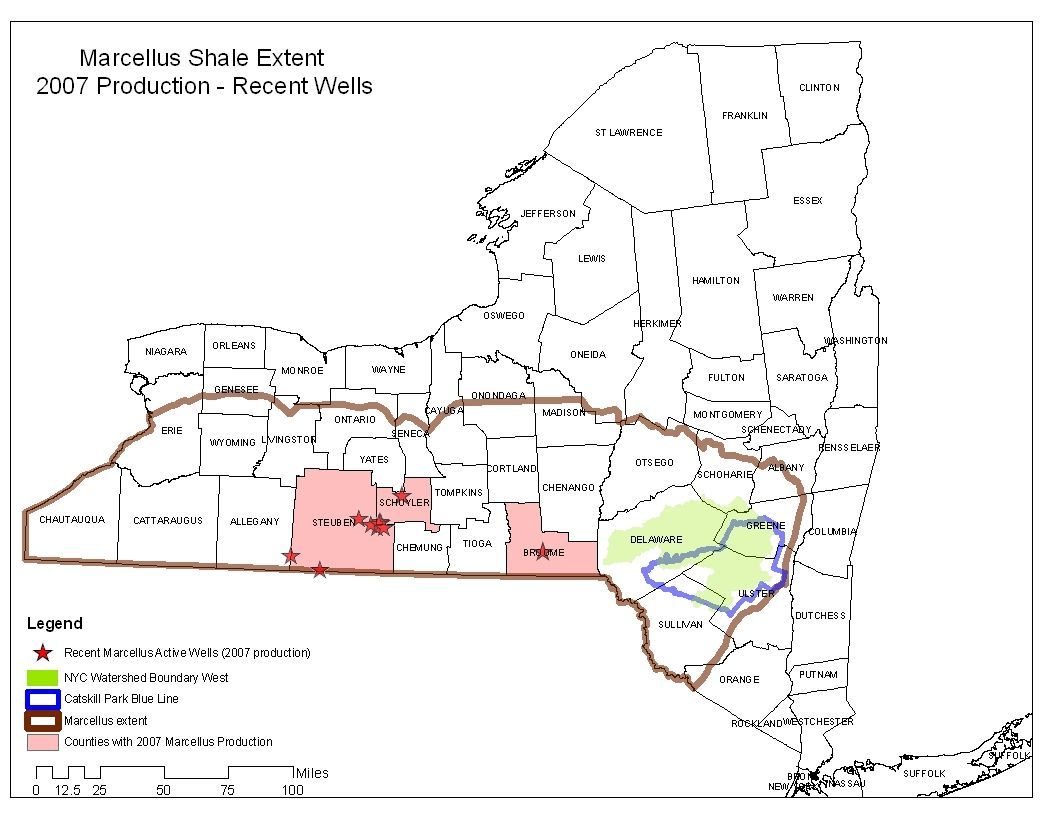
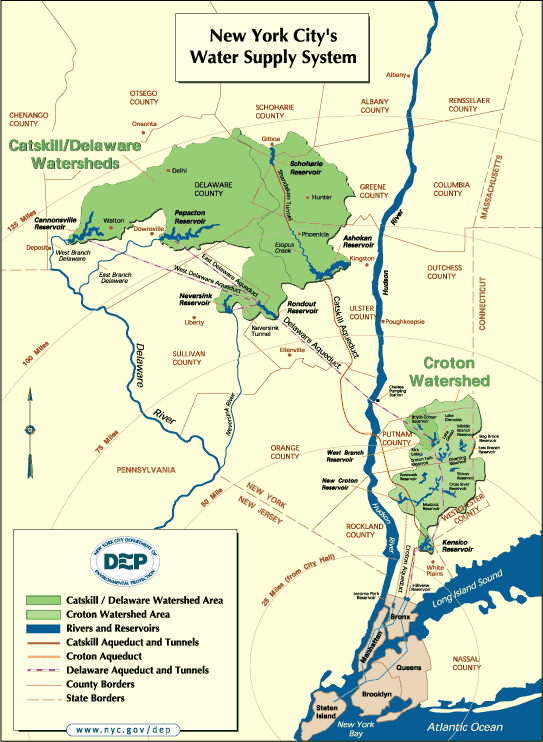
Hydraulic fracturing has been implicated in a growing number of water pollution cases across the country. It has become especially controversial in New York, where regulators are eager to clear the way for drilling in the New York City watershed, potentially imperiling the city’s water supply. Thankfully, the main company involved has now decided not to go ahead.

The safety of the nation’s water supply should not have to rely on luck or the public relations talents of the oil and gas industry.

Thanks in part to two New Yorkers — Representative Maurice Hinchey and Senator Charles Schumer — Congress last week approved a bill that asks the E.P.A. to conduct a new study on the risks of hydraulic fracturing. An agency study in 2004 whitewashed the industry and was dismissed by experts as superficial and politically motivated. This time Congress is demanding “a transparent, peer-reviewed process.”

An even more important bill is waiting in the wings. Cumbersomely named the Fracturing Responsibility and Awareness of Chemicals Act, it would close the loophole and restore the E.P.A.’s rightful authority to regulate hydraulic fracturing. It would also require the oil and gas industry to disclose the chemicals they use.

The industry argues that the chemicals are proprietary secrets and that disclosing them would hurt their competitiveness. It also argues that the process is basically safe and that regulating it would deter domestic production. But if hydraulic fracturing is as safe as the industry says it is, why should it fear regulation?

DEMAND ACCOUNTABILITY!

Tuesday, November 3, 2009


Gathering Line
- a special pipeline that transports gas from the field to the main pipeline.


The Gathering Line is a round-up of oil & gas drilling news brought to you by National Alliance for Drilling Reform (NA4DR), a broad alliance of grassroots activists from states all across the nation affected by drilling development.

This week's Gathering Line is too scary for Halloween

Peacegirl writes about gas drilling in Bradford County, PA. Welcome To Bradford County, PA, calls attention to an article in the Fall 2009 issue of Save the Bay, the magazine of the Chesapeake Bay Foundation which features the North Branch Susquehanna River in Bradford County. From the blog Gas Wells Are Not Our Friends where your comments are always welcome.

Aruba Petroleum is drilling a Barnett Shale gas well in the backyard of Tim and Christine. Their property was taken, it's value diminished, they were threatened and now Aruba Petroleum spilled toxic drilling waste a few feet from where their daughter plays. Another tale (with VIDEO) about the Victims of the Shale on Bluedaze: DRILLING REFORM FOR TEXAS.

Williams Petroleum wants to pipe drilling waste water under our homes in Flower Mound, TX to a huge tank farm. Flower Mound Citizens Against Urban Drilling we discovered an alternative that is safer and greener. Williams claims to be a "good neighbor." Here's their chance to prove it.

Allegheny State Forests Littered!! Park Management Tries To Bring Drilling To A Halt And Are Met With Intimidation Read it at Cheap Tricks and Costly Truths.

Today’s environmental horrors could lead to a scary Sci-Fi future. Drilling Santa Fe offers an excerpt from Apocalypse Soon by Laura Paskus.

Meanwhile, Splashdown says, Kiss my Gas!

DEMAND ACCOUNTABILITY!

Monday, November 2, 2009

Haudenosaunee Environmental Task Force

Excerpts from:
Environmental Restoration:
An Indigenous Strategy for Human Sustainability


Hydraulic-Fracturing

The Haudenosaunee consist of the Mohawk, Oneida, Onondaga, Cayuga, Seneca and Tuscarora Nations. The Haudenosaunee Nations and its people have a unique spiritual, cultural, and historic relationship with the land, which is embodied in Gayananshogowa, the Great Law of Peace. This relationship goes far beyond federal and state legal concepts of ownership, possession, or other legal rights. The Haudenosaunee people are one with the land and all that depends on the land, and consider themselves apart of it. It is the duty of the Nations’ leaders to work for a healing of the land, to protect it, and to pass it on to future generations.

...

Clean and abundant water is now the highest priority for human survival. The natural world is the distributor of water, according to the great systems that control our earth and its climate. It belongs to no one person, corporation, or nation. Privatization and pollution of water are fundamental violations of our human rights, and the rights of the natural world. The balance of life is predicated on sharing the Earth’s natural resources.

...

The Haudenosaunee Environmental Task Force believes that the process of hydraulic-fracturing will devastate the natural environment over a large area and for many generations into the future. We also understand that even though the New York State Department of Environmental Conservation (DEC) is able to justify moving forward with this process based on a presumption of the soundness of its written policy, by requiring permits for certain activities and providing regulatory disincentives for violations to its permitting requirements, there will be unintended consequences that DEC cannot prevent.

...

The Haudenosaunee Environmental Task Force has not been able to create a scenario by which the economic and energy benefits of hydraulic-fracturing will outweigh its known dangers and risks. DEC is one entity delegated the authority to protect our Earth and waters against contamination caused by hydraulic-fracturing by refusing to allow our Earth and its waters to be exploited in this way. We ask that the DEC partner with us to find other energy sources that do not destroy our grandchildren’s ability to live long and healthy lives.

Renewable Energy

...

Our ancestors treated the ground springs of oil as a valuable and sacred medicine for thousands of years before they were exhausted by American industry in less than a century. We are taught to have a special respect for those rare and powerful elements of Mother Earth provided by our Creator for this reason. The careful acquisition, thanksgiving, and circumspect use of the Natural World to sustain human life is the natural law for all humans, not just the Haudenosaunee.

To read this beautiful document in its entirety, CLICK HERE.

DEMAND ACCOUNTABILITY!

Sunday, November 1, 2009

The new gold rush

crain's newyorkbusiness.com
November 01, 2009 5:59 AM
By Erik Engquist


“Water itself is toxic; there was a death three or four years ago from an overdose of water, as part of a radio contest,” says Brad Gill, executive director of the Independent Oil and Gas Association of New York and owner of a drilling company.
(Amazing...)

Jeff Decker used to scratch out a living as a truck driver, inching his rig down the Cross Bronx Expressway and rolling across lonely interstates. He built a small trucking business, then sold it, but the proceeds were eaten up by basic expenses and the stock market. The 47-year-old makes ends meet by doing odd jobs and farming on the 120 rural acres outside Binghamton, N.Y., he inherited from his father, who began cobbling together parcels back in 1958.

Never did Mr. Decker imagine that his property was perched atop a figurative gold mine: a 95,000-square-mile, $1 trillion deposit of natural gas trapped within the rock of the Marcellus Shale formation—enough to supply the nation for 20 years. And neither he nor anyone else in the long-suffering Appalachian Mountains region anticipated that a frenzied quest to extract the fuel would spawn hope and havoc, dividing communities on whether it'll be a boon or a boondoggle.

Natural gas drilling is exploding—sometimes literally—across the border in Pennsylvania. In New York the Paterson administration, heeding the cries of landowners and local officials in economically depressed upstate communities, has issued draft regulations to allow it here. Landowners are keen to lease their property. Cash-strapped municipalities are eager to tax the extracted gas. Business groups say drilling would bring jobs and jolt local economies. The state would collect more income tax and, if it imposes one, a tax on gas production.

But drilling poses risks. A New York City analysis has concluded that every aspect of drilling threatens Gotham's drinking water, so the Bloomberg administration and elected officials want the activity banned in the upstate watershed, which occupies 8.5% of New York's portion of the Marcellus Shale. New York is one of five big cities not required by the federal government to filter its water, and revocation of that waiver would necessitate a filtration plant costing $10 billion to $20 billion.

...

The world is quickly waking up to the immense economic ramifications of horizontal drilling and hydraulic fracturing, or hydrofracking. Shale deposits—called plays—across the globe have the extraction industry in a feeding frenzy, and the massive Marcellus, one of several plays sprawling into New York, may be the hottest property of all. Only two years ago, the energy companies' “land men” were offering landowners in places like Broome County, where Mr. Decker lives, $50 an acre for drilling rights. Today, it's $5,750.

“The next Jed Clampett?”

... Mr. Decker, who rejected the land men's initial offers of $6,000 or so, is closing in on a deal. The Vestal coalition's lawyer won't let Mr. Decker divulge the terms, but the going rate would mean a signing bonus approaching $700,000.

That pales in comparison to what he might reap once the gas starts flowing. An 80-acre swath of the Marcellus can eventually produce $42 million worth of natural gas, says Dean Lowry, president of Fort Worth, Texas-based Llama Horizontal Drilling Technologies. With drilling leases now giving landowners 20% royalties on productive wells, Mr. Decker could become a millionaire several times over.

...

Pat Farnelli sees the effects on a daily—and nightly—basis. The mother of eight and four-year resident of Dimock, Pa., emerges breathless from her cramped farmhouse with a stack of papers and a digital camera, which she promptly drops on the lawn. She apologizes for her frantic manner. Asked if it is drilling-related, she seems surprised by the question: “Nothing happens in Dimock that isn't drilling-related anymore.”

Two years ago, the land men signed up the Farnellis and everyone else on unpaved Carter Road for $25 an acre plus Pennsylvania's statutory minimum of 12.5% royalties. There was little chance they'd ever drill, Ms. Farnelli recalls them saying, but if they did, at most they'd do one well every 640 acres. “They made it sound like a nice little windfall,” she says.

The landowners, many of whom work in the moribund quarry industry, considered it found money. None consulted a lawyer. “This entire road was in a state of desperation,” she explains.

Now, desperation truly is at hand. “For the last year and a half, they've been drilling and fracking around my house constantly,” Ms. Farnelli says. At night, stadium lights from a dozen drill sites flood her daughter's bedroom, and workers chatter on walkie-talkies. The fracking shakes her old house, and blasting is common. “I don't even flinch anymore,” Ms. Farnelli says as an explosion reverberates across the landscape.

Trucks rumble by every few minutes. Carter Road was too narrow for them, so the driller widened it—chopping off the edge of Ms. Farnelli's lawn. “Never asked us,” she says. “We had flower beds there.” Earthmovers changed the pitch of the hayfield above her house; now the road and her driveway wash out when it rains.

Methane in the water wells

Carter Road's biggest problem is the drinking water. One water well after another filled with sediment, methane and unknown elements. Ms. Farnelli's family suffered from intestinal sickness for months before fingering their tap water as the culprit. Pour a neighbor's water into a glass, she says, and it separates into sludge, sediment, brown liquid and bubbles; another's smells like formaldehyde. Ms. Farnelli says drilling-company testers found methane seeping into her well and basement.

Last New Year's Day, neighbor Norma Fiorentino's water well blew up. A spark from the pump might have ignited methane that, freed by drilling, had migrated underground. Blocks of concrete were blown across the yard. The driller refused to provide bottled water until last week, when a Scranton newspaper splashed the story across its front page. Says Ms. Farnelli, “We're basically ruined.”

...

The gas industry maintains that hydrofracking has not contaminated a single drop of drinking water. Comparing the heavy metals and other chemicals in fracking fluid to canola oil, shampoo and chlorine, industry leaders object when the substances are described as toxic.

“Water itself is toxic; there was a death three or four years ago from an overdose of water, as part of a radio contest,” says Brad Gill, executive director of the Independent Oil and Gas Association of New York and owner of a drilling company. “The key is concentration and exposure. Most of these chemicals are benign.”

The Bloomberg administration and a coalition of environmental and civic groups insist otherwise. They're lobbying the state to drop its plan to allow hydrofracking in the upstate areas that supply unfiltered water to 9.1 million people downstate. Drilling opponents won a big victory last week when Chesapeake said it would not drill in the city's watershed, given the headaches it would involve and the ready availability of the other 91.5% of the Marcellus Shale.

Chesapeake's announcement took some pressure off the Paterson administration but could empower advocates who are demanding protection for other watersheds.

The state regulations proposed Sept. 30 are considered among the nation's strongest. But they might not go far enough, says Kate Sinding, an attorney for the Natural Resources Defense Council. Among her questions: How will leftover hydrofracking fluid be disposed of? Shouldn't its chemical contents be made public? Does the state have enough staff for enforcement? “We're going to look at what the risks are and insist they get managed to the maximum extent possible,” she says.

For the complete report, CLICK HERE.

Editorial comments by Splashdown in red.

DEMAND ACCOUNTABILITY!
RURAL IMPACT VIDEOS, 6 parts

Natural gas development in Colorado, the impacts on communities, environment and public health. A primer for public servants and residents of counties that care for their lifestyles.

Drilling for Gas in Bradford County, PA ... Listen!

Cattle Drinking Drilling Waste!

EPA... FDA... Hello? How many different ways are we going to have to eat this? ... Thank you TXSharon for all you do! ... Stay tuned in at http://txsharon.blogspot.com

Landfarms

A film by Txsharon. Thank you Sharon for all you do. Click HERE to read the complete article on Bluedaze: Landfarms: Spreading Toxic Drilling Waste on Farmland

SkyTruth: Upper Green River Valley - A View From Above