Showing posts with label SGEIS. Show all posts

Friday, April 23, 2010

NY ruling sets back gas drilling in watersheds

By Basil Katz
Reuters

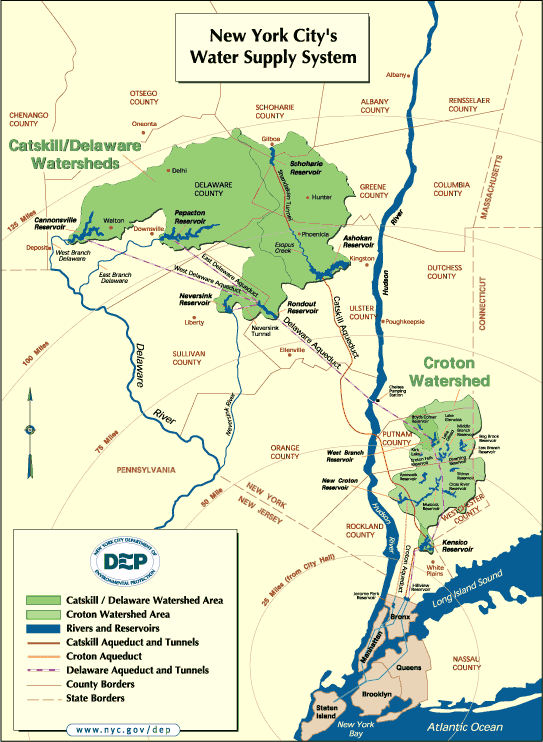
NEW YORK, April 23 (Reuters) - New York state imposed new restrictions on shale gas drilling in watersheds for the cities of New York and Syracuse, citing concerns over drinking water safety and prompting victory calls from environmentalists.

The Department of Environmental Conservation (DEC) announced on Friday that applications to drill for shale gas in the two cities' watersheds will be taken on a case-by-case basis instead of falling under the general rules that will apply to the rest of the state.

For these cities it amounts to a "de facto ban" on the drilling process known as hydraulic fracturing, said Alex Matthiessen, president of environmental group Riverkeeper. He called the ruling a "huge win." ...

"Due to the unique issues related to the protection of New York City and Syracuse drinking water supplies, these watersheds will be excluded from the pending generic environmental review process for natural gas drilling," the state agency said.

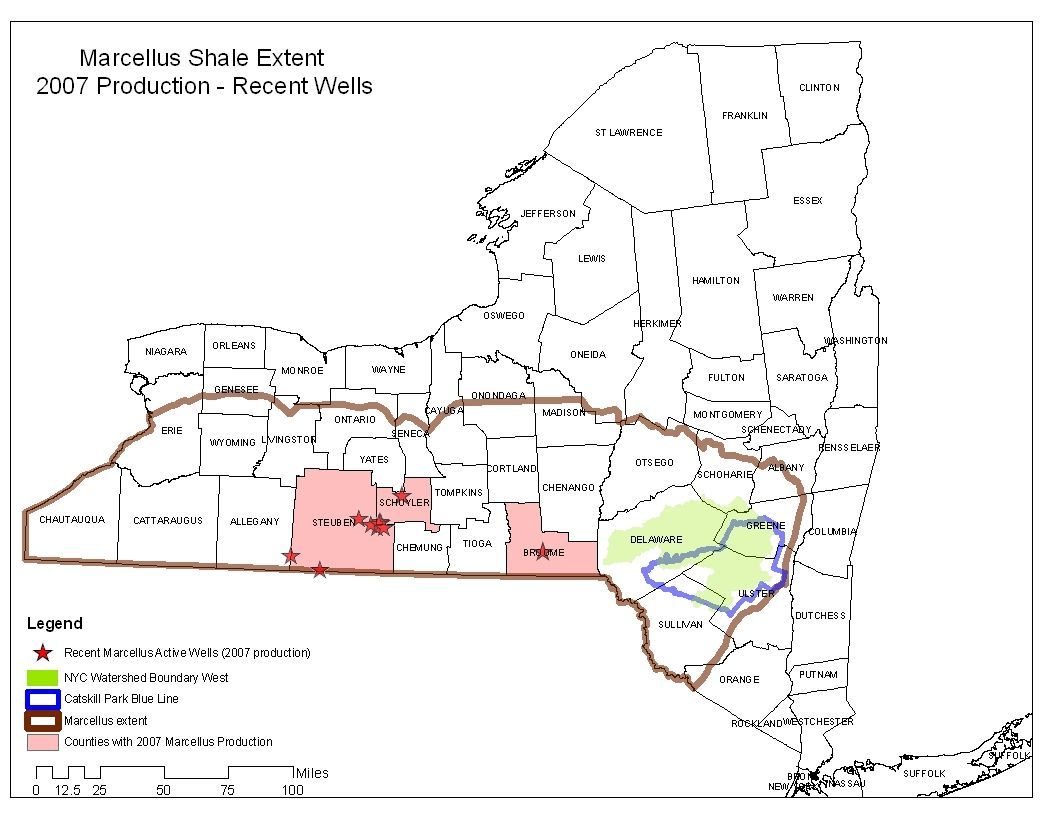
New York City joined environmentalists in December in voicing strong concern the process might harm the city's fresh water supplies, which come unfiltered from a 2,000-square-mile (5,200-square-km) watershed largely located in the Catskills Mountains north of the city.

"Portions of the Marcellus Shale where the city's watershed lies must be treated differently and the Department of Environmental Conservation's decision today recognizes that crucial fact," New York Mayor Michael Bloomberg said. ...

Some say the proposed separate track for the cities is not nearly enough and reiterated calls for a blanket ban.

"A complete ban on watershed drilling was the right thing a year ago, it's the right thing today, and it will remain the right thing for as long as we debate hydraulic fracturing in New York," Manhattan Borough President Scott Stringer said in a statement.

LINK

(Reporting by Basil Katz; editing by Daniel Trotta and Andre Grenon)

DEMAND ACCOUNTABILITY!

Wednesday, November 4, 2009

DEC Extends Public Comment Period for Marcellus Shale Draft SGEIS

News from New York State Department of Environmental Conservation

For more information contact: Yancey Roy, 518-402-8000

ALBANY, NY (11/04/2009)(readMedia)-- The New York State Department of Environmental Conservation today announced it has extended the public comment period on the draft Supplemental Generic Environmental Impact Statement (SGEIS) governing potential natural gas drilling activities in the Marcellus Shale formation from Nov. 30 to Dec. 31.

The SGEIS addresses the range of potential impacts of shale gas development using horizontal drilling and high-volume hydraulic fracturing and outlines safety measures, protection standards and mitigation strategies that operators would have to follow to obtain permits. The full draft SGEIS (www.dec.ny.gov/energy/58440.html) is available on DEC's web site, along with highlights of the document (www.dec.ny.gov/press/58472.html). Printed copies are available for review at DEC regional offices and most sub-offices and libraries that traditionally have served as repositories. A list of repositories (www.dec.ny.gov/energy/58672.html) can be found on DEC's web site.

DEC is offering four ways in which to submit comments. Comments may be provided at one of the scheduled public hearings (www.dec.ny.gov/energy/58705.html). There is an online submission system (www.dec.ny.gov/cfmx/extapps/SGEISComments/) which will allow interested parties to write comments and tag them to specific areas of concern. Attachments can also be included. E-mail comments may be submitted to dmnsgeis@gw.dec.state.ny.us; please include your name, e-mail or return mail address to ensure notice of the Final SGEIS when it is available. Finally, written comments should be sent to: Attn: dSGEIS Comments, Bureau of Oil & Gas Regulation, NYSDEC Division of Mineral Resources, 625 Broadway, Third Floor, Albany, NY 12233-6500.

*** Note: DEC also has moved up the start time of the hearing in New York City on November 10. Doors will open at 5:30 p.m. for individual questions and speaker sign-up. DEC staff will be available at this time to answer individual questions about the format and contents of the draft SGEIS. The public comment session will begin at 6:30 p.m.

DEMAND ACCOUNTABILITY!

Monday, October 26, 2009

A new light on drilling

By ABRAHM LUSTGARTEN, Pro Publica
First published in print: Monday, October 26, 2009
(Albany) timesunion.com

New York may become the first state in the nation to demand that in certain situations companies that drill in New York be required to report the concentrations of the chemicals they use to state regulators.

The rules would reveal information that environmental scientists say is essential to investigating water pollution from drilling.

New York's recently released review of the environmental risks of proposed natural gas production in the Marcellus Shale in the state's Southern Tier also offers the clearest picture yet of the chemicals used in the drilling process called hydraulic fracturing.

The document makes public the names of 260 chemicals, more than eight times as many as Pennsylvania state regulators have compiled. The list, the most complete released by any state or federal agency, could help answer concerns about hydraulic fracturing in Congress and in states where gas drilling has increased in recent years.

The industry has been reluctant to release information about the chemicals it uses because it considers them trade secrets. While New York has made the names of the chemicals public, it seems likely the data about their concentration will be shared only with state officials.

...

Environmental scientists have long sought complete information about the chemicals used in hydraulic fracturing, saying they need it to thoroughly investigate water pollution. Contamination can occur when the chemicals are pumped underground, held in waste pits or trucked to water treatment plants before being discharged back into rivers and drinking water supplies.

...In Pennsylvania, environmental officials told ProPublica that their list of chemical products used for drilling there was complete, but it names just 39 products and 31 unique chemicals. ...

New York obtained the names of the chemicals by surveying drilling companies, their contractors and the manufacturers of the chemicals. The Department of Environmental Conservation identified 152 trademarked products and obtained the complete list of their ingredients; it gathered a partial list of ingredients for an additional 45 products.*

To read more CLICK HERE.

*See the following post for the list of chemicals used in drilling/fracking operations.

Friday, October 2, 2009

Responses to NY DEC's Long Awaited Environmental Impact Statement Begin to Emerge

"The state’s mitigation proposals are half measures," Manhattan Borough President Scott Stringer said in a news release Wednesday night. "I believe the choice is simple: we either correct this error and ban drilling now, or soon enough the officials entrusted with protecting our environment will be asked to explain why they were asleep at the switch when it mattered most."

Provisions highlighted in the news release would make New York State’s environmental protections more stringent than those in many other drilling areas, but a quick review of the document indicates those provisions may be accompanied by conditions and stipulations, making it unclear exactly where the rules would apply and how they would be implemented.

To read the NY Dept. of Conservation's summary of the 809 page document, posted on Splashdown! on Sept. 30th, CLICK HERE.

New York Gov. David Paterson ordered the Supplemental Generic Environmental Impact Statement in July 2008, one day after a ProPublica investigation raised questions about the state’s preparedness to handle a rush of drilling in the Marcellus Shale. The governor has since made clear that drilling will eventually play a prominent role in the state’s economy.

In 2008, ProPublica also reported that New York was unprepared to treat the wastewater itself – the DEC said drillers would have to ship it to neighboring Pennsylvania. But ProPublica found that Pennsylvania’s specialized treatment plants don’t have the capacity for it either.

To read the ProPublica article, CLICK HERE.

According to the New York State SGEIS: The only regulatory role DEC has over disposal of flowback water at out-of-state municipal or industrial treatment plants is that transport of these fluids, which are considered industrial waste, must be by a licensed Part 364 Transporter. For informational purposes, Table 5.14 lists out-of-state plants that have been proposed for disposition of flowback water recovered in New York.

Table 5-14
Out-of-state treatment plants proposed for disposition of NY flowback water:

Treatment Facility - Location - County

Advanced Waste Services - New Castle, PA Lawrence

Eureka Resources - Williamsport, PA Lycoming

Lehigh County Authority Pretreatment Plant - Fogelsville, PA Lehigh

Liquid Assets Disposal - Wheeling, WV Ohio

Municipal Authority of the City of McKeesport - McKeesport, PA Allegheny

PA Brine Treatment, Inc. - Franklin, PA Venango

Sunbury Generation - Shamokin Dam, PA Snyder

Tri-County Waste Water Management - Waynesburg, PA Greene

Tunnelton Liquids Co. - Saltsburg, PA Indiana

Valley Joint Sewer Authority - Athens, PA Bradford

Waste Treatment Corporation - Washington, PA Washington
DRAFT SGEIS 9/30/2009, Page 5-123

Meanwhile, according to a report in the Ithaca Journal: With only 17 inspectors to enforce the state's newly proposed regulations overseeing the natural gas industry, it will be a while before the gas rush moving up the Appalachian basin takes hold in the Southern Tier.
...
"They do not have the manpower to do this. That's no secret," said Lindsay Wickham, a field adviser for the New York State Farm Bureau, an agency that advocates landowners' interests.
...
It does not address staffing necessary to enforce the regulations, which propose on-site inspection of critical operations, such as cementing well bores to protect aquifers from contamination.

"The report calls for a lot more hands-on inspection, and we are going to have to find ways to fund additional staff," said Assemblywoman Donna Lupardo, D-Endwell.
...
Once regulations are finalized, between 2,000 and 4,000 wells could be produced in Broome County in the coming decades, according to an economic report commissioned by the Broome County Legislature.

The rate at which permits are issued is a function of the staffing available to process them, DEC officials said. The smaller the staff, the slower the process.

It's clear to anyone doing the math -- 2,000 or more potential wells in Broome County alone, 47 applications already pending in the Southern Tier, only 17 inspectors -- conditions are ripe for a substantial backlog ... or for overworked regulators to cut corners.

"DEC has no intention of rubber stamping paperwork or permits just to speed things up, regardless of the number of applications that may come in," said Yancey Roy, a spokesman for the department. "The Department will work with existing staff to do this right."
...
Deborah Goldberg, an attorney for Earth Justice, said she is skeptical DEC staff facing a backlog of permits will sufficiently evaluate and track each one.

"Enforcement is absolutely key," she said. "Without it, the law is not worth the paper it is written on."

Advocates point to Pennsylvania, where Cabot Oil & Gas in Susquehanna County has been keeping regulators busy.
...
New York officials say they learned a lot watching problems unfold to the south, and that is reflected in their proposed regulations.To back them up, both opponents and critics agree, it's going to take more than 17 inspectors.

To read the complete Ithaca Journal article, by Tom Wilber, CLICK HERE.

DEMAND ACCOUNTABILITY!

RURAL IMPACT VIDEOS, 6 parts

Natural gas development in Colorado, the impacts on communities, environment and public health. A primer for public servants and residents of counties that care for their lifestyles.

Drilling for Gas in Bradford County, PA ... Listen!

Cattle Drinking Drilling Waste!

EPA... FDA... Hello? How many different ways are we going to have to eat this? ... Thank you TXSharon for all you do! ... Stay tuned in at http://txsharon.blogspot.com

Landfarms

A film by Txsharon. Thank you Sharon for all you do. Click HERE to read the complete article on Bluedaze: Landfarms: Spreading Toxic Drilling Waste on Farmland

SkyTruth: Upper Green River Valley - A View From Above