Sunday, October 4, 2009

**** What can be done with wastewater? ****

Rapid expansion of gas drilling has led to problems with disposal, contamination

Sunday, October 04, 2009
Pittsburgh Post-Gazette|post-gazette.com
"I don't know that even our [water] program people had any idea about the volumes of water that would be used," said Dana Aunkst, who heads the DEP's water program.

Much of the wastewater is the byproduct of a drilling process called hydraulic fracturing, or fracking, which pumps at least a million gallons of water per well deep into the earth to break layers of rock and release gas. When the water is sucked back out, it can contain natural toxins dredged up during drilling, including cadmium and benzene, which both carry cancer risks. It also can contain small amounts of chemicals added to enhance drilling.

But DEP officials say one of the most worrisome contaminants in the wastewater is a gritty substance called Total Dissolved Solids, or TDS, a mixture of salt and other minerals found deep underground. Drilling wastewater contains so much TDS that it can be five times as salty as sea water.

Large quantities of TDS can clog machinery and change the color, taste and odor of drinking water -- precisely the problems reported along the Monongahela River. While it's not considered particularly harmful to people, it can damage freshwater streams, which is what happened when TDS levels skyrocketed in Dunkard Creek last month.

Drilling companies currently dispose of their wastewater in Pennsylvania's municipal sewage plants, which then discharge it into rivers and streams.

The U.S. Environmental Protection Agency warns against this because the sewage plants aren't equipped to remove TDS or any of the chemicals the water may contain. Of even more concern, TDS can disrupt the plants' treatment of ordinary sewage by killing organisms that are needed to treat human waste. But the EPA is giving some Pennsylvania plants a permit amendment to accept oil- and gas-drilling wastewater, if they can prove their treatment processes won't be damaged and that the streams they discharge into won't be harmed.

When U.S. Steel and Allegheny Energy complained about the Monongahela River's water in 2008, the DEP found almost twice as much TDS as the agency considers safe. DEP officials blamed some of the problem on the river's low flow last summer and on abandoned mines that have leaked TDS into the river for decades.

What apparently tipped the balance, however, was the drilling wastewater that nine sewage plants were discharging into the river. Only one of those plants had a permit amendment to accept drilling wastewater.

Steve Rhodes, president of the Pennsylvania Oil and Gas Association, an industry trade group, argues that most of the TDS came from abandoned mines, not from drilling wastewater. A study prepared for a different trade group came to the same conclusion.

Mr. Rhodes also said Pennsylvania's waterways "are not anywhere near" their capacity to handle TDS and that the DEP's estimate of how much wastewater the industry produces is "completely exaggerated."

Caught off guard?

In April, drilling companies began temporarily trucking their wastewater to other states or to sewage treatment plants in other parts of Pennsylvania: The idea is to dilute it by spreading it among more rivers. DEP chief John Hanger said a more permanent solution will begin on Jan. 1, 2011, when new regulations will be in place requiring that the wastewater be treated by plants capable of removing TDS.

Currently, no plant in Pennsylvania has the technology to remove TDS, and it's unlikely that new plants capable of doing so can be built by 2011. Seventeen permit applications for new treatment plants have been filed so far, but the company whose bid is furthest along says its plant won't be ready until at least 2013. And at its peak that plant would be able to treat only 400,000 gallons of wastewater a day. The DEP would need 50 plants that size to process all the wastewater expected by 2011.

In the meantime, the DEP is allowing municipal sewage plants to temporarily continue taking drilling wastewater, even though none of them can remove TDS.

"That's not what these municipal plants are designed to handle -- the DEP is inviting legal problems as well as environmental problems," said Bruce Baizel, a senior attorney for the Oil and Gas Accountability Project, a Colorado-based nonprofit that focuses on the environmental impact of natural gas drilling throughout the United States.

As the DEP's responsibilities grow, its operating budget could be slashed: The state Legislature's latest draft of Pennsylvania's 2010 budget calls for a 25 percent cut in DEP funding.

Mr. Hanger says Pennsylvania's extensive experience with oil drilling has prepared it to deal with gas drilling problems quickly.

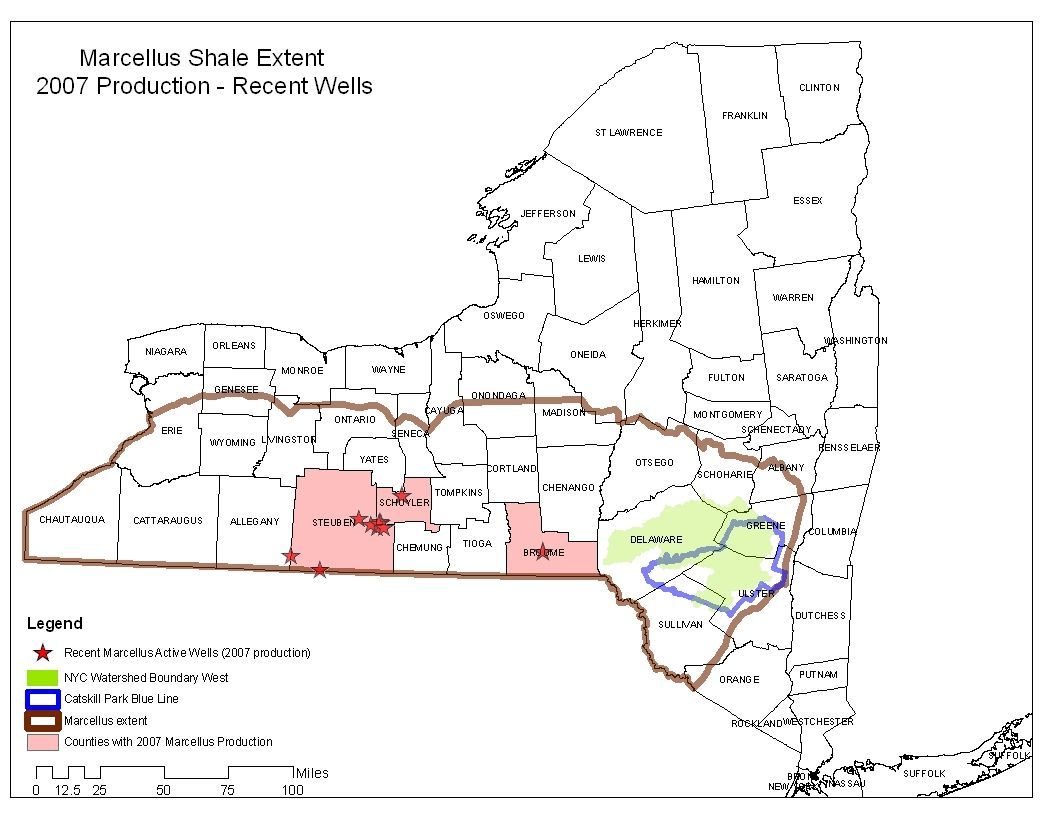
But ProPublica found that the DEP was caught off guard by the amount of wastewater the industry would produce when drilling began in the Marcellus Shale, a deeply buried layer of rock that some analysts say holds enough gas to meet all the nation's natural gas needs for more than 20 years.

When energy prices spiked in 2008, drillers flocked to Pennsylvania, bringing sorely needed revenue and jobs. A recent Pennsylvania State University study touted the benefits drilling brought last year: 29,000 jobs and $240 million in state and local taxes.

Even the industry's wastewater promised profits.

"Cha-ching!" is how Francis Geletko, financial director for the municipal sewage treatment plant in Clairton, described his first thought when he learned that drillers would pay 5 cents a gallon to get their wastewater processed at his plant.

The 1960s-era facility is in such desperate need of modernization that workers still use shovels to remove solid waste from its traps and filters. Many of the state's plants are similarly outdated: A recent report commissioned by Gov. Ed Rendell concluded that Pennsylvania needs to spend $100 billion over the next 20 years to maintain its aging sewage plants and pipelines.

Ed Golanka, who manages the municipal sewage treatment plant in Charleroi, said that when he checked with the DEP nobody told him that state and federal laws required his plant to get an amendment to its permit before accepting industrial wastewater. The amendment would require expensive modifications to allow it to treat industrial wastewater, which Charleroi couldn't afford to do, he said.

"At the time it was a new subject for all of us," Mr. Golanka said. "There was a limited amount of conversation [with the DEP] until the issue with TDS last summer."

Mr. Aunkst, the DEP's director of water standards, said he didn't know the plants along the Monongahela River were accepting the water until the spring of 2008, when people living near the plants complained to the DEP about long lines of trucks idling at sewage treatment plants. But the agency was so short-staffed that it didn't respond to the complaints immediately. Mr. Aunkst said many DEP regulators had left for more lucrative jobs with drilling companies.

"As the industry was ramping up, we were ramping down," he said. "In order for us to really catch these people we have to almost have an inspector coincidentally there on the day that these trucks pull up, because we have so many facilities and so few staff."

...

Wastewater levels cut

After Mr. Aunkst heard about the trucks, he wrote a letter to all of the state's sewage plants, reminding them that they couldn't take the wastewater without a special permit.

But before he sent it, TDS levels in the Monongahela River skyrocketed, causing U.S. Steel and Allegheny Energy to complain. The chain of events made Mr. Aunkst remember two other peculiar incidents: Cross Creek and Sugar Run Creek in Washington County were sucked dry, and DEP inspectors suspected that drilling companies had withdrawn the water to fracture nearby wells.

"We were trying to scramble, to put it bluntly, to get our act together to figure out how we were going to address these withdrawals as well as the disposal issues," Mr. Aunkst said.

The DEP did two things to lower the Monongahela's TDS level quickly. It unlocked dams upriver to flush out some of the TDS. And it ordered nearby sewage treatment plants to reduce the amount of drilling wastewater they accepted to just 1 percent of the total amount of water that flowed through their plants each day.

...

Some sewage plant operators were so alarmed that they stopped taking any wastewater at all.

But by January, the uproar had subsided. TDS levels in the Monongahela River were back to normal and plant operators began accepting the wastewater again, although in smaller quantities, as the DEP instructed.

"We didn't want to be the ones to stop the economy from growing in this area, and we felt that we were helping the country become energy independent," said Joe Rost, chief engineer at the municipal sewage treatment plant in McKeesport.

Mr. Hanger has promised to implement more aggressive regulations by 2011 that would require all drilling wastewater to be treated in special plants that are capable of removing TDS, rather than in sewage treatment plants.

...

But spokesmen for eight of the 17 plants that have been proposed told ProPublica it will be impossible to get the plants built by 2011. A spokesman for Larson Design Group, whose application to build a plant in Williamsport, Lycoming County, is furthest along in the process, expects that after it gets its permit, construction will take at least 40 months.

...
To read this article in its entirety, CLICK HERE.

Joaquin Sapien is a reporter for ProPublica, a nonprofit journalism organization in New York City. For more on natural-gas drilling, go to http://www.propublica.org.

Before drilling, plug some loopholes

(practice some sanity)

By FRED LEBRUN|COMMENTARY
First published in print: Sunday, October 4, 2009
Albany Times Union/timesunion.com

Friday, October 2, 2009

PA House Passes Tax Bill. Votes YES to Severance Tax!

By John Micek
The Morning Call

October 2, 2009

The state House signed off on a $1 billion tax bill late tonight that imposes new taxes on natural gas, boosts the state cigarette tax while levying new taxes on cigars and smokeless tobacco, and slaps a 34 percent tax on yet-to-be legalized table games at Pennsylvania's slot machine casinos.
The party-line, 103-98, vote came after five hours of sometimes acrimonious, and occasionally bitter, debate that saw majority Democrats trade jabs with Republicans over whose vision was the better to guide the state through uncertain economic waters.
...
The bill now goes to the majority-Republican Senate, which has said it opposes Democratic plans to impose a "severance" tax on natural gas that's extracted from the Marcellus shale deposits in northern and western Pennsylvania.

To read more, CLICK HERE.

DEMAND ACCOUNTABILITY!

Responses to NY DEC's Long Awaited Environmental Impact Statement Begin to Emerge

"The state’s mitigation proposals are half measures," Manhattan Borough President Scott Stringer said in a news release Wednesday night. "I believe the choice is simple: we either correct this error and ban drilling now, or soon enough the officials entrusted with protecting our environment will be asked to explain why they were asleep at the switch when it mattered most."

Provisions highlighted in the news release would make New York State’s environmental protections more stringent than those in many other drilling areas, but a quick review of the document indicates those provisions may be accompanied by conditions and stipulations, making it unclear exactly where the rules would apply and how they would be implemented.

To read the NY Dept. of Conservation's summary of the 809 page document, posted on Splashdown! on Sept. 30th, CLICK HERE.

New York Gov. David Paterson ordered the Supplemental Generic Environmental Impact Statement in July 2008, one day after a ProPublica investigation raised questions about the state’s preparedness to handle a rush of drilling in the Marcellus Shale. The governor has since made clear that drilling will eventually play a prominent role in the state’s economy.

In 2008, ProPublica also reported that New York was unprepared to treat the wastewater itself – the DEC said drillers would have to ship it to neighboring Pennsylvania. But ProPublica found that Pennsylvania’s specialized treatment plants don’t have the capacity for it either.

To read the ProPublica article, CLICK HERE.

According to the New York State SGEIS: The only regulatory role DEC has over disposal of flowback water at out-of-state municipal or industrial treatment plants is that transport of these fluids, which are considered industrial waste, must be by a licensed Part 364 Transporter. For informational purposes, Table 5.14 lists out-of-state plants that have been proposed for disposition of flowback water recovered in New York.

Table 5-14
Out-of-state treatment plants proposed for disposition of NY flowback water:

Treatment Facility - Location - County

Advanced Waste Services - New Castle, PA Lawrence

Eureka Resources - Williamsport, PA Lycoming

Lehigh County Authority Pretreatment Plant - Fogelsville, PA Lehigh

Liquid Assets Disposal - Wheeling, WV Ohio

Municipal Authority of the City of McKeesport - McKeesport, PA Allegheny

PA Brine Treatment, Inc. - Franklin, PA Venango

Sunbury Generation - Shamokin Dam, PA Snyder

Tri-County Waste Water Management - Waynesburg, PA Greene

Tunnelton Liquids Co. - Saltsburg, PA Indiana

Valley Joint Sewer Authority - Athens, PA Bradford

Waste Treatment Corporation - Washington, PA Washington
DRAFT SGEIS 9/30/2009, Page 5-123

Meanwhile, according to a report in the Ithaca Journal: With only 17 inspectors to enforce the state's newly proposed regulations overseeing the natural gas industry, it will be a while before the gas rush moving up the Appalachian basin takes hold in the Southern Tier.
...
"They do not have the manpower to do this. That's no secret," said Lindsay Wickham, a field adviser for the New York State Farm Bureau, an agency that advocates landowners' interests.
...
It does not address staffing necessary to enforce the regulations, which propose on-site inspection of critical operations, such as cementing well bores to protect aquifers from contamination.

"The report calls for a lot more hands-on inspection, and we are going to have to find ways to fund additional staff," said Assemblywoman Donna Lupardo, D-Endwell.
...
Once regulations are finalized, between 2,000 and 4,000 wells could be produced in Broome County in the coming decades, according to an economic report commissioned by the Broome County Legislature.

The rate at which permits are issued is a function of the staffing available to process them, DEC officials said. The smaller the staff, the slower the process.

It's clear to anyone doing the math -- 2,000 or more potential wells in Broome County alone, 47 applications already pending in the Southern Tier, only 17 inspectors -- conditions are ripe for a substantial backlog ... or for overworked regulators to cut corners.

"DEC has no intention of rubber stamping paperwork or permits just to speed things up, regardless of the number of applications that may come in," said Yancey Roy, a spokesman for the department. "The Department will work with existing staff to do this right."
...
Deborah Goldberg, an attorney for Earth Justice, said she is skeptical DEC staff facing a backlog of permits will sufficiently evaluate and track each one.

"Enforcement is absolutely key," she said. "Without it, the law is not worth the paper it is written on."

Advocates point to Pennsylvania, where Cabot Oil & Gas in Susquehanna County has been keeping regulators busy.
...
New York officials say they learned a lot watching problems unfold to the south, and that is reflected in their proposed regulations.To back them up, both opponents and critics agree, it's going to take more than 17 inspectors.

To read the complete Ithaca Journal article, by Tom Wilber, CLICK HERE.

DEMAND ACCOUNTABILITY!

Water Worries Threaten US Push for Natural Gas

Thursday, October 1, 2009

by Jon Hurdle, © 2009 Reuters

PAVILLION, Wyoming - Louis Meeks, a burly 59-year-old alfalfa farmer, fills a metal trough with water from his well and watches an oily sheen form on the surface which gives off a faint odor of paint.

He points to small bubbles that appear in the water, and a thin ring of foam around the edge.

Meeks is convinced that energy companies drilling for natural gas in this central Wyoming farming community have poisoned his water and ruined his health.

A recent report by the Environmental Protection Agency suggests he just might have a case -- and that the multi-billion dollar industry may have a problem on its hands. EPA tests found his well contained what it termed 14 "contaminants of concern."

It tested 39 wells in the Pavillion area this year, and said in August that 11 were contaminated. The agency did not identify the cause but said gas drilling was a possibility.

What's happened to the water supply in Pavillion could have repercussions for the nation's energy policies. As a clean-burning fuel with giant reserves in the United States, natural gas is central to plans for reducing U.S. dependence on foreign oil.

But aggressive development is drawing new scrutiny from residents who live near gas fields, even in energy-intensive states such as Wyoming, where one in five jobs are linked to the oil and gas industry which contributed more than $15 billion the state economy in 2007.

People living near gas drilling facilities in states including Pennsylvania, Colorado, New Mexico and Wyoming have complained that their water has turned cloudy, foul-smelling, or even black as a result of chemicals used in a drilling technique called hydraulic fracturing, or "fracking."

The industry contends drilling chemicals are heavily diluted and injected safely into gas reservoirs thousands of feet beneath aquifers, so they will never seep into drinking water supplies.

"There has never been a documented case of fracking that's contaminated wells or groundwater," said Randy Teeuwen, a spokesman for EnCana Corp, Canada's second-largest energy company, which operates 248 wells in the Pavillion and nearby Muddy Ridge fields. "We know they don't have the science to prove what they say," Teeuwen said of those who criticize fracking.

HARD TO PROVE SOURCE OF CONTAMINATION

Critics say their kids have got sick, their animals have died, and their water has in some cases become flammable because of methane escaped into aquifers from gas wells. But they have been unable to prove their case because drilling companies are not required to disclose exactly what chemicals they use, thanks to an exemption to a federal clean water law granted to the oil and gas industry in 2005.

The EPA, in its first tests in response to concerns over gas drilling and water quality, has not positively identified the source of the Pavillion contamination but it did name gas drilling as a possible cause. The agency is continuing its tests and expects to issue a report in spring 2010.

Luke Chavez, an EPA scientist leading the investigation, said he will now seek to determine the quantities of a range of contaminants and their health effects.

"We're taking a shotgun approach," he said.

In Pavillion, residents are on edge. Meeks' neighbor Donnet Baughman said she does not mind companies drilling for gas in her backyard, as long as it doesn't poison her water.

"We are not against the oil and gas industry at all," she said during an interview in her living room. "We just want them to do it right."

Baughman's water was clean, according to the EPA tests, but she is uneasy with the findings since she has a gas separation tank about 50 yards (meters) from her house, and some of her neighbors, including Meeks, were found to have bad water.

Three wells in the EPA's sample contained 2-BE, a potentially carcinogenic substance that's used as a lubricant in drilling, and in some household cleaning products.

GAS LIES WELL BELOW AQUIFERS

Stung by grassroots complaints, and by a bill in Congress that would require disclosure of fracking chemicals, the industry says it is using the latest technology to keep fracking safe.

At the Frenchie Draw drilling rig 60 miles east of Pavillion, EnCana workers used automated machinery to join 30-foot (9-meter) lengths of pipe and insert them into a new well, which extends 11,135 feet below ground.

The steel pipe can withstand pressure up to 9,800 pounds per square inch. It is encased in concrete to 2,500 feet, well below aquifers, said John Schmidt, an EnCana field leader.

The pipes allow EnCana to inject a fracking fluid of water, sand and chemicals at high pressure into the gas-bearing rock.

At specific depths identified by geologists, the pipe is perforated with small holes by controlled explosions. The fracking mixture then breaks up the rock, allowing natural gas to rush to the surface.

About 70 percent of the water mixture remains underground, while the rest is pumped back up and later re-injected into 10,000-foot (3,000-meter) disposal wells, Schmidt said. In 2010, EnCana plans to start treating and reusing the water.

Despite the industry's precautions, spills of fracking fluids occur.

On September 25, Pennsylvania regulators ordered Cabot Oil & Gas Corp to halt fracking operations in one county after it admitted three recent spills of fracking fluid.

TO STAY OR TO GO?

In Pavillion, Meeks said he suffers pulmonary hypertension and neuropathy in his legs. "They have ruined my life," he said. "I would like to get out of here."

He said EnCana stopped supplying him free drinking water this month, after he publicly opposed fracking practices.

"They are trying to punish me," Meeks said. "I'm a thorn in their side."

Half a mile from Meeks' house, across a valley dotted with gas wells, separation tanks and compressor stations, Rhonda Locker, 48, said she stopped drinking her water after it "went bad" in the early 1990s.

She started drinking it again about five years ago after installing a reverse-osmosis filter, but within six months started having seizures, bone pain, and cognitive problems.

Frustrated by not knowing what was causing her illness, she tried again in early September to drink the water, and experienced the same symptoms.

...

A sense of helplessness is leading some Pavillion residents to consider legal action against EnCana, said John Fenton, 37.

"We are not the kind of people who sue people," said Fenton, whose water is also contaminated. "For the first time in my life, I'm giving some serious thought to it."

But many are restrained by the knowledge that energy is the lifeblood of Wyoming, said Deb Thomas of the Powder River Basin Resource Council, an environmental group that has been an outspoken critic of gas drilling.

"It's the only economy our state has," she said. "Nobody wants to kill the golden calf."

For the complete article, CLICK HERE.

Thursday, October 1, 2009

A Letter from Wilma Subra to New York State: Fracking vs. Water

Wilma Subra, MacAuthur (Genius) Award winning chemist, offers the following information to the NY State Senate Committee on Environmental Conservation's Clean Water Hearing:


To: New York State Senate Standing Committee on
Environmental Conservation
Room 902 LOB
Albany, New York 12247

From: Wilma Subra
Subra Company
P. O. Box 9813
New Iberia, LA 70562
337 367 2216
subracom@aol.com

September 30, 2009

Subject: Clean Water Hearing

Thank you for the opportunity to submit information for consideration by the New York State Senate Standing Committee on Environmental Conservation as part of your Clean Water Hearing.

Subra Company provides technical assistance to individuals and community groups dealing with a host of environmental issues and situations. I have work with individuals and community organizations on oil field drilling and production operations and the impacts of the operations and generated waste on human health and the environment since the 1970s. I have also served on a number of advisory committees at the local, state and national level dealing with oil and gas drilling and production waste. These advisory committees reviewed the impacts to human health and the environment caused by the waste, developed proposed remedial activities, developed proposed legislation, guidelines and policies, and evaluated specific methods of assessing environmental damage (resume attached).


Today in response to the call by the Senate Committee on Clean Water issues, I would like to take this opportunity to focus on availability of water resource and the threat of contamination of water resources by hydraulic fracturing operations in conjunction with the development of natural gas from the Marcellus Shale in New York State.

Protection of Quantities of Surface Water and Groundwater Resources

Hydraulic fracturing in the Marcellus Shale requires large quantities of water. Vertical wells require in excess of one million gallons per fracturing event. Horizontal wells require more the three million gallons of water for each fracturing event. The water resources needed for fracturing come from surface water resources and/or groundwater resources. The use of surface water resources frequently impact the hydrology of the surface water bodies. Depending on the number of wells being fractured in a particular water body segment, the withdrawal of large quantities of surface water could substantially impact the availability of the surface water resources downstream, and damage the aquatic life in the surface water bodies. When groundwater resources are used in the fracturing process, the groundwater aquifers can be drawn down and result in water wells in the area going dry. It is essential when a facility applies for a permit to drill a well in the Marcellus Shale that the regulations require that the permit requirements include identification of the source of hydraulic fracturing water and quantity of water to be used. The regulations must also require that the agencies within the state that have jurisdictions over surface water hydrology/resources and groundwater resources must review the permit information and concur or object to the use of the water resource based on proposed removal of the anticipated quantities of water. Concurrence by the appropriate agencies must insure that the removal of the water will not negatively impact the water resource.

Risk to Surface Water and Ground Water Resources

Hydraulic Fracturing generates a large quantity of flowback water during and following the Hydraulic Fracturing process. The flowback waters contains and are contaminated with fracturing chemicals and fluids that were incorporated into the water prior to the fracturing process. These chemical components include surfactants, friction reducing chemicals, biocides, scale inhibitors and propping agents. The chemicals contained in the flowback water are toxic and are possible and probable human cancer causing agents. The specific chemical compounds that are contained in the additives used in the Hydraulic Fracturing fluids are not publicly available. Material Safety Data Sheets are available for most of the substances used in the fracturing process. However most of the substances listed in the MSDS are described as propriety or trade secrets and are not identified as specific chemicals. There is a desperate need for the specific chemicals in each fracturing material to be identified for use by emergency responders, evaluation of chemical components in chemical spills, identification of specific chemicals causing damage to humans and animals, identification of chemicals in spills into surface water and groundwater resources, and identification of chemicals in drinking water resources. The state of New York should adopt regulations requiring full disclosure of chemicals contained in drilling and fracturing fluids in order to protect and respond to releases of the chemicals into water resources and the environment.

Management and Disposal of Flowback Water

The methods of managing the large quantity of flowback water currently consist of injecting the flowback water into Class II injection wells for disposal and discharge into municipal and industrial waste water treatment plants for ultimate discharge into surface water resources. When a facility applies for a permit to drill a well in the Marcellus Shale, the state regulations should require that the permit application include identification of the methods of managing the waste water and flowback waters from the fracturing process and the locations of the treatment or disposal facilities to be utilized.

The regulatory agencies in the state of New York should evaluate the adequacy of the locations and capacity of treatment and disposal options available for handling waste water and flowback water from Marcellus Shale drilling and production activities. In state as well as out of state facilities and capacities should be evaluated.

The mismanagement of flowback water and produced water can result in negative impacts to surface water and groundwater resources due to spills and leaks on the drilling site, during off site transportation and at the disposal or treatment facility. Inappropriate treatment regulatory requirements or regulatory discharge limitations not covering all of the chemical constituents in the waste water can result in impairment of surface water resources down stream of the treatment facility discharge point.
Frequently the waste water treatment facilities accepting flowback waters do not have sufficient monitoring requirements and effluent limitation in their permits to insure that the chemical components in the flowback waters are required to be treated and removed prior to discharge of the waste water streams. The concentration of chemicals in the flowback water are more concentrated that the normal wastewater stream being treated by the waste water treatment facilities and the resulting effluent from the plants have a very detrimental impact on the receiving waters.

Storage of flowback water and drilling waste water on the drilling site in pits can greatly increase the risk of contamination of groundwater, soils and surface water resources. If unlined or improperly lined pits are used on site to store waste the waste can leach into the soil and groundwater resources under the drill site. In improperly lined pits or pits that have had the integrity of the liner compromised, the waste in the pit can contaminate soil and ground water resources. During closure of the on site pits, if the waste in the pits is not removed and disposed of off site prior to pit closure, the waste can contaminate soil, groundwater and surface water resources. The regulatory agencies in New York should encourage a preference for the use of tanks for storage of waste on the drill site rather than pits and the use of closed-loop systems to reduce of eliminate the quantity of drilling muds and fluids dumped into pits on site. Use of the closed-loop system also reduces the quantity of drilling waste needed to be disposed of after the drilling operations have been completed.

One method to address a number of these issues before drilling occurs is to require a Waste Management plant to be submitted and approved along with the permit to drill A Waste Management plan should require information such as where and how the flowback water, drilling fluids, produced waters and drill cuttings will be managed and disposed of, what specific chemicals will be used in the Hydraulic Fracturing fluids, what methods of storage of waste and produced fluids will be used for storage on site (examples pits, tanks, frac tanks, etc.), what methods will be used to prevent leaks and spills on site, what methods will be used to clean up and remediate the site prior to converting the site to a production facility, and what type of storage will be used for production waste.

Hydraulic Fracturing

In order to further protect groundwater resources, the State of New York should adopt regulations that require the reporting of the horizontal and vertical extent of fracturing to insure that the fracturing activity did not extend fractures outside of the targeted formation. In addition, a requirement for the reporting of the volume of Hydraulic Fracturing fluids remaining in the fractured formation after hydraulic fracturing along with the complete disclosure of chemicals in the fracturing fluids will enable the State to track potential chemicals that may migrate and be detected outside of the fracturing zones.


In order to prevent migration of fracturing fluids out of the designated fracturing formation, a regulatory mechanism should be instituted to identify and evaluate the locations of orphan and abandoned well sites in the area of the proposed wells and in the areas to be fractured. Horizontal fracturing of shale wells can extend out from the well site for long distances and have the potential to intercept orphaned and abandoned well bores. The importance of such measures is to protect ground water resources.

The regulatory process should include requirements that insure that the well piping is able to withstand the pressures to be exerted by the fracturing process and the well construction and completion standards are adequate to protect ground and surface water resources.

Habitat Destruction

The location of well pads and tank batteries are often sited with little or no consideration for the surface uses of the land. Well pads are constructed adjacent to homes, churches, parks, wetlands, and unique environmental areas. Once the habitat on the surface is destroyed by the well pad or tank battery, it is nearly impossible to restore the area to pre existing conditions.

Buffer Zones and Set Back Requirements

In order to protect surface water resources as well as reduce human health impacts, buffer zones and set back requirements should be established by the state regulatory agencies for the location of well sites, storage tank batteries, compressors, and injection well sites, from water bodies, wetlands, unique environmental areas, aquifer recharge zones as well as homes, buildings, schools, churches, and parks.


Air Emissions

The call for this hearing was clean water, however air emissions frequently result in deposition of toxic chemicals into water bodies which result in impacts to water quality and the aquatic environment.

Natural gas condensate is produced with natural gas. The condensates contain extremely toxic volatile organic compounds such as benzene (a known human cancer causing agent), xylene, toluene, ethylbenzene and other probable and possible cancer causing agents. These toxic chemicals are releases into the air from the gas separation process and tank storage of condensates. Produced water stored in tanks release methane, toxic volatile organic chemicals and sulfur based compounds into the air. Compressors and diesel fueled motors release combustion products into the air. These products combine with the volatile organic chemicals in the presence of heat and sunlight to form ozone. Elevated ozone levels result in increased respiratory impacts for community member in the area. Even though the call for this hearing is clean water, the potential for air emissions to negatively impact water quality is an important issue that must be considered.

Regulations and Enforcement

The citizens of the state of New York are in need of strong, regulatory programs to safe guard the water resources of the state from the detrimental impacts of Hydraulic Fracturing and shale gas drilling and production. Historically regulatory programs lacked adequate requirements to protect the environment and human health. Community members have suffered too long as a result of inadequate regulations and the lack of enforcement of existing regulations. The regulatory agencies frequently state they do not have adequate resources to enforce the existing regulations.

With the hugh focus on drilling and production of shale gas in the Marcellus Shale, the regulatory agencies in the State of New York need to be provided with adequate resources and staff to review, evaluate, and issue appropriate permits for shale gas wells. The agencies also need sufficient resources and staff to observe field activities during drilling and fracturing processes, perform compliance monitoring, respond to citizens complaints and enforce the regulations in order to protect water resources and human health. For too long the aquatic environment and community members have suffered due to the lack of regulations and the lack of enforcement of existing regulations.


Now is the time to enact strong regulations and ensure enforcement of those regulations for shale gas drilling and production and hydraulic fracturing in order to insure that these activities do not destroy and contaminate surface and groundwater resources, human health and the environment.

DEMAND ACCOUNTABILITY!

Gas Pains Cloud PA State Budget Deal...

Some House Democrats push for a tax on natural gas drilling.
GOP pooh-poohs the plan.

October 1, 2009
CALL HARRISBURG BUREAU


HARRISBURG - After months of debate, the fate of the 2009-10 state budget could well be decided by the way lawmakers handle an odorless, colorless gas trapped hundreds of feet beneath the ground.

Battle lines are drawn in the House over whether Pennsylvania should expand natural gas drilling in state-owned forests, raising $60 million a year, or join more than three-dozen other states and impose a ''severance tax'' on the extraction of natural resources.

In Pennsylvania's case, that's the natural gas-rich layer of rock known as the Marcellus shale.

About 30 House Democrats see the extraction tax as a stable source of revenue that would ensure oil drillers bear some of the responsibility for the environmental toll their activities would take.

''Anytime you prepare lands for drilling,'' said Rep. Josh Shapiro, D-Montgomery, ''you are eviscerating natural resources.''

The expansion of drilling leases is part of a compromise $27.9 billion budget reached by Gov. Ed Rendell, Democratic leaders in the House and Senate and top Senate Republicans. But taxing the drilling is not part of the deal.

A leading Senate Republican says even a House vote in favor of taxation won't recast the budget compromise, because Senate passage is highly unlikely no matter what the House does.

The fuss over taxing gas is ''a non-issue,'' said Senate Appropriations Committee Chairman Jake Corman, R-Centre. ''They can [vote for it] if they want to, but it won't be part of the final agreement.''

A House vote could come as soon as today on an extraction tax proposal, said Brett Marcy, a spokesman for House Democrats. A vote had been scheduled for Wednesday, but Marcy said lawmakers wanted more time to discuss the issue.

The vote is seen as an attempt to mollify restive Democratic lawmakers who, by withholding their votes, could derail the budget deal.

''We're discussing what the best options are,'' said Rep. David Levdansky, D-Allegheny.

For more on this story, CLICK HERE.

DEMAND ACCOUNTABILITY!

RURAL IMPACT VIDEOS, 6 parts

Natural gas development in Colorado, the impacts on communities, environment and public health. A primer for public servants and residents of counties that care for their lifestyles.

Drilling for Gas in Bradford County, PA ... Listen!

Cattle Drinking Drilling Waste!

EPA... FDA... Hello? How many different ways are we going to have to eat this? ... Thank you TXSharon for all you do! ... Stay tuned in at http://txsharon.blogspot.com

Landfarms

A film by Txsharon. Thank you Sharon for all you do. Click HERE to read the complete article on Bluedaze: Landfarms: Spreading Toxic Drilling Waste on Farmland

SkyTruth: Upper Green River Valley - A View From Above