Showing posts with label COAL. Show all posts

Thursday, April 1, 2010

Fracking Makes Natural Gas No Cleaner than Coal

SustainableBusiness.com
News
04/01/2010


A new chapter opens on the controversial practice of hydraulic fracturing, with the publication of research showing the natural gas recovered from the process is no cleaner than burning coal or oil.

Cornell ecology professor Robert Howarth argues that the lifecycle greenhouse gas emissions associated with hydraulic fracturing--or fracking, as it is sometimes called--are much greater than those associated with traditional drilling methods for natural gas.

He says by the time emissions are calculated from water-trucking, pipeline-laying, cutting forests and leaking methane deposits the fuel is not worth pursuing from a climate-change perspective. ...

LINK

"Government and industry should not be moving ahead on the basis of what is already misleading and incomplete information," Howarth said, arguing for a moratorium...
Read the full Jon Hurdle article HERE.

DEMAND ACCOUNTABILITY!

Wednesday, March 31, 2010

Commentary

Splashdown would like to pass along two excellent posts, very worth your reading time!

First, a powerfully comprehensive and provocative post from the blog The Falcon and the Dove : Marcellus Shale Well Drilling is Highway to Hades for Pennsylvania, posted Monday, March 29th...

Secondly, EPA TO THE RESCUE, from the blog Gracenomics, Tuesday, March 30th, is a good critique of energy mining. Comparing gas drilling to coal mining, it says government response "has been a predictable compromise: to minimize the environmental damage rather than to curtail the particular practice that perpetuates it."

DEMAND ACCOUNTABILITY!

Monday, March 22, 2010

The latest shale gas player...

from the Calgary Herald
by Peter Tertzakian
March 22, 2010


All the big boys are getting in on the shale gas action. ExxonMobil started the rush with its $US 27 billion purchase of XTO Energy a couple of months ago. Multinationals Total and Shell didn’t want to be left out and followed suit by claiming turf with their own acquisitions. Now the gas prospectors are coming from the other side of the world to the 21st century version of the North American Klondike; last week Reliance Industries, India’s largest public sector company, was said to be in talks with Atlas Energy, a leading player in the Marcellus shale.

... but the most noteworthy was the announcement last week that Consol Energy was buying Dominion Resource’s Appalachian exploration and production business... ...Consol is the most profitable publicly-traded coal company in the US with the second largest reserves of the carboniferous stuff.

What’s a coal company, the archenemy of all other purveyors of energy, doing buying up natural gas assets?

Read more HERE.

DEMAND ACCOUNTABILITY!

Sunday, February 14, 2010

Northeastern Pennsylvania's Resources Exploited Once Again

timesleader.com
Sat., February 13, 2010
Local Commentary

NORTHEASTERN Pennsylvania once contained three-quarters of the Earth’s anthracite coal deposits and, at the turn of the 19th century, provided the United States with the fuel it needed for consumer heating and industrial production.

But the hard coal industry also violated a once beautiful region rich in evergreens and oaks, leaving black refuse piles. It polluted springs and creeks, leaving acidic waste and the stench of sulfur. Underground fires, cave-ins and mine subsidence haunted many local towns for generations.

Today, the region’s natural resources again are being exploited for financial profit. Companies contend that deposits trapped miles below the Earth’s surface hold enough natural gas to supply the entire United States for 15 years. Although these companies insist there is little risk to the environment, there is serious cause for concern.

The Marcellus shale is a low-density, carbon bedrock that lies a mile or more beneath the surface in Pennsylvania, New York, West Virginia and Ohio. The shale contains an enormous volume of potentially recoverable gas, which has great economic significance for the United States at a time when we are seeking alternative fuel sources.

Gas is extracted from the Marcellus shale through a process called “hydraulic fracturing,” or “fracking,” in which up to 4 million gallons of water mixed with sand and chemicals is pumped into the shale at high pressure. The drilling not only breaks apart the shale to release the gas, but also discharges hazardous substances.

Gas companies claim that there is little risk, insisting that fracking is used safely in most oil and gas drilling operations. But last September, the Pennsylvania Department of Environmental Protection (DEP) reported that an estimated 8,000 gallons of fracking fluid spilled into a creek near Dimock, Susquehanna County. The spill was blamed on “faulty pipe work” and resulted in a significant fish kill.

Two months later, on Nov. 20, Reuters News Service reported that several of Dimock’s residents sued Cabot Oil & Gas Corp., claiming its natural gas drilling had contaminated their water wells with toxic chemicals, caused gastrointestinal sickness and reduced their property values. The lawsuit accuses Cabot of negligence and says it has failed to restore residential water supplies disrupted by gas drilling.

Dimock is not an isolated case. Hydraulic fracturing is the suspected source of impaired or polluted drinking water reported by residents who had gas drilling near their homes in southwest Pennsylvania and West Virginia.

Despite the apparent risk, the state DEP continues to issue hundreds of Marcellus drilling permits and the current state budget requires the Department of Conservation and Natural Resources to raise $60 million by leasing up to 10,000 more acres of public forestland to drillers within the year.

Gas companies are offering more than $1,000 per acre to some residents whose property overlays the Marcellus shale in order to continue the drilling. And they are protected legally for any liability.

In 2005, Congress, at the urging of then Vice President Dick Cheney, passed the “Halliburton loophole” to the Safe Drinking Water Act. The measure prevents the U.S. Environmental Protection Agency from regulating the fracking process. Halliburton, which was previously headed by Cheney, reportedly earns $1.5 billion a year from its energy operations, which rely substantially on the hydraulic fracturing business.

Pennsylvania cannot allow financial profits to take precedent over environmental stewardship. Harrisburg can begin immediately by calling for a moratorium on gas drilling in the Marcellus shale until a detailed scientific study is completed on the fracking process.

In the meantime, we should demand that our state representatives establish legislation that creates buffer zones for drilling near water supplies, requires gas companies to disclose the chemicals used in the fracking process and establishes strict guidelines for those companies to clean up the hazards created by their drilling.

LINK

DEMAND ACCOUNTABILITY!

Saturday, November 7, 2009

Natural Gas = Bridge to Nowhere

Stan Cox, Salinas, Kans., column: Natural gas threatens environment

Published November 07 2009
By Stan Cox
Prairie Writers Circle

Natural gas is “clean” only in contrast to coal — just as a bacon cheeseburger can be regarded as healthful compared with a double bacon cheeseburger.

SALINAS, Kans. — Holding out the prospect of vast new domestic reserves, the natural gas industry is promising to make the U.S. an energy-rich nation once again.

But we should be careful what we wish for. Spending those riches could endanger water supplies for millions of Americans while still failing to solve the climate crisis.

Electric utilities have expanded their use of gas because gas-fired plants can be “turned up” to meet high peak power demand more quickly than can coal-fired plants. Natural gas also is more climate-friendly than coal and less menacing than nuclear energy.

With the discovery of drilling techniques that can extract natural gas from deep shale formations, the authoritative Potential Gas Committee estimates that the total of confirmed and potentially accessible gas reserves has grown 35 percent in just three years.

Climate bills in Congress contain strong incentives to increase drilling and burning of natural gas. Seized by anti-coal fervor, most major environmental groups have gone along with the gas rush.

But natural gas is “clean” only in contrast to coal — just as a bacon cheeseburger can be regarded as healthful compared with a double bacon cheeseburger. Per kilowatt of electricity generated, gas releases 55 percent as much carbon as coal. And gas drilling poses a growing threat to our water supplies.

The investigative news organization ProPublica has documented thousands of cases of surface and groundwater contamination caused by natural gas drilling in six states.

Concern is now growing over hydraulic fracturing, in which water laced with sand, clay and “fracturing fluids” is pumped deep underground to create fissures and free gas trapped in rock formations. Most of the polluted water returns to the surface and must be handled as waste.

Drilling in shale, which depends heavily on fracturing, can consume hundreds of times more water per well than does drilling in traditional gas fields.

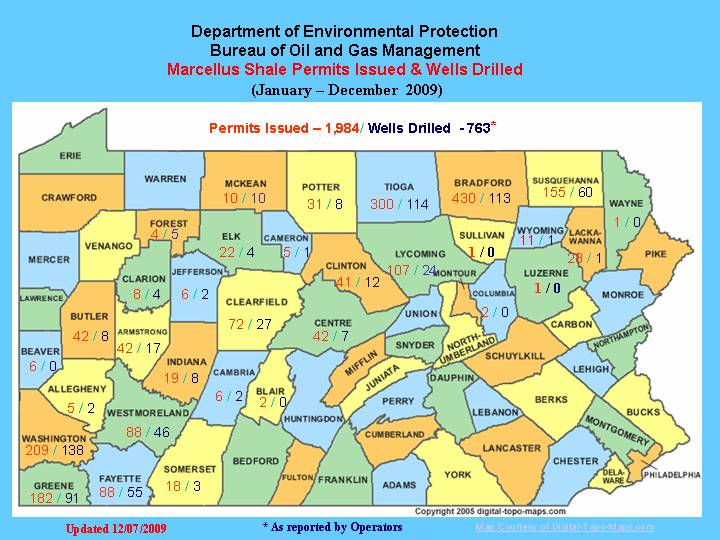
In Pennsylvania, which shares the vast, gas-laden Marcellus shale formation with four other states, drilling is expected to generate 19 million gallons of waste water daily by 2011, according to the state’s Department of Environmental Protection. The water, which carries both natural and human-made toxins and is up to five times as salty as sea water, puts a heavy burden on water treatment plants.

Gas companies have enjoyed a slack environmental leash since the 2005 Energy Policy Act exempted them from regulation under the Safe Drinking Water Act and the Water Pollution Control Act. Bills now stalled in Congress that would re-regulate the industry need broader grassroots support.

Risking our water so we can burn more natural gas will not be the planet’s miracle climate cure. For the U.S. to achieve necessary reductions in greenhouse emissions — estimated at more than 80 percent — will require not more energy production, even if somewhat cleaner, but deep cuts in energy consumption.

Coal must be phased out as quickly as possible, but more gas won’t accomplish that. While electric utilities’ gas consumption doubled from 1996 to 2007, coal use continued its steady climb.

Financier T. Boone Pickens recommends running our vehicles on natural gas. But substituting natural gas for gasoline in all vehicles would cut the nation’s total carbon emissions by less than 9 percent. Converting all gasoline-powered vehicles would consume more natural gas than electric utilities, homes and businesses combined. Consequences for the nation’s water would be disastrous.

Natural gas is being hailed by some, including Pickens, as a high-energy “bridge” to a renewable future, and by others as sufficiently climate-friendly to be a “destination” fuel. But as gas’ environmental drawbacks become more evident, it’s looking more like a bridge to nowhere.

Cox is lead scientist for the Land Institute in Salina, Kan., and wrote this comment for the institute’s Prairie Writers Circle.

DEMAND ACCOUNTABILITY!
RURAL IMPACT VIDEOS, 6 parts

Natural gas development in Colorado, the impacts on communities, environment and public health. A primer for public servants and residents of counties that care for their lifestyles.

Drilling for Gas in Bradford County, PA ... Listen!

Cattle Drinking Drilling Waste!

EPA... FDA... Hello? How many different ways are we going to have to eat this? ... Thank you TXSharon for all you do! ... Stay tuned in at http://txsharon.blogspot.com

Landfarms

A film by Txsharon. Thank you Sharon for all you do. Click HERE to read the complete article on Bluedaze: Landfarms: Spreading Toxic Drilling Waste on Farmland

SkyTruth: Upper Green River Valley - A View From Above