Saturday, June 5, 2010

Gas, fluids spew for hours from blown-out Pa. well

By MARC LEVY and JENNIFER C. YATES
Associated Press Writer

KansasCity.com

A blowout at a natural-gas well in a remote area shot explosive gas and polluted water as high as 75 feet into the air before crews were able to tame it more than half a day later, officials said Friday.

The gas never caught fire, and no injuries were reported, but state officials worried about an explosion before the well could be controlled. The well was brought under control just after noon Friday, about 16 hours after it started spewing gas and brine, said Elizabeth Ivers, a spokeswoman for driller EOG Resources Inc.

Pennsylvania, historically an insignificant source of natural gas, is trying to adapt its laws to respond to a furious rush to tap a gas-rich shale formation under its land. The blowout could test the ability of state regulators, who promised an aggressive investigation into the accident. (see DEP Press Release below)

"The event at the well site could have been a catastrophic incident that endangered life and property," Department of Environmental Protection Secretary John Hanger said in a statement. "This was not a minor accident but a serious incident that will be fully investigated by this agency with the appropriate and necessary actions taken quickly."

If the agency finds that mistakes were made, it will take steps to prevent similar errors, he said. It was too early to tell the extent of any environmental damage, he said.

Details about the accident were still sketchy, but the agency was told that unexpectedly high gas pressure in the new well prevented the crew from containing it, said Dan Spadoni, a spokesman for the Department of Environmental Protection.

EOG declined to explain how the accident happened, citing the ongoing investigation. Public safety and protection of the environment are of the utmost importance, the company said in a statement.

President Barack Obama and others have touted exploration of shale as a major new source of clean, homegrown energy. However, lawmakers who are battling for more stringent oversight of such drilling to protect clean drinking water quickly seized on the accident.

"Incidents like this blowout are a reminder that there are dangers and that precautions must be taken to protect the health and well-being of Pennsylvanians," U.S. Sen. Bob Casey said in a statement.

Casey has sponsored a bill to require the industry to comply with the Safe Drinking Water Act and force it to disclose the chemicals it uses in its hydraulic fracturing processes - in which millions of gallons of water, sand and chemicals are blasted underground to shatter tightly compacted shale and release trapped natural gas.

Amy Mall, Senior Policy Analyst, writes on Switchboard, the staff blog of the Natural Resources Defense Council:

"Today a natural gas well blew out in a Pennsylvania state forest during a hydraulic fracturing operation. Officials have estimated that one million gallons of hydraulic fracturing fluid, including chemical additives, plus an undetermined amount of wet natural gas, has blown out of the well. Wet natural gas can contain highly flammable hydrocarbons, like propane and butane, and hazardous substances, such as hydrogen sulfide. These are separated out before natural gas makes its way to your stove or furnace.

Campers and others in the forest were evacuated. While no one wants this kind of toxic explosion in a state forest, imagine if it were near a school or hospital? In this case, the Federal Aviation Administration even had to issue flight restrictions. These hazardous substances will be carried by the air and will settle on land and vegetation. It will be very important to know what chemicals were being used in this hydraulic fracturing operation. Will the company doing the hydraulic fracturing disclose this information to the public?"

LINK

David Rensink, the incoming president of the American Association of Petroleum Geologists, said gas well blowouts are very rare and can be very dangerous to control, since a spark can set off an explosion.

Typically, a blowout preventer - a series of valves that sit atop a well - allows workers to control the pressure inside, he said.

Just such a device figured into the massive oil spill off the coast of Louisiana. The oil rig's blowout preventer was supposed to shut off the flow of oil in the event of a catastrophic failure but failed to do so.

The Pennsylvania well is on the grounds of a hunting club in a heavily forested section of Clearfield County, near Interstate 80 and about 90 miles northeast of Pittsburgh.

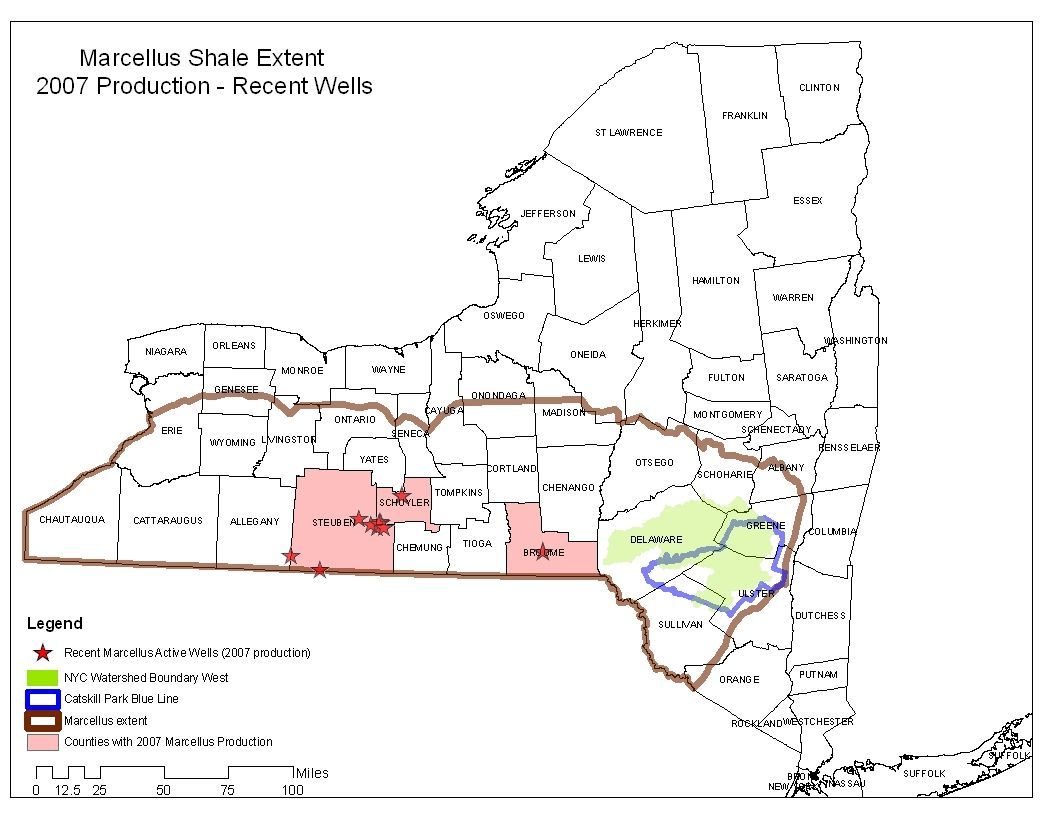
Houston-based EOG, formerly part of Enron Corp., was drilling into the Marcellus Shale reserve, a hotly pursued gas formation primarily under Pennsylvania, West Virginia, New York and Ohio that some geologists believe could become the nation's most productive natural gas field.

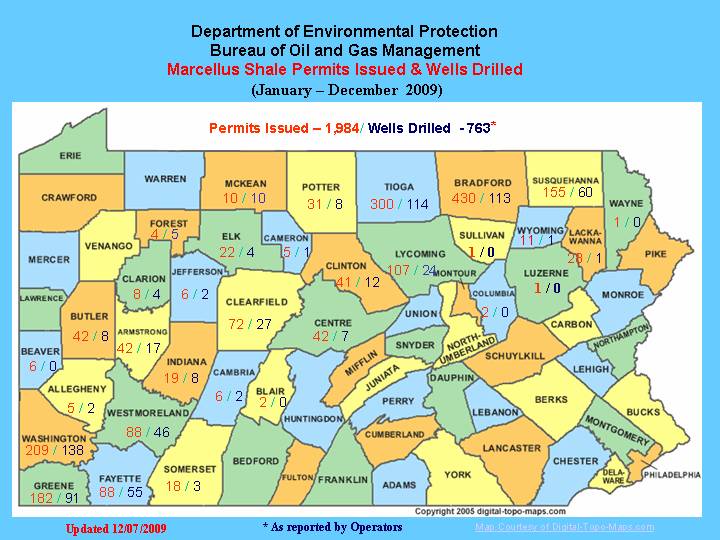
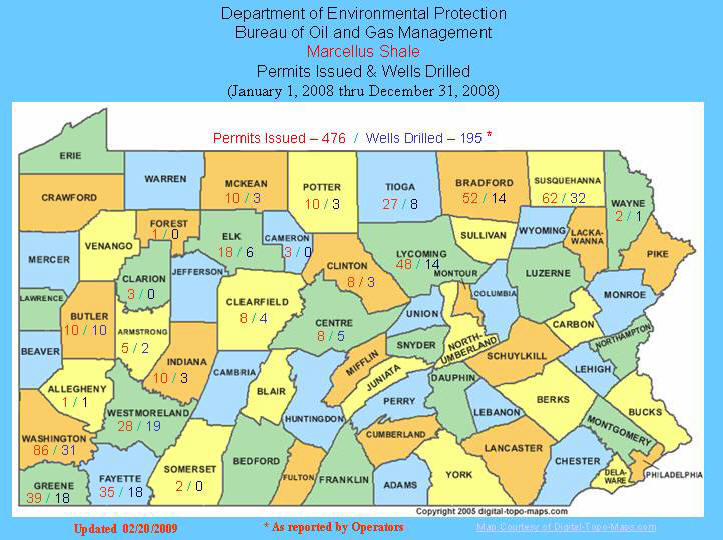
There are more than 1,000 Marcellus Shale wells in Pennsylvania alone, some of them within view of homes, farmhouses and public roads.

There were no homes within a mile of the well, and polluted drilling water was prevented from reaching a waterway, said Spadoni, the department spokesman.

On Friday afternoon, a worker blocked a dirt road to the site, while trucks hauling tanks to remove the polluted water streamed past him. He said he was not allowed to talk about what had happened.

The accident happened just after the crew finished hydraulic fracturing. The crew was clearing out debris from the well when gas shot out of it, Spadoni said.

Workers evacuated the site and contacted county authorities before 10 p.m., said John Sobel, a Clearfield County commissioner. A Pennsylvania Emergency Management Agency spokeswoman said the agency got word after midnight and within the hour notified the DEP. The DEP said it wasn't notified until 1:30 a.m., more than five hours after the blowout.

The polluted water flowing out of the well and into the woods was stopped by a trench and a pump installed by a contractor, Spadoni said. Companies that specialize in securing blown-out wells were called in, he said. ...

LINK to complete report


DEP Plans Thorough Investigation in to Marcellus Shale Well Blowout in Clearfield County

FOR IMMEDIATE RELEASE
06/4/2010

COMMONWEALTH OF PENNSYLVANIA
Dept. of Environmental Protection

Commonwealth News Bureau
Room 308, Main Capitol Building
Harrisburg PA., 17120

CONTACT:
Neil Weaver, Department of Environmental Protection
717-787-1323

EOG Resources Well Released Fracking Fluid, Natural Gas for 16 Hours

HARRISBURG -- Department of Environmental Protection Secretary John Hanger said today that his agency intends to investigate aggressively the circumstances surrounding a blowout at a Marcellus Shale natural gas well in Lawrence Township, Clearfield County, and take the appropriate enforcement action.

At approximately 8 p.m. on Thursday, June 3, the operators of the well, which is owned by EOG Resources, Inc., lost control of it while preparing to extract gas after hydrofracturing the shale. As a result, the well released natural gas and flowback frack fluid onto the ground and 75 feet into the air. The well was eventually capped around noon on June 4.

“The event at the well site could have been a catastrophic incident that endangered life and property,” said Hanger. “This was not a minor accident, but a serious incident that will be fully investigated by this agency with the appropriate and necessary actions taken quickly.

“When we arrived on scene, natural gas and frack fluid was flowing off the well pad and heading toward tributaries to Little Laurel Run and gas was shooting into the sky, creating a significant fire hazard. That’s why emergency responders acted quickly to cut off electric service to the area.

“Right now, we’re focused on limiting any further environmental damage, but once that work is complete, we plan to aggressively look at this situation and see where things went wrong and what enforcement action is necessary. If mistakes were made, we will be certain to take steps to prevent similar errors from happening again.” (Once again... -Splashdown)

DEP learned of the leak at approximately 1:30 a.m. on Friday after it was informed by the Pennsylvania Emergency Management Agency. DEP immediately dispatched its Emergency Response and Oil and Gas program staff to the site.

PEMA, which elevated its activation level to coordinate resources among multiple state agencies, also worked with PennDOT to initiate an airspace restriction above the well, which the Federal Aviation Administration authorized on a temporary basis earlier today. The restriction prohibits flights at and below 1,000 feet of ground level within a three nautical mile radius of the well site. The restriction is in effect until further notice.

The EOG well pad is located in a rural area near the Penfield/Route 153 exit of Interstate 80 in northwestern Clearfield County. Three other wells on the same pad that have been drilled and fractured remain plugged and are not in danger.

EOG Resources, formerly known as Enron Oil & Gas Co., operates approximately 265 active wells in Pennsylvania, 117 of which are in the Marcellus Shale formation.

For more information, call visit www.depweb.state.pa.us.

DEMAND ACCOUNTABILITY!

Thursday, June 3, 2010

SIGNS OF THE TIMES IN BRADFORD COUNTY

What's wrong with these pictures...
(click for larger view)

"A Better Pennsylvania"!?!
(Restoring something you destroy isn't exactly our idea of improvement.)

Heh...
Couldn't we all find the perfect spot for a sign of our own just like that these days!

YIKES!!!
How many trucks peel in and out of that well pad driveway every day while little kids
stand around waiting for the school bus, or walk to or from home along the side of the road?

DEMAND ACCOUNTABILITY!

Wednesday, June 2, 2010

As EPA Takes Action, Trade Secrets Continue Threatening Health and Safety

© OMB Watch
Posted on June 2, 2010

Unified Agenda The U.S. Environmental Protection Agency (EPA) has taken a significant step toward making more chemical health and safety information available to the public even as trade secrets claims continue to conceal such information elsewhere. A new EPA policy will reject most industry claims that chemical identities included in health and safety studies are trade secrets. Meanwhile, the oil and gas industry continues to use trade secrets privileges to thwart attempts to disclose chemical information related to the BP oil spill and controversial natural gas drilling operations.

On May 27, the EPA announced a new "general practice" where the agency will review all claims by manufacturers that a chemical's identity should be treated as confidential business information (CBI) when the identity is part of a health and safety study or the study's underlying data. The agency expects that unless the disclosure of the chemical identity explicitly reveals how the chemical is produced or processed, the secrecy claim will be rejected, allowing the public to link the chemical to its health and safety information.

This is the third recent major action by EPA to rein in overuse of trade secrets claims by the chemicals industry under the nation's primary chemicals statute, the Toxic Substances Control Act (TSCA). Earlier, the agency announced that chemical identities that were public in the TSCA inventory (a list of more than 83,000 chemical substances) could not be claimed as trade secrets and that the agency would provide free access to the inventory, which had only been available for a fee.

According to EPA, the new practice "is part of a broader effort to increase transparency and provide more valuable information to the public by identifying data collections where information may have been claimed and treated as confidential in the past but is not in fact entitled to confidentiality under TSCA." By late August, EPA plans to begin reviewing new and existing confidentiality claims for chemical identities found in health and safety studies, as well as associated data.

TSCA generally prohibits chemical health and safety information from being withheld from the public. Up to this point, however, the public might have had access to the health studies but not the identity of the chemicals the health studies referred to, rendering the studies and data practically useless. The practice of claiming chemical identity as CBI has been widespread at EPA despite regulatory language that clearly states that "chemical identity is part of, or underlying data to, a health and safety study" and also states, "Chemical identity is always part of a health and safety study."

EPA "believes that Congress generally intended for the public to be able to know the identities of chemical substances for which health and safety studies have been submitted." EPA announced that it "believes these actions will make more health and safety information available to the public and support an important mission of the Agency to promote public understanding of the potential risks posed by chemical substances in commerce."

EPA further acknowledges that TSCA was not intended "to limit the uses of information from a health and safety study" by keeping the public – including a chemical company's competitors – in the dark about chemical identities. Manufacturers have argued that their competitors could use disclosed chemical identities to learn about the proprietary manufacturing processes. EPA has rejected this argument, stating that "[disclosing] the end product of a process (i.e., a chemical identity) is not the same thing as disclosing the process to make that end product."

Oil and Gas Drillers Push for Secrecy

Despite EPA's actions, the disclosure of chemical identities remains a major issue on other fronts. At a recent House Energy and Commerce Committee mark-up, an amendment to the Safe Drinking Water Act that would have required the disclosure of the identities of chemicals used in a near-ubiquitous natural gas drilling process called hydraulic fracturing was withdrawn by its sponsor (Diana DeGette, D-CO) following strong industry criticism.

Hydraulic fracturing (or fracking) is a process where water, chemicals, and other materials are pumped under high pressure into a well to create and prop open fissures in underground rock, thus allowing trapped natural gas to flow out and be recovered. Fracking chemicals may include known carcinogens and other toxins.

Hydraulic fracturing, which was exempted from federal regulation in 2005, is linked to numerous cases of groundwater contamination. Fracking fluids may also leak or spill on the surface, creating additional ecological and public health threats. The House measure, sponsored by Rep. Diana DeGette (D-CO), only would have required the chemical constituents used in hydraulic fracturing to be posted on the Internet, with no other federal regulations placed on the process.

Another fracking disclosure measure is included in the discussion draft of climate change legislation now pending in the Senate. The language in the climate bill and other measures would only require disclosure of chemical constituents, imposing no other regulation of natural gas drilling. Regardless, the oil and gas drilling industry has fought vociferously against the disclosure of the chemicals being pumped underground, claiming the information is proprietary.

The day after the House mark-up, during which DeGette withdrew her disclosure amendment, a subcommittee of the same House Energy and Commerce Committee held a hearing to examine the BP oil spill catastrophe in the Gulf of Mexico. The poor flow of information to the public and Congress was a topic of concern.

Significant concerns have been raised regarding the use and identity of chemical dispersants on the BP oil spill. The dispersants are chemicals that attempt to break down oil before it can reach the shoreline. So far, BP has used more than 980,000 gallons of dispersants. The identities of the chemicals being poured into the Gulf of Mexico are considered to be trade secrets, and the EPA has not released this information to the public. The toxic effects – both short-term and long-term – of the dispersants are not fully understood. Scientists remain concerned about the ultimate fate of the chemicals and how they travel and interact with marine life and other chemicals in the Gulf.

EPA states, "All the information EPA can make public about these dispersants can be found on the Product Schedule. Some of the ingredients are listed as confidential. This is because the manufacturer has chosen to keep this information proprietary, and as a result EPA is obligated to withhold this information."

Both the general rules EPA uses to make CBI determinations and the specific rules that apply to TSCA's CBI determinations contain emergency provisions that allow the EPA to disclose CBI under conditions where public health and the environment face "imminent and substantial danger" or "an unreasonable risk of injury."

The chemical reportedly being used by BP to disperse the oil is banned in Britain but approved for use in the United States and Canada. Recent reports of fishermen becoming ill after possibly being exposed to the dispersants, combined with the unprecedented quantities of dispersants being used and the unique situation involving their use at extreme ocean depths, would seem to qualify the situation for the same level of openness that EPA is applying to chemical identities elsewhere. As the EPA made clear in describing its new TSCA CBI policy, without knowing what the chemicals are, researching their impacts is considerably more difficult.

LINK

DEMAND ACCOUNTABILITY!

Write to your Senators and Representatives in support of public health and safety. Demand disclosure legislation now!

Hinchey urging movement on drilling-regulation bill

Congressman warns of 'environmental catastrophe'
By Krisy Gashler
stargazette.com
June 2, 2010


ITHACA -- Congressman Maurice Hinchey, D-Hurley, sent a letter Wednesday urging House Speaker Nancy Pelosi to push for a vote on Hinchey's FRAC Act, which would require natural gas drilling companies to disclose the chemicals they use in hydraulic fracturing, and to comply with the regulations in the Safe Drinking Water Act.

At a Wednesday afternoon press conference at Ithaca's Stewart Park, Hinchey warned that environmental catastrophe could await central New York if gas drilling goes forward without tighter regulations, citing the BP oil spill in the Gulf of Mexico.

"Given the recent BP oil spill, it should be obvious to everyone that we cannot trust industry assurances about safety and risks," Hinchey said. "The situation that we're seeing in the Gulf of Mexico now is a very classic example of the way in which drilling operations have to be done very carefully, very honestly."

The Fracturing Responsibility and Awareness of Chemicals Act of 2009, introduced by Hinchey and two others is "stuck" in the House Energy and Commerce Committee, Hinchey said. He urged Pelosi to get the bill out of committee and onto the House floor for a vote.

The legislation is "designed to close legal loopholes that have allowed drilling to operate with almost no federal safeguards in place," Hinchey wrote to Pelosi.

Natural gas drilling regulations are overseen at the state level. The New York State Department of Environmental Conservation is still reviewing and responding to comments on its revised drilling regulations.

Hinchey took partial credit for the delay in the DEC's release of those regulations -- and thus the delay in drilling in the Marcellus Shale -- because of a letter he sent to Gov. David Paterson roughly a year ago, highlighting the fact that natural gas companies are not required to comply with the 1974 Safe Drinking Water Act.

Hinchey has also pushed for a new, independent U.S. Environmental Protection Agency study on the safety of hydraulic fracturing. Hinchey does not believe the FRAC Act should wait until that EPA study is completed, he stressed.
LINK

DEMAND ACCOUNTABILITY!

Group lists America's 10 most endangered rivers

By the CNN Wire Staff
June 2, 2010 7:17 a.m. EDT

(CNN) -- A U.S. conservation group released a list Wednesday of what it says are America's 10 most endangered rivers, which face man-made threats from gas drilling and new dams to outdated flood management.

The list and accompanying report from American Rivers highlights the threats facing each waterway and urges the public to act to protect them.

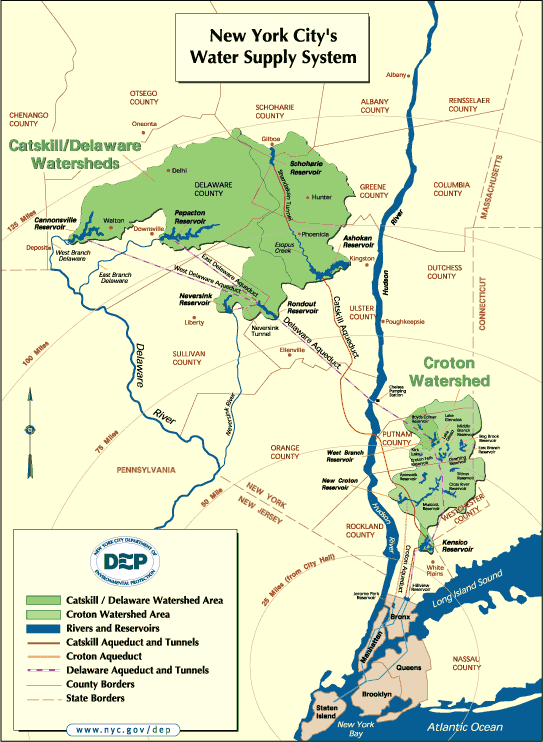
Topping the list is the Upper Delaware River, which divides northeast Pennsylvania from southeast New York state and provides drinking water for 17 million people across both states. Natural gas drilling in the area threatens the river as a clean water source, the group said.

Gas drilling is also threatening the Monongahela River in southwestern Pennsylvania and northern West Virginia, the group said. The river, which is ninth on the list, provides drinking water for hundreds of thousands of people and is home to some of the East Coast's best fishing, whitewater boating, and wildlife, the group said.

Both the Upper Delaware and the Monongahela sit on an area called the Marcellus Shale, which lies beneath large parts of Pennsylvania, New York, and West Virginia at a depth of 5-8,000 feet, according to the Pennsylvania Department of Environmental Protection.

The shale is believed to hold trillions of cubic feet of natural gas. It has long been considered too expensive to access, according to the department, but recent technological advances and rising natural gas prices have rekindled an interest in drilling beneath the Marcellus Shale.

American Rivers says the natural gas extraction involves injecting chemicals into the ground, creating untreatable toxic wastewater. It urged the Delaware River Basin Commission not to issue new permits for gas drilling in the area until there can be a thorough study of its impacts, and it urged Congress to pass the Fracturing Responsibility and Awareness of Chemicals Act of 2009.

Along the Monongahela, American Rivers urged the Ohio River Valley Water Sanitation Commission and state authorities to prohibit pollution associated with the drilling.

The Pennsylvania Department of Environmental Protection says the wastewater from the drilling is treatable, and that disruption of water quality is "often rare and generally temporary."

Except when it's not... -Splashdown!

For more on America's most endangered rivers, CLICK HERE.

DEMAND ACCOUNTABILITY!

Tuesday, June 1, 2010

Shell Buys PA-Based Natural Gas Exploration Company

By PETER LATTMAN and GUY CHAZAN

Royal Dutch Shell PLC said Friday it has agreed to buy East Resources Inc., a closely held U.S. natural-gas explorer, for $4.7 billion, in a transaction that underscores the frenzied global interest in North American shale-gas production.

Warrendale, Pa.-based East Resources is one of the biggest players in a natural-gas exploration area known as the Marcellus Shale, with control of 1.25 million acres across a territory that stretches from West Virginia to New York. ...

From Money Morning, June 1, 2010:

"Shell, Europe’s largest energy producer, gets 1.05 million acres of gas properties in the northeastern United States and Texas. About 650,000 acres gained in the acquisition are part of the crucial Marcellus Shale, a tight gas property with shale formations estimated to hold up to 262 trillion cubic feet of recoverable gas.

The remaining acres are part of the Eagle Ford Shale area in South Texas. The deal brings Shell’s total U.S. tight gas acreage up to 3.6 million acres. ...

The move into shale gas allows Shell to remain competitive with industry giant Exxon Mobil Corp. (XOM: 60.45 -0.01 -0.02%), which in December paid $31 billion for XTO Energy Inc. (XTO: 42.69 -0.05 -0.12%), the largest U.S. natural gas producer. The deal will increase Shell’s daily gas production by 7.5%." -Kerri Shannon, Associate Editor, Money Morning

North American natural gas currently accounts for about 7.8% of Shell’s global oil and gas production. Shell has pursued several deals in the North American gas market in recent years, buying Canada’s Duvernay Oil Corp. in 2008, and teaming up with Encana Corp. to develop acreage in Louisiana’s Haynesville Shale exploration area. Shell officials have said they believe that while gas prices are low now, in the long-term they will recover.

Foreign energy companies have moved aggressively on to the scene. Last month, India’s Reliance Industries ltd. invested $1.7 billion for a 40% stake in a joint venture with Atlas Energy inc., which controls about 584,000 acres in the Marcellus. In February, Japan’s Mitsui & Co. announced a deal with Anadarko Petroleum Corp. in which it will invest about $1.4 billion to develop shale gas in the region. ...

Did someone say something about American energy independence? ...WHAT WAS IT?

LINK to complete article.

LINK to inset quote.

DEMAND ACCOUNTABILITY!

ExxonMobil Shareholders Demand Natural Gas Fracking Risk Assessment

Written by Susan Kraemer
Published on May 30th, 2010
Posted in Air Quality, Fossil Fuels, Water
CleanTechnica.com


At the ExxonMobil’s annual shareholders meeting on May 26th, the San Francisco-based sustainable investors group As You Sow asked for a vote on forcing the company to assess the risks to drinking water, public health, and shareholder value associated with hydraulic fracturing for natural gas.

Representing the holders of 16,746 ExxonMobil shares valued at more than $1.1 million, As You Sow – as well as the two largest US proxy voting services, RiskMetrics Group and Proxy Governance – want to enforce disclosure of the environmental risks of “fracking” for natural gas, a process that injects high volumes of water, chemicals and particles underground to create fractures through which gas can flow for collection.

To make up for the complete absence of SEC filings from ExxonMobil covering environmental or regulatory risk, shareholders took the unusual step of filing their own assessment of these risks with the SEC.

New social proposals usually only receive between 5-7% of the vote. But, demonstrating that mainstream investors are already aware of and concerned about the risks that hydraulic fracturing poses to the nation’s water supplies, it received over 26% support.

Two concepts are essential to investor confidence: disclosure and the mitigation of risks. But two thirds of the 31 states have no regulations covering hydraulic fracturing, none require an accounting of the fracking fluid remaining, and only ten even want to know what chemicals were injected.

The disaster in the Gulf of Mexico teaches us that there is a risk with no oversight. Drowning government in a bathtub risks taking all of us down the drain along with it.

That is one risk. But for shareholders, regulatory risk normally is assessed as well, because it has an economic impact on profits.

In March 2010, the administration had the EPA begin a study of the dangers of fracking, and legislation is now pending in both houses to repeal Dick Cheney’s infamous “Haliburton loophole”, that repealed the right of the EPA to regulate hydraulic fracturing under the Clean Water Act.

Neither risk was included in ExxonMobile’s SEC filing.

LINK

Image: Wespionage
Source: InsuranceNews

DEMAND ACCOUNTABILITY!

RURAL IMPACT VIDEOS, 6 parts

Natural gas development in Colorado, the impacts on communities, environment and public health. A primer for public servants and residents of counties that care for their lifestyles.

Drilling for Gas in Bradford County, PA ... Listen!

Cattle Drinking Drilling Waste!

EPA... FDA... Hello? How many different ways are we going to have to eat this? ... Thank you TXSharon for all you do! ... Stay tuned in at http://txsharon.blogspot.com

Landfarms

A film by Txsharon. Thank you Sharon for all you do. Click HERE to read the complete article on Bluedaze: Landfarms: Spreading Toxic Drilling Waste on Farmland

SkyTruth: Upper Green River Valley - A View From Above