Wednesday, November 18, 2009

Radioactivity Rising... Along with Concern

Schuyler’s Hot

By Peter Mantius
The Odessa File

BURDETT, Nov. 13 -- When the state recently tested brine extracted from all 12 of New York’s active Marcellus Shale natural gas wells, several of the samples were highly radioactive.

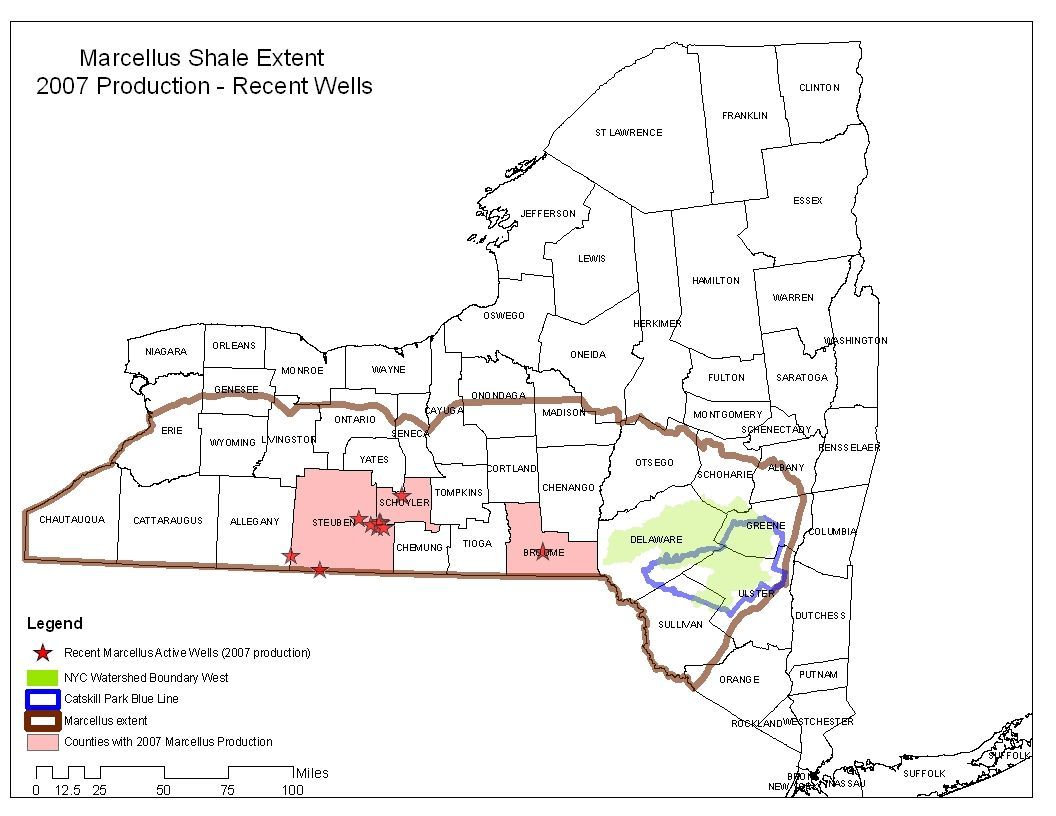
Six of those tested wells, including the four found to be the most contaminated, are located in Schuyler County.

The tests conducted between October 2008 and April 2009 found that wastewater from the six deep vertical wells in Orange, Dix and Reading showed concentrations of Radium 226 ranging from 60 to 260 times the legal limit for discharge into the environment.

The results could complicate plans for aggressive natural gas drilling locally and lead to calls for more active radiological monitoring throughout the Marcellus Shale drilling region, including Pennsylvania.

“Whatever entity produces those kinds of numbers will have to be licensed by the state,” said Theodore G. Adams, a radiological and environmental consultant in suburban Buffalo. “The waste will have to be managed, treated and disposed of (to avoid human contact).”

Radium 226, which is intensely radioactive, has a half-life of 1602 years and decays into radon gas.

In July, the state Department of Health expressed concerns about the test results in a confidential letter to the Department of Environmental Conservation, which conducted the tests.

Existence of the letter was recently reported by the website ProPublica. DEC confirmed that it received the letter but denied my repeated requests for a copy.

So far, the agency isn’t raising alarms about the test results, saying radioactivity readings can vary widely at any given site.

But if further testing confirms that the readings are roughly accurate indicators of current radioactivity levels, it could significantly drive up the cost of extracting natural gas.

Sites that consistently turn in high radiological readings for their brine would need to obtain special licenses, said Adams, a former federal Department of Energy radiation inspector who runs his own firm that serves clients such as Westinghouse and Alcoa.

Adams noted that wastewater or sludge from such wells would likely require expensive special handling.

Fortuna Energy Inc. of Horseheads operates several of the wells that showed high radioactivity readings, ProPublica has reported. But Mark Scheuerman, Fortuna’s general counsel, declined Friday to confirm or deny the company’s involvement. He said the company planned to address a myriad of drilling issues in written comments to the DEC by yearend.

The DEC conducted extensive radiological tests of New York State natural gas wells in 1999 and found little cause for concern. But none of those were Marcellus wells. In contrast, all of the recent tests were Marcellus wells (six in Schuyler, five in Steuben County and one in Chenango County), and several of them showed much higher readings than any of the 1999 tests.

The results are buried deep in an appendix to the state’s draft Generic Environmental Impact Statement for gas drilling. The charts are presented without any explanation or footnotes.
But the simple numbers speak powerfully, according to Adams.

For example, one well in Orange showed Radium 226 concentrations of 16,030 picocuries per liter. Adams said the state and federal limit for legal discharges into the environment is 60 picocuries per liter.

The legal limit for drinking water is 5 picocuries per liter. The limit for water treated at a sewage treatment plant is 600 picocuries per liter.

Three other Schuyler County wells also showed readings of more than 10,000 picocuries per liter. The highest reading detected outside Schuyler County was 7,885 picocuries per liter at a well in Steuben County. (The findings were reported with uncertainty levels of roughly 25 percent).

All 12 of the tested wells were drilled vertically in the Marcellus Shale, a rock formation several thousand feet below the surface that extends through most of the Southern Tier, Pennsylvania and parts of West Virginia and Ohio.

...

Although previous public hearings on drilling have touched on a host of environmental issues, radioactivity hasn’t been a prime concern.

Yancey Roy, a spokesman for the DEC, ...said the 12 tested wells were the only active Marcellus Shale wells in the state. And while more radiological testing is needed, he said, that can’t occur until new drilling operations get underway.

Once fracking begins in New York, “decisions will be made, based on the results, as to the proper handling and disposal of waste materials,” he added.

In the past, brine has been used on state roads to help melt snow. (!!!)

An appendix to the proposed DEC drilling rules says: “The modeling showed that the most common method of brine disposal in New York State, spreading it on the roads to control ice and snow, does not present significant (radiation) doses to the public.”

Roy noted that the DEC is concerned about potential buildup of radioactivity in pipes and other drilling equipment and said that equipment may have to be monitored. NORM is also apt to accumulate in sludge that is a byproduct of well wastewater.

For the complete report, CLICK HERE.

DEMAND ACCOUNTABILITY!

Pennsylvania regulators to inspect gas wells proactively

Tom Fowler
Houston Chronicle: chron
November 18, 2009

The Pennsylvania Fish and Boat Commission says it will start inspecting natural gas drilling sites more aggressively, instead of just responding to incidents:

"Until now our agency has only reacted to those drilling sites where a problem resulted in material entering a waterway or wetlands," said Dr. Douglas Austen, PFBC executive director. "We are now taking a proactive approach to identify possible problems at a drilling site and to work with the company to ensure necessary measures are in place to minimize the possibility of damaging nearby waterways."

The agency will focus on those well sites that are in close proximity to Commonwealth waterways, including wetlands. The inspections will determine if adequate measures are in place at the drilling site and access roads to prevent damage to the nearby aquatic resources. As part of the inspections, PFBC staff will also be obtaining water quality data from several locations in the nearby waterway.

Pennsylvania and New York lawmakers have been increasingly nervous over the growth of natural gas drilling in the Marcellus shale formations because of concerns over the fluids used in a key drilling method, hydraulic fracturing. Houston-based Cabot Oil & Gas created a stir in Pa. recently when it was fined for spilling fracking fluid three times. It has since entered into an agreement with state regulators over ongoing operations.

DEMAND ACCOUNTABILITY!

Twelve Marcellus Shale gas drilling wastewater treatment plants proposed in northern Pennsylvania

By FORD TURNER
The Patriot-News
November 18, 2009

The state Department of Environmental Protection is reviewing permit applications associated with at least 12 different proposals to build treatment plants for chemical-tainted wastewater from natural gas drilling operations in northern Pennsylvania.

Ten of the plants are proposed in DEP's 14-county north-central region, which is centered on Lycoming and Clinton counties.
...

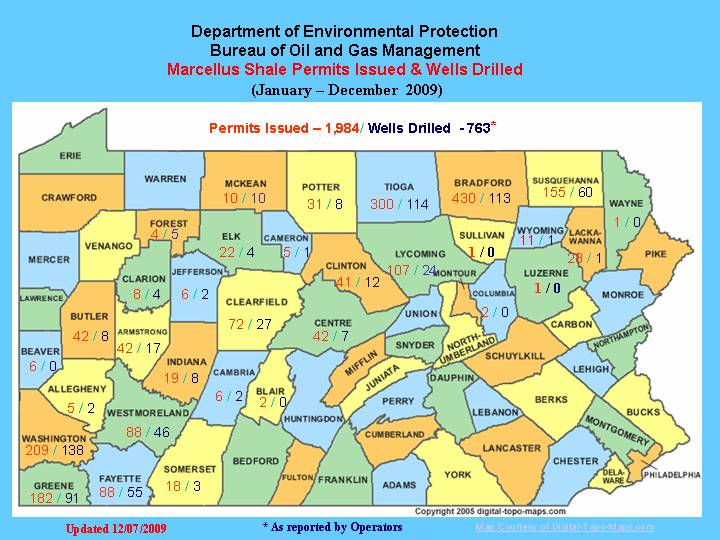
DEP issued 1,592 Marcellus Shale gas well drilling permits in the first 10 months of 2009. More than one-third of them were in the 14-county north-central region.

DEMAND ACCOUNTABILITY!


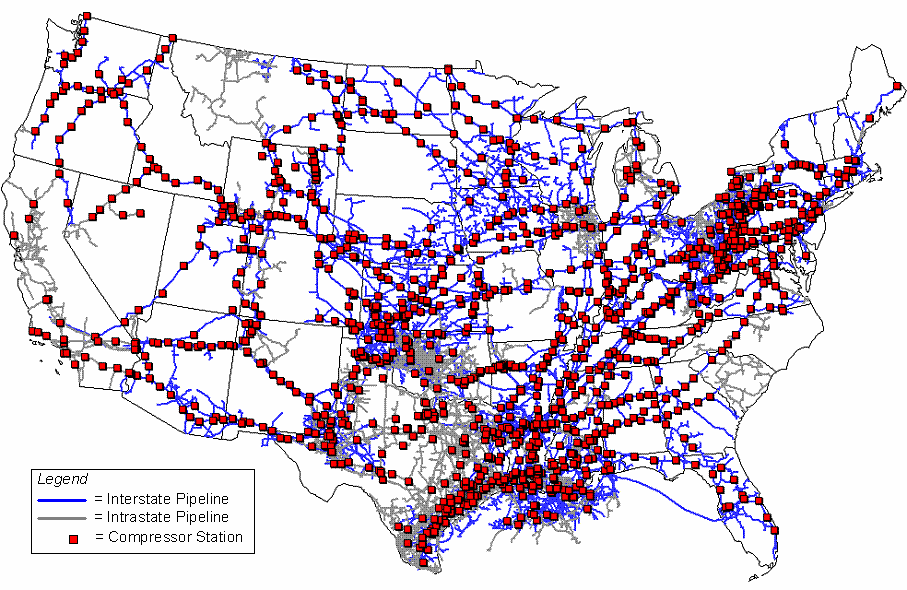
Gathering Line
- a special pipeline that transports gas from the field to the main pipeline.

The Gathering Line is a round-up of oil & gas drilling news brought to you by National Alliance for Drilling Reform (NA4DR), a broad alliance of grassroots activists from states across the nation that are affected with drilling development.


Amy Goodman interviews of Toxics Targeting, an Ithaca, NY-based environmental database firm which released a report last week, uncovering 270 documented hazardous chemical spills which occurred over the past thirty years. PA's own Department of Environmental Conservation's database contained records of fires, explosions, wastewater spills, well contamination, and ecological damage related to gas drilling. Take a moment to watch the interview Amy Goodman Interviews Walter Hang of Toxics Targeting Mr. Hang is calling on NY Governor David Paterson to withdraw the Draft Supplemental Geologic Environmental Impact Statement, citing woefully inadequate reporting which will not come close to protecting the environment, water, and public health. This is a must-see interview! Visit Gas Wells Are Not Our Friends to find out more from Peacegirl!

Would you consider this a small footprint? See the effects of 40 years of drilling! Read it at Cheap Tricks and Costly Truths.

Gas drilling is destroying Pennsylvania's wilderness. The Pennsylvania Wilds include more than 2,000,000 acres of publicly owned virgin forest, clear mountain streams and abundant wildlife. Read about how these public lands are being violated and watch Splashdown for public action you can take soon to defend the Allegheny National Forest, part of the Pennsylvania Wilds.

TXsharon continues to follow the abuses of Aruba Petroleum in a Barnett Shale backyard and Wednesday the Wise County Messenger picked up the story--don't miss the comments. It's all on Bluedaze: DRILLING REFORM FOR TEXAS.

Colleyville tables application for first well site. See story at Flower Mound Citizens Against Urban Drilling

Sue Heavenrich writes about problems with a local compressor station in upstate New York at the "Marcellus Effect." Industrial drilling in Marcellus is impact enough, but without local zoning rural areas are open to invasion by other industrial uses too, including compressor stations. You'll find more on the "Marcellus Effect"

DEMAND ACCOUNTABILITY!

Tuesday, November 17, 2009

One Landowner's Leasing Logic

My strategy with the energy extraction that is already underway in the whole area is to co-opt the Energy Exploitation corp into actively conserving our little plot of water and land by signing a strongly conservation-led non-disturbance lease. They get the gas down there legally (they don't have to steal it, I mean), and agree to not touch the land or water up here. If they do, we can (I believe) fairly easily and cheaply shut em down with an injunction - something not possible without a lease. A lease transfers the weak legal enforceability of conserving land into the strong legal enforceability of honoring an agreement. Just make sure the agreement is right for us!

If they sign this agreement, they have an 80% interest in protecting the covenants of the agreement (they get 80% we get 20%). They don't have to give a shit about the land and water. But in order to get the gas they have to give a shit about upholding the lease, which demands that they preserve land and water.

Mind you, this is a compromise and is only made possible because all our neighbors have already happily sacrificed their rights over control of their own land so the gas guys can put their rig over there and not on our land. Up until then, I was strongly in favor of no leasing, no dialog, no nothing because that kept them away quite effectively. After the entire valley leased, our holding out prevented nothing, preserved nothing, allowed us to control nothing, not even on our own land. That's when it became preferable to me that we create a binding agreement with the Gas co about how our land is affected.

DEMAND ACCOUNTABILITY!

PA Landowners Get Big Payments as Marcellus Shale Bidding Escalates

Gary Abdullah, Penn State University
November 17th, 2009

UNIVERSITY PARK - As legislators, environmentalists and others strive to balance the many interests involved in developing the natural gas deposits contained in the Marcellus shale formation, a fierce bidding war has doubled the prices being offered for leases in Pennsylvania. The resulting competition could be a boon for landowners, according to experts in Penn State's College of Agricultural Sciences.

The nation's economic troubles may have slowed development of natural gas wells for the last year, but energy companies seem to be returning to the state and buying up drilling leases with a vengeance. Joann Kowalski, Penn State Extension economic development educator in Susquehanna County, said the proven performance of existing wells may have companies competing to lock up prime properties in the state's Northern Tier.

"Word hit the street in September that Fortuna Energy was going to be paying the Friendsville Group $5,500 an acre for a five-year lease, with 20 percent royalties for producing wells," Kowalski said. "That was probably about twice the rate that had been offered up to that point. Fortuna had not been buying leases in Susquehanna County before this -- they were doing most of their work in Bradford County."

A second company, Chesapeake Energy, is reported to have offered a higher lease rate to area landowners who had not yet signed with Fortuna, according to Thomas Murphy, energy development extension educator in Lycoming County. While actual offers are unconfirmed by the companies, he says the implications are clear: energy companies are making directly competitive bids to the same landowners, hoping to wrap up lease rights in several counties along the Northern Tier.

"Companies have become very competitive to acquire leaseholds that are still available by offering these higher rates," he said. "A lot has to do with the acreage that they can tie up. The Friendsville Group was offering 37,000 acres in Bradford and surrounding counties and lower New York.

...
"Once a company knows what gas is there, there's a sense of urgency to acquire as large a foothold as possible," he said. "Other players are moving into the broader Appalachian region and acquiring or expanding some very large footholds, and with that amount of money flowing in, companies interested in getting a foothold are feeling a greater sense of urgency to capture the remaining pieces. Some other landowner groups are still negotiating with companies, and other groups probably will be forming, but that's hard now because so much of the ground in north-central and northeastern Pennsylvania has been leased."

Kowalski explained... "Large groups that negotiate as one can raise the bar for price; then others can benefit from that, as well. It's also advantageous for the company because there's less effort required to make the deal happen. The group has already gone through the steps of formation, so it makes it easier and less costly for a company to acquire a lot of foothold in one fell swoop instead of going to all the individuals independently. And a landowner group often can provide more contiguous acreage, which is valuable for an energy company."
...
"This is probably the tail end of the initial leasing wave, which has lasted for more than two years," she said. "The amount of land available now is probably pretty small, but this could be repeated as the leases terminate over time. It'll be interesting to see what happens when these leases are up in five years, since the companies will have better well-production records. I believe the companies have found that the wells are producing more than they'd expected, so this could go on for decades."
...
For the complete story, CLICK HERE.

DEMAND ACCOUNTABILITY!

PA DEP Report of Stray Gas Migration Cases


With the number of gas wells drilled in the Commonwealth since the inception of the industry [back in 1859], the potential exists for natural gas to migrate from the wellbore (via either improperly constructed or old, deteriorated
wells) and adversely affect water supplies, as well as accumulate within or adjacent to structures such as residences and businesses. Collectively, this may represent a threat to public health, safety and welfare, and is a potential threat of a fire or explosion. The Department has documented such occurrences and these cases are provided in this document.

... The gas migration cases are organized into several categories: new wells, operating or active wells, legacy or abandoned wells, and wells associated with underground storage of natural gas.

New wells involve that initial phase of an oil or gas well when the well is being drilled or re-drilled, completed and put into production. For most wells, well completion involves hydraulic fracturing either immediately after the well is drilled or at a later date.

New Wells – Stray Gas Migration Cases

McNett Township, Lycoming County - East Resources – NCRO – July 2009: A natural gas leak from an East Resources Oriskany well was confirmed on July 27, 2009. Methane gas from the well impacted multiple private drinking water wells and two tributaries to Lycoming Creek, forced one resident to evacuate her home, and required the closure of access roads near the well. Company personnel took necessary measures to stop the gas leak at the well and stream and drinking water well conditions improved. The suspected cause of the leak is a casing failure of some sort. East Resources continues to monitor homes and wells in the effected area (approximately 6000 foot + radius) where methane has been documented and reports to the Department weekly. Methane was evident in some wells and the subsurface. One gas extraction system was installed at a residence. The investigation is on-going. The Northcentral Regional office expects to receive a report regarding the incident from East Resources in approximately 30 days.

Dimock Migration, Dimock Twp., Susquehanna County - Cabot Oil and Gas – NCRO - 2009: The Department is actively monitoring domestic water supplies and investigating potential cause(s) of a significant gas migration that has been documented in several homes along Carter Road. Free gas has been encountered in six domestic water supplies and dissolved has been found in several of the wells. The operator has placed pilot water treatment systems on three water supplies. Of particular note is that this area has not experienced previous drilling and recent gas drilling in the vicinity has targeted the Marcellus Shale.

Hedgehog Lane, Foster Twp., McKean County – Schriener Oil and Gas – NWRO – April 2009: The Department is actively investigating the report of fugitive gas in domestic water well. Prior to Departmental involvement, the company drilling gas wells in the area provided a new water well to an affected residence. After stray gas was evident in the water well, apparently the concerned resident approached the company directly, a new water well was provided and the impacted well was plugged with bentonite. Some time later, neighboring water well became impacted with stray gas and the resident contacted the Department. During the investigation, four gas wells were discovered over-pressured. Packers were placed in those over-pressured wells and the wells were brought into regulatory compliance. At this time, a response in the affected water well has not been observed. Complaints of water quality degradation and water diminutions are also under investigation in the area.

Little Sandy Creek Migration, McCalmont Twp., Jefferson County – NWRO – April 2008: In April, 2008 the Department was informed of a large fugitive expression in Little Sandy Creek. Subsequent investigation indicated the presence of combustible gas in the basement of a nearby residence. It was determined that the gas was entering the structure through an un-sealed sump opening in the concrete floor of the basement. The sump was vented through the wall and the threat to the home was minimized. During the investigation the Department discovered that two recently drilled gas wells were over-pressured and were producing from different geologic strata. Isotopic analysis indicated that a specific gas well was the probable source of the fugitive gas and measures were undertaken to reduce pressure on the casing seat. After continued monitoring at the residence, it was determined that the amount of gas in the sump was decreasing. The basement sump remains vented and the problem is dissipating.

Kushequa Migration, Hamlin Twp., McKean County – NWRO – September 2007: A stray gas migration caused a change in water quality and a minor explosion in a community water well. Combustible gas was also encountered in a few private water wells within the village. The Department investigated the stray gas occurrence in September of 2007 and through an investigation determined that a specific over-pressured gas well was the cause of the migration. Pressure was released from the potentially responsible gas well and a positive change in the impacted water well was rapidly noted. Additional production casing was placed in the suspect well to permanently resolve the problem. The responsible party was recently issued a Consent Order and Civil Assessment which they plan to comply. The Department issued a well plugging contract to plug 15 orphan wells adjacent to the water wells.

Alexander Migration, Hickory, Washington County – SWRO: It appears the operator affected an old abandoned well when completing a new well in the area. Stray gas occurs in the soils and contamination exists in private water supplies. DEP is evaluating several wells in the area. The investigation is ongoing.

Five Mile Run A, Knox Twp., Jefferson County – NWRO – April 2009: The Department was made aware that on April 18, 2009 fugitive gas began escaping from a domestic water well. During the investigation, the Department also encountered combustible gas in neighboring water well. At this time evidence is being gathered and it is likely that the cause of the fugitive gas migration may be linked to a recently drilled neighboring gas well. The Department is also investigating three reports of water quality problems that may be associated with the recent gas well drilling in the area. The fugitive gas in the water well is a recent problem and at this time is not linked to the gas in Five Mile Run that is approximately 2,500 feet away.

Five Mile Run, Knox Twp., Jefferson County – NWRO – 2008: Consistent gas streams have been identified at two locations within Five Mile Run. Isotopic samples were obtained in early 2008 and the analysis indicates that the gas is of thermogenic origin. It is unknown when the gas first appeared in the stream. At the time of sampling, only older historic wells (pre-1920’s) were in the vicinity. Presently the area is experiencing an increase in drilling activity. The permitted boundary for the Galbraith Gas Storage Field (operated by National Fuel Gas) is located approximately 4000 feet to the closest stream expression of fugitive gas. The source of the gas at this time is unknown.

Mix Run Migration, Gibson Twp., Cameron County – NWRO – Fall 2007: In the fall of 2007, the Department continued the investigation of fugitive gas reported in the water well of a seasonal residence. The presence of gas in the water well is sporadic with no apparent trends in its occurrence noted. The area has experienced no recent drilling although historic records indicate Oriskany gas was produced in the vicinity. All wells that could be identified and field verified within one mile of the stray gas location are in regulatory compliance. The closest gas well was plugged and a gas well with potentially compromised casing (approximately 3000’ away) was repaired. Gas was not present in the water well at the time of the last inspection in May, 2009.

Ohl Complaint, Hebron Twp., Potter County – NWRO – June 2007: The Department responded to a complaint of fugitive gas in a water well that serves a seasonal structure in June, 2007. Isotopic analysis indicated a possible similar thermogenic origin of the gas in the water well to a neighboring gas well. Initial efforts to vent the suspected gas well to atmosphere for an extended time failed to reduce the amount of gas in the neighboring water well. The new well owner placed a down-hole packer and additional production casing in the well. This action did not produce a reduction in the fugitive gas in the water well. The Department continues to investigate the complaint.

Miller Gas Migration, Liberty Twp, McKean County – NWRO – January 2008: Departmental personnel responded to a report of fugitive gas in a domestic water well that serves a seasonal residence in January, 2008. Investigation by Departmental field representatives discovered that two recently drilled gas well was over-pressured (exceeding the amount of allowable pressure on the casing seat). The operator Placed packers and additional production casing in the gas well, thereby eliminating pressure on the casing seat. The water well was aggressively pumped and over time the amount of combustible gas in the well bore decreased significantly. The gas well was brought back into production when the amount of gas was below the allowable amount.

Head Drive Migration, Millcreek Twp., Erie County – NWRO – Fall 2007. In the fall of 2007, the Department initiated an investigation into the report of fugitive gas in the vicinity of several homes along Walnut Creek. The discovery of fugitive gas in the soil near the residences, forced the Erie County Health Dept. to evacuate the neighborhood. The residents were displaced for at least two months. Through the use of isotopic analysis and with a through investigation performed by the Department’s field staff, it was determined that the recently drilled neighboring gas wells were the cause of the migration. Through a Consent Order with the Department, the responsible party plugged two defective gas wells and placed packers in the remaining gas wells. The case is presently in private litigation.

Hughes Migration, Hamlin Twp., McKean County – NWRO – June 2006: In June, 2006 the Department responded to two water quality/diminution complaints and determined that a change in water quality was evident. Over-pressured conditions were noted at a recently drilled nearby gas well. The gas well operator drilled new water wells for the impacted residences and gas was encountered during the drilling process. Subsequently, when the operator placed additional production casing in the gas well, the Department noted a marked decrease in the amount of gas in the recently drilled water wells. Over time the problem has diminished.

Foote Rest Camp Ground Migration. Hamlin Twp., McKean County – NWRO – Late 1990s: In the late 1990’s, the Department responded to a complaint of gas escaping from an abandoned gas well located in a wooded area near a private campground. During the investigation, it was discovered that an extremely large amount of gas (estimated at more than 100 Mcf/day) was venting from the abandoned gas well. The old well became activated when fracing was completed on a new gas well approximately 4000’away. Installation of production casing placed in the new well prevented additional gas from migrating to the abandoned well and the problem was resolved.

CLICK HERE for inventories of operating or active wells, legacy or abandoned wells, and wells associated with underground storage of natural gas.

DEMAND ACCOUNTABILITY!

RURAL IMPACT VIDEOS, 6 parts

Natural gas development in Colorado, the impacts on communities, environment and public health. A primer for public servants and residents of counties that care for their lifestyles.

Drilling for Gas in Bradford County, PA ... Listen!

Cattle Drinking Drilling Waste!

EPA... FDA... Hello? How many different ways are we going to have to eat this? ... Thank you TXSharon for all you do! ... Stay tuned in at http://txsharon.blogspot.com

Landfarms

A film by Txsharon. Thank you Sharon for all you do. Click HERE to read the complete article on Bluedaze: Landfarms: Spreading Toxic Drilling Waste on Farmland

SkyTruth: Upper Green River Valley - A View From Above