Showing posts with label ENVIRONMENTAL RESPONSIBILITY. Show all posts

Wednesday, August 4, 2010

Marcellus Shale drilling industry 'is not operating at an excellent level,' state official says

DONALD GILLILAND, The Patriot-News
Wed., August 4, 2010


There are too many spills, too many leaks, and too much natural gas migrating into people’s drinking water wells due to drilling in the Marcellus Shale, said John Hanger, Pennsylvania’s Secretary of Environmental Protection.

“The industry as a whole is not operating at an excellent level,” he said. “We are not demanding perfection, but we are demanding excellence.”

Hanger’s comments were made in response to a report from the Pennsylvania Land Trust that Marcellus Shale drilling companies had been cited for 1,435 regulatory violations in the last two and a half years.

“The report disproves the claim made by some that this industry is not regulated in Pennsylvania,” Hanger said. “All of those violations were written by DEP personnel and are an indication we are regularly at drilling sites.”

Hanger responded to criticism that his agency wasn’t doing enough and had been hamstrung by budget cuts.

“I don’t think the public knows a lot of what’s actually been happening,” he said.

Despite budget cuts, he said, the agency has actually more than doubled its oil and gas inspection staff. By the end of this month, DEP will have hired 105 additional oil and gas inspectors, for a total of 193.

“We have more inspectors than the state of Louisiana,” Hanger said. “There’s no state in the country that has come anywhere close to having our oil and gas staff.”

Money for those new hires has come from raising permit fees for Marcellus drillers from $100 to a sliding scale that averages between $5,000 to $10,000 per well, Hanger said. Those increased fees have generated $10 million so far.

He said DEP has opened new offices in Williamsport and Scranton to put inspectors closer to where the drilling is taking place. The agency has equipped them with better technology, like infrared cameras to better detect leaks.

An ongoing review of agency rules and regulations has resulted in new water quality standards that require drilling companies to treat wastewater to drinking water standards before returning it to a commonwealth stream.

Getting that regulation into effect has taken two years, during which time, “the industry has been looking at other options, and they now reuse a large proportion of drilling wastewater,” Hanger said.

“Range Resources publicly say they are a zero discharge company now. That’s major progress as a result of tightening the rules.”

More stringent rules for well construction are also in the works.

“It’s not the case we’re just starting today,” Hanger said. “We’ve been working at it for two years.”

Some of the violations in the report involved serious consequences for companies, he said, because sometimes it’s appropriate “to take out a regulatory two-by-four and hit companies over the head with it.”

However, it would have been helpful, he said, if the report had also included a top 10 list of companies with the least violations per well drilled.

“In attempting to move this industry to a standard of excellence ... It’s useful to identify companies that are doing it well,” Hanger said.

“This industry requires strong oversight; there’s no question about that,” he said, but the record of some companies — like Anadarko — “really points out it’s possible to operate in a manner that creates few problems.”

“At the end of the day, what’s really going to determine if the industry maintains public confidence or loses it entirely — and at best it’s shaky right now — is their safety record and their environmental record,” Hanger said.

“We are creating strong incentives for safe operations, but it’s absolutely true that the government doesn’t run these wells and doesn’t drive the trucks. ... There are limits to what government can do. The companies themselves are writing their own safety record, and that record in Pennsylvania is going to be public.

“This industry has a huge amount at stake to create a true culture of safety,” Hanger said.
LINK

DEMAND ACCOUNTABILITY!

Friday, July 16, 2010

2 NEW REPORTS

PEC Releases Report on Marcellus Shale Development
Recommendations and Findings on Environmental Policy Needs for Pennsylvania


July 13, 2010- The Pennsylvania Environmental Council (PEC) released a report calling for swift action on new regulations and greater oversight of drilling and extraction of natural gas from the Marcellus Shale formation, a major gas field that lies deep beneath much of Pennsylvania.

Called "Developing the Marcellus Shale," the report challenges state government and the natural gas industry to adopt more stringent standards for drilling and extraction to prevent the kind of environmental impacts that have occurred throughout Pennsylvania's industrial past.

The report also includes a number of specific legislative and regulatory changes that PEC believes should be made to minimize the risk of accidents, environmental damage, and public health hazards stemming from drilling operations.

DOWNLOAD Developing the Marcellus Shale

LINK

Beneath the Surface: A Survey of Environmental Risks from Shale Gas Development | Worldwatch Institute

7/16/2010
Washington, D.C.-
Improved drilling techniques have unlocked vast new reserves of shale gas, a resource that could be large enough to displace significant amounts of coal, and an energy source that emits less than half the carbon dioxide. But growing shale gas development has raised both environmental questions and public controversy. A new independent assessment by the Worldwatch Institute concludes that improved adherence to drilling best practice and better regulatory oversight are essential to assure environmental and public protection as shale gas production continues to expand.

The report, Addressing Environmental Risks from Shale Gas Development, details what happens beneath the surface during horizontal drilling and hydraulic fracturing in deep shale formations, evaluating the risks to local water quality and the environment, as well as the technologies and policies needed to overcome them.

"Microseismic data have shown us that a properly designed hydraulic fracture job stimulates gas production only within the shale formations, which are typically hundreds of feet thick and thousands of feet deeper than drinking water supplies," says Mark Zoback, a geophysicist at Stanford University and a report co-author. "For this reason, the risk of fractures propagating from deep shale formations to underground sources of drinking water, which has been the subject of much debate, appears to be extremely low."

The report concludes that faulty well construction, in particular poorly cemented steel casings needed to isolate the gas from shallow formations, as well as above-ground contamination due to leaks and spills of fracturing fluids and waste water, pose more significant risks to the environment. In addition, continued study and improved communication of the environmental risks associated with both individual wells and large scale shale gas development are essential for society to make well-informed decisions about its energy future.

"Although the technologies, best practices, and regulations that can help minimize these risks exist, they have not yet been universally adopted," says Worldwatch Fellow and co-author Saya Kitasei. "Experiences in Colorado, Wyoming, Pennsylvania, and New York demonstrate that strong public pressure exists for stricter oversight."

The report, authored by Mark Zoback of Stanford University, Saya Kitasei of the Worldwatch Institute, and Bradford Copithorne of Environmental Defense Fund, is the second in a series of briefing papers from Worldwatch's Natural Gas and Sustainable Energy Initiative, which examines critical environmental and policy issues surrounding natural gas.

Download Addressing Environmental Risks from Shale Gas Development by Mark Zoback, Saya Kitasei, and Bradford Copithorne.

LINK

DEMAND ACCOUNTABILITY!


Saturday, June 5, 2010

Gas, fluids spew for hours from blown-out Pa. well

By MARC LEVY and JENNIFER C. YATES
Associated Press Writer

KansasCity.com

A blowout at a natural-gas well in a remote area shot explosive gas and polluted water as high as 75 feet into the air before crews were able to tame it more than half a day later, officials said Friday.

The gas never caught fire, and no injuries were reported, but state officials worried about an explosion before the well could be controlled. The well was brought under control just after noon Friday, about 16 hours after it started spewing gas and brine, said Elizabeth Ivers, a spokeswoman for driller EOG Resources Inc.

Pennsylvania, historically an insignificant source of natural gas, is trying to adapt its laws to respond to a furious rush to tap a gas-rich shale formation under its land. The blowout could test the ability of state regulators, who promised an aggressive investigation into the accident. (see DEP Press Release below)

"The event at the well site could have been a catastrophic incident that endangered life and property," Department of Environmental Protection Secretary John Hanger said in a statement. "This was not a minor accident but a serious incident that will be fully investigated by this agency with the appropriate and necessary actions taken quickly."

If the agency finds that mistakes were made, it will take steps to prevent similar errors, he said. It was too early to tell the extent of any environmental damage, he said.

Details about the accident were still sketchy, but the agency was told that unexpectedly high gas pressure in the new well prevented the crew from containing it, said Dan Spadoni, a spokesman for the Department of Environmental Protection.

EOG declined to explain how the accident happened, citing the ongoing investigation. Public safety and protection of the environment are of the utmost importance, the company said in a statement.

President Barack Obama and others have touted exploration of shale as a major new source of clean, homegrown energy. However, lawmakers who are battling for more stringent oversight of such drilling to protect clean drinking water quickly seized on the accident.

"Incidents like this blowout are a reminder that there are dangers and that precautions must be taken to protect the health and well-being of Pennsylvanians," U.S. Sen. Bob Casey said in a statement.

Casey has sponsored a bill to require the industry to comply with the Safe Drinking Water Act and force it to disclose the chemicals it uses in its hydraulic fracturing processes - in which millions of gallons of water, sand and chemicals are blasted underground to shatter tightly compacted shale and release trapped natural gas.

Amy Mall, Senior Policy Analyst, writes on Switchboard, the staff blog of the Natural Resources Defense Council:

"Today a natural gas well blew out in a Pennsylvania state forest during a hydraulic fracturing operation. Officials have estimated that one million gallons of hydraulic fracturing fluid, including chemical additives, plus an undetermined amount of wet natural gas, has blown out of the well. Wet natural gas can contain highly flammable hydrocarbons, like propane and butane, and hazardous substances, such as hydrogen sulfide. These are separated out before natural gas makes its way to your stove or furnace.

Campers and others in the forest were evacuated. While no one wants this kind of toxic explosion in a state forest, imagine if it were near a school or hospital? In this case, the Federal Aviation Administration even had to issue flight restrictions. These hazardous substances will be carried by the air and will settle on land and vegetation. It will be very important to know what chemicals were being used in this hydraulic fracturing operation. Will the company doing the hydraulic fracturing disclose this information to the public?"

LINK

David Rensink, the incoming president of the American Association of Petroleum Geologists, said gas well blowouts are very rare and can be very dangerous to control, since a spark can set off an explosion.

Typically, a blowout preventer - a series of valves that sit atop a well - allows workers to control the pressure inside, he said.

Just such a device figured into the massive oil spill off the coast of Louisiana. The oil rig's blowout preventer was supposed to shut off the flow of oil in the event of a catastrophic failure but failed to do so.

The Pennsylvania well is on the grounds of a hunting club in a heavily forested section of Clearfield County, near Interstate 80 and about 90 miles northeast of Pittsburgh.

Houston-based EOG, formerly part of Enron Corp., was drilling into the Marcellus Shale reserve, a hotly pursued gas formation primarily under Pennsylvania, West Virginia, New York and Ohio that some geologists believe could become the nation's most productive natural gas field.

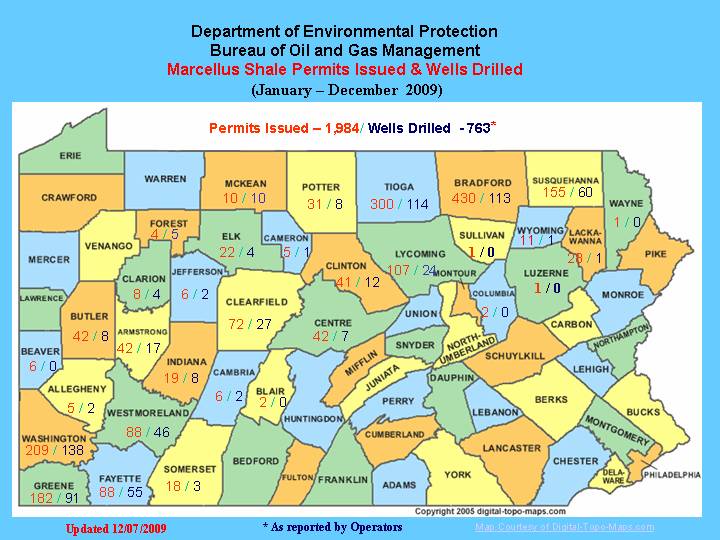
There are more than 1,000 Marcellus Shale wells in Pennsylvania alone, some of them within view of homes, farmhouses and public roads.

There were no homes within a mile of the well, and polluted drilling water was prevented from reaching a waterway, said Spadoni, the department spokesman.

On Friday afternoon, a worker blocked a dirt road to the site, while trucks hauling tanks to remove the polluted water streamed past him. He said he was not allowed to talk about what had happened.

The accident happened just after the crew finished hydraulic fracturing. The crew was clearing out debris from the well when gas shot out of it, Spadoni said.

Workers evacuated the site and contacted county authorities before 10 p.m., said John Sobel, a Clearfield County commissioner. A Pennsylvania Emergency Management Agency spokeswoman said the agency got word after midnight and within the hour notified the DEP. The DEP said it wasn't notified until 1:30 a.m., more than five hours after the blowout.

The polluted water flowing out of the well and into the woods was stopped by a trench and a pump installed by a contractor, Spadoni said. Companies that specialize in securing blown-out wells were called in, he said. ...

LINK to complete report


DEP Plans Thorough Investigation in to Marcellus Shale Well Blowout in Clearfield County

FOR IMMEDIATE RELEASE
06/4/2010

COMMONWEALTH OF PENNSYLVANIA
Dept. of Environmental Protection

Commonwealth News Bureau
Room 308, Main Capitol Building
Harrisburg PA., 17120

CONTACT:
Neil Weaver, Department of Environmental Protection
717-787-1323

EOG Resources Well Released Fracking Fluid, Natural Gas for 16 Hours

HARRISBURG -- Department of Environmental Protection Secretary John Hanger said today that his agency intends to investigate aggressively the circumstances surrounding a blowout at a Marcellus Shale natural gas well in Lawrence Township, Clearfield County, and take the appropriate enforcement action.

At approximately 8 p.m. on Thursday, June 3, the operators of the well, which is owned by EOG Resources, Inc., lost control of it while preparing to extract gas after hydrofracturing the shale. As a result, the well released natural gas and flowback frack fluid onto the ground and 75 feet into the air. The well was eventually capped around noon on June 4.

“The event at the well site could have been a catastrophic incident that endangered life and property,” said Hanger. “This was not a minor accident, but a serious incident that will be fully investigated by this agency with the appropriate and necessary actions taken quickly.

“When we arrived on scene, natural gas and frack fluid was flowing off the well pad and heading toward tributaries to Little Laurel Run and gas was shooting into the sky, creating a significant fire hazard. That’s why emergency responders acted quickly to cut off electric service to the area.

“Right now, we’re focused on limiting any further environmental damage, but once that work is complete, we plan to aggressively look at this situation and see where things went wrong and what enforcement action is necessary. If mistakes were made, we will be certain to take steps to prevent similar errors from happening again.” (Once again... -Splashdown)

DEP learned of the leak at approximately 1:30 a.m. on Friday after it was informed by the Pennsylvania Emergency Management Agency. DEP immediately dispatched its Emergency Response and Oil and Gas program staff to the site.

PEMA, which elevated its activation level to coordinate resources among multiple state agencies, also worked with PennDOT to initiate an airspace restriction above the well, which the Federal Aviation Administration authorized on a temporary basis earlier today. The restriction prohibits flights at and below 1,000 feet of ground level within a three nautical mile radius of the well site. The restriction is in effect until further notice.

The EOG well pad is located in a rural area near the Penfield/Route 153 exit of Interstate 80 in northwestern Clearfield County. Three other wells on the same pad that have been drilled and fractured remain plugged and are not in danger.

EOG Resources, formerly known as Enron Oil & Gas Co., operates approximately 265 active wells in Pennsylvania, 117 of which are in the Marcellus Shale formation.

For more information, call visit www.depweb.state.pa.us.

DEMAND ACCOUNTABILITY!
Friday, May 7, 2010

Pennsylvania’s Natural Gas Regulators Starting to Smell the Coffee?

“Quite frankly, the citizens of this state are being played for chumps."
Kate Sinding

Senior Attorney, New York City
Switchboard.NRDC.org
May 4, 2010

So said John Quigley, Secretary of Conservation and Natural Resources for Pennsylvania at a Marcellus Shale Policy Conference sponsored over the past two days by Duquesne University and the Pennsylvania Environmental Council.

Said John Hanger, Commissioner of the Department of Environmental Protection: “Let me be clear: Self regulation doesn't work. That's not contestable. We've made mistakes before. We have to get this right or the costs will overwhelm the benefits.”

The Philadelphia Inquirer described the officials’ comments as “part of a coordinated effort by Gov. Rendell's administration to build public support for the legislature to impose greater oversight on the [gas] industry.”

Sounds like the “what didn’t go wrong?” experience in Dimock and other horror stories from Pennsylvania – where drilling in the Marcellus Shale has been proceeding apace – are starting to sink in with the state’s regulators.

Regulators in other gas drilling states should sit up sharply and take notice – particularly in New York, where there is still an opportunity to figure out whether it is possible, and if so how, to rigorously regulate gas production to properly protect human health and the environment.

As the horrifying experience in the Gulf of Mexico demonstrates, we cannot be too careful when it comes to domestic fossil fuel development. The costs when things go awry can be both devastating and lasting.

DEMAND ACCOUNTABILITY!
Wednesday, April 14, 2010

Drilling company shareholders push for proxy votes for more company disclosure


Shareholders from environmentally conscious mutual funds, foundations, investment houses and the New York State Common Retirement Fund have successfully put proposals on the annual meeting agenda that would urge more disclosure and transparency of the possible environmental effects and liability risks of hydraulic fracturing. Hydraulic fracturing involves pumping water with chemical additives into a rock formation under pressure to fracture the rock and release natural gas.

Cabot Oil & Gas Corp. and EOG Resources Inc. challenged the shareholder initiative claiming the requests were "micromanagement." The Securities and Exchange Commission backed the shareholder initiatives, which will be put to a shareholder vote.

Other companies receiving the proposal, but not having issued their proxies, include Chesapeake Energy Corp., XTO Energy Inc., and Ultra Petroleum.

The goal of the effort is not to get attention of the public, media, or policymakers. The groups want the attention of shareholders, and by extension, management.

...Typically, any shareholder with more than a $2,000 stake in a company can put certain proposals before shareholders.

Most companies resisted, first by refusing to respond to questions, then fighting to keep the proposal off the ballot. The measures ask management to prepare a report on the environmental impact of fracturing and to set a course for minimizing the chance of environmental harm.

...

Management tends to see such shareholder activism as a nuisance. But Rob Whalen, spokesman for $130 billion New York State Common Pension Fund, the force behind the Cabot initiative, said the push for environmental responsibility is in the best long-term interests of the company.

...

The fund reached agreements with Range Resources Corp. and Hess Corp. Range plans to put extensive information on its company Web sites.

"Our hope is that other companies would work with their shareholders the way these companies have," Mr. Whalen said. The fund's negotiations with Chesapeake have collapsed and the company is trying to keep the proposal off the ballot, he said. Discussions with XTO, which is entertaining a takeover bid by Exxon Mobile Corp, have slowed.

In a letter to the fund, Hess agreed to show "public concern regarding the use of chemicals in fracturing and potential risks to the environment and human health." This is a departure from the industry position that conventional fracturing poses little, if any, environmental or health risks.

In their proxy statements, Cabot and EOG Resources Inc., expressed their objection to the proposal, denying any documented case of groundwater being contaminated by fracturing and depicting the process as posing little or no threat to human health or drinking water.

LINK

DEMAND ACCOUNTABILITY!

RURAL IMPACT VIDEOS, 6 parts

Natural gas development in Colorado, the impacts on communities, environment and public health. A primer for public servants and residents of counties that care for their lifestyles.

Drilling for Gas in Bradford County, PA ... Listen!

Cattle Drinking Drilling Waste!

EPA... FDA... Hello? How many different ways are we going to have to eat this? ... Thank you TXSharon for all you do! ... Stay tuned in at http://txsharon.blogspot.com

Landfarms

A film by Txsharon. Thank you Sharon for all you do. Click HERE to read the complete article on Bluedaze: Landfarms: Spreading Toxic Drilling Waste on Farmland

SkyTruth: Upper Green River Valley - A View From Above